Lowering an official inflation target is supposed to be a signal of strength. A central bank tightening its own definition of price stability is telling markets it has the discipline to enforce a stricter standard.
Except sometimes it signals the opposite. Sometimes it exposes exactly how little firepower a central bank has left to deliver on the promise it just made.
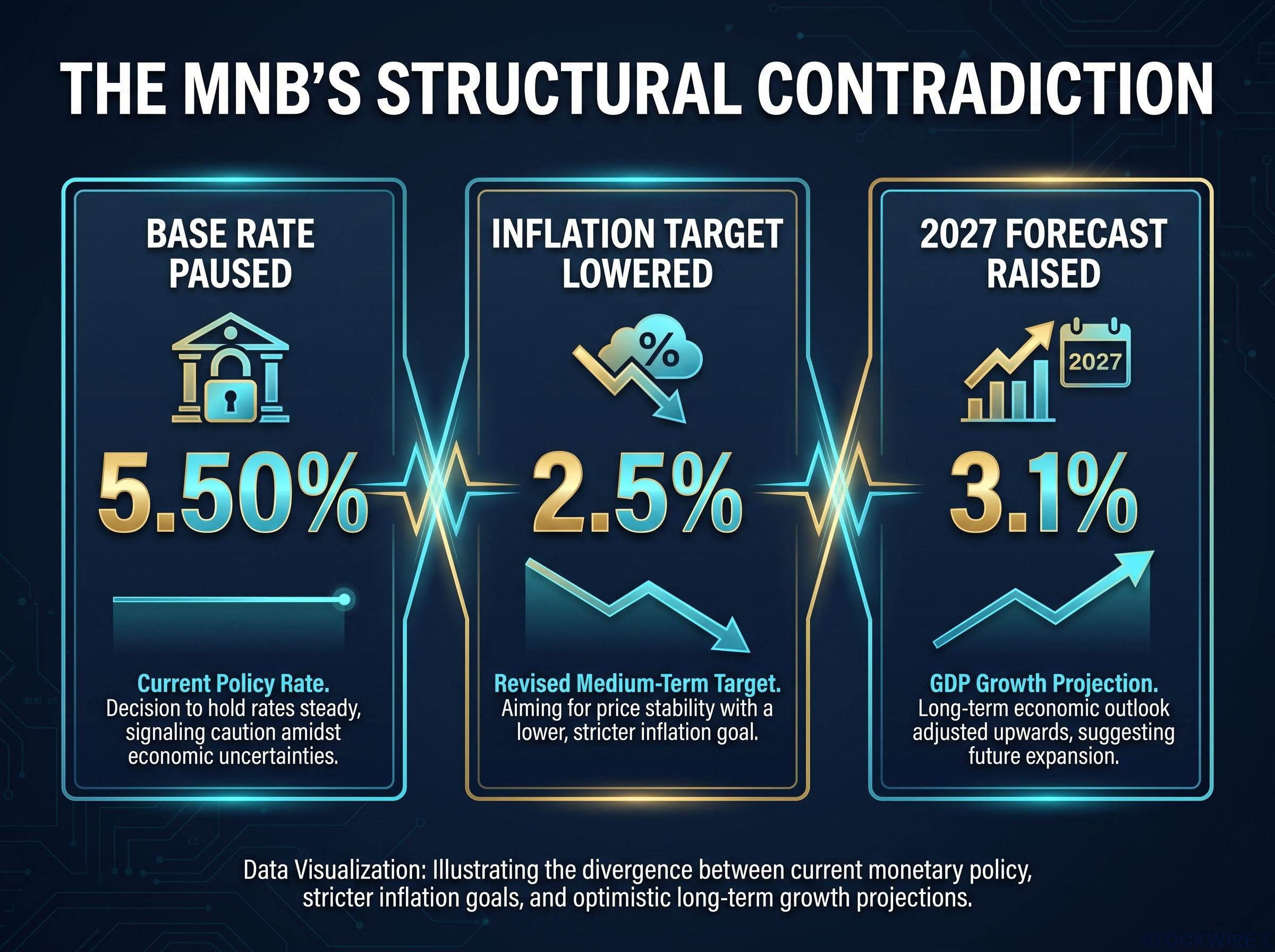
That is the puzzle now facing anyone with exposure to Hungarian assets. On 22 September 2026, the National Bank of Hungary (MNB) paused a three-month rate-cutting cycle at 5.50 percent, lowered its medium-term inflation target to 2.5 percent, and, in the same breath, revised its 2027 inflation forecast upward to 3.1 percent.
Three signals, pointing in three different directions. This analysis unpacks the mechanics behind that contradiction and gives you a clear framework for judging how the resulting credibility gap alters the currency risk sitting inside emerging market allocations.
A hawkish pause masking a structural contradiction
Start with what the Monetary Council actually did. It held the base rate at 5.50 percent, ending a run of three consecutive reductions that began in June. The overnight deposit rate was set at 4.50 percent and the overnight collateralised loan rate at 6.50 percent, both effective 23 September 2026.
That much markets could read as hawkish. A pause is a pause.
Then MPC Chair Mihály Varga framed what comes next, and the picture shifted. According to the MNB’s communication, the data-dependent framework allows the committee only to hold or to cut in the months ahead. A tightening option was explicitly ruled out.
So the central bank can stand still or ease. It cannot push back.
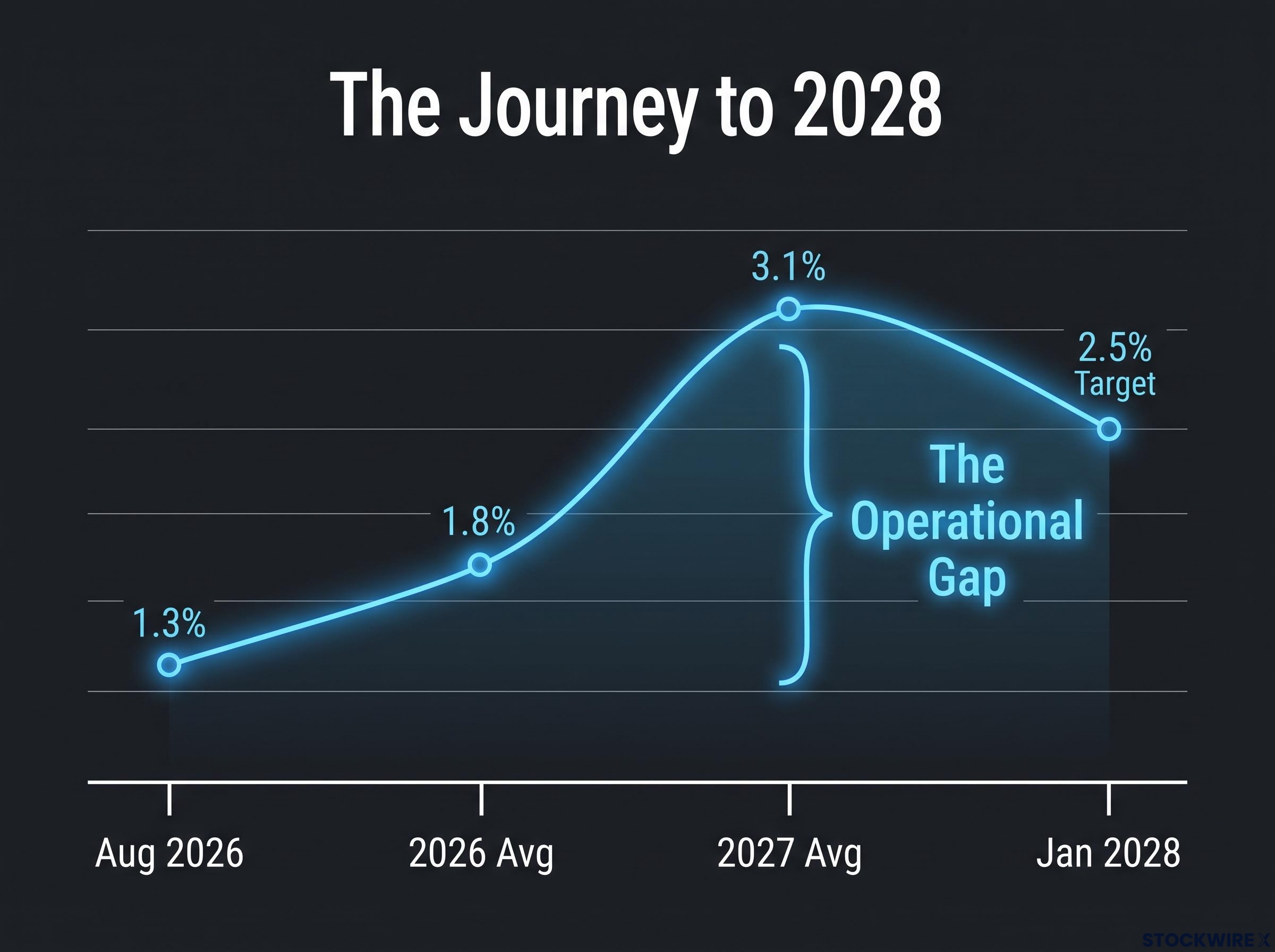
Now layer in the forecast. Hungary’s most recent headline inflation reading was 1.3 percent year-on-year for August 2026, published by the Central Statistical Office (KSH), up marginally from 1.2 percent in July. That is disinflation well below both the old 3.0 percent target and the new one.
The KSH consumer price index data for August 2026 places headline inflation at 1.3 percent year-on-year, a reading that sits well below both the old 3.0 percent target and the newly tightened 2.5 percent ceiling the MNB has just committed itself to meeting from 2028.
Yet the MNB simultaneously raised its 2027 projection, citing elevated global energy costs and a government increase to tobacco excise taxes.
| Year | Metric | Previous Forecast | Revised Forecast |
|---|---|---|---|
| 2026 | Average headline inflation | 1.8% | 1.8% (unchanged) |
| 2027 | Average headline inflation | 2.3% | 3.1% |
| 2027 | Core inflation | Not stated | 3.0% |
Read those three moves together and the friction is unmistakable. A central bank is projecting inflation to overshoot its own freshly lowered target, while removing the one tool that would force convergence.
It is telling markets it hopes to win a fight without throwing a punch.
For you, that mismatch is the early warning. When rhetoric and arithmetic diverge this visibly, the repricing tends to follow. Hungary’s refusal to keep hikes on the table also makes it an outlier, since the MNB itself notes most comparable peers have tilted more hawkish.
When big ASX news breaks, our subscribers know first
How inflation targeting relies on time consistency
Step back from the Hungarian numbers, because the reason this mismatch matters to capital flows is not obvious unless you understand how targets actually work.
An inflation target is a promise. Its value depends entirely on whether markets believe the central bank will do what is needed to keep it.
Credibility in emerging market monetary policy rests on three requirements, and Hungary’s September package strains all three.
- Consistency. Announced targets, published forecasts, and actual decisions must line up. Lowering a target while publishing an above-target forecast, and signalling no tighter policy, creates a visible gap.
- Time-consistency. If a central bank sets an ambitious goal but keeps making short-term choices, such as ruling out hikes, that make the goal unlikely, markets stop pricing the target and start pricing the behaviour.
- Communication and contingency plans. Credible target changes come with an explanation of how policy adjusts if forecasts drift, including openness to tightening. Explicitly excluding that option weakens the commitment.
Time consistency is the one worth sitting with. A target only anchors expectations if the long-term goal and the short-term levers point the same way. When they diverge, the target becomes aspiration, not policy.
Credibility gap pricing is not unique to emerging markets; the July 2026 Fed experience showed how a misalignment between hawkish written statements and a non-committal press conference tone produced a yield curve split, with long-end investors charging a premium for the uncertainty rather than accepting the stated policy at face value.
What this means for you is direct. Once a central bank loses time consistency, your currency exposure gets priced on what the institution actually does, not on what it says it wants.
The operational gap in the 2028 timeline
The Hungarian version of this problem has a specific shape. The revised forecast has inflation peaking near 3 percent around mid-2027, while the new 2.5 percent target only takes effect from 1 January 2028 and is not expected to be durably met until mid-2028.
That leaves roughly twelve months for inflation to fall from a mid-2027 peak to below the new ceiling.
Under normal circumstances, a central bank bridges that kind of gap by signalling it stands ready to tighten. The MNB has removed that signal. Bridging the timeline now depends on disinflation arriving on its own, which is a considerably less certain proposition.
Divergent market reactions to the euro adoption rationale
This is where professional opinion splits, and the split is worth mapping because it is the fault line along which regional volatility will run.
One camp reads the move as strategy. OTP Bank Global Markets described the decision as a “clearly cautious step,” treating the pause and lower target as a conservative response to risk. On this view, the MNB is sacrificing near-term easing to entrench lower inflation.
Reuters reported the structural rationale behind it: the MNB argued the 2.5 percent target should anchor inflation lower and support the requirements for eventual euro adoption. Alignment with the European Central Bank’s 2.0 percent objective is the destination. CentralBanking framed the change the same way, as a step toward ECB convergence rather than a credibility problem.
The other camp sees a policy that does not add up. Commerzbank strategists Tatha Ghose and Antje Praefcke argue the combination of a held base rate, a lower target, and a higher forecast is internally contradictory.
The pairing of an unchanged 5.50 percent base rate, a lower medium-term target, and an upgraded 2027 inflation forecast constitutes an internal contradiction, according to Commerzbank’s analysis. A stricter target logically calls for a more restrictive policy reaction, yet the MNB has signalled no willingness to tighten.
That refusal to keep hikes on the table is the specific trigger for the pessimistic read. A lower target with a higher forecast and no tightening path leaves the stance looser than a genuine commitment to 2.5 percent would require.
For you, the takeaway is not which camp is right. It is that serious analysts are this far apart on a structural move. Any regional allocation carries the risk of a sharp repricing if the pessimistic view wins out and markets decide the target is cosmetic rather than binding.
Transmission mechanisms weighing on the Hungarian currency
The immediate market reaction cut against the pessimistic case. Tradingpedia reported the forint gained after the announcement, since a pause plus a lower target read as hawkish relative to what markets had expected.
That is the short-term signal doing its work: no more cuts, for now.
The structural picture is less forgiving. Commerzbank’s warning is that recovery potential stays capped as long as tightening is off the table, and the currency is unlikely to stage a meaningful rebound until the MNB acknowledges hikes as a possibility.
Three channels connect the policy signals to what happens to the currency.
The forint carry dynamics that underpin regional allocations rest on a real-rate buffer of approximately 4.2 percentage points, a cushion that looks attractive in isolation but becomes fragile when the institution maintaining it has ruled out the one response that would defend it under stress.
- Interest rate differential and expectations. Pausing cuts and lowering the target can support the currency by limiting expected future easing. But if markets doubt the commitment, perceived real yields fall and the support fades.
- Policy credibility. A lower target paired with a higher forecast and a categorical exclusion of hikes invites the question of whether the target is operational or cosmetic. If markets decide it is non-binding, the credibility premium that would normally underpin the currency erodes.
- External amplifiers. For an emerging economy, external shocks magnify monetary signals. Deteriorating geopolitical conditions in the Middle East have already been cited as a drag on emerging market risk appetite, and such episodes hit inflexible stances hardest.
Put those together and the read for you is uncomfortable. Without a credible threat of hikes, currency exposure is structurally vulnerable to outside shocks, because policymakers have voluntarily set down their primary line of defence.
Navigating currency risk as the 2027 inflation peak approaches
The core friction is a distance. Inflation sits at 1.3 percent today and is projected to climb toward a 3.1 percent average in 2027, with the 2.5 percent target only enforced from 2028. That journey, made without a tightening option, is what puts regional currency exposure at risk.
For anyone holding these assets, the watch list is short and specific. Track monthly KSH inflation prints against the MNB’s mid-2027 peak path, because an early overshoot would expose the credibility gap fast. Watch each Monetary Council statement for any softening of the no-hike position.
EM local-currency debt positioning affects how exposed a portfolio is to exactly this kind of central bank credibility episode; local-currency bonds absorb both the FX move and the yield repricing when a target is questioned, while hard-currency EM debt insulates holders from the domestic currency channel but retains sensitivity to US rate moves.
The ultimate test is simple. If inflation tracks above projections and the MNB still refuses to reintroduce hikes to the conversation, markets are likely to price the 2.5 percent target as aspiration. If it opens the door, the credibility premium can return.
This article is for informational purposes only and should not be considered financial advice. Investors should conduct their own research and consult with financial professionals before making investment decisions. Past performance does not guarantee future results, and financial projections are subject to market conditions and various risk factors.