
In just over a month, California voters will decide whether to charge the state’s richest residents a 5% one-time wealth tax. Many of the roughly 200-250 billionaires it targets have spent years legally paying almost nothing in state income tax, because they do not take income at all. They borrow against their portfolios instead of selling, and the loans never trigger a tax bill.
That is the paradox at the heart of Proposition 40, which goes to voters on 3 November 2026. A levy on wealth exists precisely because income taxes cannot reach fortunes that are never converted into taxable income.
The vote is one of several places supply-side tax theory is being stress-tested right now. There is a decades-long pattern of high earners and companies leaving high-tax states, and a public dispute between Arthur Laffer on one side and economists Emmanuel Saez and Gabriel Zucman on the other over where tax rates stop raising money and start losing it. After reading this, you will be able to look at any wealth tax headline and understand what actually determines whether the revenue ever arrives: not the headline rate, but the tax code features, behavioural responses, and mobility pressures underneath it.
The core idea behind the Laffer Curve, and why its peak is so hard to locate
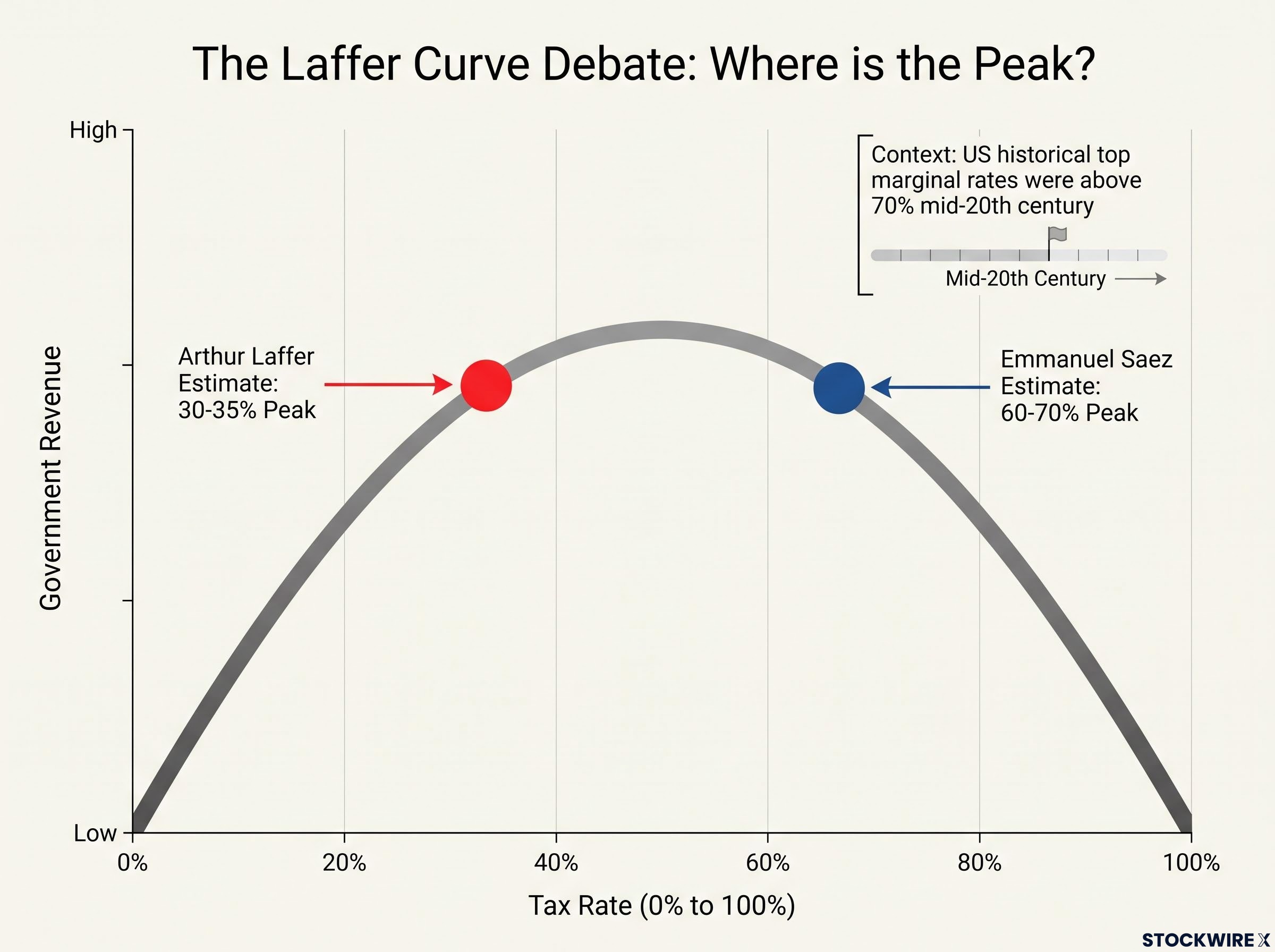
Start with the one thing everyone agrees on. At a tax rate of 0%, the government collects nothing. At a rate of 100%, it also collects nothing, because no one earns income they are not allowed to keep.
Somewhere between those two zeros, revenue rises, reaches a peak, and falls again. That is the Laffer Curve. The shape is not controversial. Where the peak actually sits is the entire fight, and the answer decides whether any given tax proposal makes money or loses it.
The curve bends downward because high marginal rates shrink the amount of income the government can tax. Three separate behaviours drive that shrinkage:
- Reduced labour supply: as rates climb, high earners work less, take fewer risks, and start fewer ventures, so there is simply less income to tax.
- Capital reallocation: high rates on investment returns make investing less attractive, slowing capital formation and long-run growth.
- Active tax avoidance: every rate increase raises the payoff from shifting income into lower-taxed forms, later years, or friendlier jurisdictions.
Here is where the economists part ways. Arthur Laffer places the revenue-maximising peak somewhere around the 30-35% range for labour income in open modern economies, and lower still for mobile capital. Emmanuel Saez, working from a formal optimal-tax model, derives a peak of 60-70% or higher using his own estimates of how much taxable income actually responds to rates.
Under Saez’s elasticity estimates, the revenue-maximising top marginal rate sits around 60-70%, well above where most current rates land. That is a direct challenge to the assumption that the Laffer peak is obviously low.
History does not settle it cleanly. The United States sustained statutory top marginal rates above 70% through much of the mid-20th century, then cut them sharply under Kennedy and Reagan. Supply-siders read the growth that followed as proof the old rates sat on the wrong side of the curve; critics point out those high rates applied to narrow bases riddled with loopholes, and that monetary and global shifts muddy any clean causal story.
The gap between 30-35% and 60-70% is not a rounding error. It tells you that whether a given proposal sits above or below the revenue-maximising peak depends entirely on whose behavioural estimates you trust. That single question is the lens to bring to every tax debate you encounter.
When big ASX news breaks, our subscribers know first
How the ultra-wealthy avoid income taxes without breaking the law, and what a wealth tax is designed to do about it
California’s top income tax rate is a headline figure. For the state’s wealthiest residents, it describes almost no one’s actual burden, and understanding why is the whole point.
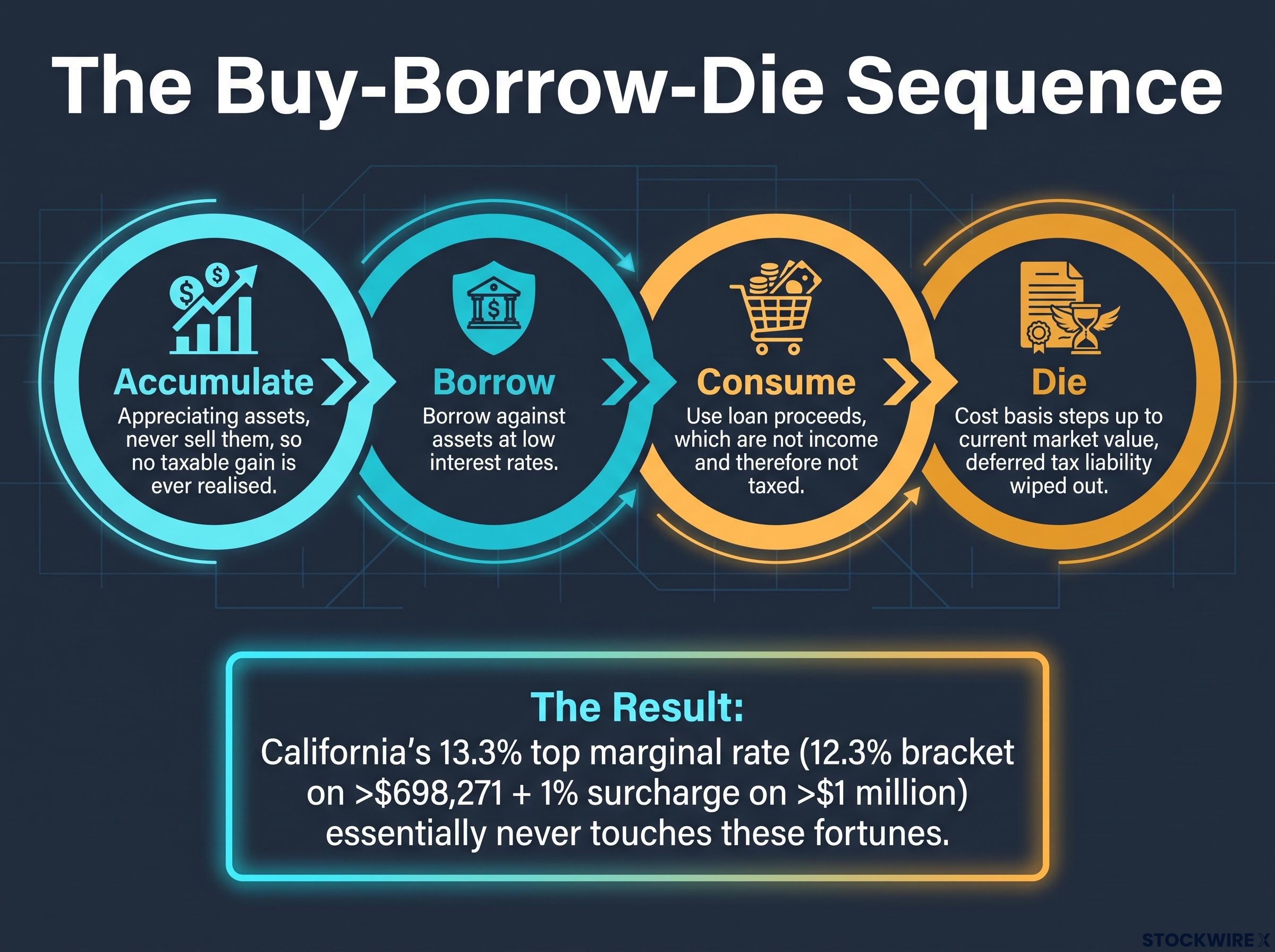
The technique is often called buy-borrow-die, and none of it is illegal. It works as a sequence:
- Accumulate appreciating assets, typically company stock, and never sell them, so no taxable gain is ever realised.
- Borrow against those assets at low interest rates, using the portfolio as collateral.
- Consume using the loan proceeds, which are not income and therefore not taxed.
- Die holding the assets, at which point the cost basis steps up to current market value and the deferred tax liability is wiped out entirely.
The step-up in basis provision is the keystone of the buy-borrow-die strategy: at death, inherited assets reset to current market value, wiping out the entire deferred gain that a lifetime of borrowing rather than selling was designed to preserve, which is why any reform targeting this provision would be at least as disruptive to ultra-high-net-worth planning as the wealth tax itself.
The result is that California’s 13.3% top marginal rate, made up of a 12.3% bracket on income above $698,271 plus a 1% Mental Health Services Tax surcharge on income above $1 million, essentially never touches the largest fortunes. (The California Chamber of Commerce cites a higher 14.4% figure from 2024, though its meaning is unclear and it conflicts with the 12.3% bracket data from the Tax Foundation. The 13.3% characterisation is the more consistent one.)
Middle-income Californians cannot borrow against a portfolio to fund their lives. So the stated top rate effectively falls on people wealthy enough to need income, not on those wealthy enough to live on loans. That gap is what makes the wealth tax argument legible rather than arbitrary.
The buy-borrow-die technique is most powerful precisely because asset prices compound without triggering a tax event, and the wealth concentration dynamics that result, including the U.S. top 1% wealth share reaching roughly 34.9% of total wealth by late 2025, are part of what makes proposals like Proposition 40 politically legible to voters who see record markets but do not feel prosperous.
The NBER research on billionaire tax burdens, co-authored by Saez and Zucman, provides empirical grounding for the claim that effective rates on the ultra-wealthy fall far below statutory top marginal rates, precisely because realisation-based income taxes cannot reach wealth that is never converted to cash.
| Statutory top rate | Mechanism reducing the effective rate | Policy instrument to close the gap |
|---|---|---|
| 13.3% top marginal state rate | Buy-borrow-die: borrow against unrealised gains, step-up in basis at death | Proposition 40: one-time 5% wealth tax |
| Applies to realised income only | Effective rate on accumulated wealth often near zero | Reaches net worth income tax cannot touch |
A net-worth wealth tax is the policy instrument built specifically to reach wealth that accumulates on paper. Because income is only taxed when realised, a tax on total assets is the only tool that captures gains a taxpayer never converts to cash.
What California’s Proposition 40 is actually designed to capture
Proposition 40 is a one-time levy, not the recurring annual charge used across Europe. It applies to billionaires who were California residents as of 1 January 2026, and that date does most of the work.
The cutoff gives the measure a retrospective quality, since it reaches back to a fixed past date rather than taxing wealth going forward. It also creates a forward-looking incentive: anyone accumulating future wealth now has a reason to establish domicile elsewhere before any similar measure appears.
The measure’s fate is genuinely uncertain. Reuters described it on 20 September 2026 as “far from certain to pass,” and two competing ballot initiatives could further complicate its prospects.
The constitutional questions surrounding the unrealised capital gains tax run in parallel with the wealth tax debate: Moore v. United States (2024) left open whether the Sixteenth Amendment permits taxing gains that have never been realised, and that unresolved ambiguity shadows any federal expansion of the policies California is currently testing at the state level.
What wealth taxes actually do when implemented, and where they have failed
Wealth taxes are not theoretical. Several countries have run them as real experiments, and the outcomes are more mixed than either side of the debate likes to admit.
Sweden taxed net wealth for decades before abolishing the levy in 2007, after finding it raised modest revenue relative to its administrative cost and coincided with wealthy residents and assets moving abroad. France replaced its broad wealth tax, the ISF, with a narrower real-estate-only version in 2018, amid perceptions that the original had pushed some wealthy households toward Switzerland and Belgium, though post-reform investment evidence remains mixed. Norway still levies a wealth tax at roughly 0.85%, and while some high-net-worth Norwegians have relocated to Switzerland, revenue remains positive and the economy stays strong.
| Case | Policy action | Outcome observed | Current status |
|---|---|---|---|
| Sweden | Annual wealth tax | Modest revenue, capital and resident flight | Abolished 2007 |
| France | ISF replaced by narrower IFI | Perceived relocation abroad, mixed investment effects | IFI in force since 2018 |
| Norway | Ongoing wealth tax | Some relocation, positive revenue, strong economy | Active at ~0.85% |
| Kansas | Sharp income tax cuts | Large revenue shortfalls, partial reversal | Cuts partly rolled back |
| US historical | Top marginal rates above 70% | Strong growth, narrow base, heavy avoidance | Reduced under Kennedy and Reagan |
The domestic counterpoint comes from Kansas, which cut rates sharply and exempted pass-through business income in the early 2010s.
Kansas’s aggressive tax cuts produced large revenue shortfalls and a partial reversal of the cuts, and the episode is now a standard reference against the claim that tax cuts pay for themselves.
Beyond the outcomes, five practical obstacles make wealth taxes hard to run in the first place:
- Valuation of illiquid assets: private businesses, real estate, and art have no transparent market price, so annual appraisals are costly and disputable.
- Liquidity constraints: founders can be asset-rich but cash-poor, forcing sales to pay a tax on gains they have not realised.
- Residency-based avoidance: recurring wealth taxes give the wealthy a standing reason to relocate.
- Constitutional constraints: a federal net-worth tax may face challenge as a “direct tax” requiring apportionment, and clashes with the realisation doctrine.
- Administrative capacity: US tax systems track income flows, not balance sheets, and building net-wealth infrastructure would take years.
Gabriel Zucman’s proposed 2-3% annual wealth tax on ultra-high-net-worth individuals shows what the optimal-tax framework prescribes in practice. Norway’s tax coexisting with a strong economy while some residents leave, set against Kansas’s revenue collapse, tells you both the supply-side case and the optimal-tax case rest on empirical claims the record only partly supports.
Proposition 40 is not the only place policymakers are testing the boundaries of taxing paper wealth: unrealised gains experiments abroad, including the Netherlands’ scheduled 2028 levy at 36%, are confronting the same valuation and liquidity problems that the California measure sidesteps only because it is a one-time charge rather than an annual one.
How tax competition between states is reshaping where capital and corporations locate
The Laffer Curve is not only an abstract argument. At the state level, it plays out as a visible, ongoing pattern of location decisions with real directional momentum.
The mechanism is straightforward. Because buy-borrow-die shields most fortunes from ordinary income tax, the taxes that actually fall on high earners are the ones they cannot dodge: business sales, large capital events, and compensation structured as income. Those are exactly the moments that trigger a hard look at relocating, because moving before a liquidity event can erase a state tax bill entirely.
American federalism hands those earners an obvious destination. A tier of states charges no income tax at all:
- Tennessee
- Texas
- Florida
- Nevada
- Wyoming
- South Dakota
- Alaska
- New Hampshire
Their existence puts permanent downward pressure on high-tax states. Arthur Laffer attributes an ongoing movement of businesses and financial institutions toward these low-tax states to exactly this dynamic, and points to a low-rate, broad-based flat tax as his preferred alternative to both high progressive rates and targeted wealth levies. (Current quantitative data on the scale of that migration was not available in the research, so treat the claim as directional rather than precise.)
Proposition 40’s 1 January 2026 residency cutoff is a live example of the incentive at work, creating a reason to leave before the tax even passes.
The honest counterargument is that the flight is slower and smaller than pure models predict. California and New York keep their high rates and still host enormous concentrations of high earners and companies. Several frictions explain why:
- Professional networks
- Family ties
- Industry clusters
- Regulatory environment
- Quality of public services
That persistence tells you something specific. The Laffer Curve’s behavioural assumptions point in the right direction, but they likely overstate how fast and how completely capital actually flees, because the cost of leaving is measured in more than tax dollars.
Making sense of the Laffer Curve debate before the November vote
You do not need an economics degree to evaluate a Laffer Curve claim. You need two questions.
- What elasticity is baked in? What assumption about how much taxable income responds to rates sits inside the revenue forecast?
- Which side of the peak? Given that assumption, is the proposed rate plausibly above or below the revenue-maximising point?
Saez and Zucman argue that elasticities are modest in well-enforced systems, which puts the revenue-maximising peak far above current rates. Laffer counters that mobile capital and flexible residency make elasticities higher than standard estimates suggest, especially at the state level, where crossing a state line is far cheaper than emigrating.
That distinction matters enormously here.
Laffer places the revenue-maximising peak around 30-35%; Saez derives 60-70% or higher. The gap is the entire dispute, and it is widest exactly where mobility is cheapest.
An alternative sits between the two camps: taxing unrealised capital gains annually while symmetrically allowing deductions for unrealised losses. That approach reaches the buy-borrow-die gap without the valuation and constitutional headaches of a net-worth tax, and the symmetry is what keeps it equitable rather than punitive.
Proposition 40’s narrow base of 200-250 billionaires is what makes the revenue projection so sensitive to even a handful of departures. The vote on 3 November 2026 is the most proximate real-world test of whether voters accept the Laffer-style warning or the optimal-tax reply. The insight to carry forward is that the Laffer argument is strongest at the state level, where leaving is cheapest, and weakest federally, where every friction applies, which means California will not settle the national debate.
This article is for informational purposes only and should not be considered financial advice. Investors should conduct their own research and consult with financial professionals before making investment decisions. Past performance does not guarantee future results, and the outcomes described remain speculative and subject to change based on policy developments and voter decisions.