

Nexsen enters term sheet for proposed 50:50 joint venture to accelerate molecular GBS diagnostics
Nexsen Limited (ASX: NXN) has entered into a non-binding term sheet with FlashDx Shenzhen Inc. to establish a proposed 50:50 joint venture for the development and commercialisation of an enhanced molecular Group B Streptococcus (GBS) diagnostic test. Critically, the proposed JV builds from FlashDx’s existing CE-marked molecular GBS test as its technical and regulatory foundation, rather than starting from the ground up.
The CE-marked basis of the proposed collaboration is a material de-risking factor. It provides the JV with access to an established molecular technology, manufacturing capability, and regulatory know-how before a single regulatory submission has been filed for the enhanced product.
When big ASX news breaks, our subscribers know first
JV structure and what each party brings
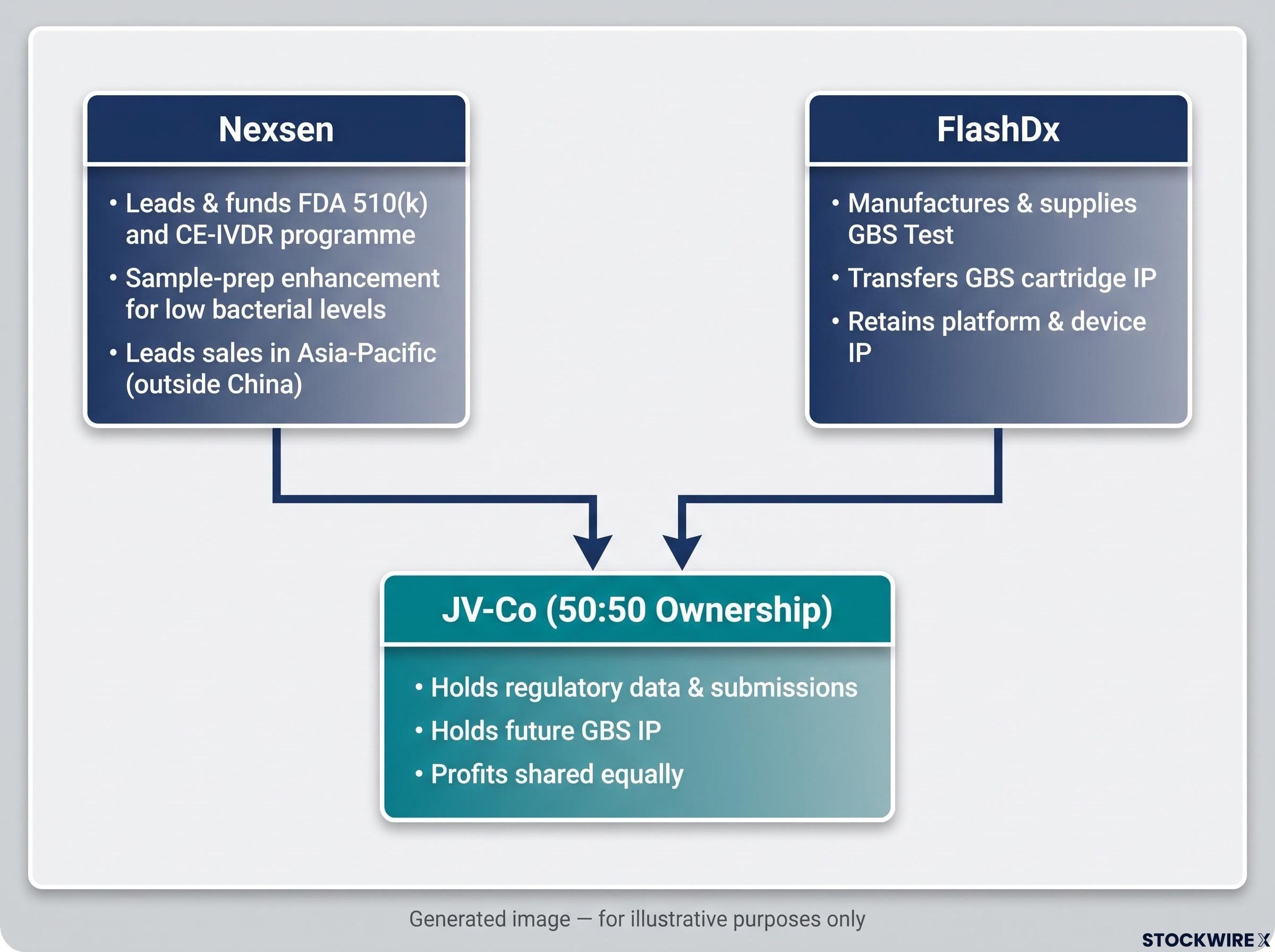
The proposed joint venture contemplates a new company owned equally by Nexsen and FlashDx, with each party contributing distinct capabilities:
- FlashDx: Exclusively manufactures and supplies the GBS Test to the JV; transfers GBS cartridge-specific intellectual property into the JV upon regulatory approvals being obtained, while retaining ownership of its platform, device, reader, manufacturing know-how, and other background intellectual property.
- Nexsen: Leads and funds the agreed US FDA 510(k) and CE-IVDR regulatory programme; contributes a sample-preparation enhancement designed to improve detection at low bacterial levels; leads sales and commercial development across Asia-Pacific markets outside China.
- JV-Co: Holds regulatory data, submissions, and future GBS-specific intellectual property developed in connection with the GBS test; profits shared equally between the parties.
Binding documents, including a shareholders’ agreement, a manufacturing and supply agreement between JV-Co and FlashDx, and a detailed business plan, are still required. The non-binding status of the current term sheet should be noted by investors.
Mark Muzzin, Managing Director
“The proposed joint venture with FlashDx has the potential to materially accelerate Nexsen’s commercial strategy. We have built strong hospital, clinical and commercial relationships across Asia-Pacific, and FlashDx gives us the opportunity to combine that network with an established molecular technology that already underpins a CE-marked GBS diagnostic.”
“Importantly, the JV is intended to build from that established base and develop an enhanced molecular GBS product, rather than simply take the existing FlashDx test to new market. Nexsen is also bringing its own technical contribution to the product, including an enhancement designed to improve detection where bacterial levels are low. That gives us a much more advanced starting point than developing a molecular system from scratch, while still allowing us to build a product specifically for the regulatory and commercial pathways we are targeting.”
What is GBS and why does rapid molecular testing matter?
Group B Streptococcus is a bacterial infection that carries significant risk in the context of childbirth. Key facts investors should understand include:
- GBS is carried by approximately 10–30% of pregnant women globally.
- The bacteria can cause serious, potentially life-threatening neonatal infections, including sepsis, pneumonia, and meningitis.
- Current screening is typically performed at 36–37 weeks of pregnancy, with samples sent to a laboratory for testing. GBS colonisation can change over time, meaning a result obtained weeks before delivery may not accurately reflect a woman’s GBS status during labour, when transmission to the baby most commonly occurs.
- Molecular testing at or near the point of care addresses this timing gap, with FlashDx’s existing CE-marked test delivering results in under one hour from a vaginal swab sample.
The scale of the market opportunity reflects this unmet clinical need. There are approximately 132 million births globally each year, and GBS is estimated to contribute to around 150,000 stillbirths and infant deaths annually. A test capable of delivering an accurate result during labour, rather than weeks before it, represents a meaningful commercial and clinical advancement.
Asia-Pacific market entry and dual regulatory pathway
Hong Kong and India as priority markets
The proposed JV directly supports Nexsen’s existing Asia-Pacific strategy. Over the past six months, Nexsen has expanded its regional presence through the establishment of research facilities in Hong Kong and in partnership with Universiti Malaya, alongside its first hospital partnership with IHH Healthcare’s Gleneagles Hospital Hong Kong.
Building the enhanced JV product from FlashDx’s CE-marked GBS diagnostic is expected to provide a faster entry point into priority regional markets. Hong Kong is anticipated to be an initial commercial focus, leveraging Nexsen’s local presence and growing hospital network. India has also been identified as a significant target market, subject to the applicable local regulatory pathway. Nexsen is anticipated to lead sales and commercial development across Asia-Pacific markets outside China.
Gleneagles Hospital Hong Kong is already engaged as Nexsen’s first hospital-based clinical validation partner in Asia, with a binding term sheet in place covering GBS and kidney function diagnostic validation across IHH Healthcare’s North Asia network.
US FDA 510(k) and CE-IVDR pathways
Nexsen and FlashDx intend to pursue US FDA 510(k) clearance for the enhanced JV product and CE-IVDR conformity. FlashDx’s existing CE-marked GBS test detects two separate genetic markers of the bacteria and includes a built-in quality control, which is the same approach used by a product currently cleared by the FDA for use during labour. This places the proposed enhanced product in a category the US regulator has previously cleared.
Three US clinical sites already engaged by Nexsen are intended to support the FDA programme. FlashDx will provide the molecular testing platform, manufacturing capability, and clinical trial materials required to support the JV product’s regulatory development.
Two complementary products, one expanded GBS market
The proposed JV product and Nexsen’s existing StrepSure programme are designed to be complementary, targeting distinct clinical settings, workflows, and price points. The table below illustrates the key distinctions:
| Product | Technology | Clinical Setting | Regulatory Target |
|---|---|---|---|
| Enhanced JV Product | Molecular (real-time PCR) | Hospital and intrapartum testing | FDA 510(k) + CE-IVDR |
| StrepSure | Rapid lateral-flow | Antenatal screening and decentralised care | Per StrepSure programme |
The two products are aimed at different parts of the GBS diagnostic pathway. The enhanced molecular JV product targets hospital and intrapartum settings where speed and sensitivity at low bacterial levels are critical, while StrepSure addresses antenatal screening and decentralised care. Together, they are intended to broaden Nexsen’s total addressable market across different healthcare settings rather than compete for the same use case.
For investors exploring how StrepSure and the JV product fit within Nexsen’s broader commercial ambitions, our full explainer on Nexsen’s StrepSure global rollout strategy covers the multi-region market entry plan, manufacturing capacity targets, and simultaneous regulatory pathways across the U.S., Asia-Pacific, and emerging markets.
Don’t Miss the Next Healthcare Breakthrough on ASX
Big News Blast delivers FREE breaking ASX healthcare news and in-depth analysis directly to your inbox within minutes of release. Join 20,000+ investors who stay ahead of the market the moment announcements drop. Click the “Free Alerts” button at StockWire X to start receiving alerts today.