
Two consumer companies can report identical revenue and be worth wildly different amounts. The reason has nothing to do with how much they sell and everything to do with how that revenue behaves once it lands.
A transactional business, the kind that sells a product and then has to go and find the next buyer, starts every single month at zero. There is no guaranteed income waiting for it when the calendar flips. Every dollar has to be won again.
A subscription business does the opposite. It opens each period with a known baseline of income already locked in, because renewals happen automatically unless a customer actively leaves. That single structural difference changes almost everything: how the company forecasts, how it spends on marketing, and how it relates to the people who buy from it.
What follows gives you a clear framework for evaluating consumer companies that are shifting their revenue base, using the proposed acquisition by Elixinol of subscription platform Vitable as the live worked example. By the time you finish, you will know exactly which numbers to watch and why the headline revenue figure is the least useful one.
How subscriber unit economics actually work
Recurring revenue sounds simple, but the mechanics underneath it are what separate a business that compounds in value from one that quietly leaks. To evaluate the shift Elixinol is attempting, you first need to understand why a subscriber is mathematically a different animal to a one-time customer.
Start with the four concepts that govern every subscription business.
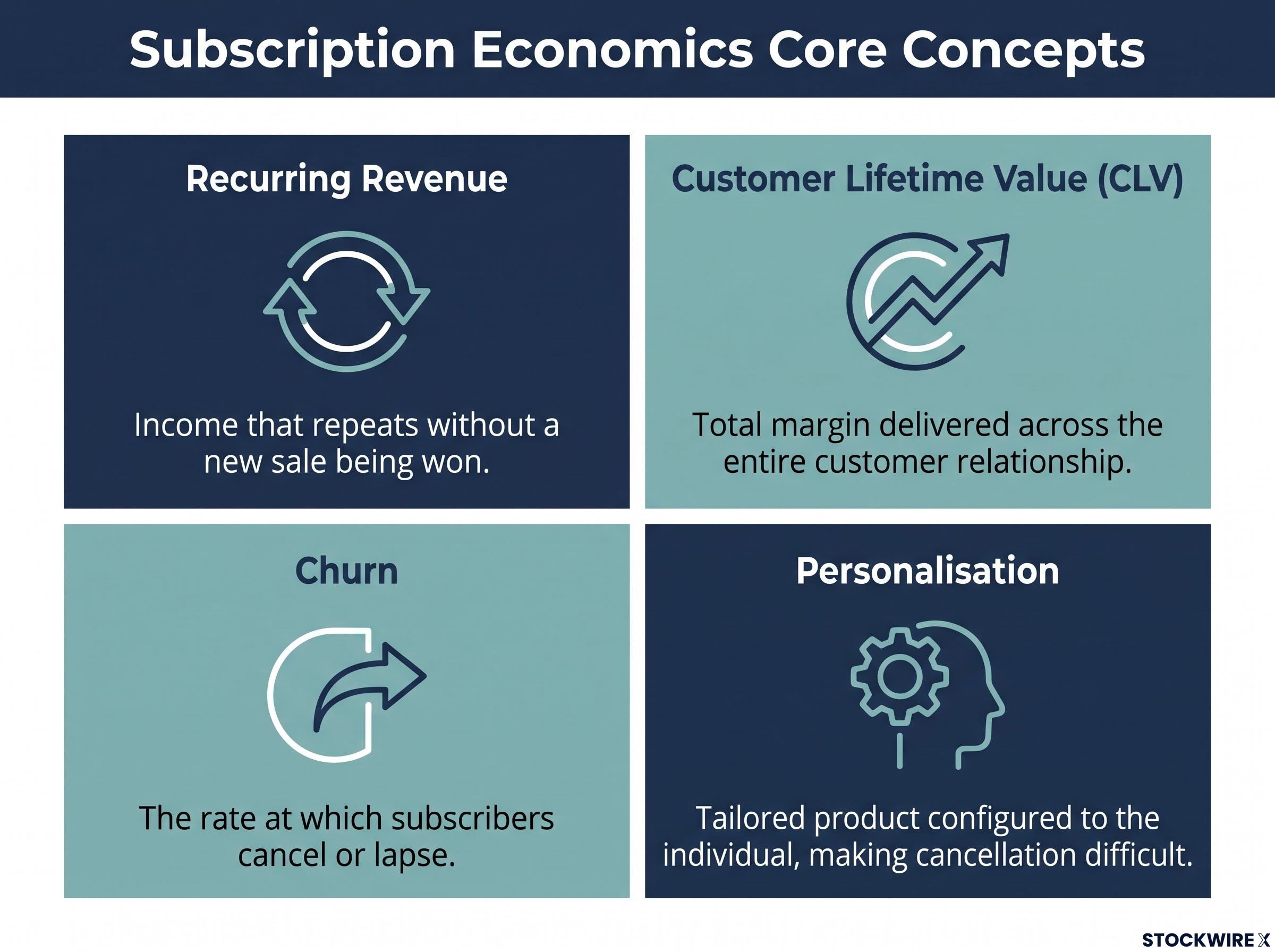
- Recurring revenue is income that repeats without a new sale being won. It is considered the most predictable and therefore the most valuable category of revenue, because part of next period’s income already exists before the period begins.
- Customer lifetime value (CLV) measures the total margin a customer delivers across the entire relationship, not just at a single point of sale. This is why a subscriber is structurally worth more than a one-off buyer, even if the first transaction looks identical.
- Churn is the rate at which subscribers cancel or lapse. It is the critical variable that decides whether acquisition spending compounds or gets consumed replacing people who left.
- Personalisation is a tailored product configured to the individual, which becomes difficult to cancel because replicating it elsewhere means starting the whole setup process from scratch.
The contrast between a single sale and lifetime value is where the mathematics gets interesting. A one-time product sale earns its margin once. A subscriber earns margin every billing cycle, so even a modest monthly gross margin accumulates into something far larger over a multi-year relationship.
That accumulation only works if churn stays low. When churn is low, every dollar spent acquiring a customer keeps paying off long after it was spent. When churn is high, the business is stuck on a treadmill, forever spending to replace departing subscribers rather than growing the base. This is the difference between owning customers and merely renting them.
Columbia Business School research on recurring revenue valuation confirms that investors systematically assign higher multiples to firms with predictable subscription income, precisely because a known baseline of future revenue reduces the discount rate applied to earnings forecasts.
Personalisation is the lever that directly attacks churn. A generic product is easy to walk away from. A supplement pack built around your specific health assessment is not, because leaving means answering all the questions again somewhere else and hoping the new provider gets it right.
There is a data dimension too. A company selling directly to consumers can observe individual purchase patterns, reorder frequency, and even the timing of cancellations, proprietary behavioural information that businesses selling through retail intermediaries never get to see.
Put these together and you have the exact tools to judge any consumer company shifting its revenue base. Instead of getting distracted by headline revenue growth, you can ask whether the underlying unit economics are building durable value or simply funding temporary customers. That distinction is what actually dictates valuation.
When big ASX news breaks, our subscribers know first
What the base business repair looked like
Before you can judge an acquisition, you need to know whether the company doing the buying is healthy enough to absorb a new operating model. In Elixinol’s case, the repair work came first.
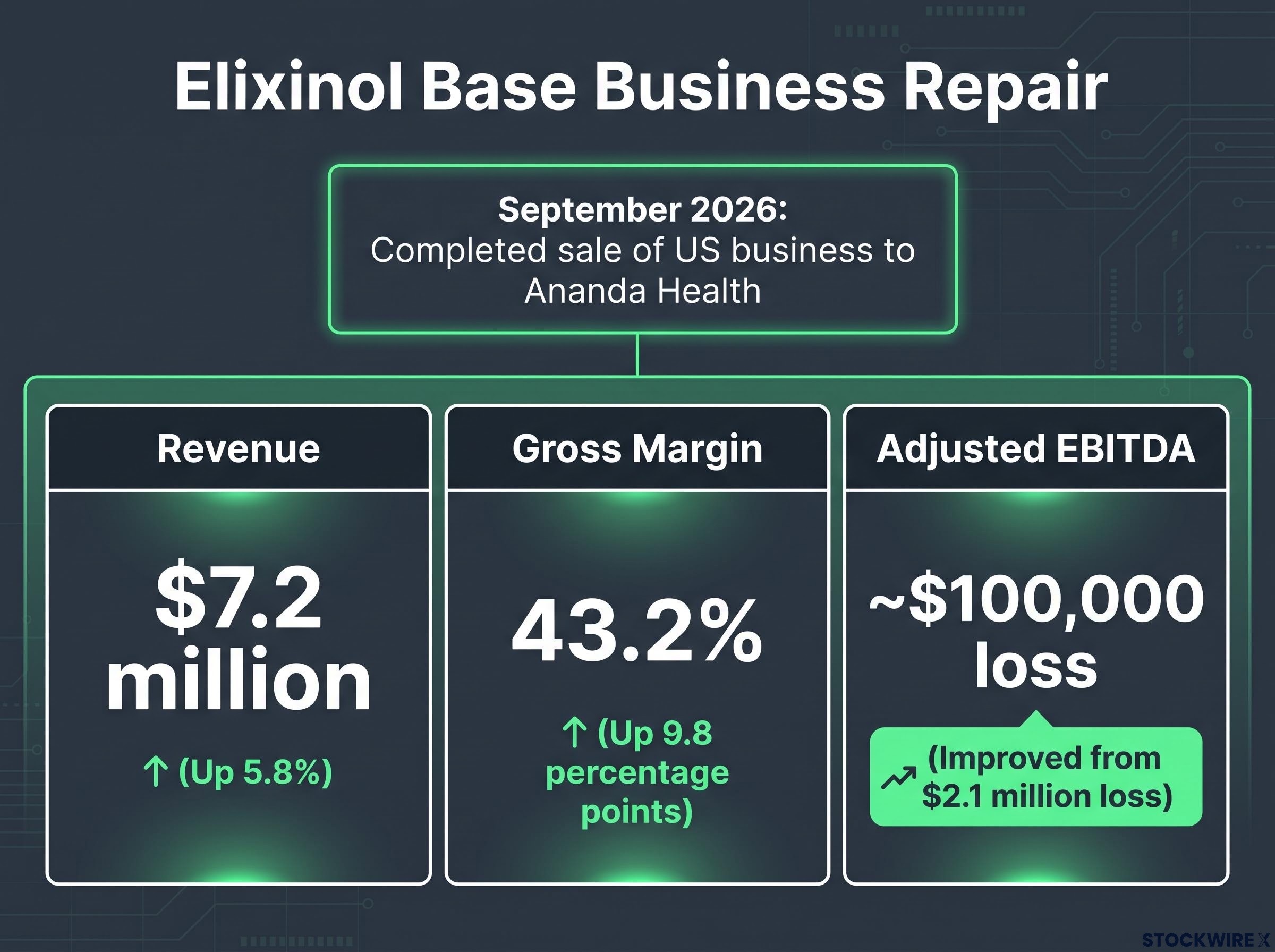
The company spent the prior period simplifying its operations. The most significant move was the sale of its US business to Ananda Health, a divestiture that completed in September 2026 and left the group concentrated on its Australian health and wellness portfolio.
The US business divestiture had its own conditional structure worth examining: only A$250,000 of the A$465,000 consideration was payable at completion, with the remainder deferred or tied to Ananda Health’s post-completion revenue performance, a structure that mirrors the earn-out logic later applied to the Vitable deal itself.
The H1 FY26 results, covering the six months to 30 June 2026, show what that focus delivered.
Revenue reached $7.2 million, up 5.8% on the prior corresponding period. That is steady rather than spectacular growth. The far more informative number sits one line down.
Gross margin came in at 43.2%, an improvement of 9.8 percentage points on the same period a year earlier. Alongside that, the adjusted EBITDA loss narrowed to roughly $100,000, a sharp recovery from a $2.1 million loss in the prior corresponding period.
The full H1 FY26 results also show that all three core Australian brands grew revenue simultaneously for the first time, with The Healthy Chef leading at 22.2% growth ahead of a Priceline rollout across approximately 410 stores, a brand-level detail the headline margin figure does not capture.
Here is why that margin jump is the single most useful figure in the result. When gross margin improves by nearly ten points while revenue grows only modestly, the improvement is coming from a repaired cost base and better product mix, not from simply pushing more volume through the door.
In plain terms: you are looking at a fundamentally fixed cost structure, not a company buying top-line revenue to paper over core problems. That distinction matters enormously when a new business model is about to be bolted on.
“Having reset the business and sharpened our focus on Australia, this acquisition marks the next phase of growth,” said Natalie Butler, Chief Executive Officer and Executive Director of Elixinol.
A business close to breakeven, with a demonstrably improved margin profile, is in a position to integrate a subscription asset without the acquisition being a rescue in disguise. That is the platform on which the Vitable deal rests.
Mapping Vitable to the subscription asset framework
This is where the theory and the transaction meet. Vitable is not a bundle of vague corporate synergies; it is a specific set of assets, and each one maps directly onto a concept defined earlier.
Vitable was founded in 2019 by Larah Loutati and Ilyas Anane. It operates a direct-to-consumer model, delivering personalised daily supplement packs to subscribers using proprietary recommendation technology. Customers complete an online health assessment, which drives the personalisation and is designed to embed the service into their daily routine.
Now watch the pieces snap into place.
The subscription platform is the recurring revenue mechanism, the engine that produces income without winning a fresh sale each month. The personalisation technology, built on that health assessment, is the churn-reduction mechanism, the thing that makes cancelling inconvenient. And the direct consumer relationships are the proprietary data asset, the behavioural information Elixinol’s existing retail-facing products cannot generate on their own.
According to Butler, Vitable’s subscription platform, personalisation capability, and direct consumer relationships are highly complementary to Elixinol’s existing Australian brand portfolio, with the combination intended to grow customer value across the group through increasingly personalised wellness offerings.
The lesson here is transferable. Acquiring a subscription business is not really about buying revenue. It is about acquiring the data and personalisation mechanisms that make revenue stick, and those are the levers you should look for behind any deal dressed up in synergy language.
The revenue expectation
The financial framing needs a careful eye, because it is easy to blur achieved results with hopes.
Elixinol’s existing revenue base sits at approximately $14.4 million over the trailing twelve months. That figure is recorded and real.
Vitable is expected by the company to add more than $5 million in revenue, which would take combined annual revenue past $20 million after completion. That $5 million is a forward-looking company expectation, not a historical result already on the books, and the distinction is not pedantic. It is the difference between what has happened and what management hopes will happen.
Investors familiar with ASX software disclosures will recognise a parallel issue: non-audited contract metrics like Annual Contract Value carry specific regulatory obligations under ASIC guidance and can diverge persistently from earned revenue if the underlying conversion rate deteriorates, a risk equally relevant when evaluating forward-looking subscription revenue claims.
Completion is not guaranteed. The transaction is conditional on Elixinol shareholder approval at an extraordinary general meeting expected in early November 2026.
The structure and the cost of scrip
A good asset bought with the wrong capital structure can still destroy value, so the terms of this deal deserve a clear-eyed look. The headline here is that no cash changes hands.
The total headline consideration is $2.5 million, payable entirely in Elixinol shares across five tranches at a floor price of $0.00525 per share. The strategic logic of an all-scrip structure is straightforward for a company that has only just narrowed its losses: it preserves cash for working capital, marketing, and integration rather than draining the balance sheet at signing.
That preservation comes at a cost to existing owners. The maximum issuance is 476.19 million new shares, a substantial number relative to Elixinol’s existing capital base, and shareholders are being asked to approve exactly this issuance at the upcoming meeting. This is the plain dilution figure, and it tells you precisely what the acquisition costs the people who already hold the stock.
The deal is also structured so the majority of value is deferred and tied to performance, which keeps the Vitable founders financially aligned with results rather than fully paid on day one.
| Component | Value | Conditions attached |
|---|---|---|
| Headline scrip consideration | $2.5 million | Paid in Elixinol shares across five tranches at a floor price of $0.00525 per share; up to 476.19 million new shares issued |
| Performance consideration | $625,000 in shares | Split 50/50 between net revenue outcomes and direct EBITDA gains over the twelve months following completion |
| Platform Kicker | $1 million | Contingent on milestones tied to integration of Vitable’s technology and subscriber base |
The earn-out design is the counterweight to the dilution. By splitting the $625,000 performance consideration evenly across net revenue and direct EBITDA, and layering a $1 million Platform Kicker on top, the structure ties the founders to actual delivery of the subscription growth being promised. The risk, in other words, is shared: existing shareholders wear the dilution, and the sellers only collect the full amount if the numbers materialise.
Monitoring the model shift
A change in revenue model is a fundamentally different event from a change in revenue level, and it demands a different scorecard. Once Vitable is inside the group, headline revenue on its own will tell you very little.
The real test is the subscription metrics that reveal whether the model is healthy. Watch subscriber count and net subscriber growth, watch churn, and watch whether recurring revenue becomes a growing share of total group income. A rising revenue figure can easily mask deteriorating unit economics underneath, which is why composition matters more than size in the first year or two.
For completeness, the company has indicated a combined-group target of $27 million in revenue and approximately $3 million in EBITDA by 2028, conditional on full realisation of the scrip-based earn-out terms. This is a forward-looking company target reported via media commentary, not a result, and it should be treated purely as management’s stated ambition.
The combined-group target of $27 million in revenue by 2028 encodes a specific implied growth rate from the current base, and converting that management aspiration into a minimum annual growth demand is the calculation that tells you whether the target is reasonable, stretched, or simply promotional.
The question that ultimately settles the thesis is a simple one. Does recurring subscription revenue grow into a meaningful and increasing share of group revenue, while the gross margin repair already demonstrated in the base business holds through integration? If both happen, the model shift worked. If only one does, the framework tells you where to look for the crack.
This article is for informational purposes only and should not be considered financial advice. Investors should conduct their own research and consult with financial professionals before making investment decisions. Past performance does not guarantee future results, and financial projections are subject to market conditions and various risk factors. Forward-looking targets and expectations discussed here are speculative and subject to change based on market developments and company performance.