A software acquirer built on debt, run by a core team of roughly 700 people, listed on Nasdaq in July 2026 at a valuation above $18 billion and closed its first day worth $25.7 billion. On paper, the model looks improbable.
The numbers do not. Bending Spoons grew revenue 126% year-over-year in Q2 2026, expanded margins while doing it, and has closed two enterprise software acquisitions in the weeks since listing.
This is a structural examination of why that model produces the results it does, not a recap of the IPO. If you have seen the BSP ticker and want to know whether the investment case has durable substance or is leveraged momentum dressed as a compounder, the distinction is what this piece is built to answer.
Here is what the analysis covers: which of the three structural advantages (the technology platform, the talent model, and capital discipline) are genuinely hard to replicate, which risks the current valuation does not price in, and what to watch in the next 12 months to test the thesis for yourself.
What the Q2 2026 numbers actually say about the model’s economics
Start with the headline. Bending Spoons reported $704.155 million in Q2 2026 revenue, up 126% on the same quarter a year earlier, according to its Form 6-K as summarised by StockTitan on 13 August 2026.
The Bending Spoons Form 6-K filings, published on the company’s official investor relations page, are the primary source for the revenue, operating income, and adjusted margin figures cited throughout this analysis, including the Q2 2026 results and full-year guidance band.
That growth rate alone would make the company unusual. The more revealing figure sits one line below it.
Operating income grew faster than revenue. It reached $240.25 million, a 34% operating margin, up 139% year-over-year. When the profit line outpaces the revenue line, it tells you the cost base is not scaling in step with sales.
That gap is the operating leverage thesis in a single data point. The platform’s shared infrastructure is already absorbing new revenue without a matching rise in cost, and if that pattern holds, it is precisely what justifies paying a premium multiple for the stock.
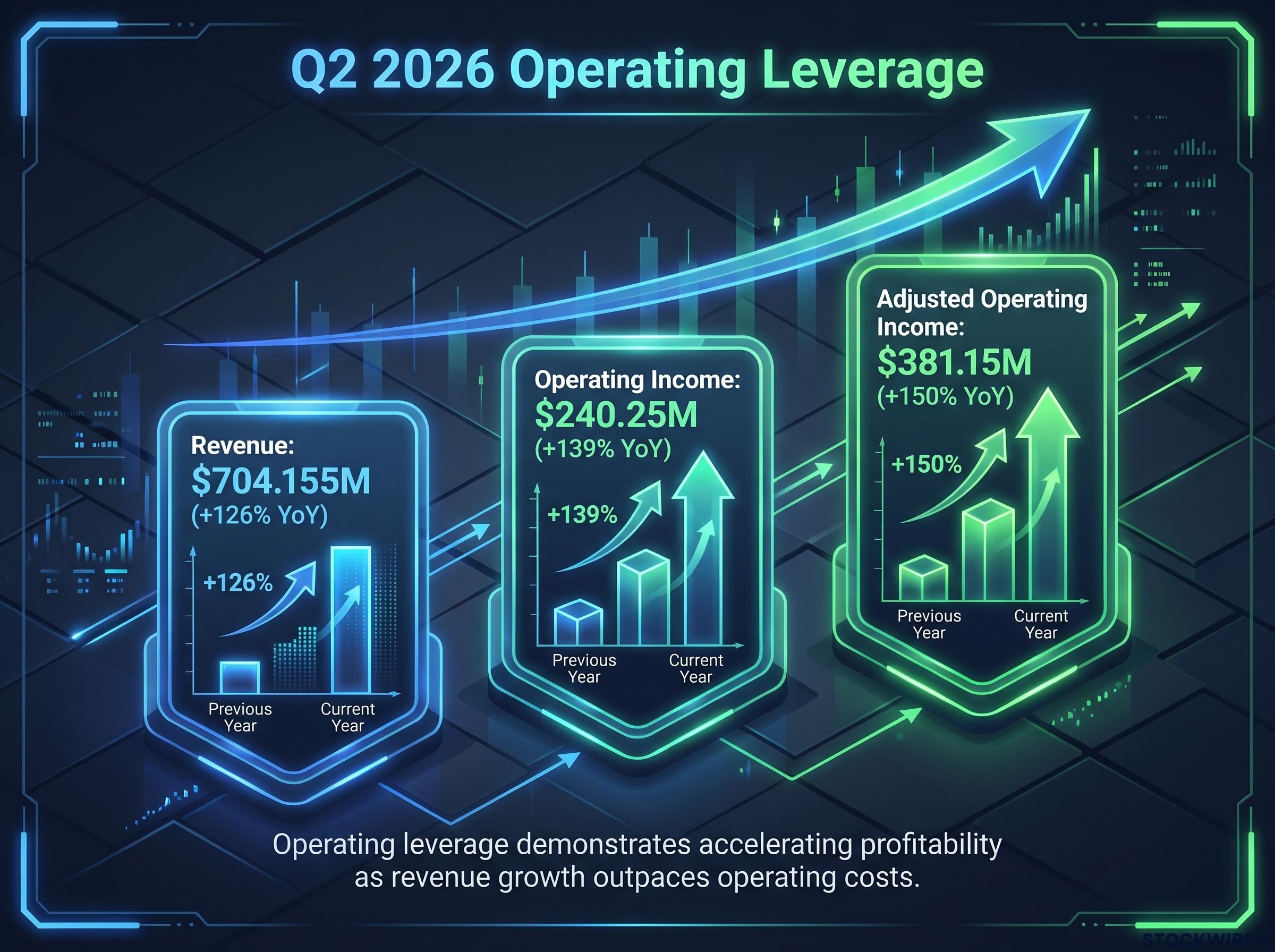
The adjusted figures push the point further. Adjusted operating income hit $381.15 million, up 150%, and adjusted net income landed at $292.98 million.
| Metric | Value | YoY Growth | Margin |
|---|---|---|---|
| Revenue | $704.155M | +126% | – |
| Operating income | $240.25M | +139% | 34% |
| Adjusted operating income | $381.15M | +150% | – |
| Net income | $176.97M | – | 25% |
| Adjusted net income | $292.98M | – | 42% |
The divergence between the reported net margin of 25% and the adjusted net margin of 42% is the number to interrogate. Adjusted figures typically strip out items such as acquisition-related and financing costs, which for a debt-funded serial acquirer are substantial and recurring, so treat the adjusted figure as management’s view of underlying economics rather than a clean cash number.
The number that anchors the forward thesis: a 42% adjusted net income margin. At this scale of revenue growth, a margin like that is what separates a compounding business from a rollup.
Full-year 2026 guidance is where the market’s expectation becomes visible. Management is targeting $2.78-$2.82 billion in revenue and $1.46-$1.51 billion in adjusted operating income, which implies a forward adjusted operating margin approaching 53%.
Enterprise SaaS margins of 70-80% mean that pricing increases flow almost entirely into free cash flow rather than being absorbed by input cost inflation, a structural property that makes the 53% forward adjusted operating margin Bending Spoons is guiding toward more credible than it would appear for a capital-intensive business at equivalent scale.
That is the number the multiple is pricing. With a P/E of 38.67 as of 19 September 2026 per InvestingPro, the market is not paying for today’s margin. It is paying for the continuation of the expansion, and that is the assumption every other section here exists to test.
When big ASX news breaks, our subscribers know first
The 50-plus-tool platform: why it is the moat, not the acquisitions
The Airtable and Miro deals get the headlines. The operating system underneath them is the actual investment thesis.
Bending Spoons has built a centralised technology platform of more than 50 proprietary tools, according to CEO Luca Ferrari, that it deploys across every company it buys. The mechanism is simple to describe and hard to copy: rip out the acquired company’s existing back-end infrastructure and replace it with a standardised one that the whole portfolio already runs on.
The platform spans six broad capability areas:
- HR systems, running people operations under one uniform process across every portfolio company.
- Financial operations, consolidating accounting and reporting onto shared rails.
- Technology operations, standardising how software is built, deployed, and maintained.
- AI model orchestration, managing how AI models are trained and deployed across products.
- Recruiting tools, feeding the hiring engine that supplies the whole group.
- A/B testing platforms, running controlled product experiments to measure what actually moves user behaviour.
The concrete margin lever sits in vendor consolidation. Folding every acquired company onto a single set of supplier agreements, a single AWS contract covering all entities, for example, is estimated to add 1 to 10 percentage points of EBITDA margin improvement according to Ferrari. That benefit compounds: the larger the portfolio, the more negotiating leverage and the wider the base over which fixed platform costs are spread.
Why replication takes longer than capital
Here is the part that matters for the durability of the moat. A well-funded competitor cannot simply buy equivalent tooling from vendors or rebuild it in 18 to 24 months.
The advantage is not the technical novelty of the tools. It is knowing what to build across wildly different acquisition types, from a solo-developer app to enterprise SaaS, and how to deploy it without breaking the product you just paid for.
Ferrari describes replicating the infrastructure as time-consuming and painful, requiring years of accumulated experience to know what to build in the first place. Bending Spoons has been iterating since 2013, meaning the current platform reflects roughly 13 years of compounding product decisions.
For a U.S. investor weighing Bending Spoons against other software acquirers, that decade-plus build time is the key fact. The moat is a function of institutional knowledge, not capital, and capital alone cannot buy 13 years of iteration on a short timeline. If the platform is genuinely hard to replicate, the competitive advantage is durable. If it is not, the premium multiple collapses toward a rollup discount.
Talent density as a capital efficiency multiplier
The workforce model started as an accident. In its early days acquiring solo-developer apps, Bending Spoons discovered that internal teams far smaller than anyone assumed could manage and improve those products effectively.
That discovery became the template for the entire company. Rather than inherit and retain the full headcount of every business it buys, Bending Spoons runs a lean core team, the “Spooners”, of roughly 600-800 people, with total headcount higher when transitional acquired teams are included. Around 75% of that core are engineers, AI researchers, product designers, and product managers.
The selectivity behind it is the number that defines the model.
The talent filter: approximately 800,000 job applications in a recent year, fewer than 300 hires.
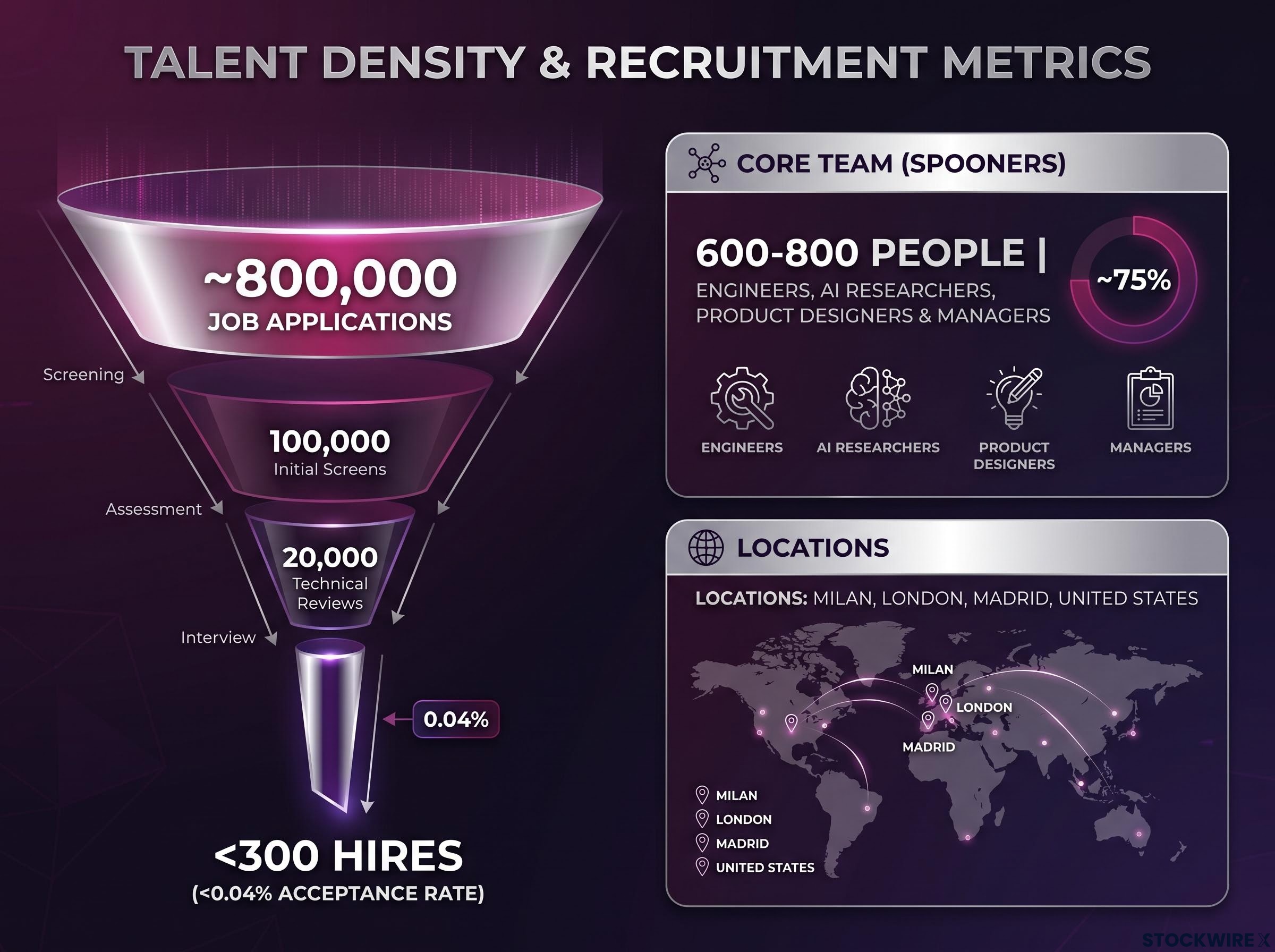
That is an acceptance rate below 0.04%, a filter more selective than most elite graduate programmes. According to Ferrari, this is deliberate. Fewer, better-compensated people replacing larger, less-productive headcount at acquired companies is not a culture story, it is a margin story, and it connects directly to the operating leverage visible in the Q2 results.
The geographic footprint shows where that talent is concentrated:
- Milan: the largest hub, for historical reasons as the company’s founding city.
- London: the fastest-growing location and an active hiring centre.
- Madrid: an established, active hiring location.
- United States: an ongoing expansion consistent with plans discussed in prior years.
The model is also self-reinforcing. High-calibre people attract more high-calibre candidates, which creates a hiring flywheel that is difficult to disrupt once it is spinning.
The competitive pressure on Bending Spoons’ hiring model is intensifying: AI skill premiums have compounded from 25% to 62% in two years according to PwC analysis, which means that maintaining the compensation advantage needed to attract sub-0.04% acceptance-rate calibre talent is becoming structurally more expensive across the entire engineering labour market.
For an investor assessing whether the financial performance is sustainable, this is one of the key variables to watch. If the hiring flywheel holds, the margin efficiency at acquired companies is likely to persist. If the company has to ramp hiring volume to staff a much larger portfolio, the quality bar becomes harder to hold, and the efficiency that underpins the margins could erode.
Capital structure, acquisition discipline, and the “permanent hold” distinction
The debt is the part that makes the model look improbable, and it is the part most worth understanding as a deliberate system rather than a liability.
Bending Spoons runs at roughly 2.5 times leverage, with a blended cost of about 9%, all fixed rate, maturing in 2031, according to Ferrari. Every one of those choices is defensive by design.
The three parameters, at a glance:
- Leverage ratio: approximately 2.5x
- Blended debt cost: approximately 9%, all fixed
- Maturity: 2031
Fixed-rate debt insulates the company from rate increases on its current obligations. Management goes further and argues that a rising-rate environment actively helps the model, because higher rates depress the valuations of acquisition targets, and the resulting cheaper deals more than offset the higher cost of any new borrowing. Whether that holds in practice is one of the thesis’s open questions, but the logic is internally consistent.
The returns history is what makes the leverage tolerable. Historical unlevered returns have consistently exceeded 25%, per Ferrari, and only about $500 million in primary equity was raised in total before the IPO, which tells you how little dilution has funded the growth to date.
What “permanent hold” changes about acquisition economics
The distinguishing choice, according to Ferrari, is that Bending Spoons holds companies permanently rather than for resale. A traditional private equity firm with a five-to-seven-year exit horizon has no rational reason to invest in shared infrastructure it cannot fully monetise before selling. Owning indefinitely changes the maths: infrastructure spend that pays back over a decade becomes sensible, which is exactly why the platform can exist at all.
That permanent-hold logic is what lets Bending Spoons pay differently for assets, and its two post-IPO deals are the live tests of whether the discipline holds at scale.
| Deal | Enterprise Value | Key Metric | Status |
|---|---|---|---|
| Airtable | $1.29B | ~$9B below prior peak private valuation | Closed 4 Sep 2026 |
| Miro | $1.355B | ~$600M ARR, ~90% enterprise, 250,000 paying organisations | Announced 10 Sep 2026 |
Airtable, announced 4 August 2026 and closed 4 September 2026, was bought at an enterprise value of $1.29 billion, roughly $9 billion below Airtable’s prior peak private valuation according to Fortune. That is the discount-to-peak sourcing strategy in action.
The discount-to-peak sourcing strategy that delivered Airtable at roughly $9 billion below its prior private valuation is partly a product of the broader legacy software repricing cycle, in which AI disruption drove a $2 trillion wealth destruction event across US software markets and pushed private valuations sharply downward from their 2021 peaks.
Miro, announced 10 September 2026 at a $1.355 billion enterprise value, brings a different profile: around $600 million in annual recurring revenue, nearly 90% from enterprise customers, and 250,000 paying organisations. It is the enterprise-SaaS anchor the margin thesis leans on.
One detail deserves more than a footnote. Certain Miro shareholders agreed to reinvest $295 million of their proceeds into newly issued Bending Spoons equity.
That is a qualitative endorsement worth weighing. Miro’s former owners chose BSP stock over cash, which signals they view the equity as a better risk-adjusted hold than the money they could have walked away with. This is where the investment case either coheres or reveals its stress points: if you are comfortable with 2.5x leverage, convinced by the 25%-plus unlevered return history, and reassured by discount-to-peak sourcing, you have a coherent long thesis. If you are not, you have just located the primary risk vector.
What to watch before sizing a position in BSP
The thesis and its risks are now on the table. What a commercially-minded reader needs next is not a recommendation, it is a set of specific signals that would confirm or invalidate the case over the coming reporting cycles.
Both Airtable and Miro are, by every available account, too early to judge operationally. Airtable closed on 4 September 2026 with no operational results reported yet, and the Miro acquisition, announced 10 September 2026, had not closed at the time of writing. The next 12 to 18 months of results will show whether the playbook scales to full enterprise-SaaS complexity.
Three variables, in priority order, are the tests worth tracking:
- Airtable operational metrics in the next earnings release. As the first post-IPO acquisition, its integration timeline is the clock. Evidence of margin improvement and product traction is the earliest read on whether the platform delivers on a large U.S. asset.
- FY 2026 adjusted operating income against the $1.46-$1.51 billion guidance band. This is the near-term margin test. Landing inside or above it supports the roughly 53% forward margin the market is pricing; falling short undermines it.
- Miro integration pace and talent model integrity as the portfolio expands. Watch whether the hiring flywheel and lean-team efficiency hold as headcount demands grow beyond the current 600-800 core Spooners.
One structural feature of the information environment raises the stakes on all three. There is no formal sell-side coverage with detailed public notes on valuation or moat durability, which means you are working from primary sources, Form 6-K filings and management statements, rather than an analyst consensus.
A P/E of 38.67 at a market cap ranging from $22.98 billion (StockTitan, 23 September 2026) to $25.73 billion (InvestingPro, 19 September 2026) prices in sustained margin expansion and clean acquisition execution. If either disappoints over the next two reporting cycles, multiple compression is a real risk, and the framework above is what lets you tell a temporary integration hiccup apart from a structural failure of the playbook.
For investors wanting to stress-test the permanent-hold compounder thesis against the most studied precedent in serial software acquisition, our deep-dive into the Constellation Software acquisition playbook examines how decentralised approval architecture, institutional sourcing scale, and cultural compounding create an imitation gap that widens with each additional year of operation.
This article is for informational purposes only and should not be considered financial advice. Investors should conduct their own research and consult with financial professionals before making investment decisions.
Past performance does not guarantee future results. Financial projections and forward-looking statements are subject to market conditions and various risk factors, and may change based on company performance and market developments.