The US Dollar should be softening right now. Oil prices have dropped below $100 per barrel, global risk appetite has improved, and the safe-haven case for holding dollars has faded into the background.
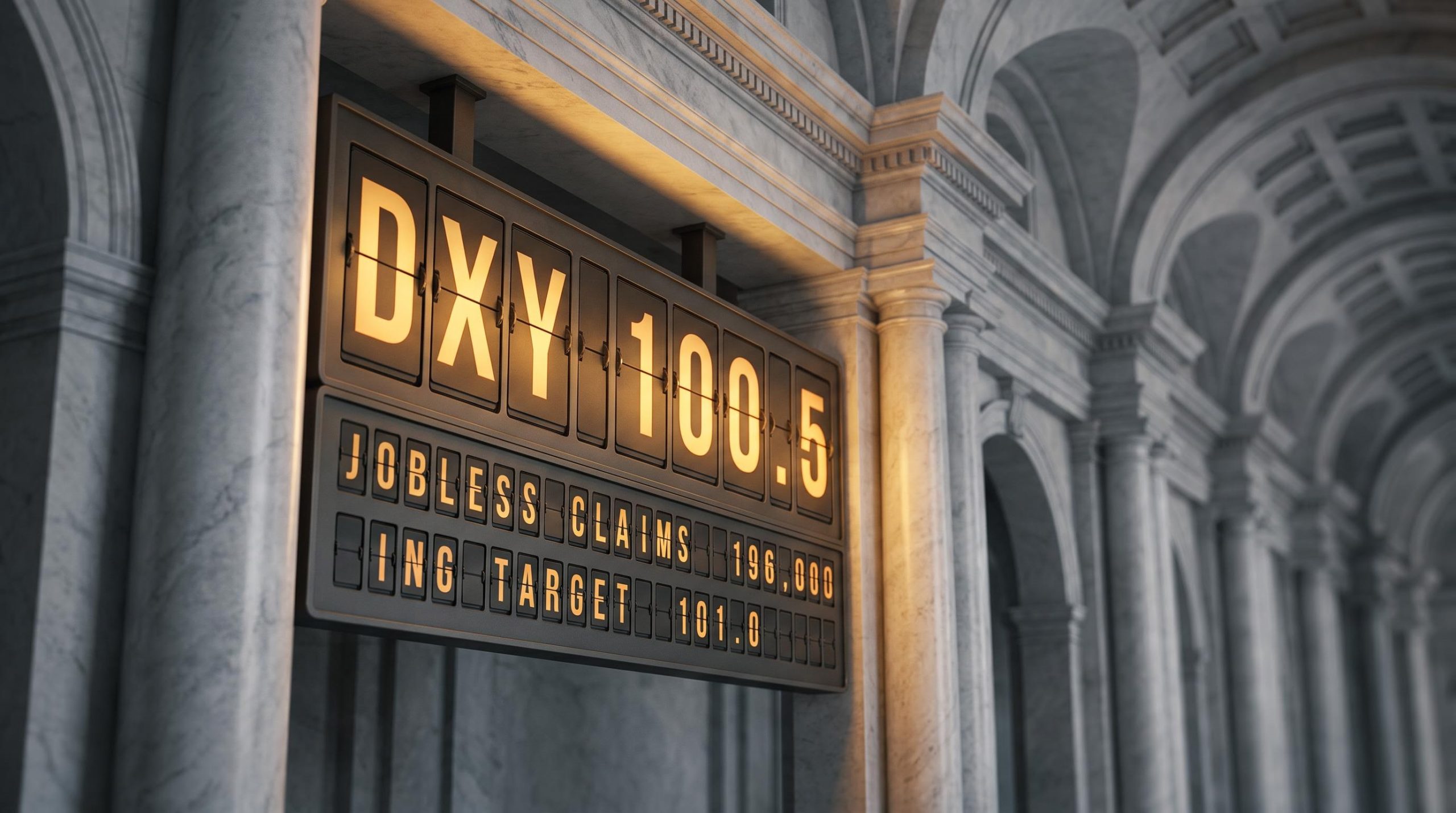
Yet the Dollar index is sitting near 100.5, close to its highest level since late July, and institutional strategists are calling for further gains. Something is overriding the normal rules, and if you are reading US Dollar strength through the usual commodity or risk-sentiment lens, you are working with the wrong map.
The good news is that this behaviour is not a mystery once you understand what is actually driving it. Here is the framework for why the Dollar is holding firm despite cheaper oil, which data points genuinely move it right now, and how this unusual configuration could break in either direction over the coming weeks.
The paradox: why a weaker oil price is not weakening the Dollar
Start with what you would reasonably expect. Higher oil prices have historically supported the Dollar, because the US is seen as relatively less exposed to energy shocks than many of its trading partners. Flip that logic around, and falling oil should soften the greenback.
That is the conventional read. It is also, right now, the wrong one.
Brent crude fell beneath the $100 per barrel mark after the Saudi East-West pipeline returned to service and diplomatic exchanges with Iranian representatives took a more constructive turn. Under the old rulebook, that decline should have taken some air out of the Dollar. Instead, the DXY index held near 100.382 on 22 September 2026, staying close to its strongest level since late July, according to TradingEconomics.
What is happening is that a different channel has taken over the pricing. Federal Reserve hawkishness and the rate differentials it creates are dominating the commodity channel entirely. ING strategist Francesco Pesole has been explicit about the mechanism: when oil is trading somewhere in the $90-$100 per barrel band, that is simply not sufficient to prompt markets to revise their rate expectations in a dovish direction. The energy story is real, but it is not the story that sets the Dollar’s level.
Marc Chandler of Bannockburn Forex makes the same point from the other direction, tying the Dollar directly to what US yields are doing rather than what oil is doing.
Treasury yield pressure intensified sharply in the weeks before this Dollar episode: the 10-year closed at 4.975% on 13 September 2026, rising 19.1 basis points in a single week as core CPI surprised to the upside, and that simultaneous move across the 2-year, 10-year, and 30-year confirmed the broad repricing of rate expectations that subsequently anchored the DXY near its multi-week highs.
The Dollar’s moves are closely linked to US yields, not to the price of oil, according to Marc Chandler of Bannockburn Forex.
The table below shows why the two channels are pulling in different directions, and which one is winning.
| Channel | Conventional expectation | Current reality |
|---|---|---|
| Commodity (oil) channel | Falling oil softens the Dollar, since the US is less energy-import-exposed than peers | Muted influence. Oil below $100 has barely moved the DXY |
| Rate-differential channel | Wider US yield advantage over peers strengthens the Dollar | Dominant. Fed hawkishness is anchoring the DXY near multi-week highs |
ING’s near-term target of 101.0 rests on this exact reading. The takeaway for you is a recalibration: the signal that matters is coming from rates and Fed communication, not from the oil futures screen.
When big ASX news breaks, our subscribers know first
What is actually driving Dollar demand right now
If oil is not setting the price, what is? The answer is a transmission chain that runs from the US labour market straight through to the DXY level, and it is worth tracing link by link.
- Labour market tightness. A still-tight jobs market signals the economy can absorb higher rates.
- The Fed maintains a restrictive posture. Tight employment gives policymakers room to keep tightening rather than easing.
- Front-end yields stay elevated. Continued restrictiveness keeps short-dated US yields high.
- Rate differentials sustain Dollar demand. A persistent yield advantage over peers keeps capital flowing into dollars.
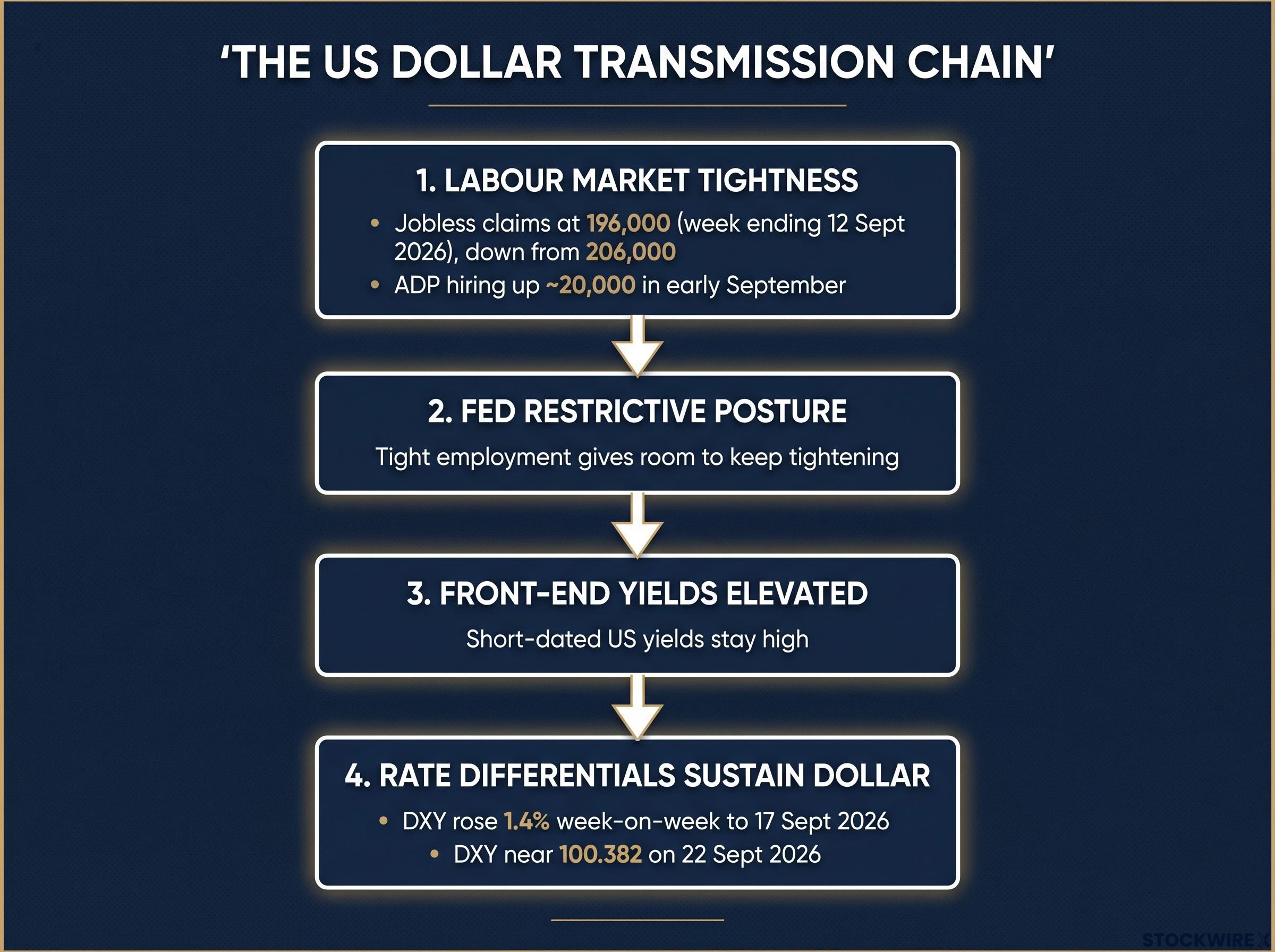
The latest labour data feeds directly into step one. Initial jobless claims came in at 196,000 for the week ending 12 September 2026, down from 206,000 the prior week, according to FRED and the US Department of Labor. Claims dropping back below 200,000 for the first time in several weeks is consistent with a labour market that has not loosened. ADP added to the picture with weekly hiring up roughly 20,000 in early September.
The jobless claims signal that markets read as bullish for the Dollar in September 2026 carries a significant caveat: the 196,000 reading for the week ending 12 September came from a Labor Day holiday week when filing patterns are routinely distorted, and a parallel analysis shows roughly 2 million Americans have quietly exited the workforce since December 2025, meaning the stability the headline data projects may be partially a statistical artefact.
Here is why that jobs data matters more than it might appear. It is not just an economic reading; it is the input that tells the Fed it can keep tightening, which tells currency markets the yield gap with peers will persist, which is what is holding the Dollar up.
Fed communication is doing the anchoring. Richmond Fed President Thomas Barkin has argued that a single rate increase may not be enough to deal with inflation, and that any dovish pivot would require visible deterioration in employment. That framing keeps front-end yields “firmly anchored”, in the words of OCBC strategists Sim Moh Siong and Christopher Wong, alongside Elias Haddad of Brown Brothers Harriman, all citing persistent hawkish rhetoric as the floor under the Dollar.
The Fed raised rates to 3.75-4.00% in September 2026 while inflation remained at 3.4% and unemployment held at 4.1%, meaning the Fed dual mandate is pulling in two directions simultaneously; the Bostic principle resolves the tension by directing policy hardest at whichever target is farthest off, and with inflation 1.4 percentage points above the 2% threshold, price stability is the dominant objective anchoring the hawkish posture.
The result showed up in the price. The DXY rose 1.4% week-on-week to 17 September 2026, according to Reuters, even as oil fell and risk appetite improved.
US growth outperformance as a secondary floor
There is a second, quieter layer of support beneath the rate mechanics. The US economy is simply outgrowing its major peers, and that relative strength gives investors a reason to hold dollars on a value basis, not just a yield basis.
Structural and fiscal challenges in Europe, combined with the Fed’s hawkish stance against more cautious central banks elsewhere, sharpen the contrast. When commodity tailwinds fade, this relative-value case does not fade with them.
It is not the primary driver, but it is a floor. And it explains why the Dollar has somewhere to stand even on days when the rate story goes quiet.
Has the Dollar been here before? The 2014-2015 playbook
If this configuration feels familiar, that is because markets have run this exact scenario before, and recently enough to learn from.
In 2014-2015, oil prices collapsed while the Dollar surged. The driver was not energy at all. It was the expectation of Fed tightening at a time when the European Central Bank and the Bank of Japan were easing. According to the IMF and broader market analysis of that period, relative policy stances and growth differentials dominated the currency impact of cheaper energy.
Line the two episodes up and the shared structure is hard to miss.
- Oil falling sharply in both periods
- The Fed tightening, or expected to tighten, while peers ease or lag
- US labour-market and growth outperformance versus major peers
- The Dollar rising despite the cheaper energy backdrop
The parallel is precise, but be careful about what it proves. The analogy does not guarantee the current move will play out identically. What it does establish is that the Dollar decoupling from oil is not an anomaly; it is a recurring pattern that appears whenever the policy and growth gap between the US and its peers is wide enough to override the commodity channel.
The historical lesson is straightforward: the Dollar holds its ground during falling-oil episodes only when policy and growth differentials are wide enough to override the usual commodity effect.
There is one more precedent worth holding onto. In past risk-on phases, when US assets offered higher yields and stronger growth than the alternatives, capital still flowed into dollars even as global sentiment improved. That is exactly the dynamic playing out now.
For you, the read is this. If the 2014-2015 template holds, Dollar firmness is likely to persist until either US data softens meaningfully or a major peer central bank shifts toward tightening. This is structure, not noise.
What could break the Dollar’s momentum, and what to watch next
Knowing the mechanism is only useful if you know what would break it. Because the Dollar is now priced off rate expectations, the catalysts to watch are the ones that move those expectations, and the most immediate is the September payrolls report.
Market consensus, via ING, is forming around a September payrolls figure in the 80,000 to 100,000 range. That number is not just a labour reading right now; it is the single most important input determining whether the Dollar pushes toward 101 or gives back recent gains, because it feeds directly into the October rate-hike probability that is anchoring the DXY.
Here is how the payrolls print maps onto the Dollar.
- Strong payrolls: An October hike gets priced in more firmly, and the DXY heads toward ING’s 101.0 target.
- In-line payrolls: The status quo holds, and the Dollar stays near current levels.
- Weak payrolls: Hike expectations get pared back, and the Dollar gives back some of its recent gains.
The logic behind that third scenario is worth spelling out. Any reading that forces markets to price fewer hikes or earlier cuts becomes the specific trigger for Dollar weakness, precisely because the current level is so rate-dependent. Barkin himself has framed the threshold: a dovish pivot requires visible employment deterioration. Until the data delivers that, the hawkish case stands.
The Fed communication risk
There is a second way this could turn, and it does not require the data to soften at all.
Even with strong numbers, a shift in Fed tone toward more neutral or data-dependent language could cool rate-differential support on its own. The words matter as much as the figures, because the market is trading Fed credibility as much as Fed action. Reuters noted the Dollar slipped briefly as yields eased after the Fed’s decision, a small illustration of how quickly the currency responds to any change in the rate signal.
ING has flagged October as the key window for any such pivot. For now, OCBC and BBH see the Dollar as well-positioned through year-end, but that view carries an explicit condition: continued hawkish guidance. Remove the guidance and the base case weakens, regardless of where oil trades.
What the current Dollar environment actually tells you
Step back from the individual data points and the durable lesson comes into focus. When the Fed is credibly hawkish and the US is outgrowing its peers, the Dollar can decouple from oil and risk sentiment for extended stretches, and stay decoupled.
The familiar shorthand, Dollar up with oil and down with risk appetite, is a heuristic. It works until monetary policy divergence gets large enough, and then it stops working. Knowing when the shorthand applies and when it does not is itself the analytical skill worth building. The 1.4% week-on-week DXY gain to 17 September 2026, achieved while oil fell, is the evidence that the rate-driven bid is holding.
So track the right variables. Three inputs will determine how long this configuration lasts:
- Fed communication tone, and any shift from hawkish toward neutral or data-dependent language
- Front-end US Treasury yield movements, the clearest real-time gauge of rate-differential support
- Labour market data releases, beginning with September payrolls
ING’s 101.0 marks how much further the current dynamic could run. Barkin’s requirement of visible employment deterioration marks the threshold that would end it. Anyone still reading the Dollar through oil or risk indices is watching the wrong dial.
For investors wanting to place the current DXY configuration in its full 2026 context, our deep-dive into the Dollar’s 2026 rebound examines Morningstar’s estimate that the index is approximately 15% overvalued at current levels, a valuation risk that exists alongside the rate-differential support this article describes.
This article is for informational purposes only and should not be considered financial advice. Investors should conduct their own research and consult with financial professionals before making investment decisions. Past performance does not guarantee future results, and forward-looking projections are subject to market conditions and various risk factors.