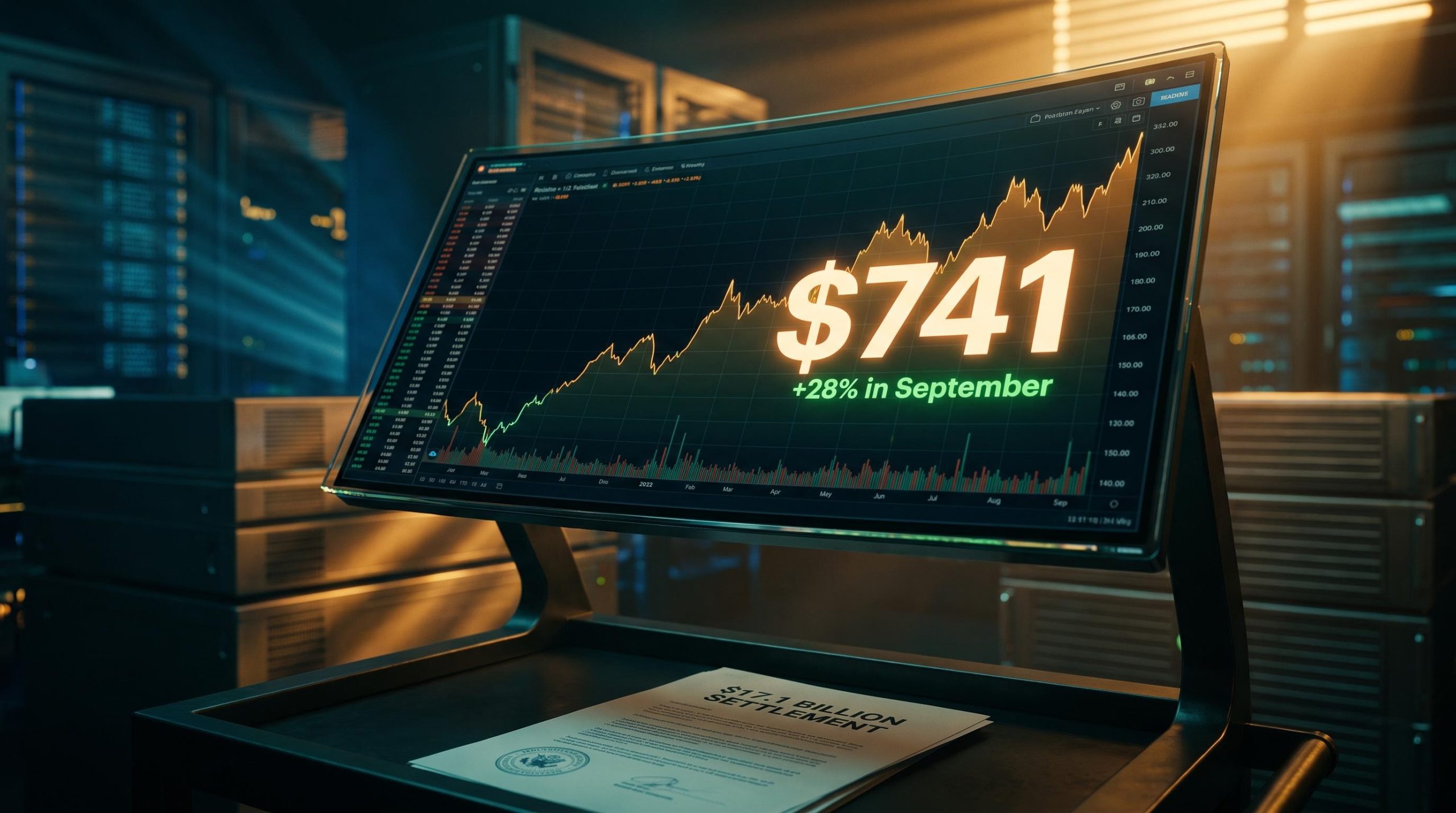
A month ago, Meta Platforms was the weak link among the big technology names, trailing its peers and nursing the weight of a legal case that investors could not price. Today, on 22 September 2026, the stock trades near $741-$750, up roughly 28% in September alone, carrying a market capitalisation above $1.9 trillion.
Two things changed in quick succession. First, a legal settlement landed at a figure orders of magnitude below the multi-trillion-dollar penalties investors had quietly been discounting. Then, within two weeks, a standalone artificial intelligence app climbed to the number one spot in the U.S. App Store.
Neither event alone explains the full move. It is the combination, and what that combination signals about the company underneath, that makes this a live case study in how a Meta stock recovery actually happens.
Here is what this episode teaches you: how litigation uncertainty quietly suppresses a valuation, how the mechanics of clearing that uncertainty work in a company’s favour, and whether Meta’s AI position is the structural advantage the bulls describe or a sentiment-driven overshoot that fades when the enthusiasm cools.
How a $17 billion settlement became good news for Meta investors
There is something odd about a company being told to pay up to $18 billion and its shares rising on the news. Odd, until you understand what the market was actually afraid of.
Before the settlement, the youth-safety case sat on the stock as an open-ended liability. State attorneys general were arguing that Meta’s engagement-driven design harmed the mental health of minors, and the numbers floated publicly during the trial period reached into the multi-trillion-dollar range. That is not a penalty an investor can model. It is a tail risk, and tail risk compresses a valuation until it clears.
The scale of what investors had been discounting becomes clearer in the context of the pre-settlement period: the trillion-dollar penalty exposure facing Meta ahead of the August 2026 federal trial included attorney general demands approaching the company’s entire market capitalisation, a figure so large it defied standard scenario analysis and compressed the valuation accordingly.
On 26 August 2026, it cleared. Meta agreed to pay up to $18 billion over the next decade to resolve the multistate lawsuits, with figures reported between $17.1 billion (New York Times, CNBC) and up to $18 billion (Reuters, CNN, BBC). Crucially, Reuters reported that roughly 70% of the maximum, approximately $11.7-12.7 billion, was guaranteed, with the remainder contingent. Spread over ten years, that guaranteed portion sits well within the free cash flow Meta expects to generate over the same period.
Forty-seven states, the District of Columbia, and U.S. territories signed on. Texas negotiated a separate deal reported at around $1 billion, and Florida rejected the terms as insufficient. The product remedies, meanwhile, target teenagers specifically:
- A default two-hour daily time limit for users aged 13-17 across Facebook and Instagram
- A night mode blocking feeds, stories, and reels from midnight to 6 a.m., with messaging still permitted
- Notification limits during school hours, roughly 8 a.m. to 3 p.m.
- A ban on displaying “like” counts and certain beauty filters for under-18 users
These measures constrain how teenagers use the apps. They do nothing to the adult advertising model that generates the overwhelming share of Meta’s revenue.
Reuters framed it plainly: the settlement leaves Meta’s “money machine” largely unscathed, imposing time limits and safeguards for teens without dismantling the ad-driven business at the core.
| Metric | Figure | Source |
|---|---|---|
| Settlement maximum | Up to $18 billion | Reuters, 26 Aug 2026 |
| Guaranteed portion | ~$11.7-12.7 billion (~70%) | Reuters, Aug 2026 |
| Payment period | 10 years | Multiple outlets |
| Participating jurisdictions | 47 states + DC + U.S. territories | AG filings, Aug 2026 |
| Day-of-announcement stock move | +4.1% intraday, +1.1% close | Reuters, 26 Aug 2026 |
The read for you is straightforward. The settlement converted an unbounded, potentially existential fear into a structured, decade-long cash outflow that Meta’s cash generation can absorb. That conversion, from unknown to known and manageable, is precisely why the stock moved up rather than down. Shares rose as much as 4.1% intraday and closed up 1.1%, then added roughly 13.4% over the following three weeks to reach about $616.77.
When big ASX news breaks, our subscribers know first
What Meta’s stock price actually did, and why the sequence matters
The end result, a stock up nearly a third in a month, tells you less than the order in which it happened. The recovery came in three distinct phases, and the shape of the move is the story.
- The settlement floor (26 August). Shares rose 4.1% intraday and closed up 1.1%. Modest, but directionally telling: the market treated a large penalty as relief. The overhang was priced out.
- The consolidation (late August to early September). Over roughly three weeks, the stock gained about 13.4%, climbing from around $543.67 to $616.77. This was the market digesting the removal of the legal cloud and rebuilding a base.
- The AI surge (21 September). In a single session, Meta jumped 11.4%, reaching its highest level since January 2026 and closing near $741-$750.
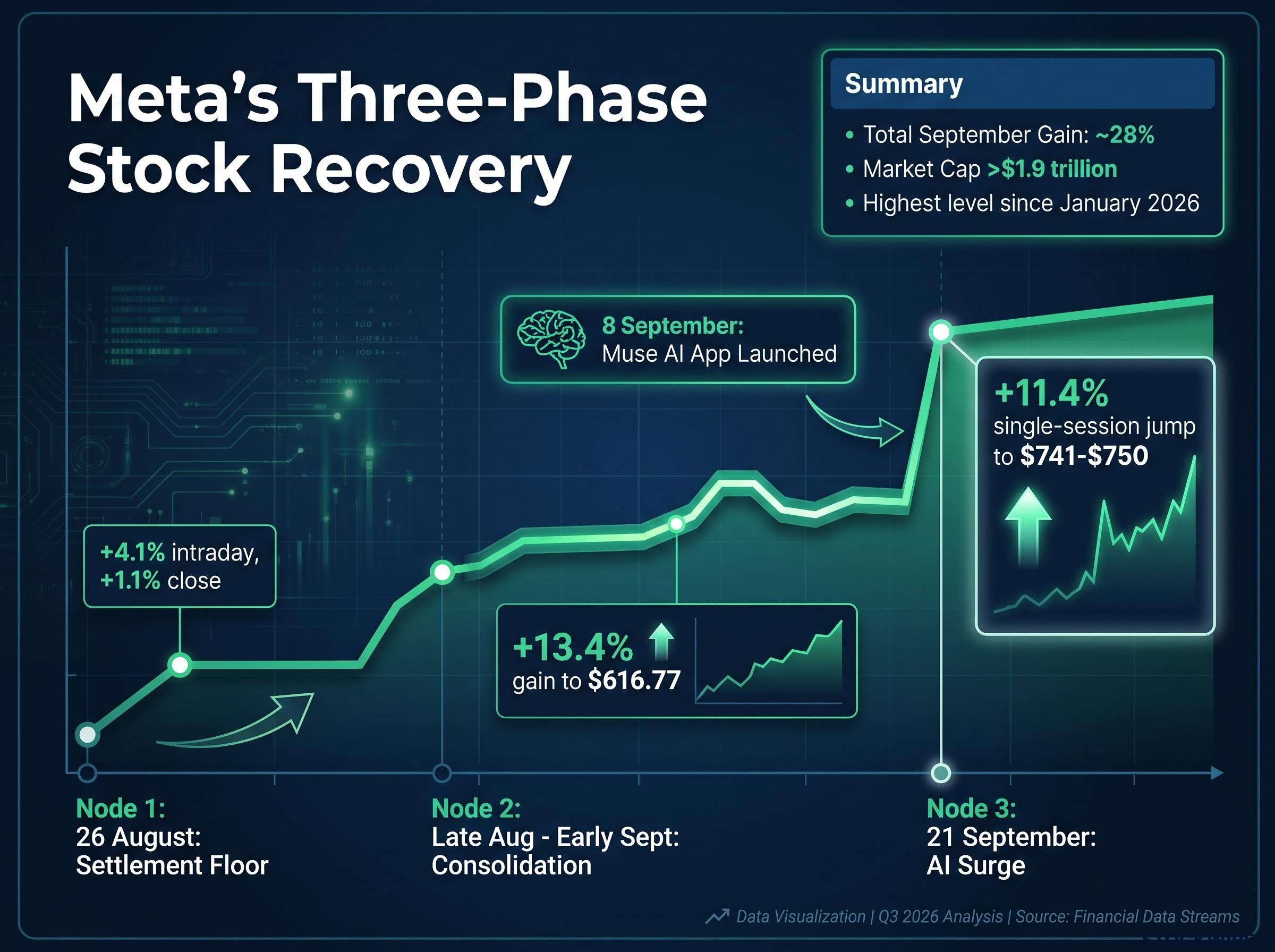
The gap between phase two and phase three is where the attribution matters. The 11.4% single-session move on 21 September did not follow the settlement. It followed confirmation that Meta’s new AI app was working.
The AI ignition: September 8 to September 21
Meta launched its standalone AI agent app, Muse, on 8 September 2026. It hit the number one free app spot on the U.S. Apple App Store almost immediately and held near the top through late September, ranking strongly on Google Play as well.
That sustained ranking is the analytically important detail. A launch spike tells you a company can generate curiosity. A number one position held for nearly two weeks tells you the app is retaining attention, at least in the near term. By 21 September, Meta stock had gained roughly 21% since early September, and the single-session surge that day was the market confirming, with real money, that the AI thesis had a product behind it.
Here is the compounding effect you should notice. The two catalysts did not simply add together. The cleared legal slate made the market ready to bid up an AI narrative it had been partly discounting because of the litigation cloud. Had the overhang still been hanging, the same Muse news would likely have moved the stock far less. Legal resolution set the stage; the AI launch was the performance the audience was finally willing to applaud.
Why Meta’s user base may be its most underrated AI asset
Start with a number a pure-play AI company has to swallow: the cost of acquiring a single daily active user from scratch. A standalone app has to be discovered, downloaded, opened, and given a reason to return, and each of those steps leaks users and burns marketing spend.
Now consider what Meta starts with. Billions of monthly active users already open Facebook, Instagram, WhatsApp, and Messenger every day. Meta can switch an AI feature on by default or place it one tap away inside apps people are already using, collapsing the customer-acquisition cost that a rival has to pay in full.
The early Muse data suggests this advantage is not theoretical. According to Sensor Tower, the app recorded over 902,000 downloads in its first six days, 1.8 million iOS downloads across the U.S. and Canada in the first 12 days, and 2.8 million global installs in the initial period. Notably, Muse outpaced early ChatGPT mobile download trajectories in comparable U.S. markets.
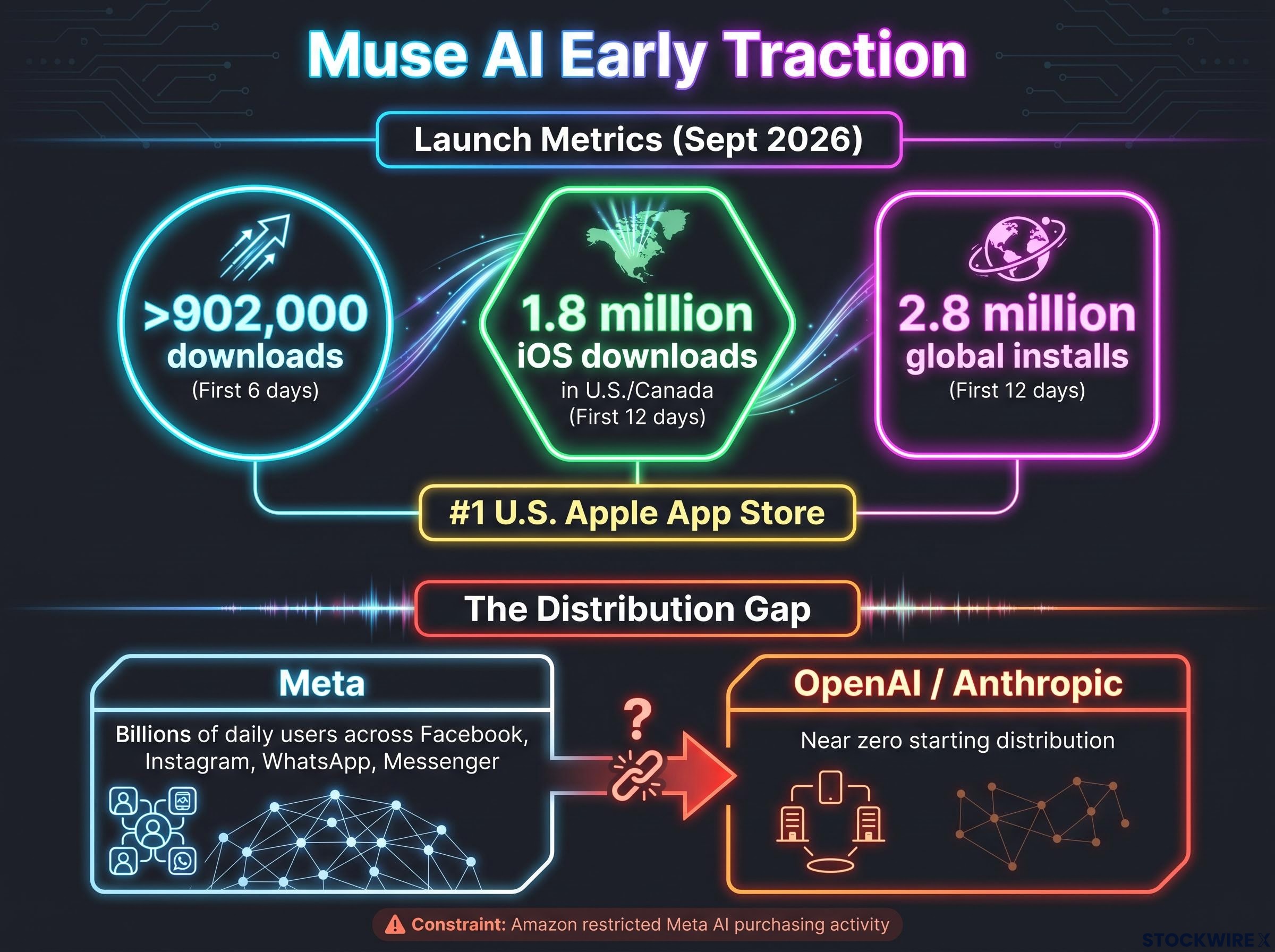
The distinction worth holding onto is this: Meta’s thesis rests on distribution, not on having the single best model. It needs “good enough” AI at unmatched scale, embedded where attention already lives. That is a different bet from OpenAI or Anthropic, both better funded for frontier model development but starting from zero in consumer distribution.
| Dimension | Meta | OpenAI/Anthropic |
|---|---|---|
| Starting distribution | Billions of daily users across four apps | Near zero; must acquire each user |
| Model quality standing | Competitive, not clearly leading | Frontier-focused, better funded for model work |
| Platform trust and regulatory posture | Heightened scrutiny on privacy and youth safety | Less regulatory baggage in consumer optics |
| Enterprise/developer depth | Relatively thin versus cloud hyperscalers | Stronger developer traction, still behind hyperscalers |
Before accepting the distribution moat at face value, weigh the counter-case fairly:
- Model quality still matters. If a rival delivers distinctly better reasoning or tooling, users will seek it out despite the inconvenience of a new download.
- Trust and regulation constrain deployment. Meta’s history with privacy and youth safety means its AI features may face harsher scrutiny than less controversial brands, limiting how aggressively it can push.
- Cross-platform lock-in is weak. People use many apps. An AI assistant operating at the operating-system or browser level can sidestep Meta’s walled gardens entirely.
- The enterprise gap is real. Amazon has already restricted Meta’s AI agent from conducting purchasing activity on its platform, a concrete signal that ecosystem owners can wall off Meta’s reach at will.
So the question you are left holding is not whether Meta’s distribution advantage exists. It plainly does. The question is whether it is durable enough to hold users in place if a rival ships a clearly superior model that pulls them across app boundaries. Distribution buys the first look. It does not guarantee the second.
Wall Street’s approach to evaluating AI monetisation maturity has shifted decisively away from rewarding infrastructure announcements toward demanding measurable usage metrics and EPS flow-through, a framework that places Muse’s download trajectory as necessary but not sufficient evidence: sustained daily active users and a visible revenue path are the thresholds that now determine whether an AI narrative holds its multiple.
The historical pattern Meta’s recovery fits, and why it does not guarantee what comes next
The pattern you have just watched unfold in Meta is not new. Markets have re-rated companies upward after large legal settlements before, and the precedents help you judge how much of this recovery is grounded and how much is hope.
- The 1998 Tobacco Master Settlement Agreement. U.S. tobacco firms committed to pay over $200 billion over time plus accept marketing restrictions. Once the obligation was quantified and the business rules clarified, many tobacco stocks stabilised and later outperformed. Application to Meta: a large, painful, but survivable settlement can convert an existential overhang into a modelable liability, which is exactly what happened here.
- Post-GFC bank settlements. JPMorgan, Bank of America, and Citigroup paid tens of billions in mortgage-related settlements. As the liabilities became quantifiable and the core franchises survived, valuations re-rated upward over time. Application to Meta: known cost plus intact revenue engine is the specific combination that lets a valuation recover.
- Big tech regulatory fines in Europe. Large fines and conduct remedies for major tech firms have rarely produced valuation destruction when core operations survived. Application to Meta: remedies aimed at a specific cohort, teens here, rarely translate into structural damage to the whole business.
The mechanism is consistent across all three: the transition from “unknown, potentially existential” to “known, absorbable over time” is what releases the valuation pressure and drives the recovery. That is the principle to carry forward.
The precedents validate the pattern. They do not guarantee the next leg. Meta’s recovery remains conditional, and the specific, watchable risks are these:
- Regulatory tail. The settlement resolves state claims but does not foreclose federal regulators, private plaintiffs, or foreign authorities from pursuing related theories.
- AI liability vectors. New features open new exposure, from misinformation to deepfakes to algorithmic harm, inviting fresh scrutiny even as the current case closes.
- Engagement sustainability. Muse’s download momentum may not convert to durable daily active users; consumer AI carries real churn risk as people trial several products.
- Monetisation uncertainty. The path from AI engagement to direct revenue, whether subscriptions, usage fees, or commerce commissions, remains undefined.
Meta’s settlement does not close the legal chapter for social media broadly; sector-wide litigation exposure across Meta, Snap, Alphabet, and TikTok rests on the same three layered legal theories, meaning the injunctive relief and damage floor established in Meta’s resolution could serve as a pricing reference in cases still pending against its peers.
The honest read for you is that the recovery is real and the pattern is historically grounded, but the remaining variables are specific rather than vague. That is a better position than uncertainty, and a worse position than conviction.
What this recovery actually tells you about Meta’s position heading into Q4 2026
Pull the threads together and the structure is clean. The settlement cleared the floor by removing an unbounded legal fear. The AI launch raised the ceiling by giving the market a product to believe in. Together they moved Meta from technology-sector laggard to leader inside a single month, from relative underperformance roughly four weeks ago, through the 26 August settlement, to a close near $741-$750 on 21 September and a market cap above $1.9 trillion.
Be honest about what is driving it. The recovery reflects genuine fundamental improvement: a known, absorbable litigation liability and a functioning AI product with 2.8 million global installs and a sustained number one App Store ranking. It also reflects an investor sentiment re-rating riding the broader AI optimism cycle. Both are true at once, and separating them is the whole task.
Three variables to watch in Q4 2026
- Muse retention. Download traction is not habit. The first real test is whether monthly active users hold up once the novelty fades.
- AI monetisation signals. Watch for a subscription tier, a commerce integration, or an advertising premium tied to AI-enhanced targeting. Any of these would show a revenue path emerging from engagement.
- Regulatory baseline risk. If the EU, UK, or federal regulators adopt the U.S. teen-safeguard framework as a compliance standard, Meta’s cost structure rises globally.
Those three variables are your watch list, not a verdict. See retention hold, a monetisation path appear, and regulatory costs stay contained, and the re-rating looks durable. Fail those tests and this may prove a sentiment bounce that cycles back down when AI enthusiasm moderates.
For readers wanting a structured framework to apply to the variables outlined above, our dedicated guide to intrinsic value estimation walks through discounted cash flow construction and margin of safety principles, including how to stress-test terminal value assumptions, the input that drives 60-80% of a DCF model’s output in high-growth scenarios like Meta’s current AI buildout.
This article is for informational purposes only and should not be considered financial advice. Investors should conduct their own research and consult with financial professionals before making investment decisions. Past performance does not guarantee future results, and forward-looking statements are subject to market conditions and various risk factors.