SB Energy is heading into its IPO with $139 million in first-half revenues, a $3.21 billion net loss, and a contracted backlog more than 3,100 times that revenue figure. That is not a typo, and it is not a red flag in the conventional sense.
It is the entire investment thesis.
The company filed its Form S-1 with the SEC on 1 September 2026, targeting a valuation above $50 billion, with Nvidia committing $3 billion in equity and OpenAI holding roughly $5.5 billion in warrants. This is a capital structure unlike anything in recent IPO history, and understanding why sophisticated institutional money is flowing in despite the losses requires a different framework than the one most investors apply to growth stocks.
This piece breaks down the architecture of the SB Energy IPO investment case: what the backlog actually represents in cash-flow terms, how the Nvidia and OpenAI commitments change the risk calculus, and where the whole structure could fail. Read it and you will have a grounded way to evaluate long-duration infrastructure plays, not just this one offering.
What $439 billion in contracted backlog actually means for investors
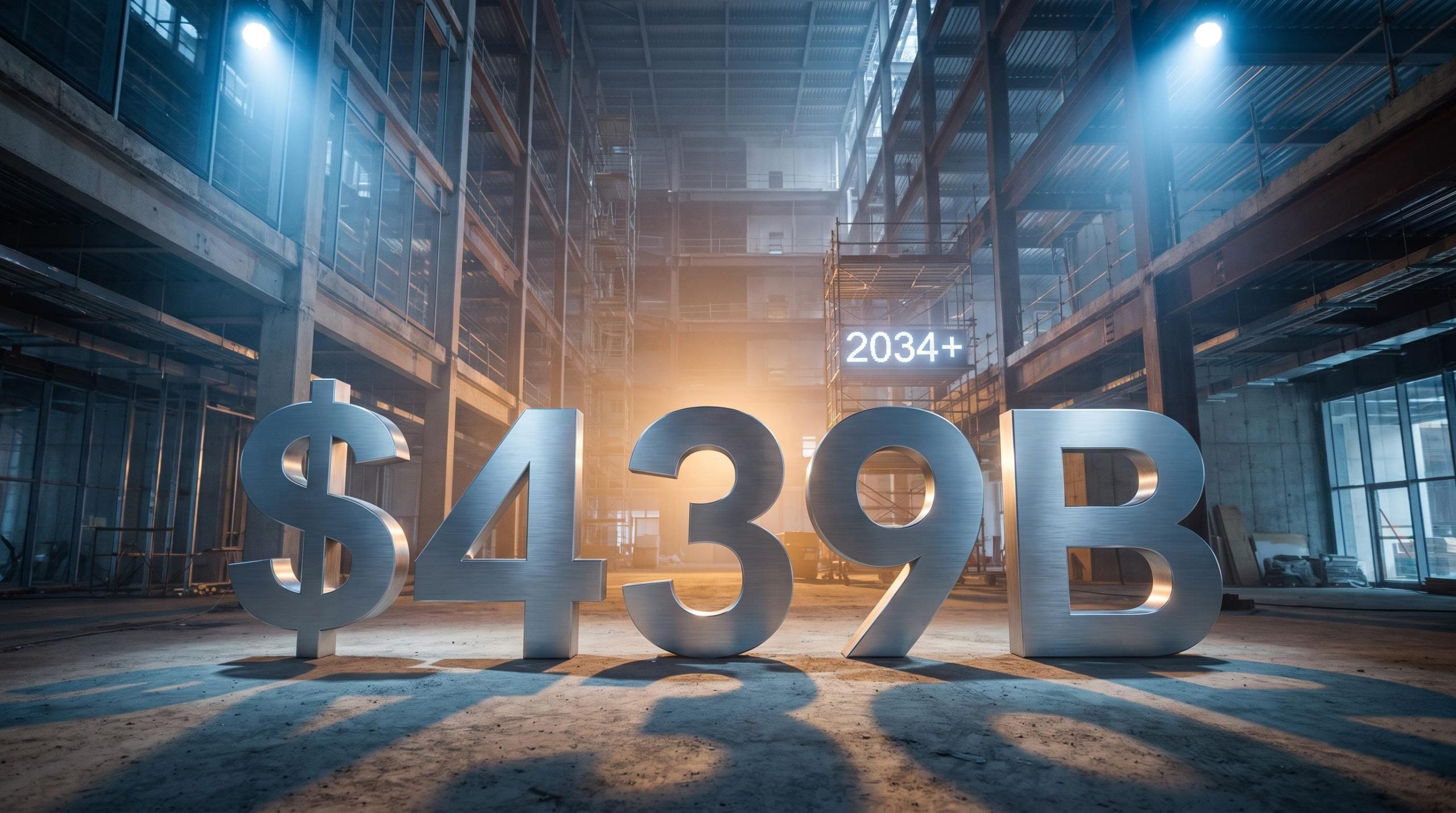
The headline number is $439 billion. It is not cash sitting in an account, and it is not revenue the company has earned. It is the total value of contracted commitments from enterprise clients for future data-centre capacity, a promise of payment against facilities that, in most cases, do not yet exist.
The timing is where the number gets interesting. Roughly $357 billion of that $439 billion total is projected to be recognised in 2034 or later, according to SB Energy’s filing. That means the majority of the backlog value sits more than eight years out from today.
SB Energy holds 8.8 GW of contracted data-centre capacity underpinning those commitments. Set the backlog against current sales and the multiples turn almost comic: more than 180 times annualised first-half 2026 revenue, and more than 3,100 times the actual first-half figure.
GuruFocus put the caution plainly, warning that investors should not mistake future contracts for cash in the bank. Value Add VC framed it more vividly.
The backlog is “a construction schedule with a dollar sign.”
That is the correct mental model. A backlog of this magnitude is a claim on future revenue streams, not a bank balance. The 2034-plus recognition date means anyone buying into this offering is being asked to discount eight-plus years of execution risk, interest-rate variability, and technology change into today’s price. That is the single most important thing to understand before anything else in the deal makes sense.
The $178 billion build-out that still needs to be financed
Turning that backlog into revenue requires building the facilities, and that is not cheap. SB Energy estimates the associated capital expenditure at approximately $178 billion, roughly $174 billion for data centres and $4 billion for power, measured from 30 June 2026.
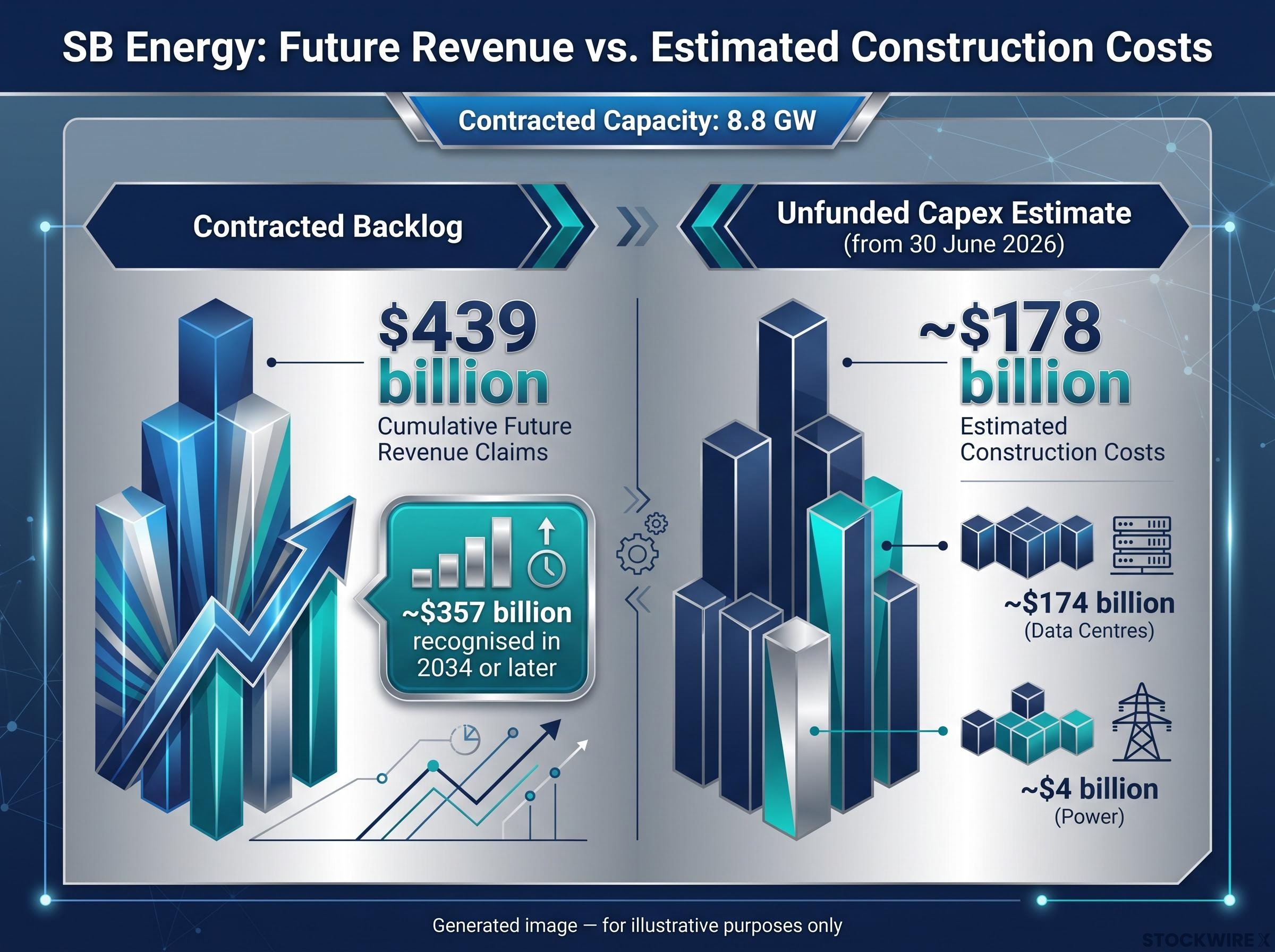
Here is the distinction that matters. That $178 billion is an internal company estimate, not a line of committed project financing. No lender has signed off on the full figure; it is what management calculates the build will cost, not money that is secured.
| Metric | Figure |
|---|---|
| Total contracted backlog | $439 billion |
| Backlog recognised 2034 or later | ~$357 billion |
| Associated capex (data centres) | ~$174 billion |
| Associated capex (power) | ~$4 billion |
| Contracted capacity | 8.8 GW |
The tension sits right there. A $50 billion IPO valuation implies the market is already pricing the backlog at a steep discount to its face value, which is rational. But that discount still has to absorb $178 billion of construction that has not yet been funded, and the terms on which SB Energy raises that money will shape everything.
When big ASX news breaks, our subscribers know first
How Nvidia and OpenAI restructured the risk profile of this offering
Two names carry most of the credibility in this deal, and neither is playing a single, simple role. Peel back the commitments and you find a structure deliberately engineered to make an unfundable project feel financeable.
Start with Nvidia. It is performing three distinct functions here, and conflating them is where investors get the risk profile wrong.
Nvidia’s capital partner model, in which the chipmaker uses its balance sheet to pre-finance demand for its own hardware, was taking shape before the IPO filing landed, with early reporting flagging materially different guarantee figures and no confirmed commitment from any party.
- Equity investor: committing $3 billion across two tranches of Class N non-voting shares.
- Residual value guarantor: providing up to $105 billion in credit support covering roughly 4.25 GW at the Ohio PORTS-Pike campus.
- Technology infrastructure supplier: the chipmaker underpinning the compute capability the whole project is built to house.
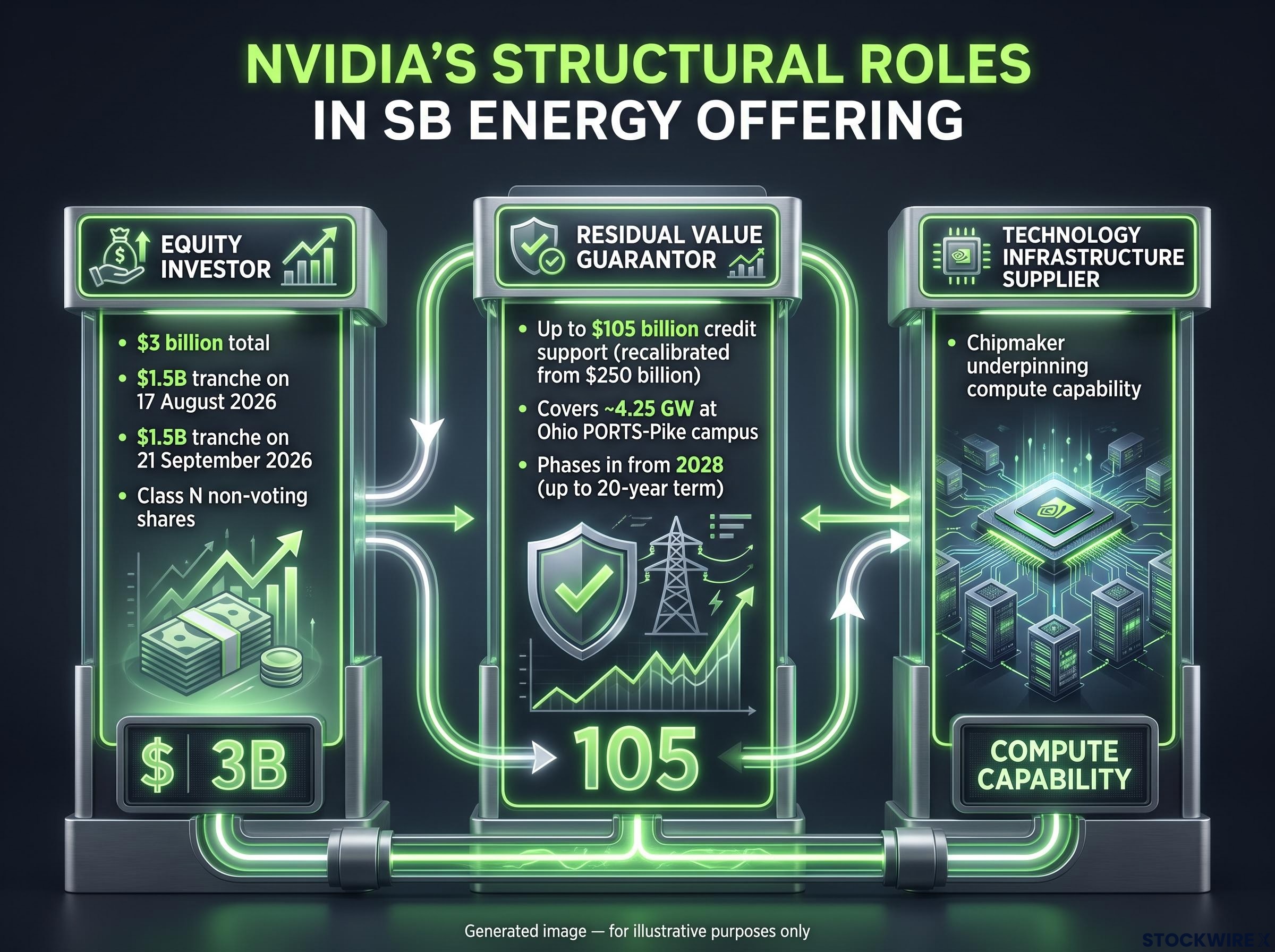
The equity came in two moves. The first $1.5 billion was announced on 17 August 2026. The second $1.5 billion followed on 21 September 2026, structured as newly issued Class N non-voting shares combined with a prepaid forward contract priced at 90% of the eventual IPO price. Both tranches are contractually agreed but contingent on the IPO closing rather than fully funded as of the filing.
The $105 billion guarantee: what it covers and what it does not
The residual value guarantee is the load-bearing element, and it is widely misread as a promise to fund construction. It is not.
According to TradingView’s analysis, the guarantees phase in as nine data centres enter service beginning in 2028, run up to 20 years from lease commencement, and are triggered only in specific circumstances such as tenant default or insolvency. In plain terms, Nvidia is not writing a cheque for the build; it is backstopping the value of the assets if the tenant walks away after leases begin.
That distinction changes what the guarantee actually does. It functions as a credit-support mechanism, letting SB Energy secure project financing against assets that will not generate a dollar of revenue until 2028 at the earliest. Analyst Hiroki Miyano framed it as Nvidia’s balance sheet functioning as collateral to enable early financing, which is exactly right.
It also tells you something about how both sides read the risk. Earlier coverage cited guarantee figures as high as $250 billion before the structure was trimmed to the current $105 billion cap. A renegotiation of that size signals both parties recalibrated their exposure downward before committing.
The guarantee renegotiation is not an isolated data point: Nvidia has now scaled back a major OpenAI financial commitment twice in under a year, and the market’s near-flat response on high volume suggests investors separated the balance-sheet backstop question from Nvidia’s underlying hardware demand thesis.
Then there is OpenAI, the primary tenant and holder of roughly $5.5 billion in warrants. Its role is not supporting; it is foundational, and the prospectus does not hedge on this.
The broader AI infrastructure investment case, which points toward power grids, data centres, and capacity suppliers rather than model developers, gains force from OpenAI’s own financials: $13 billion in 2025 revenue set against a $20 billion operating loss, a trajectory that raises legitimate questions about the tenant creditworthiness underpinning SB Energy’s backlog.
SB Energy is “substantially dependent” on OpenAI, and “our near-term revenues, project-level financing arrangements, and development plans are significantly linked to OpenAI’s continued performance under our lease and related agreements.”
Read that carefully and the implication is stark. If OpenAI defaults before any data centre comes online in 2028, the guarantee protects asset value, but the revenue thesis that justifies the whole valuation evaporates. Nvidia and OpenAI are not passive stakeholders here. Their financial health and strategic continuity are embedded, non-optional risks in any position you take in this offering.
How markets have historically valued long-duration infrastructure, and where SB Energy fits
None of this is as exotic as it first appears. Markets have financed and valued long-duration infrastructure on contracted future cash flows, not current earnings, for decades.
Power plants get built against 20-year offtake agreements. Renewable developers raise capital against multi-decade power purchase agreements. Data-centre REITs (real estate investment trusts, companies that own and lease income-producing property) are valued on the leases they hold, not last quarter’s profit. Names such as NextEra Energy, Clearway Energy, Digital Realty, and Equinix are the established reference points for exactly this kind of valuation.
The mechanism applied to SB Energy is a discounted cash flow model. You take the contracted revenue stream, apply a discount rate that accounts for time and risk, and derive a present value. The logic runs in three steps:
- Establish the contracted revenue stream from long-term leases backed by creditworthy tenants.
- Apply a discount rate that reflects the time value of money and the probability the cash flows actually arrive.
- Derive the present value, which becomes the basis for the valuation.
That is precisely how investors price a portfolio of 20-year power purchase agreements, and it is the framework SB Energy’s institutional backers are using.
| Peer | Asset type | Cash flow basis | Development stage |
|---|---|---|---|
| Digital Realty / Equinix | Data-centre REIT | Existing lease income | Operational |
| Clearway / NextEra | Power infrastructure | Long-term PPAs | Operational |
| AES | Power generation | Contracted capacity | Operational |
| SB Energy | Hybrid AI infrastructure | Contracted backlog (2034+) | Development stage |
Where the analogy breaks is scale and stage. SB Energy is a hybrid of a data-centre REIT and a power yield vehicle, but with AI-native tenants and no operational capacity yet, a structure with no direct public-market precedent at this size. The target valuation of roughly $50 billion-plus implies more than 180 times annualised first-half revenue, a multiple that only holds if the backlog cash flows are treated as near-certain.
GuruFocus adds a wrinkle worth knowing: SB Energy’s valuation is tied to SoftBank’s net asset value, and the IPO aims to narrow SoftBank’s roughly 49% NAV discount by surfacing the backlog’s value. The company also cites data that 92% of firms plan to increase AI spending over the next three years, its case for durable demand.
If you have ever evaluated a renewable yieldco or a data-centre REIT, the valuation logic here is familiar. But the development-stage status and the sheer scale push it into territory where peer multiples offer limited guidance, and the discount rate you apply to those 2034 cash flows determines almost everything about whether the price is sane.
The concept of equity duration explains why the discount rate applied to 2034 cash flows matters so much: a one-percentage-point rise in that rate cuts far more from a cash flow due in ten years than from one arriving next quarter, and the sensitivity compounds with every additional year of deferral.
The concentration risks that could unwind the entire investment case
Strip away the framework and look at what has to remain true, all at once, for the thesis to hold. This is less a disclaimer list than a stress test, because the dependencies are stacked so tightly that a single failure cascades through the rest.
Start with tenant concentration. According to Reuters Breakingviews, all 8.8 GW of contracted data-centre capacity is leased to either SoftBank or OpenAI. That is a two-tenant dependency at a scale with no infrastructure precedent, and one of those tenants is OpenAI, on which the prospectus admits SB Energy is “substantially dependent.”
Then there is SoftBank, which wears so many hats the related-party structure becomes a risk in itself. It occupies five roles simultaneously:
- Controlling shareholder
- Ultimate parent
- Major customer
- Guarantor
- Trademark licensor, collecting 1% of consolidated gross profit
That density complicates governance and valuation, because SB Energy is less an independent company than an extension of SoftBank’s capital allocation strategy.
The execution and financing risks are equally concrete. The $178 billion capex gap is unfinanced, and building at this scale invites a familiar set of failure points:
- Financing gap on the ~$178 billion build-out
- Grid-connection delays
- Equipment supply constraints
- Permitting challenges
- Construction cost inflation
There is a credit-market signal worth flagging too, with a caveat. Some reporting suggests investors in SB Energy-linked debt have demanded yields around 10%, though this figure is unverified and should be treated with caution. If accurate, it would imply credit markets view the risk as closer to junk-rate infrastructure despite the long-term contracts. Layer on the prospectus’s own warnings about technology obsolescence, regulatory change, and community opposition to data centres, and the picture sharpens.
Reuters Breakingviews argues the giant IPO is “getting ahead of itself.” AInvest is blunter still, contending the “$50 billion IPO prices the dream, not the math.”
The concentration in two tenants who are also equity holders, credit supporters, and strategic partners is not automatically disqualifying. But it means an SB Energy investment is inseparable from a view on OpenAI’s long-term financial health, and most retail investors have no visibility into that risk before committing capital. Understanding the dependency web is not pessimism. It is the minimum diligence required before treating the $439 billion backlog as a signal rather than a marketing figure.
Making sense of SB Energy on terms that hold regardless of the IPO outcome
Here is the analytical core, stripped down. The case rests almost entirely on revenue that begins recognising in 2034 or later, and it demands simultaneous confidence in four separate things: OpenAI’s commercial durability, Nvidia’s guarantee performance, SoftBank’s governance discipline, and SB Energy’s construction execution. Remove any one and the structure strains.
The framework institutional investors appear to be using is worth internalising, because it reframes the whole offering.
Treat SB Energy as a long-duration infrastructure bond with equity upside, priced at a discount to the backlog’s present value rather than against current earnings.
That lens explains the interest. It also explains the international appetite: a Japanese investor tranche of up to $500 million and a US primary raise of $5-7 billion signal that sophisticated capital finds the structure investable, even at a $50 billion-plus valuation with $357 billion of backlog sitting beyond 2034 and $178 billion of capex to finance.
Three variables will resolve the bull-bear debate long before 2034:
- Whether SB Energy secures project financing at workable rates.
- Whether the first Ohio PORTS-Pike data centres come online on schedule in 2028.
- Whether OpenAI’s commercial trajectory sustains the lease structure.
If all three resolve positively, the backlog may justify today’s valuation with room to spare. If any one fails, the cascading effect on the financing stack means the downside is not a haircut but a restructuring. That asymmetry, not the headline backlog, is what you are actually pricing.
SB Energy is not a conventional growth stock, and it is not a conventional infrastructure play. It is a structured bet on the intersection of AI demand, long-duration capital markets, and a handful of relationships. Knowing exactly what those relationships must deliver, and by when, is the starting point for any rational position.
This article is for informational purposes only and should not be considered financial advice. Investors should conduct their own research and consult with financial professionals before making investment decisions.
Past performance does not guarantee future results. Financial projections are subject to market conditions and various risk factors. Certain figures cited, including debt yield estimates, are unverified and speculative, and are subject to change based on market developments and company performance.