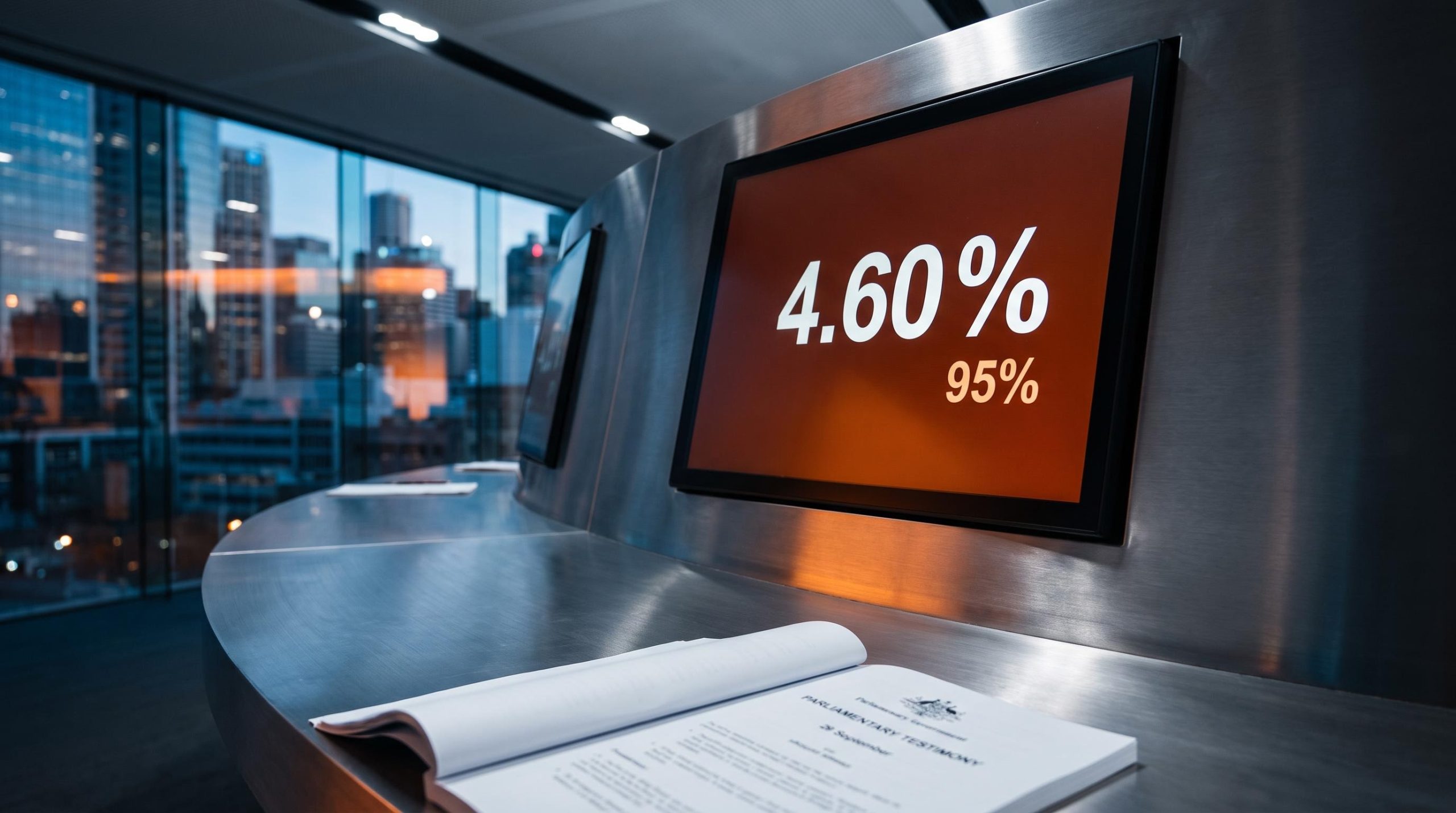
Money markets are treating a 25-basis-point hike from the Reserve Bank of Australia (RBA) on 29 September as close to a done deal. The pricing is near-unanimous, but the decision itself is anything but mechanical.
It is the product of a specific set of inflation readings, geopolitical shocks, and a central bank that has already lifted rates three times this year and is now weighing whether a fourth move is warranted now or simply premature.
With the cash rate sitting at 4.35% and the RBA openly flagging upside inflation risks tied to the Middle East conflict and the artificial intelligence (AI) boom, this meeting carries unusual weight. A move to 4.60% would take rates to their highest since around 2011, placing the RBA among the more aggressive tighteners still active in advanced economies.
This piece unpacks what the market pricing actually reflects, what RBA officials have said and why it matters, where the genuine uncertainty sits, and what a hike (or a surprise hold) would mean for Australian mortgages, housing values, and the dollar. Here is what the data tells you about where policy is heading, and what it costs households.
How certain is September 29, and what the pricing actually tells you
The convergence is the first thing worth noticing. Across separate data providers, money markets are pricing a September hike at somewhere between 93% and 95%, a level of agreement that leaves almost no room for surprise in either direction.
Reuters put the implied probability at 93% on 18 September 2026. LSEG data reported by PerthNow lifted that to 95% by 21 September. Prime Terminal data sat in between at 94%.
| Source | Date | Probability | Implied Cash Rate |
|---|---|---|---|
| Reuters | 18 September 2026 | 93% | 4.60% |
| Prime Terminal | Mid-September 2026 | 94% | 4.60% |
| LSEG / PerthNow | 21 September 2026 | 95% | 4.60% |
Read that consensus for what it is: not certainty, but the market’s best interpretation of the available signals. When pricing runs this hot, the September call has effectively been made, and the more interesting disagreement sits further out on the curve.
That is where the picture fragments. Swaps markets tracked by TradingEconomics implied a lower 85% to 87% chance of a September increase, but crucially, they priced at least two further hikes by the February 2027 meeting.
According to TradingEconomics swaps data on 21 September 2026, markets had priced in at least two additional rate hikes by the RBA’s February 2027 meeting, anchoring a forward path that extends well beyond the immediate decision.
Beyond September, the conviction thins. Money markets assigned a 37% to 44% probability to a follow-up hike in November or December 2026, and just a 17% chance of another move by May 2027.
For anyone weighing a mortgage or repositioning a portfolio, that distribution is the real story. September is close to settled; the question of how much further the RBA still needs to travel is not.
When big ASX news breaks, our subscribers know first
What the RBA has said, and why Governor Bullock’s testimony shifts the calculus
The strongest signal did not come from a swaps curve. It came from the central bank itself, in front of parliament, a week before the decision.
Governor Michele Bullock told a parliamentary committee on 18 September 2026 that inflation remains too high and that the upside risks the board had flagged are now materialising. She named the culprits directly: the Middle East conflict and the AI boom, both pushing global and domestic prices higher.
RBA Governor Bullock’s parliamentary opening statement set out the board’s reasoning in direct terms, identifying the Middle East conflict and the AI boom as the primary upside risks now materialising, and framing the September decision around whether three prior hikes are sufficient to return inflation to the 2-3% target band.
Her framing of the decision matters more than the observation itself.
Governor Bullock framed the 29 September decision as turning on a single question: whether the three rate hikes delivered so far this year are sufficient to return inflation to the RBA’s 2-3% target band.
That is not standard central bank hedging. When a governor stands before parliament and specifically identifies geopolitical and structural drivers of inflation seven days out from a meeting, treat it as a public justification for action rather than routine communication. It shifts the burden of proof squarely onto anyone still arguing for a pause.
The supporting data reinforced her case. Commonwealth Bank of Australia (CBA) estimated trimmed-mean inflation, the RBA’s preferred underlying measure that strips out the most volatile price movements, was tracking at 0.9% in the September quarter against the RBA’s implied 0.8%.
Trimmed mean inflation is the RBA’s preferred policy signal precisely because it removes transitory noise: at 3.3% for consecutive quarters in 2026, it has been the consistent driver of each successive hike, sitting above the 2-3% target band even as headline CPI fluctuated with fuel and administered price changes.
What the assistant governor’s language adds to the picture
Assistant Governor Sarah Hunter echoed the concern, but with a sharper edge. She indicated the policy board is worried inflation has stayed elevated for long enough that it risks becoming embedded in price-setting behaviour.
That phrasing changes the nature of the problem. A cyclical inflation spike fades as demand cools; inflation that becomes embedded in how firms set prices and how workers negotiate pay is far harder to dislodge.
For the reader, Hunter’s language signals that the RBA no longer views this as a passing data point. It sees a structural risk, and structural risks tend to justify sustained action rather than a single move followed by a pause.
The case for a pause, and why most analysts have moved past it
The argument for holding in September was never irrational. It rested on timing and caution, and until late in the cycle it had genuine support.
Analysts favouring a hawkish hold, including Guardian economist Bui and earlier positions inside CBA and Westpac, argued the RBA should wait for the full October quarterly inflation update before committing. Westpac’s Leading Index commentary added weight, flagging soft growth momentum and the risk of overtightening before the effect of earlier hikes had fully worked through the economy.
The demand environment the RBA is navigating includes the weight of a per capita economic contraction already underway: per capita output fell roughly 0.7% across 2025 while corporate insolvencies hit their highest level since the 1990-91 recession, adding a growth-risk dimension to the inflation calculus that the pause camp had cited before July’s CPI reading shifted consensus.
Then July’s inflation data landed, and the consensus moved almost as one.
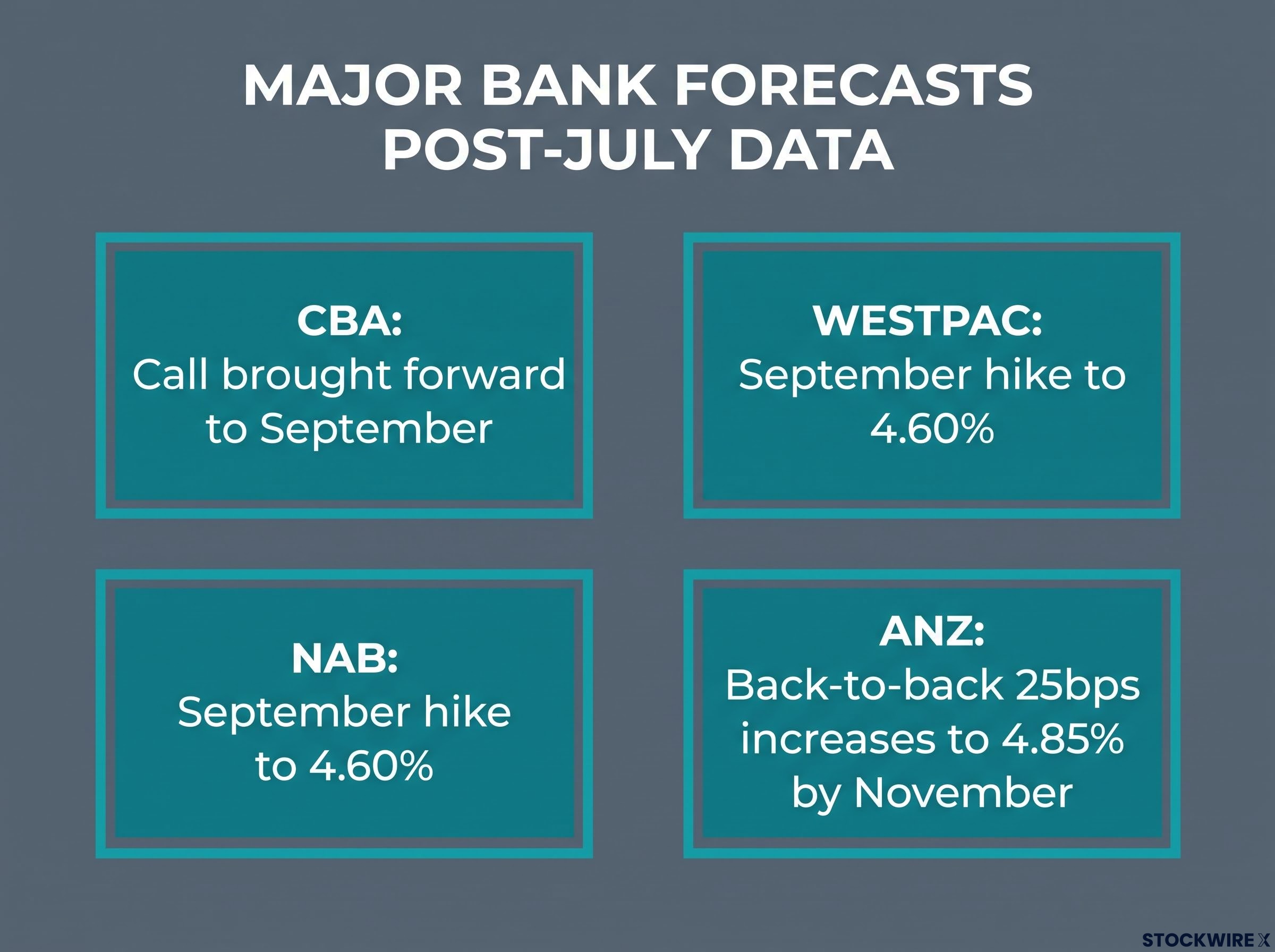
- CBA brought its call forward from November to September. Economist Belinda Allen pointed to trimmed-mean inflation running ahead of the RBA’s implied pace as the trigger.
- Westpac and NAB converged on a September hike to 4.60%.
- ANZ went furthest, forecasting back-to-back 25-basis-point increases to 4.85% by November, citing persistent inflation and limited slack in the labour market.
- Deutsche Bank expected a September move, with chief economist Phil O’Donaghoe describing underlying price growth as “intolerably high.”
- The International Monetary Fund (IMF) flagged that the RBA may need further hikes, and stressed that fiscal restraint is also required, not monetary tightening alone.
Deutsche Bank chief economist Phil O’Donaghoe characterised underlying price growth as “intolerably high,” a striking assessment that captures why the pause case lost its footing.
The speed of that shift is itself a signal. The pause argument was not talked down by sentiment or momentum; it was displaced by a specific inflation reading that the RBA has publicly confirmed it is watching.
That distinction helps you gauge the odds of a surprise hold more accurately. The case for waiting did not collapse under vague pessimism. It was undercut by hard data the central bank has already told you it cares about, which is why it has become so hard to sustain.
What a 4.60% cash rate means for mortgages, housing, and the dollar
Strip away the swaps curves and the testimony, and a hike to 4.60% lands in one place: the household budget.
CBA data shows scheduled mortgage repayments as a share of household disposable income are already near their 2024 peak. Push the cash rate higher and that pressure intensifies, with a move to 4.60% cutting the borrowing capacity of a median-income household by roughly $18,000.
| Metric | Current Position | Projected Impact at 4.60% |
|---|---|---|
| Median household borrowing capacity | Baseline at 4.35% | Reduced by approximately $18,000 |
| Mortgage repayments (share of disposable income) | Near 2024 peak | Further upward pressure |
| National housing prices vs March 2026 peak | Roughly 1.5% below peak | Continued weakness (KPMG) |
| AMP home value forecast | Prices already easing | Around 10% fall from peak over 6-9 months |
The property market has already turned. National housing prices sat roughly 1.5% below their March 2026 peak as of August, and KPMG expects the softness to persist through the rest of the year.
The property weakness the RBA is monitoring extends beyond the 1.5% pullback from March peak: Morgan Stanley’s analysis of the housing market correction projected a fall of up to 10% by end-2027 and triggered a 4% earnings downgrade for ASX bank stocks, illustrating how rate pressure transmits through credit quality as well as valuation.
AMP chief economist Shane Oliver anticipates average home values could fall by around 10% from their recent peak over the next six to nine months, driven by higher borrowing costs, a weak economy, and tax changes.
The RBA is watching the same downturn, but reads the systemic risk as contained. Governor Bullock acknowledged the housing market has softened more than expected and poses a downside risk to activity, yet argued financial-stability risks remain manageable because borrowers have built up savings buffers.
That read matters for how far the bank is prepared to go. Challenger chief economist Jonathan Kearns noted that property weakness is unlikely to stop the RBA delivering a fourth hike. In other words, softening prices alone will not buy borrowers a reprieve.
For anyone holding a variable-rate mortgage or property exposure, 4.60% is not a macro abstraction. It means higher monthly repayments, less borrowing headroom, and continued downward pressure on values in a market already below its peak.
The Australian dollar and what the September decision means for FX
The currency has been the quieter beneficiary of all this tightening talk. The AUD/USD traded at 0.7124 on 21 September 2026, holding a narrow 0.7123-0.7126 band, supported around the 0.71 level by expectations of further RBA action.
The outcome here is close to binary. Deliver the hike with hawkish guidance and the dollar likely stays firm; a surprise hold would reprice it lower as the rate gap with global peers narrows.
Global sentiment has helped. An anticipated Trump-Xi diplomatic meeting and signals of US-Iran engagement lifted risk appetite, and on the Iran news WTI crude fell more than 3.60%. That decline eases one inflation input for the RBA, even as the pressures Bullock named persist elsewhere.
What September 29 settles and what it leaves open
Whatever the RBA decides, the September meeting resolves a narrow question, not the broader one. It answers whether a fourth 2026 hike comes now or later. It does not tell you where the tightening cycle ends.
Three hikes have already been delivered this year. September would make four, and ANZ’s back-to-back forecast points to 4.85% by November, a level that edges toward pre-GFC territory.
The distribution of post-September outcomes matters as much as the September call itself: a higher-for-longer rate environment extending toward 2028 is what the RBA’s own published forecasts describe, and positioning purely for a near-term peak requires betting directly against those projections.
Three variables will shape the path from here:
- The October quarterly CPI print, the next major inflation reading, available before the November meeting.
- Labour market slack data, which will show whether demand is cooling enough to ease price pressure.
- Whether the geopolitical inflation drivers Bullock cited, the Middle East conflict and the AI boom, intensify or fade.
The market has not closed the question either, still pricing a 37% to 44% chance of a November or December follow-up. The IMF, for its part, argues monetary tightening alone will not do the job and that fiscal restraint is also required.
For anyone managing variable-rate debt or holding rate-sensitive assets, the practical takeaway is this: treat 4.60% as a floor scenario, not a ceiling. A September hike settles the near-term uncertainty; it does not confirm the peak.
The common post-announcement mistake is assuming a delivered hike means the cycle is over. The data and the pricing both suggest the RBA is keeping its options open well into 2027.
This article is for informational purposes only and should not be considered financial advice. Investors should conduct their own research and consult with financial professionals before making investment decisions. Past performance does not guarantee future results. Financial projections are subject to market conditions and various risk factors, and forward-looking statements are speculative and subject to change based on market and economic developments.