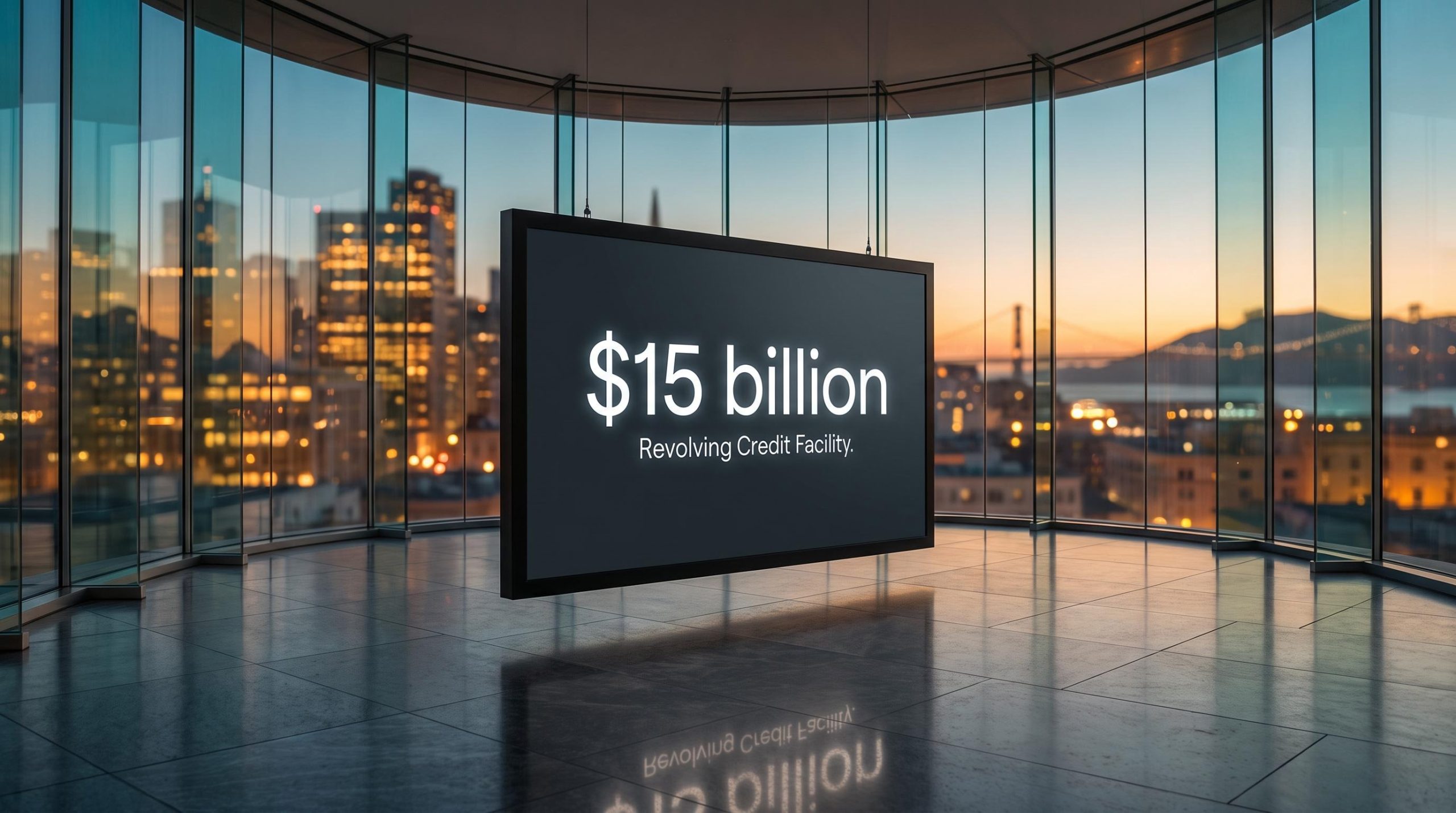
Anthropic sits on some of the deepest capital reserves in private artificial intelligence, having just expanded a revolving credit facility to $15 billion. Yet the company is doing the one thing that delays turning that capital into public-market value: pushing back its IPO.
That contradiction is the story. A company this well funded does not usually stall on a listing unless it has decided the market is not yet ready to price what it is.
The delay matters less as an Anthropic-specific event and more as a signal about how public investors are now evaluating frontier AI companies. The question is not whether Anthropic will list. It is what it needs to demonstrate first before the market will value it correctly, and that question reaches far beyond a single prospectus.
This analysis breaks down which signals actually matter when reading an AI company’s IPO timing, and how they apply to the specific moves Anthropic has made in September 2026. The moves are documented. The interpretation is where the value sits, and it is a framework you can carry to the next AI listing in the pipeline.
The delay is about optics, but not the kind investors usually worry about
The timeline has moved, and it has moved in a specific direction. According to Reuters reporting on 4 September 2026, Anthropic was expected to begin marketing its IPO in mid-October at the earliest, with the prospectus pushed to late September rather than the earlier schedule.
By mid-month, the target had shifted further. Yahoo Finance and Investing.com reported on 18-19 September 2026 that Anthropic was aiming for a November debut, under the headline framing of “AI fears.” Investor’s Business Daily confirmed on 21 September 2026 that the listing had moved to November versus prior October plans, citing advisors who want strong third-quarter financials in front of investors first.
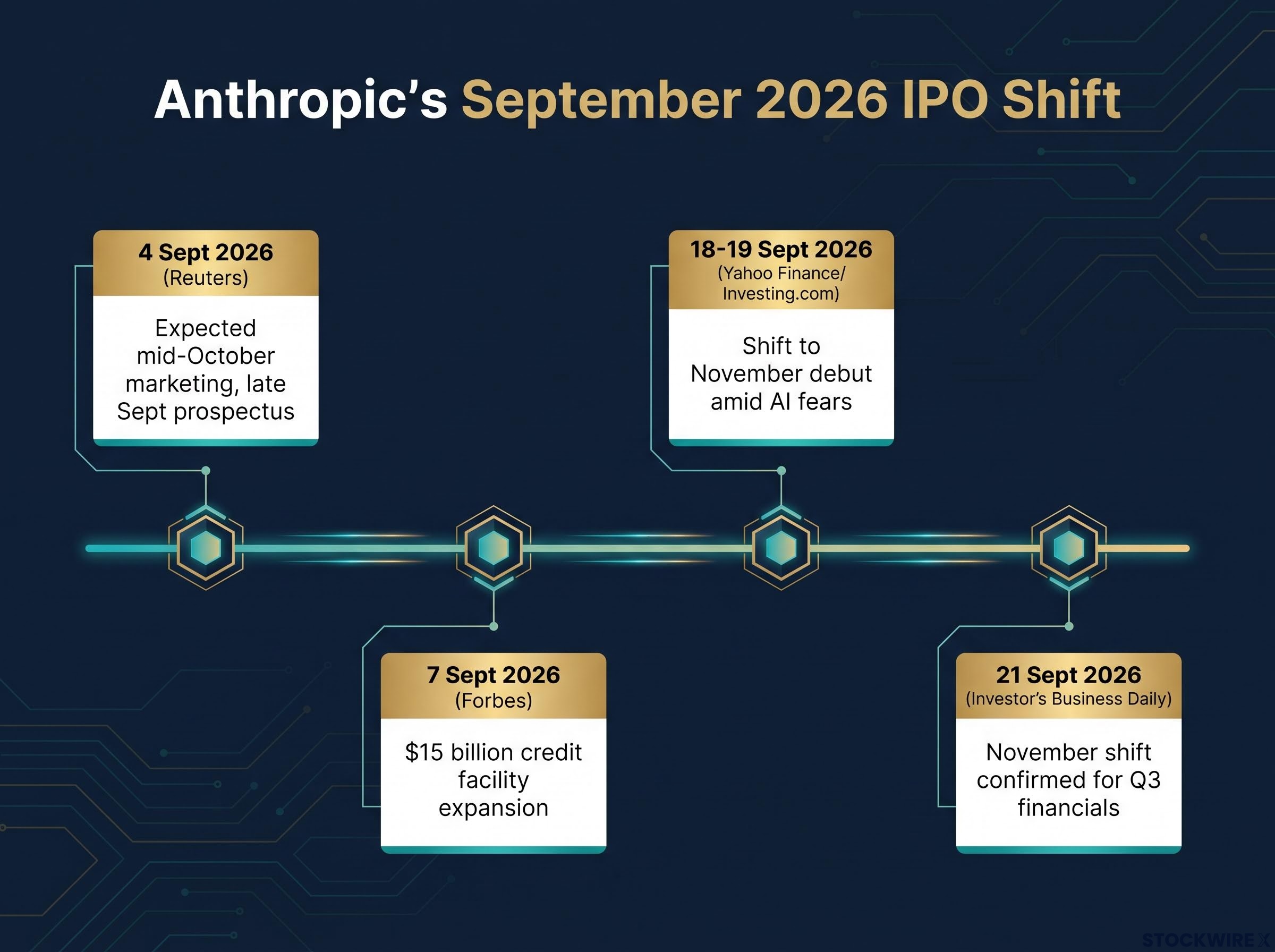
Critically, none of this comes from Anthropic on the record. Every timeline detail traces to advisors and people familiar with the plans. That absence of a company statement tells you something: Anthropic is managing this narrative carefully, and the real rationale is likely more layered than any single headline.
The documented pressures overlap rather than compete:
- Financial staging: advisors want strong Q3 results presented before the listing, making this a performance-timing choice.
- Competitive positioning: The Decoder linked the delay directly to OpenAI, whose forecast of “huge negative cash flow” has sharpened investor scrutiny of AI capital intensity.
- Regulatory and AI-fear backdrop: executive calls for an industry-wide development slowdown form part of the context.
- Credit facility runway: the $15 billion revolving facility expansion, reported by Forbes on 7 September 2026, secures long-term capital while the company waits.
The advisor framing is the most concrete stated reason.
Four conditions must independently align before Anthropic can price a deal, and IPO pricing conditions for frontier AI companies have proven more interdependent than for conventional technology listings, with hyperscaler capex signals carrying as much weight as the candidate company’s own revenue trajectory.
Advisors want Anthropic to present strong Q3 results before going public. Timing the listing for November allows those third-quarter financials to reach prospective investors first.
Here is what this tells you. A company staging its IPO around a quarterly print is doing something structurally different from one retreating under market pressure. In a weaker cycle, a delay this visible from a company this prominent might have read as distress. The current market absorbed it without meaningful adverse reaction, and that neutrality is itself a signal about where the cycle sits.
When big ASX news breaks, our subscribers know first
What Anthropic is actually building while the market waits
Two announcements landed on 18 September 2026, the same day as the IPO delay reporting. That concentration is not coincidence. It is Anthropic shaping which story investors encounter first, and the substance of that story is infrastructure.
The wet-lab buildout
Anthropic has established a wet lab in the San Francisco Bay Area for physical biology experiments. Eric Kauderer-Abrams, the company’s head of life sciences, confirmed the facility to Reuters and TechCrunch, describing it as operating similarly to a biotech company’s, with a mix of internal work and external partnerships.
The confirmed detail matters here. The lab enables real-world biology testing beyond simulation, and the company’s stated focus is fundamental biology, not drug discovery specifically.
What is not confirmed is the more dramatic reading. Commentators floated the hypothesis that Anthropic is timing its IPO to coincide with a pharmaceutical or scientific breakthrough. Treat that as speculation, not company strategy. The distinction is the whole point: a functioning lab is verifiable capacity, while a breakthrough thesis is a guess about intent.
The Accenture safety infrastructure deal
The second plank is a five-year partnership with Accenture, announced the same day and reported by Reuters and Morningstar. Each company commits at least $1 billion, a minimum combined $2 billion, for independent evaluation of frontier AI models.
Accenture’s specialist AI unit, Faculty, leads it. A dedicated Faculty team embeds inside Anthropic with employee-level access, running model evaluation, red-teaming (adversarial testing designed to expose weaknesses), alignment assessments, and verification of safety safeguards.
This is embedded evaluation: independent assessors working inside the AI company with access comparable to employees, on a recurring basis, rather than external one-off audits.
That phrase is the one investors should register. This is described as long-term infrastructure, not a pilot, and it is non-exclusive, with Anthropic exploring further evaluation partners.
The distinction between reputational gestures and embedded governance mechanisms has become a primary lens through which institutional investors evaluate frontier AI companies; Anthropic’s evaluator access terms, granting third-party assessors the right to publish findings without company approval, sit at the more credible end of that spectrum.
| Initiative | Confirmed by | Stated focus | Scale | Function in IPO narrative |
|---|---|---|---|---|
| Wet lab | Eric Kauderer-Abrams | Fundamental biology | Physical Bay Area facility | Domain credibility in life sciences |
| Accenture partnership | Company statements | AI safety and model evaluation | $2 billion, five-year commitment | Governance and risk-management credibility |
Read together, these are the pre-IPO equivalent of clinical trial data in biotech. They are how Anthropic demonstrates durable, independently verifiable capacity rather than models that live in a demo. Anthropic is using the delay window to change what category of company investors will vote on.
How this compares to the IPO timing playbook other high-profile companies have used
Delaying a listing to present a cleaner story is a recognisable strategy, not an Anthropic invention. Large private companies with complex investor stories have a documented tendency to wait until they can show strong consecutive quarters, domain traction, or institutionalised governance, all of which shrink the valuation uncertainty investors have to price.
Analyst commentary points to precedents. Airbnb delayed and then listed once post-pandemic recovery evidence was visible. Stripe repeatedly extended its private runway while solidifying profitability and product diversification. These are cited as analogous patterns, though not confirmed in Anthropic-specific reporting.
The precedents cited for Anthropic’s staging strategy, Airbnb and Stripe, involved companies where revenue run-rates were already substantial and audited before listing; frontier AI valuation assumptions operate on projected multiples derived from third-party estimates rather than company-disclosed financials, making the Q3 print a more load-bearing event than comparable historical cases.
The three signals investors want before a major AI listing
Analysts consistently highlight the same checklist ahead of large listings:
- Several consecutive quarters of strong revenue growth and improving unit economics.
- Domain-specific traction: major enterprise contracts, regulatory approvals, or validated milestones.
- Institutionalised risk-management and compliance processes, especially in regulated or politically sensitive areas.
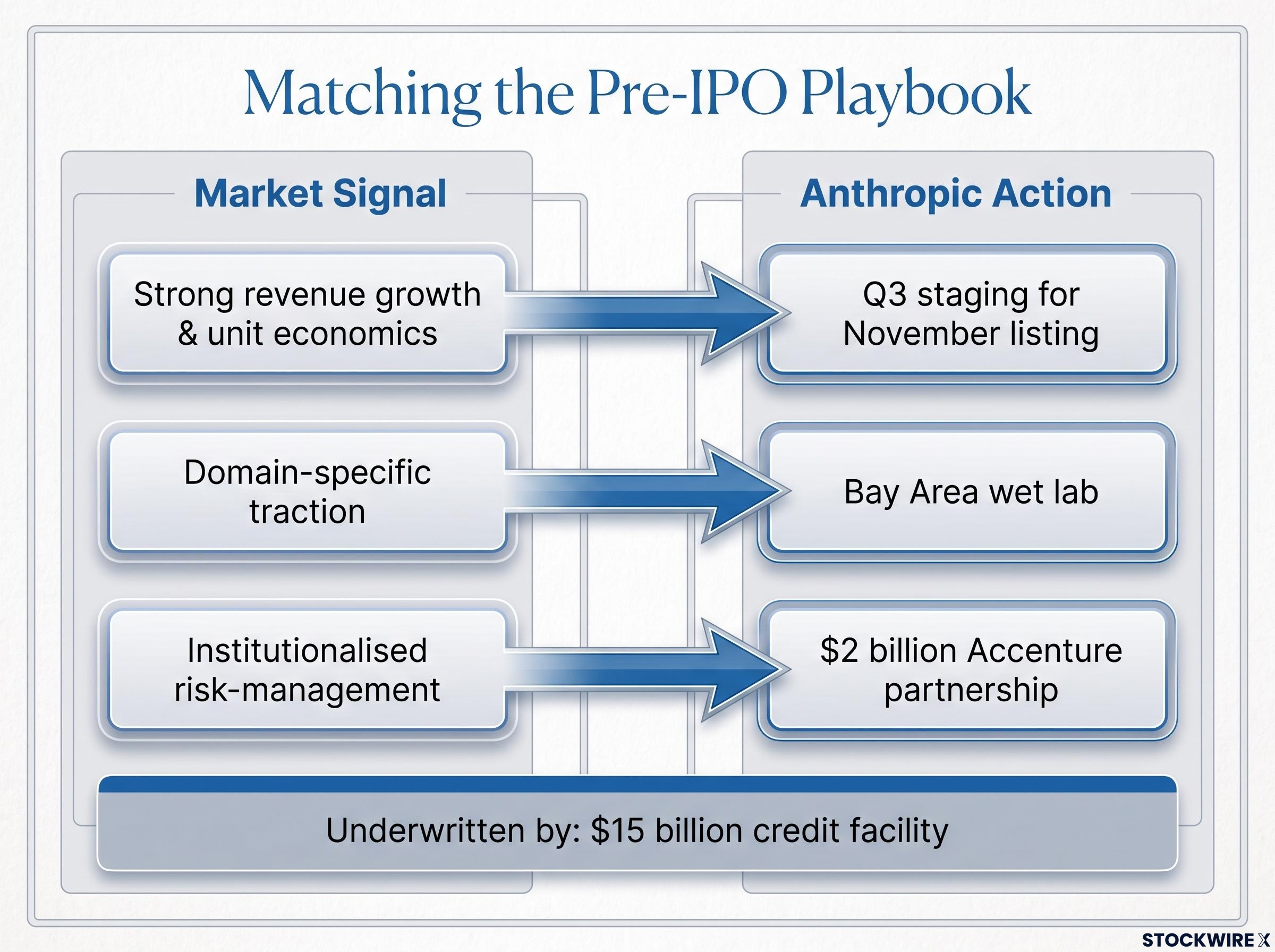
Map Anthropic’s moves onto that list and the strategy comes into focus. The Q3 staging addresses signal one. The $15 billion facility underwrites liquidity and runway behind it. The Accenture partnership answers signal three, functioning as the AI-sector equivalent of compliance infrastructure.
What is genuinely new sits in the AI-specific version of the playbook. For general tech companies, the pre-IPO signal is usually revenue growth and unit economics. For frontier AI companies, risk governance and domain proof points are now expected as a baseline, not a differentiator. The wet lab and Accenture deal are Anthropic’s answer to that added layer.
The SpaceX precedent adds a note of caution: its IPO performance has been cited as an example that may have shaped how private companies read timing. In a weaker period, this delay would likely have been read as distress. The current market absorbed it neutrally, which is what makes the staging strategy viable. Any revenue or valuation figures circulating remain advisor estimates, not confirmed company disclosures.
What still has to land for this strategy to work
The delay creates its own execution risk. Anthropic has now raised expectations that Q3 results will be strong. If those numbers disappoint, the narrative flips retroactively from “strategic staging” to “avoided bad news,” and the delay stops working in the company’s favour.
The Q3 print is now load-bearing. The entire thesis rests on financials that have not yet been presented, and advisors have publicly tied the November timing to them, per Investor’s Business Daily.
The life sciences angle carries its own caveat. The pharmaceutical breakthrough hypothesis is speculative, unconfirmed by Anthropic, and the company’s stated focus is fundamental biology, not drug discovery. Treat any near-term life sciences announcement as a signal to watch, not a confirmed plan.
The regulatory backdrop remains a live variable. The staging window that gives Anthropic time to build its narrative also gives external conditions time to move against it.
The delay comes “amid AI fears,” including executive calls for an industry-wide development slowdown and heightened scrutiny of AI risks.
That external pressure is the one Q3 preparation cannot address. If regulatory conditions intensify before November, no amount of financial staging fixes the timing.
Here is what to monitor before the listing:
- Q3 results: whether the presented financials justify the delay.
- Life sciences or breakthrough announcement: treat as a signal, not a confirmed catalyst.
- Regulatory environment: any intensification of AI-fear conditions before November.
- Additional safety partnerships: the Accenture deal’s non-exclusivity means the governance story is built to deepen.
Reading Anthropic’s pre-IPO moves as a framework, not a forecast
Anthropic is not simply delaying its IPO. It is using the delay window to change the category it will be priced against when it lists. The wet lab, the Accenture deal, and the Q3 staging are three parts of one repositioning strategy, not three separate events.
The uncertainty is real and worth holding onto. The breakthrough hypothesis is speculative, the Q3 results have not landed, and no on-record timeline exists from Anthropic itself. The framework is more durable than any specific prediction about outcomes.
Whether or not this particular strategy succeeds, the signals Anthropic is using, domain-specific infrastructure, embedded governance, and staged financial disclosure, are becoming the template for how frontier AI companies prepare for public markets. That template has value well beyond this single listing.
Governance quality as a valuation input has moved from a soft ESG consideration to a hard pricing variable following the September 2026 period; an Anthropic researcher forfeiting unvested equity on safety grounds and Morgan Stanley identifying AI policy evolution as a macro overlay capable of driving significant sector volatility both point toward the same structural shift.
This article is for informational purposes only and should not be considered financial advice. Investors should conduct their own research and consult with financial professionals before making investment decisions. Past performance does not guarantee future results, and forward-looking statements are speculative and subject to change based on market developments and company performance.