


NHS technology transfer milestone advances ColoSTAT® toward global markets
Rhythm Biosciences (ASX: RHY) announced on 22 September 2026 that the Southern Hub research laboratory, based at Royal Surrey NHS Foundation Trust and part of the NHS Berkshire and Surrey Pathology Services network, has successfully completed the technology transfer of ColoSTAT®, the company’s blood-based bowel cancer detection test.
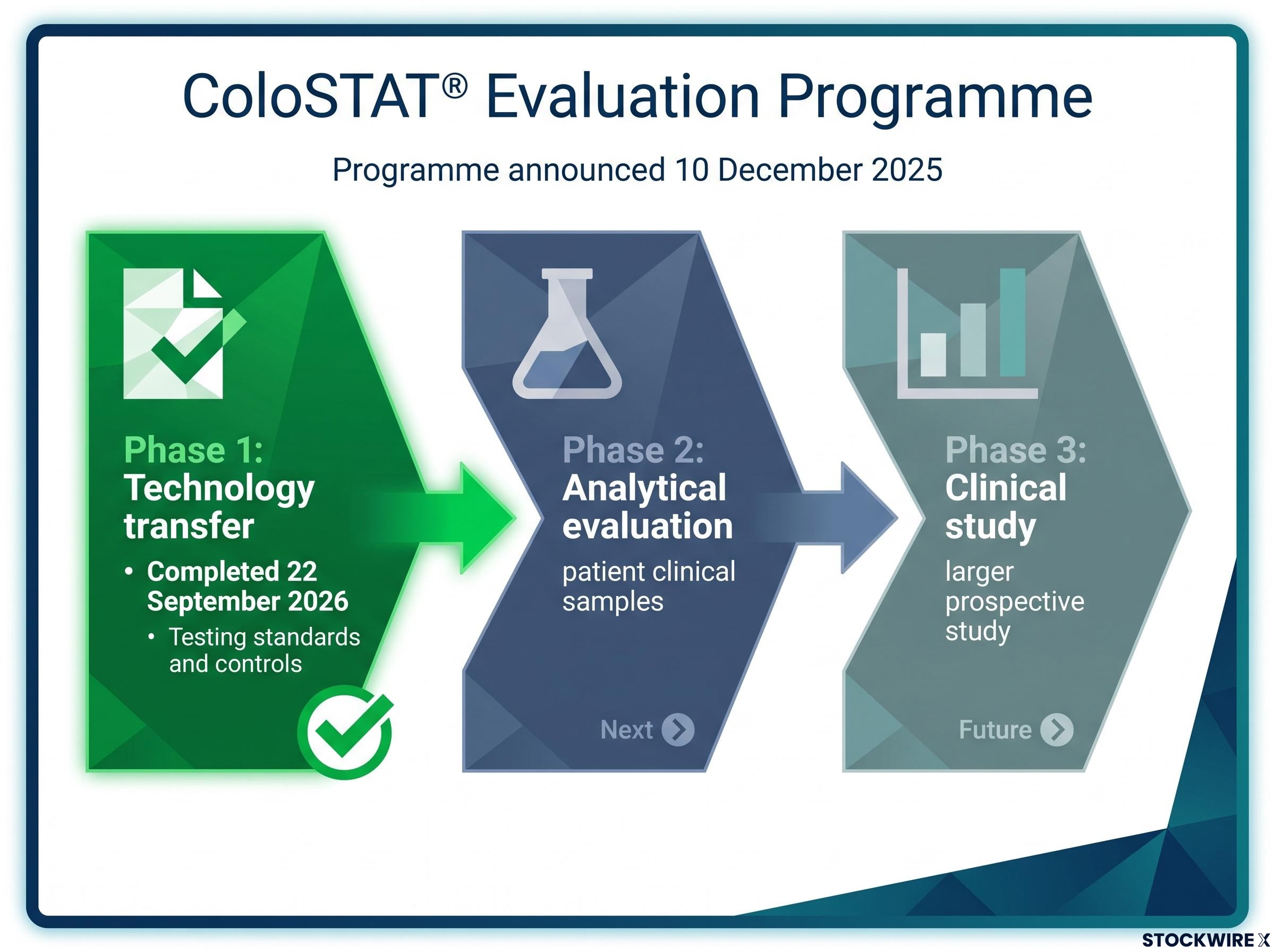
The Hub team is now independently running the ColoSTAT® assay in their own laboratory, using Rhythm’s system and reagents. This completes Phase 1 of the independent evaluation programme announced to the market on 10 December 2025.
Dr David Atkins, CEO and Managing Director
“Getting a new clinical diagnostic running in someone else’s laboratory, to their standards, with their people, is a critical step in taking a test beyond a single laboratory and into new markets. The Hub team, led by Professor Sally Benton, are now running ColoSTAT® themselves, which is exactly what we set out to achieve in this first phase. Attention now turns to the next stage of the Hub’s evaluation,”
When big ASX news breaks, our subscribers know first
What the technology transfer actually means
Technology transfer, in the context of diagnostic testing, refers to the process of establishing a test in a laboratory other than the one where it was originally developed. For any diagnostic intended to run across multiple facilities, it must first be proven that an external team can operate it reliably and consistently using their own people, equipment environment, and quality standards.
Prior to this milestone, ColoSTAT® had been run within Rhythm’s own laboratory. The completion of Phase 1 confirms that an independent, third-party team can establish and operate the assay without direct involvement from Rhythm’s scientists.
The first NHS evaluation of ColoSTAT was initiated in February 2026, just weeks after the December 2025 programme agreement, with the Southern Hub taking on the technology transfer process as the opening phase of a structured multi-stage assessment.
Why this matters for the investment case
This milestone is directly relevant to Rhythm’s stated commercialisation strategy, which centres on laboratory partnerships in international markets. Successful technology transfer is a prerequisite for that model, not a guarantee of it. The company has noted it believes it is now better positioned to pursue additional geographies, subject to local regulatory approvals, reimbursement, and suitable commercial arrangements.
Key points from Phase 1:
- Phase 1 involved the Hub team testing standards and controls (reference samples with known results) supplied by Rhythm
- Demonstrating third-party operability supports Rhythm’s laboratory-partnership commercialisation model and the pursuit of additional international markets
- The company’s strategy targets laboratory partnerships in geographies beyond Australia, contingent on regulatory, reimbursement, and commercial conditions in each market
The road ahead — analytical evaluation and clinical study
Two further phases remain within the evaluation programme. The announcement is explicit that the timing, scope, and outcomes of both phases are determined by the Hub and are outside Rhythm’s control.
- Analytical evaluation: The Hub team will run ColoSTAT® on patient clinical samples in their own laboratory to confirm the assay performs reliably and consistently in their setting. This phase is expected to commence immediately.
- Clinical study: If analytical evaluation succeeds, a larger prospective study would follow, designed to generate independent data on how accurately ColoSTAT® detects bowel cancer in an NHS laboratory setting.
There is no certainty that either phase will be successful, or that the evaluation will result in NHS adoption of ColoSTAT® or any commercial arrangement.
Professor Sally Benton, Consultant Clinical Biochemist and Hub Director
“We are continuously searching for ways to improve our diagnostic pathway for bowel cancer. We are very excited to now have the ColoSTAT® equipment in our laboratory and look forward to the next stages of this project and the results it will generate.”
The scale of the NHS opportunity — and what lies beyond it
The Southern Hub has established research expertise in bowel cancer diagnostics, including prior work that has informed how the faecal immunochemical test (FIT) is used in both screening and symptomatic pathways. This background provides relevant scientific context for evaluating novel biomarker-based tests such as ColoSTAT®.
The NHS Bowel Cancer Screening Programme offers a stool-based test every two years to those aged 50 to 74. Key programme statistics include:
- Approximately 8 million invitations issued in 2024–25, with approximately 65% uptake
- A significant proportion of bowel cancer diagnoses continue to occur through the symptomatic pathway, not the screening route
- The NHS National Cancer Plan contemplates changes to increase the sensitivity of bowel cancer testing, which could place additional pressure on endoscopy capacity
- ColoSTAT® has the potential to play a role in the symptomatic pathway, both as a blood test option for individuals who are unwilling or unable to complete stool-based testing and as a triage tool to help prioritise colonoscopy capacity
Beyond the NHS, Rhythm has framed the completed technology transfer as a foundation for pursuing broader international opportunities. The company estimates the Australian market opportunity at approximately 200,000 tests per year, based on the estimated share of colonoscopies performed annually in Australia that are diagnostic, drawing on data from the AIHW, the Gastroenterological Society of Australia, Cancer Council Australia, and company estimates. Australia is generally considered to represent approximately 2% of the global healthcare market, indicating the potential scale of the international opportunity.
The ColoSTAT commercial rollout in Australia has been progressing in parallel with the NHS evaluation, with 38 blood collection sites activated across Queensland, New South Wales, and Victoria through the 4Cyte Pathology partnership as Rhythm builds domestic test volume alongside its international programme.
| Market | Programme scale | ColoSTAT® role | Status |
|---|---|---|---|
| United Kingdom (NHS) | ~8 million invitations per year (screening); significant symptomatic pathway volume | Symptomatic pathway testing; colonoscopy triage | Phase 1 (technology transfer) complete; analytical evaluation to commence |
| Australia | ~200,000 tests per year (company and industry estimates) | Blood-based diagnostic test; clinical service launched | Commercially launched |
| International (broader) | Australia estimated at ~2% of global healthcare market | Laboratory partnerships in additional geographies | Subject to local regulatory approvals, reimbursement, and commercial arrangements |
Rhythm has stated it will update the market on material developments in accordance with its continuous disclosure obligations.
Don’t Miss the Next ASX Healthcare Breakthrough
Big News Blast delivers FREE breaking ASX healthcare news to your inbox within minutes of release, complete with in-depth analysis. Join 20,000+ investors already staying ahead of the market. Click the “Free Alerts” button at StockWire X to get the next market-moving announcement the moment it drops.