Three hundred and twelve sustainability reports have now landed on ASIC’s desk, and the regulator has just told Australian companies, in plain language, what they got wrong.
This is not a compliance milestone. It is a directional signal. The rules have teeth, the bar is rising, and the first companies through the door have shown everyone else exactly where the tripwires sit.
Australia’s mandatory climate disclosure regime is no longer theoretical. Group 1 entities have already filed their first reports, ASIC reviewed a sample of 40, and on 21 September 2026 the regulator published REP 839 with eight specific action items. Groups 2 and 3 are now approaching their own commencement dates, which means this review speaks to a far larger population than the companies that filed first.
If you are a finance professional, a company director, or a governance practitioner, here is what ASIC found, where companies fell short, and the specific guidance that should shape every sustainability report you prepare from this point forward. This is a negative template you can use before your next lodgement.
What Australia’s mandatory climate disclosure regime actually requires
Before you can understand ASIC’s critique, you need to understand what companies are actually being asked to do, and why the regulator’s findings carry legal weight rather than advisory weight.
The regime operates under the Corporations Act 2001, introduced through Treasury Laws Amendment legislation. It requires large businesses and financial institutions that already lodge financial reports to also lodge a sustainability report, filed alongside the financial and directors’ reports.
Here is the point that changes everything: this is a statutory filing subject to an auditor’s report. It carries the same weight in law and in capital markets as a financial report. It is not a voluntary ESG document you can shape to suit your narrative.
The regime builds on a framework that was already signalling its direction before REP 839 arrived; mandatory climate disclosures under the Corporations Act took effect for Group 1 entities from financial years beginning 1 January 2025, making climate reporting legally enforceable for the first time and establishing the evidentiary standard every subsequent review will hold companies against.
The rollout is phased across three groups, and the dates matter because they determine whether you are already inside the regime or months away from entering it.
| Group | Commencement Date | First Report Period |
|---|---|---|
| Group 1 | Financial years commencing on or after 1 January 2025 | Year ending 31 December 2025 (for December year-ends) |
| Group 2 | Financial years commencing on or after 1 July 2026 | First full year from 1 July 2026 |
| Group 3 | Financial years commencing on or after 1 July 2027 | First full year from 1 July 2027 |
The scale is already substantial. As of 6 May 2026, 259 sustainability reports for 31 December 2025 year-ends had been lodged, and by 21 September 2026 that figure had risen to 312.
The content is built on AASB S2, the Australian standard derived from the International Sustainability Standards Board’s IFRS S2 framework. That alignment gives your disclosures international comparability. It also narrows the mandatory scope: only climate disclosures are compulsory, not broader ESG topics.
The content of AASB S2 derives directly from IFRS S2 Climate-related Disclosures, the ISSB standard that establishes the four-pillar framework of governance, strategy, risk management, and metrics and targets that Australian companies must now satisfy under statute.
Under AASB S2, your report must cover four disclosure categories:
- Governance: how the board and management oversee climate-related risks and opportunities
- Strategy: how climate risks and opportunities affect the business model, strategy, and financial planning
- Risk management: how the entity identifies, assesses, and manages climate-related risks
- Metrics and targets: the measures used to track performance, including emissions and targets
This is a narrower and more focused regime than the EU’s Corporate Sustainability Reporting Directive (CSRD), which uses double materiality and covers a wider set of sustainability topics. Australia’s version is climate-only and single-materiality. That distinction shapes what you are, and are not, on the hook for.
When big ASX news breaks, our subscribers know first
What ASIC’s review of 40 reports actually found
ASIC’s verdict on the first cohort opened with genuine credit. The regulator described the reports as a step-change in volume and consistency compared with the voluntary disclosures that came before. Mandatory reporting appears to have pushed entities into deeper engagement with climate-related risks, and some were observed adapting their governance and risk management frameworks in direct response.
That is the good news, and it is real. Then the action items arrive, and they make one thing clear: progress is not the same as adequate.
What went well
The regulator’s headline finding is comparability. Standardised requirements have produced more consistent, more extensive climate information than the market has seen before, which is exactly what investors need to make decisions across entities.
ASIC also framed the first wave as a baseline, not a benchmark.
ASIC signalled that the first reports set a floor for comparability but should not become the standard the market settles for, indicating it expects more robust and granular forward-looking information with each reporting cycle.
That single distinction reframes the whole exercise. The first reports were the starting line.
Where the first reports fell short: four specific gaps
ASIC’s sample of 40 sustainability reports from the December 2025 cohort surfaced four gap categories. Each maps directly onto a section of AASB S2, which means you can read this list and immediately identify where your next report needs the most work.
- Forward-looking information. Disclosures about future climate pathways, transition plans, and scenario analysis were often high-level. They lacked clear explanation of the assumptions behind them, did not convey uncertainty ranges, and offered little sensitivity analysis to show how results would change under different conditions.
- Strategy. Most entities acknowledged climate risks and opportunities, but few connected those risks to concrete business responses. The missing link was between stated risk and actual investment decisions, product changes, capital allocation, interim milestones, and governance oversight.
- Metrics and targets. ASIC found incomplete coverage of material emissions sources, thin explanation of the methodologies and boundaries behind emissions figures, and headline targets such as net-zero commitments presented without baselines, scope detail, or any link to the business plan and capital expenditure.
- Inappropriate disclaimers. Some entities included statements telling users not to rely on the sustainability report for investment decisions, or disclaiming responsibility for parts of the information. These conflict with the statutory purpose of the document. A mandatory filing designed to provide decision-useful information cannot legally carry a disclaimer telling people not to use it that way.
ASIC has already flagged its next move. During the 2026-27 financial year, it will review a sample of Group 1 reports for 30 June 2026 year-ends and continue engaging with major audit firms on assurance methodologies. The bar is moving in real time.
The eight action items ASIC wants companies to act on now
REP 839 shifts from diagnosis to prescription. Building on the early observations published on 18 May 2026, ASIC set out eight practical action items, each a direct response to the gaps found in the 40-report review. Treat this as a briefing from the regulator to your reporting team, because that is effectively what it is.
The publication itself carries weight. Now that ASIC has stated what it looked for and did not find, a company that keeps filing reports with the same gaps has far weaker grounds to claim it did not know the standard expected.
Here is the practical action set, framed around the disclosure areas ASIC identified:
- Document the assumptions underlying scenario analysis and forward-looking climate pathways, rather than stating conclusions without showing the reasoning.
- Disclose uncertainty ranges and sensitivities so users can see how projected outcomes shift under different conditions.
- Link climate strategy to actual business decisions, including investment, product, and capital allocation choices.
- Set out interim milestones between the reporting date and long-term ambitions such as net-zero targets.
- Integrate climate oversight into governance, showing how the board and management actually supervise these risks.
- Complete emissions scope coverage, ensuring all material emissions sources are captured rather than selectively reported.
- Explain target methodology, including baselines, the scopes included, and how targets connect to business plans and capital expenditure.
- Remove inappropriate disclaimers that conflict with the mandatory, decision-useful purpose of the report.
The value here is that each item maps to a standard requirement, so you can stress-test a draft against ASIC’s own stated expectations.
| Action Focus | AASB S2 Disclosure Category |
|---|---|
| Documented assumptions, uncertainty ranges, sensitivities | Strategy (forward-looking information) |
| Strategy-to-business linkage, interim milestones | Strategy |
| Governance integration | Governance |
| Emissions scope completeness, target methodology | Metrics and targets |
| Disclaimer removal | Overall report integrity |
These items apply directly to Group 1 entities refining their next report, and they are directional guidance for Group 2 and Group 3 entities about to enter the regime. Working through all eight lets you document your compliance process against the regulator’s published list, not against a guess about what it wants.
Why forward-looking disclosures are so hard to get right
Read the previous section and it is tempting to conclude that companies simply did not try hard enough. That reading misses the point. Forward-looking climate disclosure is a genuinely difficult compliance problem, and understanding the structural tension you are navigating matters as much as knowing the symptom.
The legal tension: no safe harbour, strict liability
Forward-looking climate statements must rest on “reasonable grounds” to avoid being treated as misleading under the Corporations Act and the ASIC Act. The reasonable grounds test refers to the requirement that a forward-looking claim be supported by adequate evidence and a defensible basis at the time it is made.
The difficulty is that a climate context involves projections stretching decades ahead, over emissions trajectories and technology pathways riddled with data gaps. Meeting a test built for shorter-horizon claims becomes genuinely hard.
Australia also lacks a safe harbour for forward-looking statements. A safe harbour is a legal protection that shields a company from liability where a forward-looking claim was made in good faith and later proves wrong. According to the Australian Institute of Company Directors (AICD), the US and UK both offer such protections, which leaves Australian directors more personally exposed when making long-term climate representations, particularly on scope 3 emissions and transition plans.
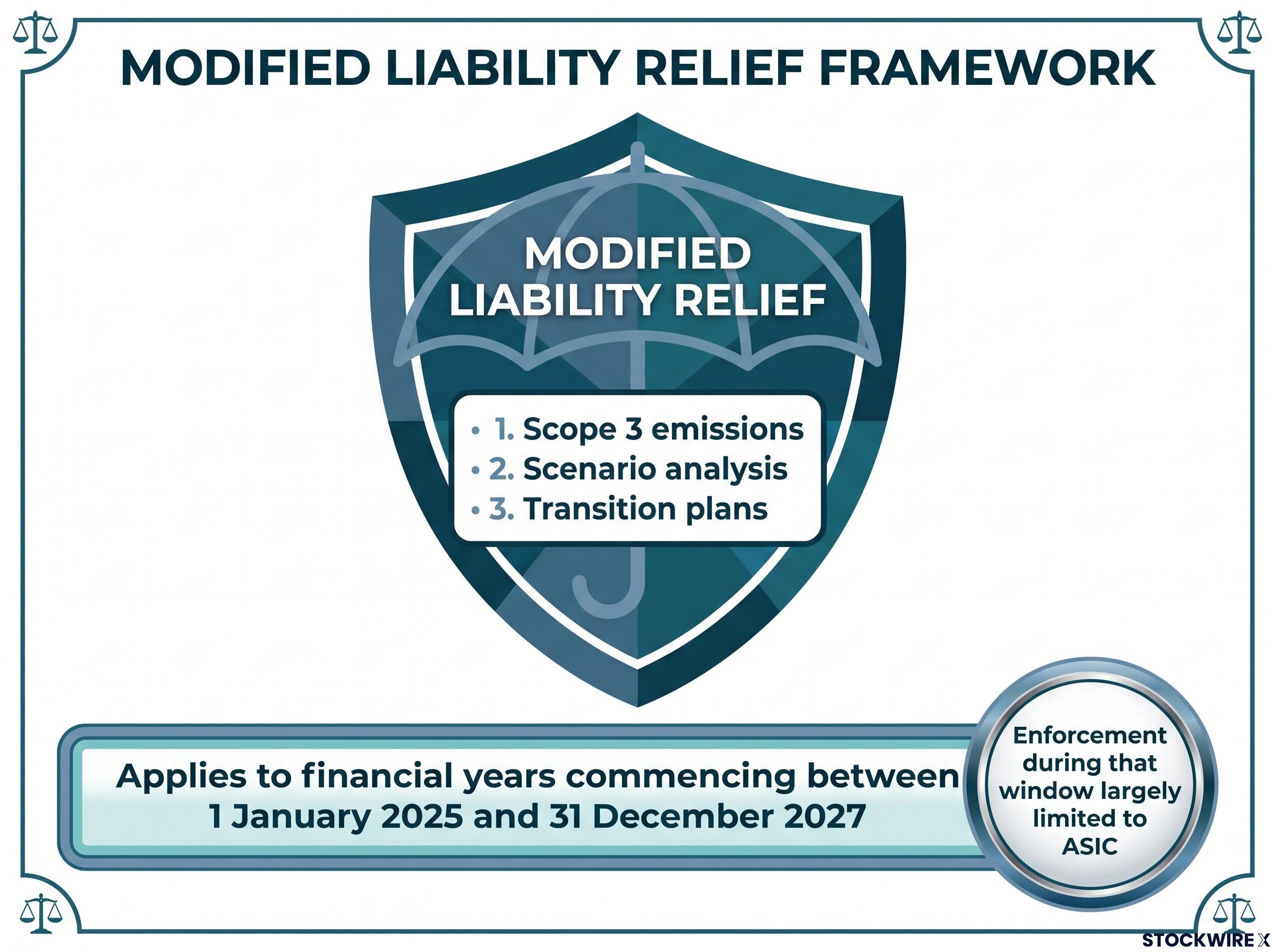
There is a partial buffer during the early years. Modified liability relief covers the most uncertain disclosures for the first three reporting years.
- Scope 3 emissions (emissions from an entity’s value chain, not its own operations)
- Scenario analysis (modelling of how the business performs under different climate futures)
- Transition plans (how the entity intends to shift toward a lower-carbon model)
This relief applies to financial years commencing between 1 January 2025 and 31 December 2027, with enforcement during that window largely limited to ASIC.
The practical tension: capability, data, and model limitations
Even where the law is understood, the capability gap is real. AICD’s Board Insights from Australia’s First Mandatory Climate Disclosures (August 2026) found that directors cite high uncertainty over 5-20 year decarbonisation pathways as their main challenge, and that boards must test and document key judgements to support what they sign.
CA ANZ has pointed out that current climate models cannot accurately predict risks at the spatial scale of individual assets, yet companies feel pressure to produce precise asset-level figures anyway. The models are not built for that precision, which puts preparers in an awkward spot.
According to CA ANZ, 84% of its Australian members feel unprepared for climate reporting, and almost 90% of auditors surveyed do not support mandatory climate reporting and assurance for Group 3 entities.
That is a systemic signal, not a handful of laggards. AICD explicitly cites the ACCR v Santos greenwashing litigation as the cautionary backdrop: statements about long-term sustainability targets are forward-looking, and they must have reasonable grounds even when they extend decades out. The transitional protections exist precisely because regulators recognised how hard this standard is to meet, which is why every director signing a report right now needs to know exactly what those protections cover and when they expire.
Greenwashing litigation has become the sharpest practical illustration of why the reasonable grounds test matters: the ACCR v Santos case, where claims about long-term sustainability targets were tested against actual internal strategy, is the cautionary precedent that AICD explicitly cites as the backdrop directors must keep in mind when signing forward-looking climate statements.
What the enforcement and liability settings mean for directors personally
Here is where institutional compliance becomes individual accountability. Every director who signs the sustainability report carries personal liability for its accuracy under the Corporations Act. This is not a reputational document that creates soft accountability. It is a statutory filing with the same exposure as a financial report, and criminal consequences sit at the most serious end.
What directors must sign, and when the standard changes
The declaration you sign changes over the life of the transitional period, and this is the single most important inflection point to track.
During the first three reporting years, directors provide a qualified declaration: an opinion on whether the entity has taken reasonable steps to comply with the Corporations Act and AASB standards. It is a “reasonable steps” test.
After the transitional period, that buffer disappears. Directors must attest that the report actually complies with the law and the standards. The declaration shifts from effort to outcome.
The transitional period runs across financial years commencing between 1 January 2025 and 31 December 2027. When it ends, so does the “reasonable steps” cushion.
Who can take action, and for what
The exposure runs across three legal pathways, according to AICD’s greenwashing analysis:
- Corporations Act 2001, for misleading or deceptive disclosure
- ASIC Act 2001, for misleading or deceptive conduct
- Australian Consumer Law, where climate claims mislead consumers
AICD warns that inconsistency between a company’s stated climate ambitions and its actual internal strategy can trigger “stepping stone” liability, exposing individual directors to claims for breach of their duty of care.
During the transitional period, ASIC holds exclusive enforcement standing for misleading conduct relating to protected climate statements, and private class actions on those protected disclosures are generally excluded. What remains live throughout is ASIC enforcement and criminal liability. A director who fails to take reasonable steps to secure compliance risks substantial fines, and, where the failure is dishonest, imprisonment. If the company suffers loss from a failure to disclose foreseeable climate risks, that can breach the director’s duty of care and diligence.
ASIC enforcement of lodgement obligations has moved from warning to penalty in parallel with the climate disclosure rollout: three ASX-listed companies were collectively fined $1.17 million in March 2026 for multi-year failure to lodge annual financial reports, confirming that the regulator is running active surveillance across all statutory filing requirements simultaneously.
What comes next for Australian companies and the regime itself
The regime is still moving, and the direction is clear: the gap between current practice and expected practice narrows with every reporting cycle. If you are treating this as a slow-moving reform, the timeline has already outpaced you.
ASIC’s feedback loop is now continuous rather than annual. During 2026-27, it will review a sample of Group 1 reports for 30 June 2026 year-ends and keep engaging with major audit firms on assurance methodologies. Expect published observations to keep arriving.
Group 2 entities commence reporting for financial years beginning 1 July 2026, which means they are entering the regime now. Every lesson in REP 839 is immediately applicable to their preparation.
| Milestone | Date | Implication for Companies |
|---|---|---|
| Group 2 commencement | 1 July 2026 | New population enters the regime; REP 839 applies to preparation |
| ASIC next review cycle | 2026-27 financial year | June 2026 Group 1 reports scrutinised; continuous feedback |
| Group 3 commencement | 1 July 2027 | Smallest reporters enter, subject to reform debate |
| End of modified liability period | Financial years to 31 December 2027 | Qualified declaration replaced by full compliance attestation |
Reform is also on the table. ASIC and Treasury are consulting on ways to reduce compliance burden without removing fundamental obligations, consistent with broader simplification work such as REP 830. The sharpest focus is on Group 3, where Treasury’s own analysis indicates 95% of those entities will have no material climate exposure.
The reform discussion sits within ASIC’s broader REP 830 simplification programme, which has already eliminated approximately 45,000 paper-based submissions annually and is now targeting duplicated data collection requirements across insurance and superannuation, providing useful context for understanding how the regulator balances compliance burden reduction against its market-integrity obligations.
Key considerations under discussion include:
- Whether Group 3 scope should be narrowed for entities with immaterial climate exposure
- Whether full audit requirements are proportionate for reports confirming no material climate risks
- Whether liability settings and assurance obligations should be right-sized for smaller entities
Underneath all of it sits the investor expectation. The market wants credible, comparable, decision-useful climate information, and ASIC’s progressive enforcement treats that as a market-integrity obligation rather than a best-efforts aspiration.
This article is for informational purposes only and should not be considered financial advice. Investors should conduct their own research and consult with financial professionals before making investment decisions.
Forward-looking statements and reform proposals described here are speculative and subject to change based on regulatory developments and consultation outcomes.