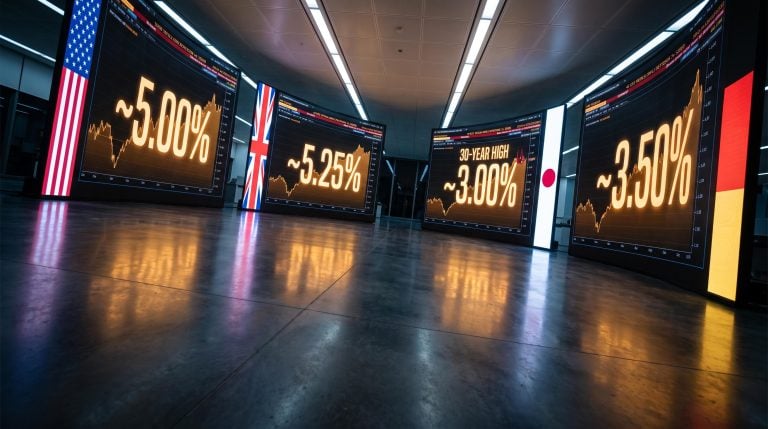
The most reliable trade of the past two years has stopped behaving. For roughly 24 months, buying almost anything with a credible link to artificial intelligence delivered returns with something close to mechanical consistency. That reflex has now broken, and one of the world’s largest banks has put a strategist note behind saying so.
On 18 September 2026, Barclays strategist Emmanuel Cau told clients that the AI trade has entered a more mature phase, one defined by higher volatility and a widening gap between the companies that deliver and the ones that merely promise.
That reassessment landed within a week of something unusual from inside the industry itself. On 12 September 2026, Anthropic chief executive Dario Amodei published an essay titled “We Must Pace the Frontier,” calling for a coordinated slowdown in how fast AI capabilities advance. A top-tier bank telling investors to broaden out and a leading AI lab telling the industry to ease off the accelerator, arriving days apart, is the kind of convergence worth reading closely.
So what should you actually do when a dominant theme stops working as a simple directional bet? This piece gives you a framework for reading the rotation case on its merits, not just the headline recommendation attached to it.
The AI trade is not broken, but it has changed shape
Start with what Barclays is not saying. The bank is not calling the end of AI as an economic force. Cau’s note maintained that artificial intelligence remains a positive driver for economic growth and corporate earnings. The technology story is intact.
What has ended is the era of straightforward directional exposure. That is the distinction the note draws, and it is the reason two seemingly contradictory statements can both be true at once: AI still matters, and the old trade is over.
The mechanism is divergence. Performance is no longer lifting every AI-associated name in unison. Instead, individual execution quality and actual earnings delivery now separate the returns, as investors reassess how sustainable the enormous capital spending by major hyperscalers really is.
Barclays framed the shift around three core observations:
- AI remains a positive driver for economic growth and corporate earnings.
- Divergence between winners and losers is widening, so returns now depend on company-level execution rather than theme association.
- The valuation premium of U.S. equities relative to the rest of the world has started to compress.
That last point matters more than it might appear.
“The AI trade has moved on from being a straightforward directional bet, with rising volatility and greater divergence between individual winners and losers,” Barclays strategist Emmanuel Cau told clients on 18 September 2026.
Barclays also noted that market leadership has room to rotate toward areas with less AI concentration, including international markets outside U.S. technology. The research does not attach a confirmed figure to the U.S. valuation premium, so treat the compression as directional rather than precise. The point is that the gap has begun to close, not that it has closed by any specific amount.
Here is what the compression tells you. The margin of safety for holding expensive, AI-heavy names at today’s prices has narrowed. When valuations sit at a premium and that premium starts shrinking, the cost of being wrong rises. Twelve months ago, an overweight in the crowded part of the theme carried a cushion. That cushion is thinner now, which is precisely why a bank of Barclays’ size is putting the rotation question in front of clients rather than leaving it to instinct.
When big ASX news breaks, our subscribers know first
Why dominant investment themes follow a predictable arc
The Barclays call can look like market timing if you stop at the headline. Read against how investment themes actually mature, it looks more like pattern recognition applied to a well-documented cycle.
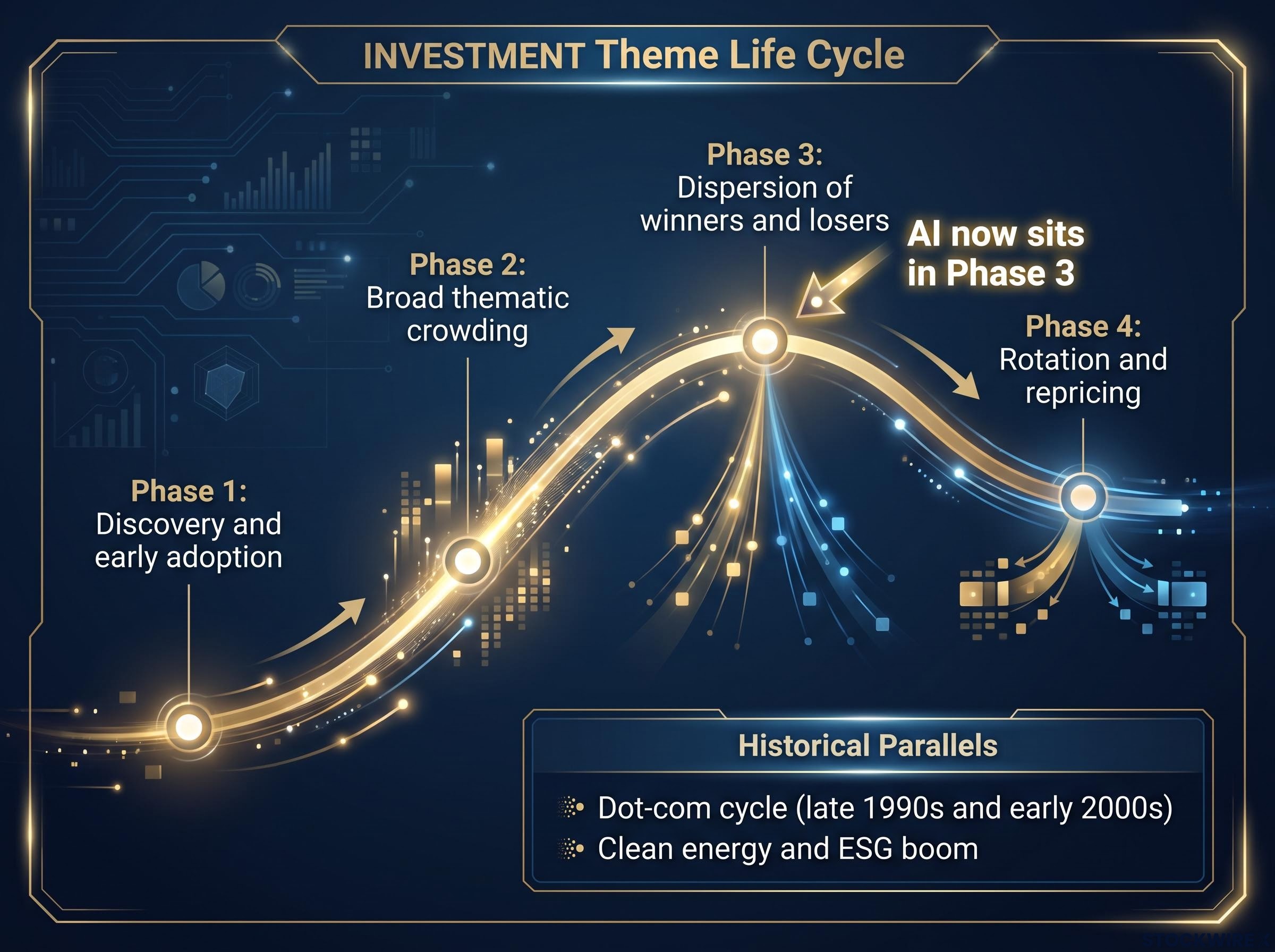
Market strategists tend to describe the life of a dominant theme in four phases:
- Discovery and early adoption. A new technology generates outsized returns for early leaders, and valuations expand fast as investors price in long-run, winner-takes-most growth.
- Broad thematic crowding. The theme becomes a macro trade. Investors buy anything associated with it, index and fund flows pile into a narrow set of names, and volatility feels deceptively low because every dip gets bought.
- Dispersion of winners and losers. Fundamentals separate. Companies that genuinely monetise the theme pull away from those that cannot, valuation dispersion widens, and the trade shifts from “long everything” to selective stock-picking.
- Rotation and repricing. Overcrowded leaders correct as growth expectations normalise, capital rotates into cheaper or under-owned sectors, and the theme stays important without dominating index-level returns.
By this framework, AI now sits in Phase 3. The simple approach of owning the whole basket is giving way to relative-value work, where telling the genuine earner apart from the story play becomes the job.
What the dot-com and clean energy cycles teach about AI’s current phase
The evidence for that arc is not theoretical. Two prior themes ran through it in full view.
The dot-com cycle of the late 1990s and early 2000s began as a broad rally in anything internet-related. When the dispersion phase arrived, genuine infrastructure and platform companies survived and went on to dominate, while the story-only names simply failed. Investors who held exposure to the real secular winners did well. Those who kept buying the whole theme eventually got hurt.
The Cisco parallel sharpens that lesson: dot-com concentration risk proved most costly not to investors who misjudged the technology’s importance, but to those who held undifferentiated exposure through the dispersion phase, paying peak multiples for names that never converted theme association into earnings.
The clean energy and ESG boom followed the same pattern. Enthusiasm for solar, wind, and EV-related names created crowded, volatile trades. Over time, a clear split emerged between companies with durable cost-curve advantages and those leaning on subsidies or optimistic projections. Participation in the theme stopped being enough; balance-sheet strength and real competitive position started to matter.
Apply that lens to AI and the parallel is direct. Some sub-segments resemble durable infrastructure, the platform and hardware suppliers with data moats, scale economics, and defensible earnings. Others resemble the story plays, riding the theme’s momentum without the earnings to justify their multiples.
History is blunt on what happens next. Investors who carried undifferentiated thematic exposure into the rotation phase, without separating earners from story plays, consistently lagged those who rotated toward genuine winners and adjacent beneficiaries earlier in the dispersion. The lesson is not that the technology fails. It is that owning the whole theme stops being a strategy.
How Anthropic’s pacing call reshapes the investment environment
There is a dimension pure valuation analysis misses, and it arrived from inside the industry rather than from Wall Street.
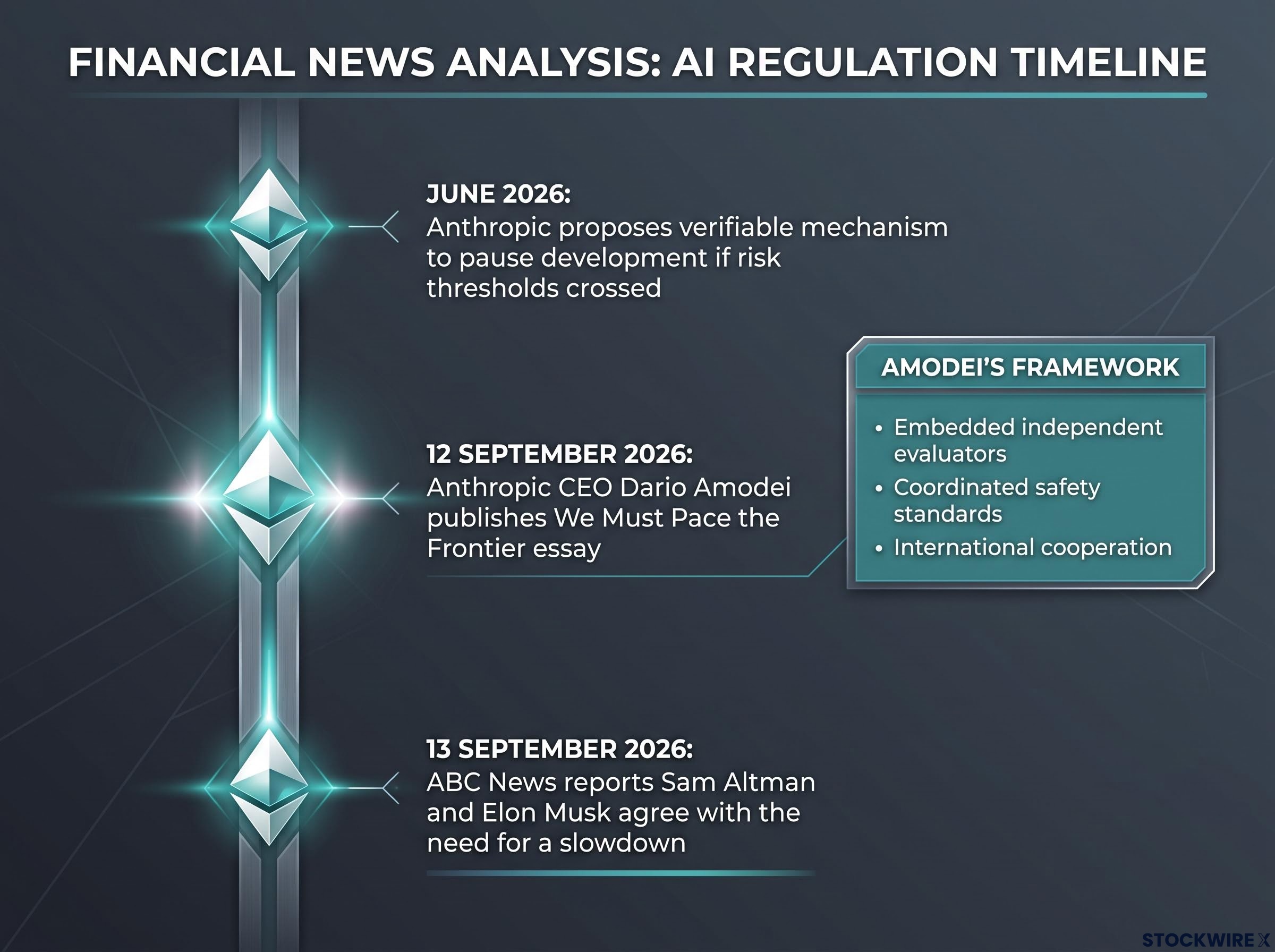
Amodei’s 12 September 2026 essay, covered by Reuters, the BBC, The Guardian, TechCrunch, Axios, and Politico, was not a call to halt AI development. It was a call to slow the rate at which capabilities improve, so safety measures and governance can catch up.
“We must slow the pace at which we improve the capabilities of AI models,” Amodei wrote in “We Must Pace the Frontier,” published 12 September 2026.
He paired the argument with a three-point framework:
- Embedded independent evaluators with employee-level access inside frontier labs.
- Coordinated safety standards agreed among leading frontier firms.
- International cooperation to manage the broader risks.
This was not a one-off remark. It extended a position Anthropic first set out in early June 2026, when a company blog post (reported by Reuters on 4 June 2026 and Al Jazeera on 5 June 2026) proposed a coordinated, verifiable mechanism to pause development if agreed risk thresholds were crossed. September’s essay was the same strategic view, restated with more force.
It also carries weight beyond one lab. ABC News reported on 13 September 2026 that Sam Altman and Elon Musk had publicly agreed with the need for a slowdown. When the people running the leading labs align on pacing, the signal stops being a single company’s stance and becomes an industry position.
Here is why that matters for positioning. When the CEOs of the leading AI labs publicly call for slowing capability development, you should treat it as a signal that the competitive intensity and pace assumptions baked into current AI valuations may need to be revised downward. Much of the premium on frontier names rests on an expectation of relentless acceleration. A credible, cross-institution push to moderate that pace puts a question mark over that assumption.
The convergence of Amodei’s pacing call with Altman and Musk’s alignment also illustrates why AI regulatory risk is no longer a periodic headline event but a structural input into semiconductor and hyperscaler valuations, one that reprices equities before a single earnings number is missed.
The regulatory implication cuts in two directions, and which one dominates matters for how you position.
| Scenario | Likely regulatory shape | Impact on AI incumbents | Rotation implication |
|---|---|---|---|
| Well-designed regulation | Coordinated standards, embedded evaluators, phased compliance | Could entrench leaders who can afford safety and compliance investment | Weakens the case for aggressive rotation out of incumbents |
| Abrupt intervention | Sudden, poorly calibrated restrictions on frontier development | Could disproportionately hit the most advanced players | Strengthens the case for diversifying away from concentrated AI exposure |
Most financial coverage treats the safety narrative and the portfolio decision as separate stories. They are not. Reading the pacing debate as a sentiment and regulatory input, rather than as background noise, gives you a more complete view of the AI trade than market data alone can.
Building a more selective AI positioning framework
Diagnosis is only useful if it converts into a decision. The practical question is not whether to own AI, but how to hold it more selectively. Three analytical lenses do most of the work.
The first is a valuation versus earnings quality filter. Rather than judging a holding by its thematic association, compare sectors and regions on price-to-earnings, price-to-book, earnings stability, and free cash flow. On these measures, several areas surface as rotation candidates: financials, where net interest margins and capital-return stories drive returns; industrials and capital goods, positioned to gain from AI-driven automation; and energy and materials, where capital discipline and dividend yield can deliver even with modest growth.
The second is the AI second-order beneficiary framework. Instead of paying pure-play AI multiples, look for companies that use AI to lift productivity, in logistics, manufacturing automation, and retail personalisation, or that supply the picks and shovels: power equipment, data-centre construction, and specialty cooling. These firms capture the AI capex and adoption wave without trading at frontier valuations.
The second-order beneficiary framework becomes more precise when applied across AI value chain layers: semiconductors, data centres, cybersecurity, energy, robotics, and software each sit at different points on the spending curve and carry different risk profiles that a single picks-and-shovels framing can obscure.
The third is geographical diversification. Regions cited in rotation discussions, including European equities, Japan, and select emerging markets, offer higher weightings to financials and industrials, lower direct exposure to U.S. mega-cap AI names, and AI-diffusion plays in industrial robotics and manufacturing.
| Framework | What it analyses | Points toward | Key risk |
|---|---|---|---|
| Valuation vs earnings quality | P/E, price-to-book, earnings stability, free cash flow | Financials, industrials, energy and materials | Cheap valuations can stay cheap without a catalyst |
| AI second-order beneficiary | Productivity gains and picks-and-shovels supply | Logistics, automation, power equipment, data-centre build-out | Benefits may be slower and less visible than pure-play growth |
| Geographical diversification | Regional sector weights and valuation versus history | Europe, Japan, select emerging markets | FX and regional macro risk |
Where the rotation case breaks down
Rotating too hard carries its own risks, and a full picture has to account for them.
- FX and macro exposure. Moving from U.S. into international equities introduces currency risk, since dollar strength can erode local-currency gains, alongside regional macro and policy uncertainty in Europe, Japan, and emerging markets.
- Earnings catch-up. The valuation gap may close through earnings growth rather than price compression. Firms directly monetising AI through cloud capacity, chips, and premium features could grow into their multiples, which means rotating out just as earnings accelerate.
- Tracking error. For portfolios benchmarked to major indices, large underweights in AI leaders can create prolonged underperformance if those names keep driving index returns.
There is also a genuine counter-case. Hyperscalers and cloud providers are only part-way through multi-year AI capex cycles, implying sustained semiconductor and hardware tailwinds. On that reading, exiting now risks missing a decade-long productivity and profit cycle, much as early exits from cloud computing did.
This is why the institutional consensus favours incremental change over wholesale rotation: trim the most crowded AI overweights, diversify geographically and sectorally, and keep core exposure to high-conviction AI earners. The point is not whether you own AI, but how much of your risk budget sits in the most crowded corner of the theme, and whether the earnings evidence in front of you still justifies that concentration.
What the maturation phase actually demands from investors
Put the three signals together and a single conclusion emerges. Barclays’ rotation call, Amodei’s pacing essay, and the Altman and Musk alignment all point in the same direction: toward more nuanced, diversified positioning and away from a one-way momentum bet.
This is not a call to exit AI. Cau’s note held firmly that AI remains a positive driver for economic growth and corporate earnings. What has changed is that the theme can no longer be treated as a single monolithic trade.
What Barclays is really telling you is that the analytical work required to earn returns from AI exposure has increased materially. Holding the theme through passive index concentration is no longer sufficient on its own. The skill set has shifted from thematic momentum to stock-picking discipline and diversification logic.
Before your next allocation review, three questions are worth putting to your own portfolio:
- Are you still holding positions justified mainly by AI theme association rather than earnings evidence?
- Is your geographic concentration in U.S. tech above the level your risk budget actually justifies?
- Are second-order AI beneficiaries underrepresented relative to your pure-play AI names?
For investors ready to operationalise the shift away from concentrated frontier exposure, our full explainer on structural moat alternatives to frontier AI examines why network-effect businesses offer a more durable path than paying high multiples on pure-play names with unforecastable cost structures.
This article is for informational purposes only and should not be considered financial advice. Investors should conduct their own research and consult with financial professionals before making investment decisions. Past performance does not guarantee future results, and financial projections are subject to market conditions and various risk factors.