
Here is a number that reframes how big the AI buildout has become. In July 2026, US data center construction spending hit a seasonally adjusted annual rate of $75.2 billion, a 57.2% jump from a year earlier.
That single category now competes head to head with American manufacturing, housing, and energy infrastructure for the same finite pool of skilled workers, steel, transformers, and grid capacity.
This is where AI infrastructure inflation stops being a technology story and becomes a macroeconomic one. The stubborn difficulty of taming US inflation has a structural component that standard monetary policy narratives tend to underweight, and Federal Reserve officials at the highest levels, including Chair Jerome Powell and Governor Lisa Cook, have named it directly.
After reading this, you will understand the specific channels through which AI infrastructure spending keeps inflation elevated, why the Fed is watching those channels closely, and what it means for anyone tracking the rate environment or making decisions tied to it. The disinflationary counterargument gets its full hearing too, because the honest position on this topic holds both sides at once.
A buildout unlike anything the US construction sector has seen
Start with the construction data, because that is where the money becomes physical.
According to US Census Bureau figures, spending on data centers reached a seasonally adjusted annual rate of $50.7 billion in April 2026. That was enough to overtake general office construction as a category and account for 2.3% of all US construction spending.
By July 2026, the annualised rate had climbed to roughly $75.2 billion, up 6.2% month over month. ConstructConnect data tells the same story from another angle: $7.9 billion of data center construction spending in May 2026 alone, and year-to-date outlays of $58.1 billion, more than four times the record set over the same stretch of 2025.
Supply has already been swallowed by demand. Real estate services firm JLL reported that by mid-2026, more than 66 GW of data center capacity was under construction across North America, with vacancy pinned at a record-low 1% for a third straight year.
When vacancy sits at 1%, there is effectively nothing spare. Everything being built already has a buyer.
From corporate announcements to concrete on the ground
Every dollar a hyperscaler commits eventually turns into a bid for skilled labour, raw materials, and a grid connection. The scale of those commitments explains why the pressure is not theoretical.
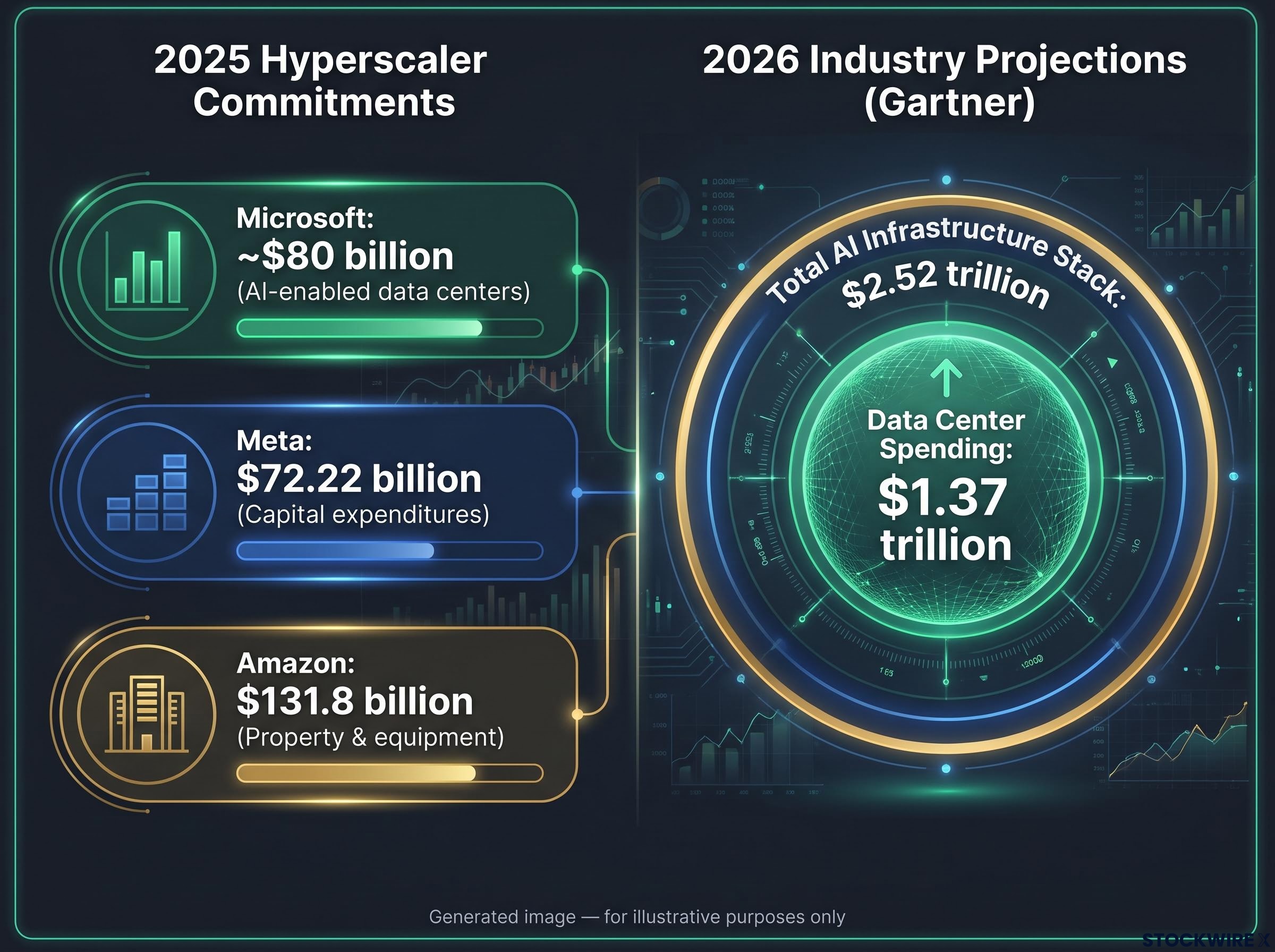
- Microsoft outlined plans to invest about $80 billion in fiscal 2025 specifically on AI-enabled data centers.
- Meta reported actual capital expenditures of $72.22 billion for full-year 2025, well above its earlier guidance.
- Amazon disclosed cash purchases of property and equipment of approximately $131.8 billion in 2025 to support its AWS growth.
Zoom out to the sector level and the figures get harder to hold in your head.
The individual company announcements are large enough on their own, but hyperscaler capital expenditure at the sector level reached roughly $725 billion in combined 2026 guidance across the four largest spenders, with debt issuance to fund those commitments running at approximately four times the five-year average.
Research firm Gartner projected data center spending at $1.37 trillion in 2026, sitting inside a broader AI infrastructure stack worth an estimated $2.52 trillion.
What this means is simple and consequential. AI infrastructure is no longer competing at the margins of the US economy. It has become a primary demand driver in construction, energy, and capital markets, and that has direct implications for anyone watching prices.
When big ASX news breaks, our subscribers know first
Where the inflation actually comes from: the resource competition mechanics
The scale is the setup. The transmission mechanism is what turns spending into sustained price pressure, and it works through several bottlenecks at once.
Begin with labour, because it is the tightest. Associated Builders and Contractors (ABC) estimated the US construction industry needs 349,000 net new workers in 2026, rising to 456,000 in 2027. Even at those numbers, 92% of construction firms still report difficulty hiring.
The squeeze is worst in specialised trades. Electrical work accounts for 45-70% of a data center build’s cost, requiring hundreds of electricians per site at peak, which makes competition for those roles especially fierce.
The workforce simply is not there. Consider the projected gaps for AI infrastructure alone.
- The Bureau of Labor Statistics (BLS) projects an annual shortfall of roughly 81,000 electricians from 2024 to 2034.
- McKinsey estimates the US will need 130,000 additional electricians, 240,000 construction labourers, and 150,000 construction supervisors between 2023 and 2030 to keep pace.
The BLS electrician employment outlook projects 9% job growth from 2025 to 2035, faster than the average for all occupations, and explicitly cites rising AI data center electricity demand as a primary driver of that acceleration.
When supply is that scarce, price does the rationing. The Wall Street Journal reported that workers switching from homebuilding to data-center projects receive salary bumps of 25-30%. BLS wage data shows the steadier underlying climb: the mean hourly electrician wage rose from $31.39 in May 2022 to $32.60 in May 2023, with nonresidential electricians averaging $33.64 per hour.
That homebuilding detail matters. Every electrician pulled onto a data center site is one not framing the electrical system of a house, which is a direct channel from AI spending into housing costs.
Power and materials: the bottlenecks beyond the workforce
Labour is only the first pressure point. The grid is the second, and arguably the harder one to fix.
Moody’s estimates the grid needs around $110 billion of new generation capacity, with development delays of up to seven years. Grid operator PJM Interconnection has warned of a potential 60 GW power-supply shortfall that could leave capacity short by 2027.
Transformers, the equipment that steps voltage up and down across the grid, are in short supply, pushing up costs and lead times and forcing utilities to ration components between new data center connections and ordinary grid reinforcement.
The IEA projects data centre and AI electricity consumption will exceed 1,000 TWh by 2026, more than doubling in four years, a demand curve that sits at the centre of what analysts are calling a structural grid crisis for utilities and grid operators across North America.
The trade-offs are no longer hypothetical. During severe heat waves, the Department of Energy granted PJM authority to force data centers onto backup diesel generators to protect residential cooling. When the grid has to choose between an AI facility and a family’s air conditioning, the competition for power has stopped being an abstraction.
The table below maps the three resource fronts side by side.
| Resource | Shortage metric | AI-driven demand | Crowding-out effect |
|---|---|---|---|
| Labour | 81,000 annual electrician shortfall (BLS, 2024-2034) | 130,000 extra electricians needed by 2030 (McKinsey) | 25-30% wage premiums pulling workers off homebuilding |
| Energy / grid | Up to 60 GW supply shortfall by 2027 (PJM) | $110bn new generation capacity required (Moody’s) | Transformers rationed between data centers and grid upkeep |
| Land and materials | Development delays of up to seven years | Tech developers outbidding residential builders for land | Housing supply pipelines shrinking (NAHB) |
For you, the takeaway is that AI infrastructure spending is not stimulating the economy in a vacuum. It is actively pulling workers, power, and land away from housing, manufacturing, and grid reliability, and those are exactly the channels through which inflation reaches everyday costs.
What the Fed is saying, and why it matters for rates
This is not analyst speculation. The most credible voices in US monetary policy have named AI infrastructure on the record, and the pattern of their remarks is what gives the argument its weight.
Read them in order and the coordination becomes hard to miss.
- Governor Michael Barr (February 2026) warned that “in the short term, investment in AI could be inflationary,” pointing to inefficient power grids colliding with data center energy demand.
- Chair Jerome Powell (March 2026) said AI data centers are “probably pushing inflation up” through rising utility costs.
- Governor Lisa Cook (May 2026) flagged more than $1.5 trillion in announced data-center plans as a pipeline of potential inflationary pressure.
- Minneapolis Fed President Neel Kashkari (August 2026) argued the investment has added a new demand element lifting prices for electricity, chips, software, and real estate.
The single highest-authority statement deserves to sit on its own.
AI data centers are “probably pushing inflation up” through rising utility costs, said Federal Reserve Chair Jerome Powell in March 2026.
The concern is not confined to individual remarks. FOMC minutes from June and July 2026 recorded multiple participants noting that strong AI infrastructure demand sustains upward pressure on tech and electricity prices, potentially keeping inflation higher for longer.
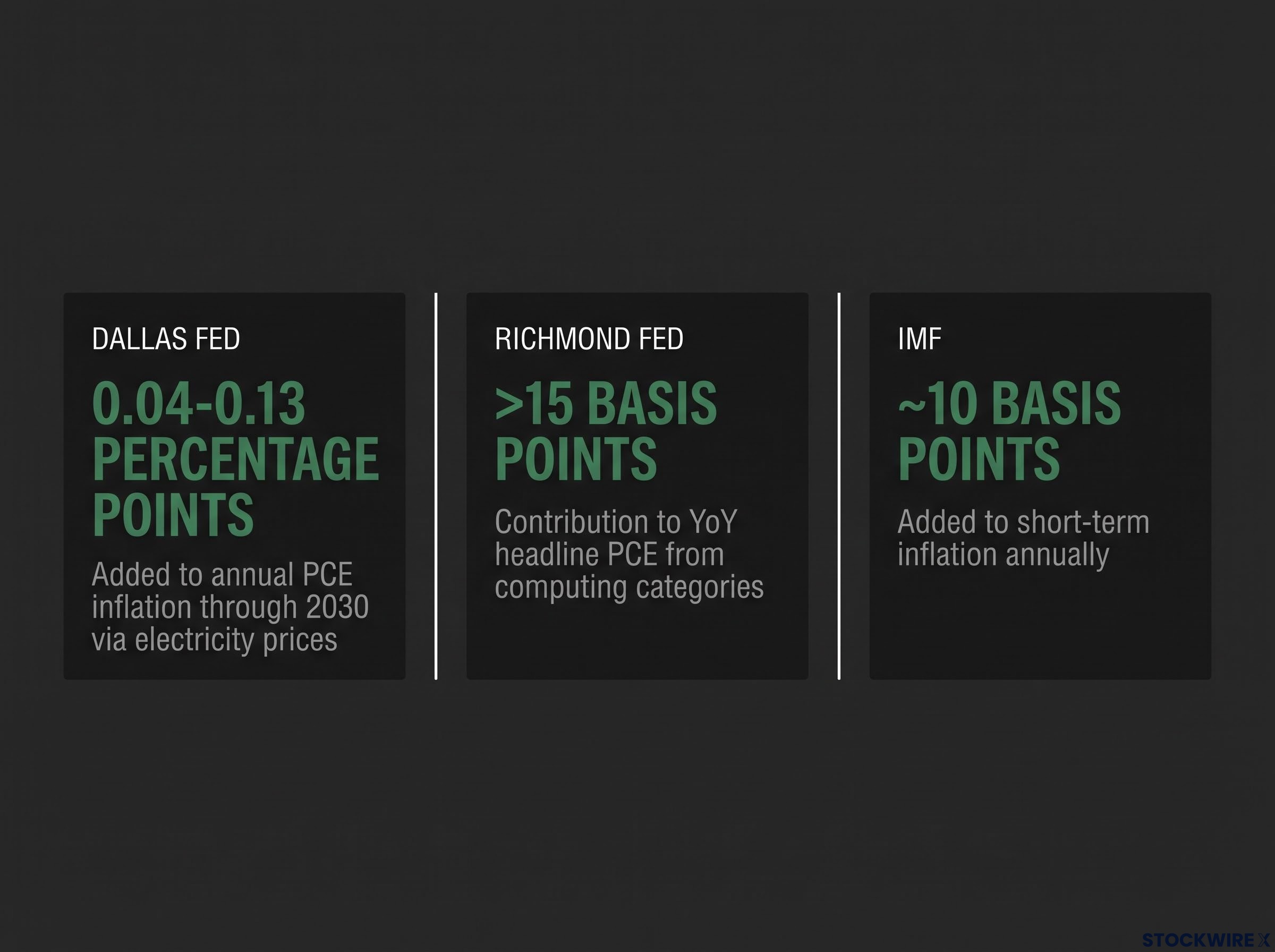
Regional Fed research turns that qualitative worry into numbers. The Dallas Fed estimates the data center boom could raise annual PCE inflation by 0.04-0.13 percentage points through 2030 via higher electricity prices alone. The Richmond Fed found computing-related categories contributed over 15 basis points to year-over-year headline PCE inflation, while the St. Louis Fed showed that news about future AI productivity gains creates immediate inflationary demand pressures.
The International Monetary Fund (IMF) models AI investment as a demand shock that raises short-term inflation by roughly 10 basis points annually and, critically, lifts the natural rate of interest.
Here is why that matters for you. When Fed officials independently name the same structural driver in public and in meeting minutes, the market implication is that rate cuts will be slower and more conditional than a standard disinflation path would suggest. Any rate-sensitive positioning should account for that.
The disinflationary case, and what would need to be true for it to hold
The counterargument is genuine, not a consolation prize, and it deserves a fair hearing before you weigh it.
BCA Research’s Peter Berezin argues that the near-term inflationary effects of AI extend beyond electricity into semiconductor and memory pricing, a position that directly contradicts the structural disinflation framing some Fed officials have publicly endorsed.
The core idea is productivity. The June 2026 FOMC minutes recorded that some participants expect gains from broad AI adoption to eventually lower production costs and expand aggregate supply, pushing inflation down over time. The IMF’s own modelling projects a two-phase dynamic: a modest near-term inflation rise from higher investment, followed by stabilisation and disinflation as total factor productivity improves.
The physical limits of the buildout could help too. CBRE found that under-construction capacity fell nearly 6% year over year in the second half of 2025, suggesting grid and financing constraints can throttle the pace of expansion, and with it the associated price pressure. JPMorgan research notes that scarce electricity could force cancellations, delays, or more efficient designs.
The tension sits in the timing, laid out below.
| Near-term inflationary pressure | Conditions required for disinflation |
|---|---|
| Investment-driven demand hitting the economy now | Productivity gains must arrive and reduce production costs |
| Labour, power, and materials in acute competition | Grid and financing constraints must slow the buildout without shock |
| Fed modelling a lift to the natural rate of interest | Aggregate supply must expand faster than aggregate demand |
The most precise articulation of the risk comes from the IMF’s chief economist.
Business investment and household spending can surge ahead of realised productivity gains, causing supply crunches with ambiguous net inflation outcomes, warned IMF Chief Economist Silvana Tenreyro in August 2026.
Her colleague Pierre-Olivier Gourinchas has cautioned the boom could end in a bust, though not necessarily a systemic financial crisis. Even so, the IMF still expects US consumer inflation to ease gradually to 2.4% in 2026.
The disinflationary payoff is real in theory. It simply arrives later than the inflationary pressure does. Anyone making near-term rate or inflation assumptions should weight the demand shock happening now more heavily than the productivity promise still to come.
What this means before the next rate decision
Pull the four arguments together and one claim holds. AI infrastructure is a structural, multi-channel inflation input, the Fed has formally acknowledged it, and it is not resolving on a short timeline.
The scale of the buildout is not a phase that burns out next quarter. Goldman Sachs forecasts a 15% compound annual growth rate in data center power demand through 2030, lifting data centers’ share of US electricity from around 3% to 8%. The Richmond Fed’s finding that computing categories already add over 15 basis points to headline PCE shows the effect is in the data now, not merely projected.
The deeper implication is about the natural rate of interest, sometimes called r-star, meaning the neutral rate at which policy neither stimulates nor restrains the economy. The IMF’s modelling suggests AI investment is lifting it. If the neutral rate itself is drifting higher, the Fed’s eventual easing path will be shallower than markets anchored to pre-AI rate cycles expect, and that repricing carries consequences for every rate-sensitive asset class.
U.S. real bond yields hit 2.55%-2.60% in mid-September 2026, a cycle peak driven largely by the real component rather than inflation expectations, compounding the repricing risk for rate-sensitive assets already contending with a structurally higher neutral rate.
Here is what to watch to track whether the pressure is building or easing.
- Data center construction spending in the monthly US Census Bureau release
- Electrician and skilled-trade wage growth in BLS data
- PJM and other grid operators’ capacity filings and shortfall warnings
- The computing-related contribution to headline PCE inflation
This article is for informational purposes only and should not be considered financial advice. Investors should conduct their own research and consult with financial professionals before making investment decisions. Past performance does not guarantee future results. Financial projections are subject to market conditions and various risk factors, and forward-looking statements are speculative and subject to change based on market and policy developments.