Taiwan’s central bank has now sat on its hands for ten straight meetings, holding its benchmark rate at 2.00%, and it is doing so while the island posts its fastest economic growth in a generation. On paper, that combination should have produced a hike long ago.
It has not. And the reason it has not is the entire story of Taiwan’s economic outlook right now.
As of September 2026, the pressure is building on both sides. Consumer prices have run above the Central Bank of the Republic of China’s own 2% alert threshold for four consecutive months, the 2026 growth forecast has been revised into double-digit territory, and Commerzbank has flagged early 2027 as the moment the bank’s patience could finally snap.
What follows below is not a recap of the last rate decision. It is a framework for reading the specific conditions under which Taiwan’s wait-and-see stance breaks, and what the leading indicators look like before it does.
Ten meetings, one rate: why the CBC keeps holding while growth accelerates
The Central Bank of the Republic of China (Taiwan), known as the CBC, kept its policy settings unchanged at its third-quarter board meeting on 17 September 2026, extending its pause to a tenth consecutive quarterly decision. This is not a single number sitting in isolation; it is a complete policy posture.
The benchmark discount rate stayed at 2.00%, alongside two supporting rates that shape how banks fund themselves:
- Benchmark discount rate: 2.00%
- Rate on refinancing of secured loans: 2.375%
- Rate on temporary accommodations: 4.25%
The hold surprised almost nobody. Reuters polls heading into recent meetings showed near-unanimous expectations for no change, and CBC officials have repeatedly signalled they see no urgent case to tighten.
The bank’s own logic is worth understanding, because it explains why growth alone is not enough to force a move. Taiwan’s inflation sits below the levels seen across major advanced economies, the CBC views its current stance as already restrictive enough to keep prices in check, and strong momentum gives policymakers the luxury of waiting rather than reacting.
That is the key read for anyone watching Taiwan-exposed equities or regional rates markets. The hold is not inertia. It is a deliberate threshold position, and the threshold is inflation, not output.
Which is why December 2026 is not the meeting to circle. A hike is not broadly anticipated then. The live risk sits one quarter later.
The forward signal to watch Commerzbank has flagged that a shift toward tightening could arrive as early as Q1 2027 if inflationary pressures persist. That makes the first quarter of next year, not the December meeting, the point at which the CBC’s patient stance is genuinely on the clock.
Understanding that timing matters more than reacting to the headline hold. The question is no longer whether the CBC is holding. It is what would make it stop.
When big ASX news breaks, our subscribers know first
The semiconductor engine powering Taiwan’s growth revision
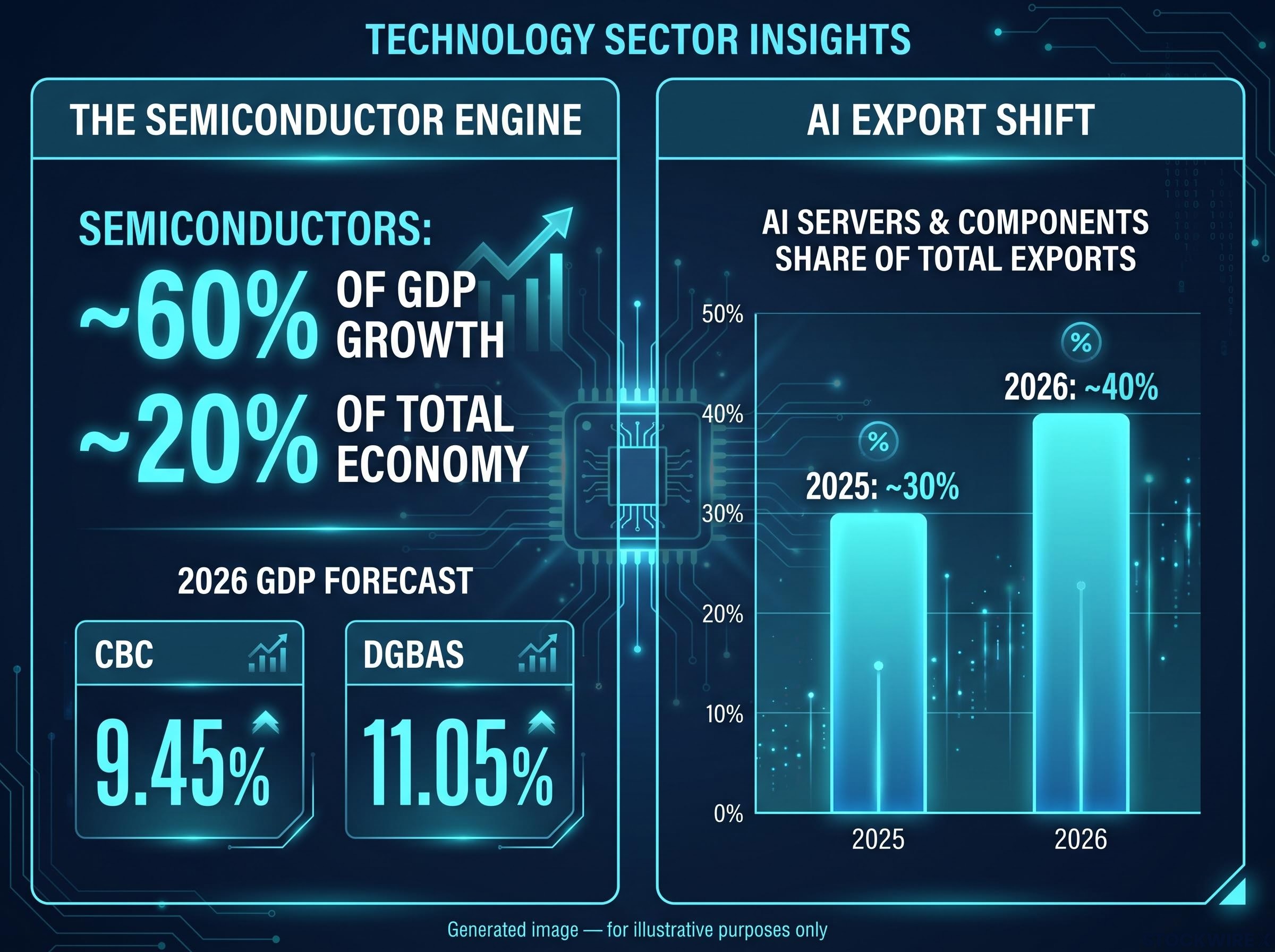
Start with the number that anchors everything else: the CBC has lifted its 2026 real GDP growth forecast to 9.45%, up from a prior 7.28%. Taiwan’s Directorate-General of Budget, Accounting and Statistics (DGBAS) goes further still, projecting roughly 11.05%, which would mark the fastest pace of expansion in 16 to 39 years.
Those two figures do not contradict each other. They are two readings of the same underlying reality, an artificial-intelligence-driven semiconductor boom that has moved from forecast into hard trade data.
Hyperscaler capital expenditure commitments of approximately $725 billion for 2026, rising toward a $1 trillion annual run rate in 2027, are the upstream source of the export surge showing up in Taiwan’s trade data, with AI infrastructure hardware and advanced packaging accounting for a growing share of that spending.
Semiconductors now account for close to 60% of Taiwan’s GDP growth and roughly one-fifth of the entire economy. This is not a diversified expansion. It is a chip story with an economy attached.
TSMC sits at the centre of that story, surrounded by a dense cluster of chip designers and advanced packaging firms that make Taiwan the primary hub for the processors powering leading AI models. The capital-expenditure race among global cloud providers is what feeds it, and that spending is showing up in Taiwan’s export ledger in real time.
The structural demand floor for AI chips has proven resistant to sentiment shocks through 2026, with the competitive dynamic between the US and China making unilateral slowdowns in hyperscaler infrastructure spending strategically untenable regardless of near-term valuation concerns.
What the export figures actually show
The monthly and cumulative trade data is where the growth revision stops looking like optimism and starts looking like arithmetic.
| Period | Total exports | IC exports | Year-on-year change |
|---|---|---|---|
| July 2026 | US$75.30B (third-highest month on record) | US$26.30B (record) | IC exports +52.3% |
| Jan-Jul 2026 (cumulative) | US$491.95B | N/A | Total exports +44.7% |
The cumulative trade surplus over those seven months reached US$114.61 billion, up 63.5% year-on-year. The DGBAS projects full-year merchandise exports of roughly US$894.5 billion, with AI-related servers and components making up about 40% of that total, up from around 30% in 2025.
That last shift is the one to hold onto. A jump from 30% to 40% in a single year is a structural change in what Taiwan sells, not a temporary spike.
For anyone with exposure to global AI infrastructure themes, this changes how you read the data. Taiwan’s export figures function as a real-time gauge of how much hyperscalers are actually committing to capex, which means the risk question is no longer “will the growth arrive” but “how long can this pace continue.”
Where the inflation risk lives and what could force the CBC’s hand
The growth story is genuine. It also comes with a pressure point that the CBC is watching closely, and the data is quietly counting down its patience.
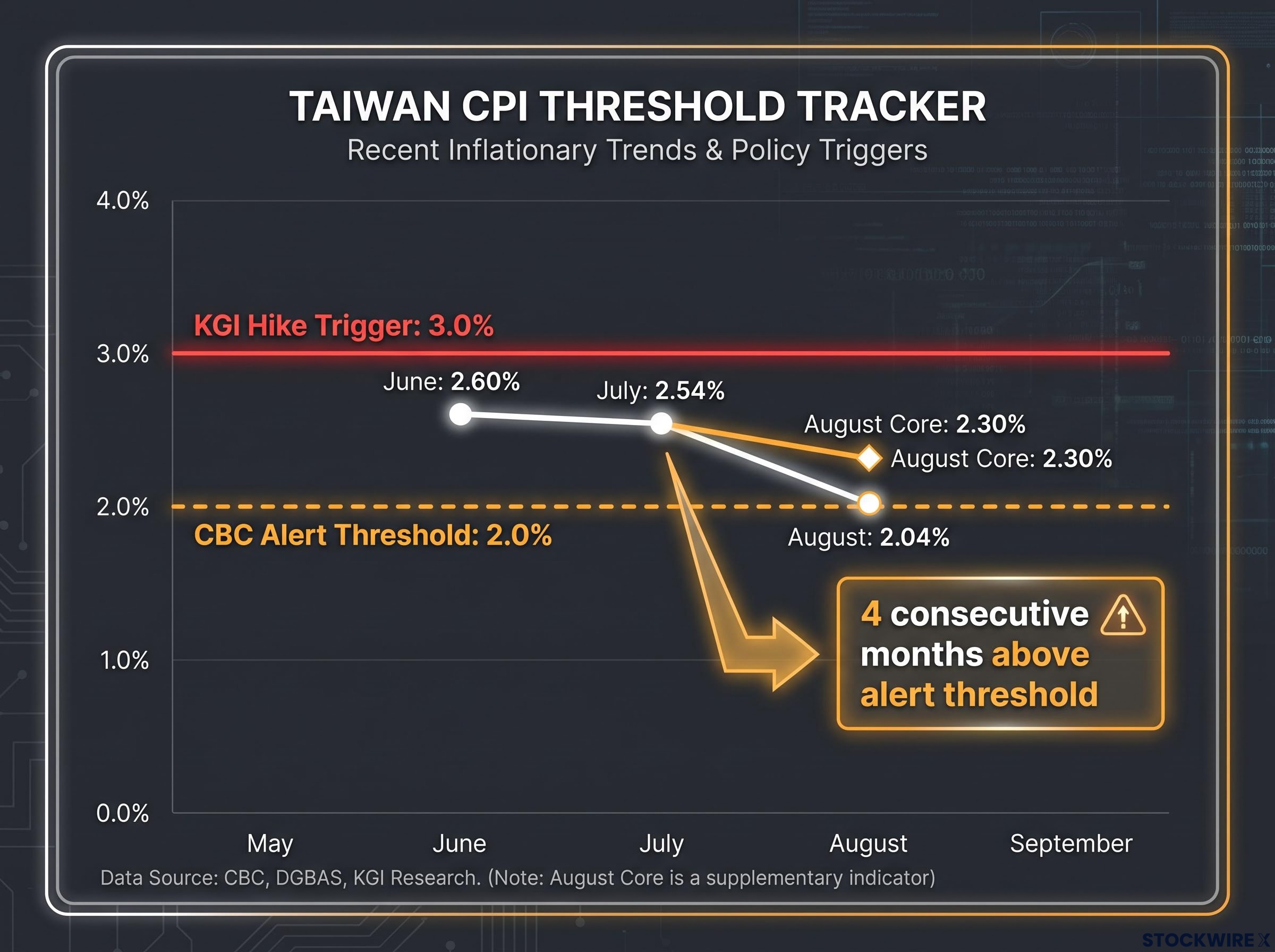
Consumer prices rose 2.04% year-on-year in August 2026, the fourth straight month above the bank’s 2% alert threshold, following 2.60% in June and 2.54% in July. Core CPI, which strips out volatile energy and food prices, ran hotter still at 2.30% in August.
The CBC has already nudged its own forecasts upward. Its Q3 2026 headline CPI projection was revised to 2.03% from 1.91%, and core CPI to 2.16% from 1.90%. For 2027, however, it still sees inflation cooling to a headline 1.83% and core 1.89%, which is the base case that keeps the hold intact.
The mechanism that could break that base case is energy. Taiwan sources roughly 70% of its energy imports from the Middle East, which leaves it unusually exposed to prolonged regional conflict and oil price swings that feed straight into domestic prices.
Beyond energy, three distinct downside vectors sit on the table, and they are worth keeping separate rather than blending into a single worry:
- Semiconductor down-cycle: Growth leans heavily on global tech capex. TI Insight has warned that today’s AI-race-driven expansion could normalise toward 2.5-3% once the investment surge matures.
- Geopolitics and reshoring: The Asian Development Bank, Allianz, and the CBC’s own financial stability work all point to US and China efforts to build domestic chip capacity, protectionist tariffs, and rising defence-spending needs as a potential drag.
- US Federal Reserve divergence: A widening policy gap with the Fed could pressure the Taiwan dollar, potentially forcing the CBC’s hand on either exchange-rate management or rates.
The genuine analytical uncertainty is best captured by how far apart the forecasters sit.
Two forecasts, one economy DBS Bank projects 2026 CPI at 1.9%, citing energy risks. Allianz sees just 1.1%. The gap between those two numbers is the difference between a bank that keeps holding comfortably and one that starts eyeing the exit.
Four months above the alert threshold is not a crisis. But it narrows the CBC’s window in a way you can measure, and a fifth or sixth month above 2% would push the probability of a Q1 2027 move meaningfully higher. That is the countdown to track.
How Taiwan compares to its regional peers, and what that signals about the tipping point
To understand where Taiwan sits, look at two neighbours running the same AI-chip tailwind but landing in different places on policy.
The Asian regional tightening cycle that Bank Indonesia’s shock 50-basis-point hike set in motion earlier in 2026 reframes the CBC’s hold as a deliberate outlier position rather than regional consensus, with Goldman Sachs having projected Taiwan among the central banks most likely to follow in H2 2026.
Singapore is the closer mirror. Its central bank, the Monetary Authority of Singapore (MAS), has managed elevated core inflation of 1.2-1.5% not by hiking rates but by allowing the Singapore dollar to appreciate within a managed band, a strategy Taiwan echoes through cautious holds and exchange-rate smoothing rather than direct tightening.
South Korea is the warning. Facing a sharper 3.2% CPI reading, the Bank of Korea broke a prolonged pause in July 2026 with a 25 basis point hike to 2.75%, its first increase in over three years. That is what the data forcing a pivot actually looks like in practice.
| Economy | Current policy rate | Recent CPI | 2026 policy response |
|---|---|---|---|
| Taiwan | 2.00% | 2.04% (Aug) | Held for tenth meeting |
| Singapore | Managed via NEER band | 1.2-1.5% core | Currency appreciation, no hike |
| South Korea | 2.75% | 3.2% | 25bp hike in July |
Taiwan currently leans firmly toward the Singapore model. But the South Korea example gives the reader something more useful than a vague warning: a concrete calibration point.
KGI Securities Investment Advisory chairman Chu Yen-min has suggested the CBC would likely act only if inflation reached 3%. That aligns almost exactly with the level that pushed the Bank of Korea off the sidelines.
Not every analyst waits for that trigger. DBS Group Research forecasts a 12.5 basis point hike to 2.125% in December 2026, a minority call that sits against the consensus hold.
The takeaway for your monitoring is precise. Singapore-style gradualism is the base case, but a Taiwan CPI reading sustained above 3% into 2027 is the live scenario that would flip the model, and if it arrives, expect a South-Korea-style 25 basis point step rather than anything dramatic.
What the data tells you to watch before Q1 2027
The analysis converts into a short, ordered watchlist. Three signals will tell you whether Taiwan’s hold is holding or breaking, and they are ranked by how much they matter.
- CPI trajectory relative to the thresholds. The alert level is 2.0%; the informal hike trigger flagged by KGI is 3.0%. That band is your monitoring range, and each monthly print above 2% tightens the case for action.
- Energy price developments. With roughly 70% of energy imports from the Middle East, any sustained oil move feeds directly into the CPI readings above.
- CBC forward guidance language. A shift in tone at the December 2026 meeting is the earliest verbal warning that Q1 2027 is becoming a genuine decision rather than a scenario.
Fed policy divergence and energy shocks are not independent risk vectors for Taiwan: the same Hormuz-linked oil price pressure that feeds directly into Taiwan’s CPI is simultaneously widening the yield differential that pulls capital toward US assets, compressing the CBC’s room to hold without triggering currency weakness.
The forecast divergence is real and worth holding without forcing a resolution. Commerzbank sees Q1 2027 as the live window; DBS puts a smaller move as early as December 2026; the CBC’s own 1.83% 2027 headline projection underpins the base case for no change at all.
Here is the structural point that makes all of this matter beyond Taiwan. With semiconductors driving close to 60% of GDP growth, the CBC’s policy path is not a domestic curiosity. It is a signal for global tech capex conditions, and the reader tracking Taiwan’s monthly CPI and CBC statements will often hold a better leading indicator of AI infrastructure sentiment than most market commentary offers.
This article is for informational purposes only and should not be considered financial advice. Investors should conduct their own research and consult with financial professionals before making investment decisions. Past performance does not guarantee future results, and financial projections are subject to market conditions and various risk factors. Forward-looking statements are speculative and subject to change based on market developments.