USD/CNH is trading near 6.70 while the broader dollar has held firm, and that contradiction is not an accident.
Six days before Xi Jinping walks into the White House, Beijing appears to be sending a message through the currency market that no press conference could deliver as cleanly.
The Trump-Xi summit on 24 September 2026 is the most consequential bilateral meeting of the year, with a 10 November trade-truce deadline sharpening every exchange into something markets must price. Currency traders are already doing that pricing, and the renminbi’s pre-summit behaviour has compressed two separate questions into one live trade: is this move Beijing’s policy choice, or just the dollar cycle doing its work?
What follows separates the market-driven baseline from the diplomatic overlay, explains exactly how the People’s Bank of China (PBOC) engineers a signal through its daily fixing, and maps the three scenarios that will determine where USD/CNH trades after 10 November. By the time you finish, you will have a framework for reading currency moves in real time around the summit, rather than waiting for someone else to interpret the outcome after the fact.
Why USD/CNH is moving against the dollar grain
Here is the anomaly. The yuan is strengthening while the dollar is not weakening.
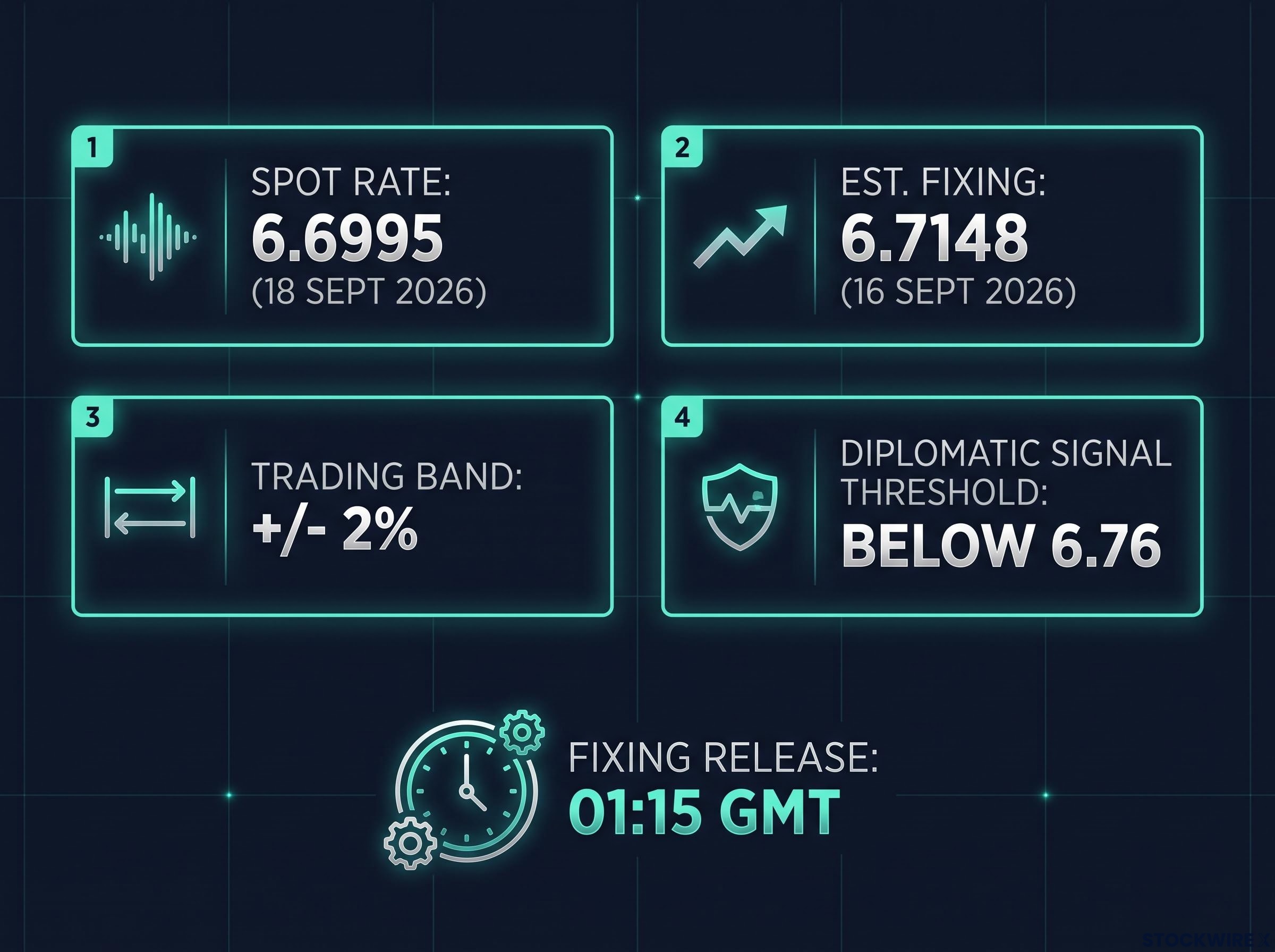
- USD/CNH spot: 6.6995 (Bloomberg, 18 September 2026), corroborated at 6.699465 by Forbes Advisor on the same date
- USD/CNY estimated fixing: 6.7148 (Reuters estimate via InvestingLive, 16 September 2026)
- PBOC onshore trading band: plus or minus 2% around the daily midpoint
Non-USD currencies typically weaken when the dollar firms. That is the default relationship. So the renminbi grinding toward 6.70 while the dollar holds tactically firm is the puzzle that drives everything that follows.
The DXY breakout above 100 driven by the Fed’s unanimous September 2026 hike to 3.75-4.00% and a revised dot-plot median is the near-term dollar firmness the current article’s anomaly is set against; a yuan grinding toward 6.70 during that move is precisely the divergence that isolates China-specific policy forces.
The dollar’s own path in 2026 is contested, which complicates the read. Goldman Sachs, in July 2026 commentary, pointed to near-term dollar strength driven by interest-rate differentials and a hawkish Fed repricing. Against that, the medium-term consensus from Morgan Stanley and DeVere Group has the US dollar index (DXY) sitting in the mid-90s with downside risk toward 92. Firm now, softer later.
That ambiguity matters because it means you cannot simply attribute yuan strength to a falling dollar. The dollar has not been falling in the near term.
DBS Group Research on the RMB move Analyst Chang Wei Liang, cited by FXStreet, characterises the renminbi’s move toward 6.70 as consistent with a pre-summit goodwill gesture, treating the declining fixing rate as a potential diplomatic signal rather than a purely market-driven adjustment.
That is the diagnostic takeaway. The divergence between yuan strength and a tactically firm dollar tells you China-specific forces are at work, not just the global FX cycle. And working out which force dominates is what separates a tradeable signal from noise. Track USD/CNH through a purely macro-dollar lens and you are missing half the picture.
When big ASX news breaks, our subscribers know first
How Beijing engineers a signal through the daily fixing
The mechanism behind the signal is a sequence of deliberate choices, and understanding it turns the daily fixing announcement from background data into something you can read.
Each trading day at approximately 01:15 GMT, the PBOC publishes a USD/CNY reference rate, or midpoint. The onshore yuan is then permitted to trade within a band of plus or minus 2% around that number. The fixing formula incorporates the prior-day close, moves in major currencies, and domestic factors such as capital flows, but policymakers retain discretion over the final figure. That discretion is the whole point.
This framework hands the PBOC three practical levers.
| Lever | How it works | Diplomatic application |
|---|---|---|
| The fixing level | Set the midpoint stronger or weaker than market models predict | A stronger-than-expected fixing signals goodwill and stability ahead of talks |
| Counter-cyclical adjustment | Adjust the formula weighting to lean against one-way speculation | Dampens disorderly moves that could read as competitive devaluation |
| Band management | Window guidance to state-linked banks influences the usable range in practice | Tightens or loosens actual trading without changing the formal band |
The estimated 6.7148 fixing for 16 September sits against a clear analyst benchmark. DBS Group Research identifies fixings below 6.76 as consistent with a diplomatic signal rather than a purely market-driven adjustment. That gives you a number to watch.
History shows how this plays out. During the 2018-2019 trade war, the PBOC allowed the yuan to weaken in response to tariff announcements but used the fixings to slow the pace, setting midpoints stronger than a free float would have implied. When USD/CNY pushed above the psychologically important 7.0 level in August 2019, the calibrated fixings let the currency absorb the tariff shock while demonstrating enough control to avoid a disorderly slide. Ahead of the January 2020 Phase One Agreement, the PBOC guided toward stability to project commitment to the deal.
Knowing this converts the 01:15 GMT release into a real-time diplomatic communique. You can read Beijing’s posture each morning before the summit’s outcome is even known.
Where PBOC’s fixing leverage runs out
The PBOC cannot push fixings far from fundamentals without cost. Persistently over-strong fixings hurt export competitiveness and risk destabilising capital flows. If the fixing consistently deviates from fundamentals, the offshore USD/CNH market and non-deliverable forwards diverge visibly from the onshore rate, exposing the gap and weakening the signal. And during US-China tensions, aggressive fixing management invites scrutiny from US officials and IMF monitoring, which could complicate summit diplomacy rather than support it. The lever is real, but it has limits.
Market-driven dollar weakness or Beijing’s diplomatic hand?
Two camps read this move differently, and the honest answer sits between them.
The market-driven camp argues the yuan’s strength is largely the flip-side of a soft dollar.
- Morgan Stanley projects DXY moving toward 94 by Q2 2026, its lowest since 2021
- DeVere Group’s January 2026 note has DXY averaging in the mid-90s with downside toward 92
- Goldman Sachs framed its January 2026 view as “Global FX 2026 Outlook: Different Dollar Downside,” expecting gradual weakening as demand for US assets softens
- A Reuters FX strategist poll on 7 January 2026 showed a broadly bearish dollar consensus, driven by concerns over Federal Reserve independence and lower rate expectations
On this reading, attributing the entire renminbi move to Beijing overstates its agency.
The diplomatic signalling camp reads it the other way. China specialists and DBS Group Research’s Chang Wei Liang treat pre-summit renminbi firmness and supportive fixings as deliberate policy tools, designed to demonstrate goodwill, neutralise US currency-manipulation accusations, and frame the summit inside a controlled, cooperative monetary environment.
The contrasting anchor A Reuters FX strategist poll on 2 September 2026 found the dollar is expected to “hold firm over coming months but trade weaker in a year,” with strategists seeing limited upside as markets scale back Fed rate-hike expectations.
That poll matters because it undercuts the clean version of both stories. If the dollar is firm now, the pure market-driven explanation weakens. But the medium-term softness is real too, so the pure diplomatic story overstates its case.
The defensible position is the hybrid one. Global macro forces set the baseline direction of the renminbi, while the PBOC calibrates the timing and pace of its fixings to align that baseline with diplomatic objectives. The two drivers are intertwined, and observable data alone will not separate them cleanly.
The rare coexistence of falling yields and a firming yuan, documented in mid-August 2026, signals the PBOC faces no current trade-off between domestic stimulus and FX stability, which directly narrows the space in which competitive devaluation could be used as a policy tool regardless of what the November deadline produces.
For positioning, that has a sharp implication. Treat the move as purely diplomatic and you will misprice the reversal risk if the dollar firms. Treat it as purely macro and you miss that the PBOC is actively managing the path, which changes the probability distribution around November. As USD/CNH approaches 6.70 in the days before the summit, assume both forces are live at once.
Three scenarios for USD/CNH after 10 November
The structural anchor for everything is the 10 November 2026 deadline. The current trade truce, extended by executive order in August 2025, expires on that date, and the September summit is the primary variable determining what happens next.
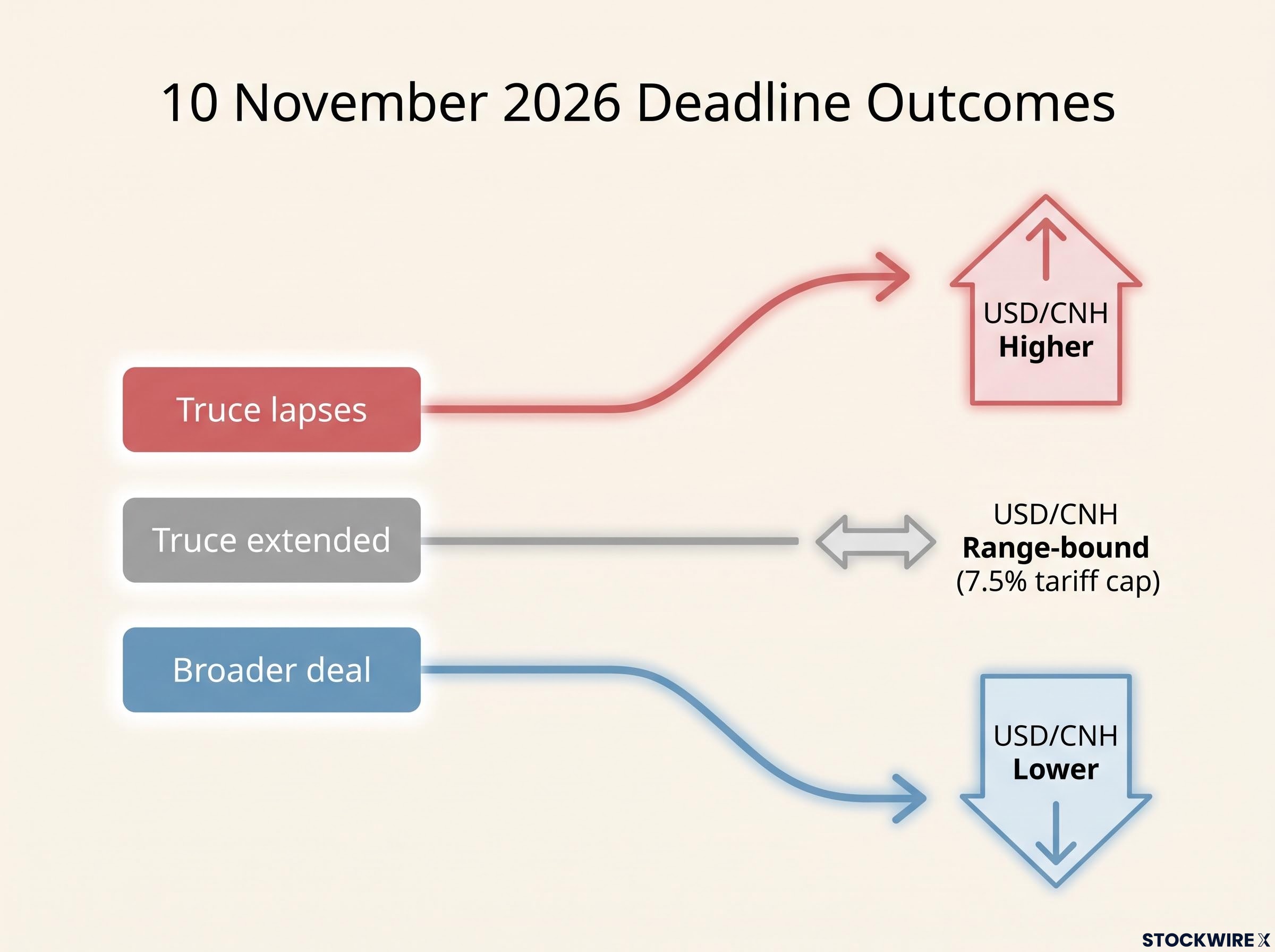
| Scenario | Summit / November outcome | USD/CNH direction | Key risk |
|---|---|---|---|
| 1. Truce lapses | No new deal, tariffs ratchet higher | Higher (weaker CNH) | Renewed escalation and risk-off USD demand |
| 2. Truce extended | Summit disappoints, simple rollover | Range-bound | Latent 7.5% overcapacity tariff caps any rally |
| 3. Broader deal | Summit succeeds, de-escalation roadmap | Lower (stronger CNH) | PBOC paces appreciation deliberately |
In the first scenario, a lapse without extension likely reintroduces risk-off sentiment, supporting the dollar as a safe haven while pressuring the yuan. USD/CNH would move higher, and faster in offshore markets than the onshore band permits, since offshore prices future policy shocks more quickly. Historical precedent suggests the PBOC would repeat its 2019-style controlled depreciation, accepting some weakness while preventing a disorderly slide.
In the second scenario, a disappointing summit followed by a plain rollover likely leaves USD/CNH range-bound, with moves driven more by global dollar trends and Chinese growth data than by tariff dynamics. The proposed 7.5% overcapacity tariff package, reported by Reuters citing Bloomberg on 24 August 2026, sits in the background as a latent risk that caps any renminbi rally.
In the third scenario, meaningful de-escalation with a tariff-rollback roadmap would support risk assets and non-USD currencies. USD/CNH could grind lower if the PBOC signals comfort with appreciation through stronger fixings, consistent with the medium-term structural dollar-weakness consensus.
The scenario that matters most for you is not the one you think most likely. It is the one where your current positioning would suffer most. Stress-test against that.
Phase One implementation failure, where China met only 58 percent of its purchase targets and no enforcement mechanism was triggered, is the historical baseline investors must apply to any commitments made at the September summit, since the gap between announced and confirmed language has already proven costly for those who priced unverified claims.
Two risks that apply regardless of which scenario plays out
Domestic constraints do not disappear under a positive headline. Property-sector stress and capital-flow management mean even a strong summit outcome is unlikely to produce a free rally, with the PBOC likely to pace any appreciation deliberately rather than let it run.
The latent tariff risk cuts the other way. The 7.5% overcapacity package reported by Reuters and Bloomberg remains in discussion, and if it moves to implementation after the summit, it introduces a trade-friction premium into USD/CNH that persists even under a soft-dollar environment.
What the summit changes, and what the fixing will confirm
The renminbi’s pre-summit behaviour is jointly driven, and you now have the framework to weight each force. The structural dollar cycle sets the baseline; Beijing’s calibration of the daily fixing tunes the path to fit its diplomatic goals. Neither explanation stands alone.
The days after 24 September are the most information-dense window of the entire cycle. Two signals will tell you what the summit actually changed.
- The USD/CNY fixing in the three trading days after 24 September. Watch the 01:15 GMT release. A fixing that holds below 6.76 would confirm Beijing signalling continued comfort with appreciation and a positive summit tone. A weaker fixing would signal the PBOC pulling back the diplomatic gesture toward neutral.
- The status of the 7.5% overcapacity tariff. Implementation accelerating versus further delay is the cleanest binary outcome for renminbi direction.
Reading those fixings before the analyst notes land gives you a genuine positioning edge. The summit on 24 September is the diagnostic event. The 10 November deadline is the pricing event. Watch whether the summit outcome shifts the probability distribution around November before you reposition.
For investors wanting to calibrate how much weight to put on summit-day market moves before confirmed deal language emerges, our full explainer on how markets priced the May 2026 Trump-Xi summit details how the Nasdaq and Shanghai Composite both rallied on atmosphere rather than substance, and what that pattern implies for positioning discipline.
This article is for informational purposes only and should not be considered financial advice. Investors should conduct their own research and consult with financial professionals before making investment decisions. Past performance does not guarantee future results. Financial projections are subject to market conditions and various risk factors, and forward-looking scenarios are speculative and subject to change based on market and policy developments.