
On 15 January 2015, traders at brokers without negative balance protection went to bed with funded accounts and woke up owing money they did not have. The Swiss franc had moved sharply in minutes, and high leverage did the rest.
Most traders treat the choice between an onshore and an offshore broker as a paperwork decision, a matter of which website looks more professional. In practice, that single choice sets the maximum loss you can sustain, decides whether your funds are recoverable if the broker collapses, and determines whether the leverage you are planning to use is even available to you at all.
This is not a compliance topic. The regulatory tier your broker sits under controls leverage caps, instrument lists, what happens to your money during insolvency, and whether any compensation exists to catch you if things fail. Those are structural facts that touch every trade you place.
Here is what each regulatory tier actually controls, and how to weigh that against your own strategy.
What regulatory tier actually controls (and what it does not)
The word “regulation” gets used as if it were a switch: a broker is either regulated or it is not. That framing is wrong, and it is expensive to believe.
Tier-1 jurisdictions are the ones with the heaviest rulebooks: the UK’s Financial Conduct Authority (FCA), Australia’s Australian Securities and Investments Commission (ASIC), Singapore’s Monetary Authority of Singapore (MAS), and the EU’s European Securities and Markets Authority (ESMA). Offshore centres such as Mauritius, Vanuatu, Belize, and Seychelles are not lawless. They simply run a different, generally lighter ruleset, and the practical gap between them varies enormously from one jurisdiction to the next.
What a regulator controls comes down to four separable things: how much leverage you can use, which instruments you can trade, how your money must be held, and whether any compensation scheme covers you. You may care intensely about one of these and barely at all about another. The point is that they move independently.
Leverage is where the differences are sharpest and easiest to measure. Under the FCA and ESMA framework, set out in Policy Statement PS19/18 and effective from 1 August 2019, retail leverage is capped by asset class. ASIC replicated the same functional grid through Instrument 2020/986, effective 29 March 2021. MAS took a slightly different route, raising the minimum retail forex margin to 5% from 8 October 2019, which works out to a functional cap of 20:1.
FCA Policy Statement PS19/18 set the permanent leverage caps for retail CFD clients at 30:1 for major forex pairs down to 2:1 for cryptocurrencies, with the rules taking effect from 1 August 2019 and forming the basis for the grid that ESMA member states adopted in parallel.
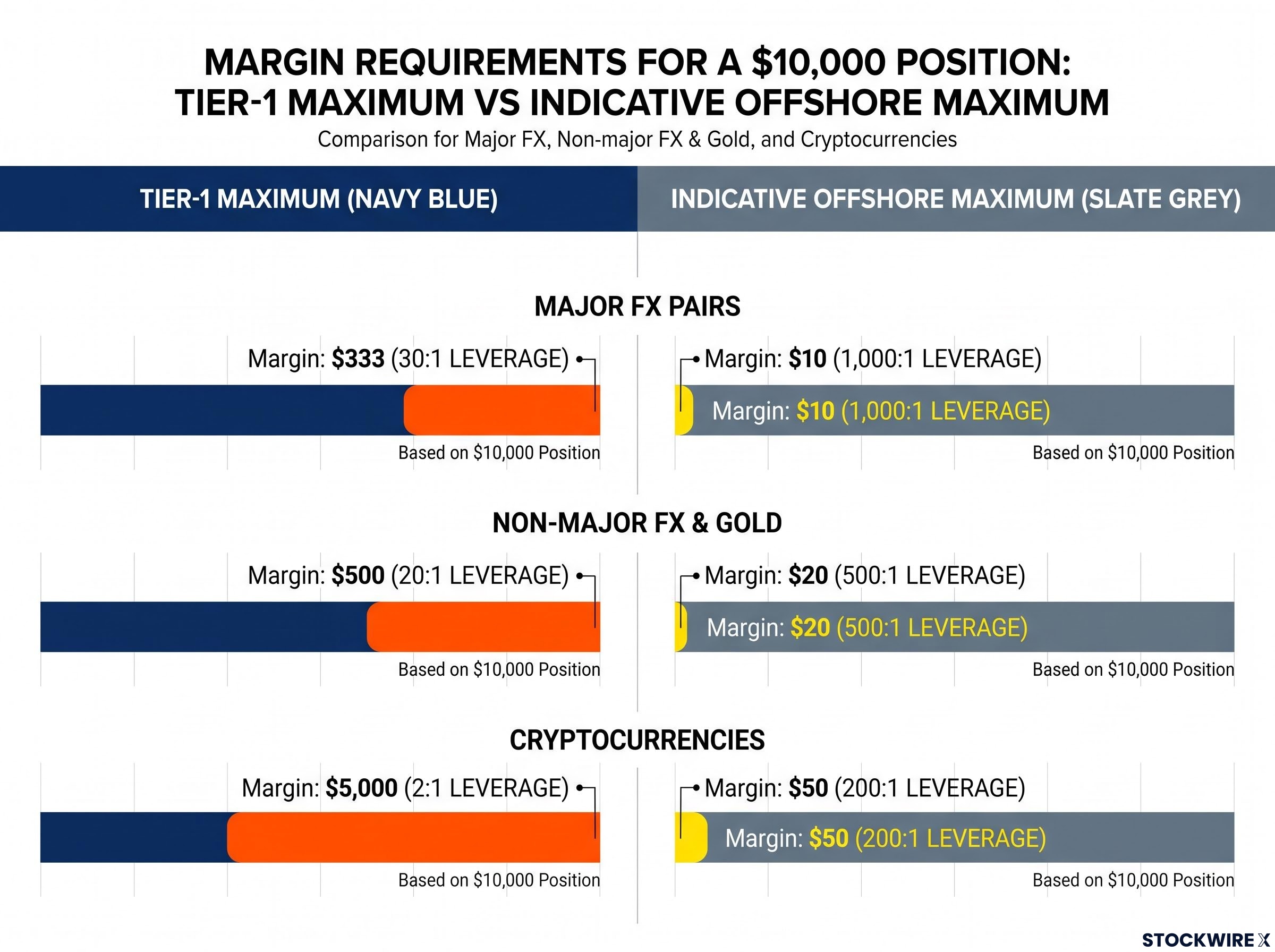
These caps are not regulatory trivia. Each number decides how much of your own capital you must post per position and how fast a move against you can wipe that position out. Offshore brokers, by contrast, routinely advertise 200:1 to 1,000:1, with some reaching 3,000:1 on forex.
| Asset Class | Max Leverage (Tier-1) | Indicative Offshore Max | Margin at Tier-1 ($10,000 position) | Margin Offshore (same position) |
|---|---|---|---|---|
| Major FX pairs | 30:1 | 1,000:1 | $333 | $10 |
| Non-major FX, gold | 20:1 | 500:1 | $500 | $20 |
| Non-gold commodities | 10:1 | 200:1 | $1,000 | $50 |
| Individual equities | 5:1 | 200:1 | $2,000 | $50 |
| Cryptocurrencies | 2:1 | 200:1 | $5,000 | $50 |
Read the last two columns as your real starting risk. Post $20 instead of $500 on the same position, and the same price wobble that a Tier-1 account absorbs can close you out entirely offshore.
What regulation does not guarantee
Tier-1 status is not a solvency guarantee. In 2019, FCA-regulated AFX Markets entered special administration, showing that heavy oversight at the front end does not stop a firm from failing.
It also does not make you profitable. ESMA and FCA data show that 70-80% of retail contract-for-difference (CFD) accounts lose money even under capped leverage. The caps limit how badly a single event can hurt you; they do not turn losing strategies into winning ones. That is worth calibrating for, not because it weakens the case for Tier-1 protection, but because it stops you expecting the wrong thing from it.
CFD loss rates are not uniformly distributed across account types; ESMA data from Q1 2026 shows between 74% and 89% of retail accounts lose money, with average losses reaching up to 29,000 euros per client, figures that apply even under capped leverage within Tier-1 jurisdictions.
When big ASX news breaks, our subscribers know first
The leverage maths that changes everything
Numbers persuade better than warnings here, so work through one trade.
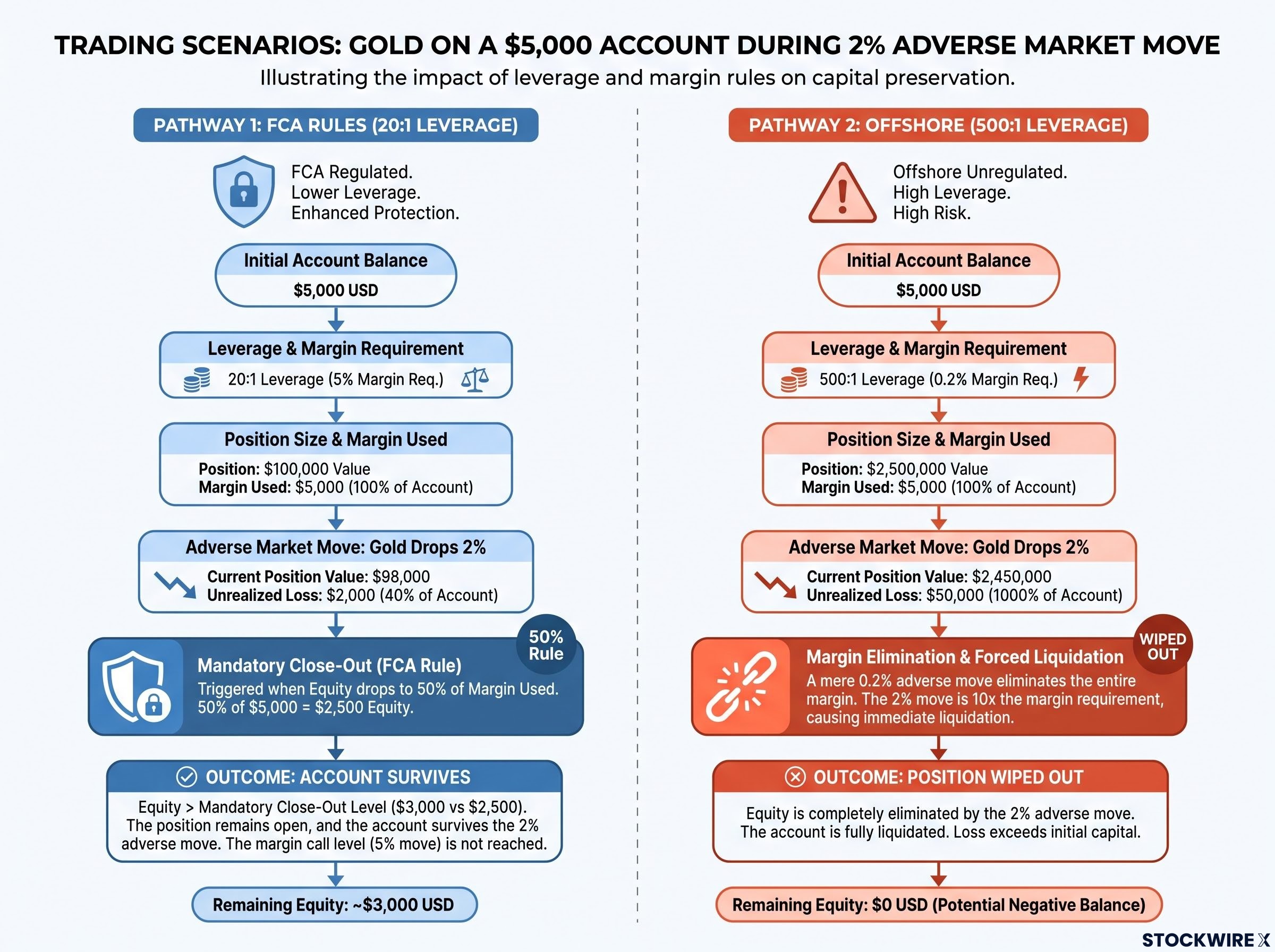
Take a $5,000 account and a gold position under two regimes. Follow what a 2% adverse move does to each.
- Under FCA rules, gold leverage is capped at 20:1. To lose your posted margin on a position, gold has to move roughly 5% against you. A 2% adverse move stings but leaves you standing, and the mandatory close-out at 50% of required margin steps in before you reach zero.
- Offshore at 500:1, the same gold position needs only a 0.2% move to eliminate the margin behind it. A 2% adverse move is ten times that. The position is gone long before you have finished reading the price alert.
Margin close-out mechanics operate differently across regulatory regimes: under FCA and ASIC rules, positions must be closed at 50% of required margin, while offshore brokers often apply discretionary thresholds or none at all, meaning the same adverse move can produce a forced close under one framework and a runaway loss under another.
Same account, same trade, same market. The only variable is the leverage number, and it is the difference between a bruise and a blown account.
Now push it to a genuine tail event.
On 15 January 2015, the Swiss National Bank triggered extreme Swiss franc volatility. At 500:1 leverage, a large sudden move represents many times the margin posted.
At brokers without negative balance protection, accounts did not just hit zero. They went deeply negative, and clients were left owing sums far beyond anything they had deposited. This is the stress test that reveals what offshore leverage does during a real shock, and every trader running high leverage has the same structural exposure baked into every position.
The uncomfortable part is that high leverage does not only amplify the disaster scenarios. It quietly changes ordinary trading too. Stop distances that feel conservative at 30:1 sit close enough to price at 500:1 that routine intraday noise can trigger them.
The offshore broker Finrix Markets illustrates the setup plainly: 1,000:1 on forex, 500:1 on gold, with voluntary negative balance protection in place. That protection is the only thing standing between a client and a 2015-style negative balance, and it is voluntary, not mandated.
So the real question is not whether high leverage is attractive. It obviously is. The question is whether the margin efficiency you gain is worth the loss scenario you inherit, and the arithmetic above is how you answer that for yourself rather than treating leverage as a dial to turn to maximum.
Client money, compensation schemes, and what actually happens when a broker fails
Most traders assume their money is protected somewhere. It is worth taking that assumption apart, because the answer depends entirely on where your broker is regulated.
In the UK, the Financial Services Compensation Scheme (FSCS) covers investment business up to £85,000 per eligible person per firm for failures after 1 April 2019. That is a genuine statutory backstop: if the firm fails, the scheme pays out.
Singapore’s MAS runs something narrower. Capital markets licence holders typically lodge a S$100,000 deposit with the regulator to compensate clients for losses from misconduct or misappropriation, not from general firm failure. Australia sits further along the spectrum again, with no statutory compensation fund for forex or CFD traders at all. Protection there rests entirely on client money segregation rules under the Corporations Act and Regulatory Guide 227.
| Jurisdiction | Regulator | Statutory Compensation Fund | Protection Limit | Segregation Required |
|---|---|---|---|---|
| United Kingdom | FCA | Yes (FSCS) | £85,000 per person, per firm | Yes |
| Singapore | MAS | Limited (misconduct only) | S$100,000 broker deposit | Yes |
| Australia | ASIC | No | None statutory | Yes (RG 227) |
| Offshore centres | FSC Mauritius, Vanuatu, etc. | No | None statutory | Varies / voluntary |
The USGFX / Union Standard International Group collapse shows why the gap between these rows matters. Court proceedings uncovered A$357 million in client and creditor claims against just A$8 million in remaining funds, with total retail CFD losses linked to associated offshore brands exceeding A$458 million in the 2024 financial year. Penalties of A$300.2 million were ordered in June 2026.
When claims dwarf assets like that, the regulatory tier decides whether you recover anything at all. Without a statutory fund, offshore clients typically rank as unsecured creditors in insolvency, behind secured lenders and tax authorities.
Cross-border structures make it worse. When AFX Markets failed in 2019, most of its £7.7 million in client money sat with its Cypriot parent, claims exceeded £13.7 million, and the offshore holdings frustrated recovery when that parent was also insolvent.
On 30 October 2025, the FCA warned that authorised firms were redirecting UK retail clients to third-country CFD providers, stripping away the domestic protections those clients assumed they still had.
FCA protections stripped offshore extend beyond leverage caps alone; the same broker group can operate two entirely different regulatory regimes under identical branding, with the Vanuatu-regulated international platform carrying none of the legally enforceable rights that apply to the FCA-authorised UK entity.
What offshore brokers do instead
Offshore brokers substitute voluntary measures for statutory schemes: segregated accounts, negative balance protection, and private insurance. Finrix Markets, for instance, reports segregated accounts, voluntary negative balance protection, and Lloyd’s of London cover up to US$1 million.
The catch is enforcement. Offshore regulators rarely have the capacity to compel these measures, so they depend on broker behaviour rather than legal obligation. That means you have to distinguish between brokers that genuinely implement them and those that list them as marketing copy no one independently checks. On offshore ground, a claim on a website is not the same as a protection you can rely on.
Instrument access, costs, and the practical reasons traders go offshore
None of this means offshore is irrational. Experienced traders choose it deliberately, and the reasons are concrete rather than reckless.
The practical pull comes down to three things:
- Unrestricted leverage far beyond the Tier-1 grid, useful for tight-stop intraday strategies that capped leverage disrupts.
- Instruments prohibited onshore, including crypto CFDs, which the FCA bans for retail clients, along with certain exotic products and promotional bonuses.
- Hedging capabilities that some Tier-1 regulators restrict.
Finrix Markets shows the breadth on offer: roughly 1,300 instruments, including over 1,000 share CFDs and 98 forex pairs, at leverage impossible under Tier-1 rules. That range is a genuine draw for equity-heavy traders.
Costs are more of a trade-off than a clear win. Offshore brokers often advertise zero commission but embed the cost in wider spreads. That can be less transparent than the onshore model of a visible commission plus tighter spreads, so “commission-free” is not automatically cheaper once the spread is priced in.
The professional client pathway as a Tier-1 alternative
Here is the piece many traders do not know exists. Under FCA and MiFID II rules, you can elect professional client status while staying onshore, and doing so lifts several of the retail restrictions that push people offshore.
Qualifying means meeting two of these three criteria:
- An average of significant trades per quarter over the past year, at a sufficient frequency and size.
- A financial instrument portfolio of sufficient size.
- Relevant professional experience in the financial sector.
Once classified as professional, higher leverage may apply depending on broker policy, and you gain access to conditions closer to what draws traders offshore. You waive certain retail protections to get there, so it is a conscious trade, not a free upgrade.
This route does not replicate 1,000:1 leverage. What it does is materially widen your conditions within a protected framework, which for many traders removes the single strongest reason to leave it. It is information worth having before you default to offshore for the leverage number alone.
Making the offshore decision with open eyes
You now have the four levers that actually matter: leverage, protection, instruments, and cost. The decision is not about which broker is good or bad. It is about matching those levers to your own capital, strategy, and tolerance for counterparty risk.
The differences are stark across all four: leverage caps of 30:1 to 2:1 onshore against 200:1 to 3,000:1 offshore, FSCS-style coverage against no statutory fund, restricted instruments such as the FCA crypto CFD ban against open access, and transparent costs against embedded ones.
Offshore makes rational sense for a specific profile:
- Experienced, well-capitalised traders whose leverage or instrument needs cannot be met onshore, and who treat the broker as counterparty risk to actively manage rather than a protected utility.
Onshore is the better structural fit for another:
- Newer traders and smaller accounts, where £85,000 of FSCS protection represents a meaningful slice of capital, and traders whose strategies already work within Tier-1 caps.
Recent enforcement shows why the offshore route carries selection risk even among licensed firms.
ASIC cancelled the licences of XTrade.AU in June 2024 and FXOpen AU in September 2024 over deficiencies in resources and supervisory arrangements. Offshore licensing does not equal safety.
If you do choose offshore, verify the voluntary protections rather than trusting the marketing:
- Segregated accounts, independently confirmed rather than self-reported.
- Negative balance protection, documented in the client agreement.
- Private insurance, with actual policy details rather than a logo.
- Withdrawal policy, checked against independent reviews for evidence of timely processing.
The trader who goes offshore knowing exactly what statutory protection they are giving up, and having verified the substitutes, is in a completely different risk position from the one who chased a leverage number.
Pre-committed trading rules are the mechanism that separates professional risk management from reactive decision-making; research covering more than 8,400 active journal users found that traders who formalise their process before entering positions reach profitability at roughly double the rate of those who do not.
What the regulatory tier you choose actually determines about your risk
The regulatory tier your broker sits under sets your leverage ceiling, your instrument access, the mechanism protecting your funds, and whether any compensation exists at all. Knowing which of those four matters most to your specific strategy is what turns the broker choice from an arbitrary default into a rational decision.
If leverage is your main reason for looking offshore, investigate the professional client pathway first. It is the underused middle option that widens your conditions without stripping away your protections entirely.
The boundary itself is moving. The FCA’s October 2025 warning on client redirection and ASIC’s 2024 licence cancellations show that the offshore route is being policed harder, not left alone, so this is not a decision you make once and forget.
Before you close this, run four checks:
- Confirm your current broker’s regulatory tier.
- Identify which of the four dimensions matters most to your strategy.
- Investigate the professional client pathway if leverage is the driver.
- Verify voluntary protections if you are staying or moving offshore.
This article is for informational purposes only and should not be considered financial advice. Investors should conduct their own research and consult with financial professionals before making investment decisions. Past performance does not guarantee future results.