The Bank of Japan just raised interest rates to their highest level since 1995, and the yen fell. That apparent contradiction is the story.
On 18 September 2026, the BoJ lifted its policy rate by 25 basis points to 1.25%, completing a tightening sequence that has dismantled three decades of near-zero rates in under a year. Two board members dissented, and USD/JPY climbed above 157 in the hours that followed. The Federal Reserve had raised rates just two days earlier, tightening from the other side of the world’s most important currency differential.
This piece explains the mechanics behind these seemingly contradictory market moves, what the narrowing Japan-US rate gap means for leveraged positions built on cheap yen borrowing, and which parts of global markets are most exposed to the structural shift now underway.
A 31-year high built on a 7-2 vote: inside the BoJ’s September decision
The number carries weight. At 1.25%, Japan’s policy rate now sits at its highest since 1995, the year the country began its long slide into near-zero borrowing costs after its asset bubble collapsed. Getting here took a remarkably fast sequence: 0.75% in December 2025, 1.00% in June 2026, and now 1.25%.
But the headline conceals a fracture. The decision passed on a 7-2 vote, with board members Toichiro Asada and Ayano Sato dissenting, both citing concerns about inflation excluding fresh food and the underlying strength of the economy.
That split is not a footnote. Two dissenting voices at a landmark hike tells you the BoJ’s internal consensus is genuinely divided, and that the pace of future moves is far from settled. When you read the next BoJ statement, watch whether that dissent widens or narrows, because it is one of the clearest signals of where the board’s centre of gravity is heading.
The July hold decision is the direct precursor to September’s split vote: at that meeting Hajime Takata dissented in favour of an immediate hike to 1.25%, establishing the internal pressure that Asada and Sato’s opposing dissent in September now complicates from the other direction.
Publicly, the central bank leaned hawkish. The FXStreet Speechtracker scored the communication 8.2 out of 10 for hawkishness. The BoJ’s stated reasoning centred on the following signals:
- Underlying inflation approaching the 2% price stability target, with a risk of overshooting
- Wage-driven cost pass-through cited as a structural, rather than temporary, inflation driver
- Recent yen depreciation flagged as an amplifier of imported price pressure
- Risks to monitor including Middle East instability and foreign exchange volatility
August headline inflation ran at approximately 1.9%, close enough to target that the deflationary argument for holding rates near zero has effectively evaporated.
ING economist Min Joo Kang characterised the normalisation as a signal of progress toward more sustainable growth and price stability, framing the move as a step away from the ultra-loose policy Japan maintained for decades.
The takeaway for anyone tracking Japanese policy: this was a landmark decision that is also contested from within. The direction is clear, but the speed is not.
When big ASX news breaks, our subscribers know first
Why the yen weakened on a rate hike, and what that actually signals
Higher rates are supposed to lift a currency. When a central bank raises borrowing costs, higher yields attract international capital, and that inflow strengthens the currency. The BBC’s own explainer puts the principle plainly: typically, a rate rise means a stronger national currency.
“Typically, when a central bank raises rates, the national currency strengthens, as higher rates tend to attract more traders.” The September reaction inverted that logic entirely.
So why did the yen fall? The answer sits in the expectations layer. Currency markets do not trade the rate change itself; they trade the gap between what was delivered and what was priced in. When a 25 bp hike arrives after markets have positioned for something more aggressive, the modest move reads as confirmation of restraint, not acceleration.
This pattern has now repeated at every hike in the cycle. In December 2025, the absence of hawkish signals from Governor Kazuo Ueda sent the dollar to a one-month high above 157 yen, despite the increase to 0.75%. In June 2026, markets had speculated on a 50 bp move; the BoJ’s decision to stay at 25 bp was read as dovishly restrained, tempering yen strength.
September fitted the mould. USD/JPY sat near 156.25-156.30 before the announcement, then climbed to roughly 156.6-157+ afterward, with some venues reporting moves above 157.
| Hike date | Rate move | Market expectation context | USD/JPY reaction |
|---|---|---|---|
| December 2025 | to 0.75% | No hawkish signals from Ueda | Yen weakened, dollar above 157 |
| June 2026 | to 1.00% | Markets priced 50 bp; got 25 bp | Yen strength tempered |
| September 2026 | to 1.25% | Pace recalibrated downward | Yen weakened toward 157 |
The repeated pattern tells you something practical: the yen will only strengthen durably when markets trust the pace of tightening, not simply when individual hikes land. If you are watching USD/JPY for direction, watch the guidance, not just the rate.
The carry trade under pressure: what $500 billion in borrowed yen means for global markets
To understand why a domestic Japanese decision matters to a portfolio in Sydney, London, or New York, you need to understand the yen carry trade. For decades, investors have borrowed money cheaply in Japan, where rates sat near zero, and deployed it into higher-yielding assets around the world. The gap between near-free yen funding and richer returns elsewhere was the entire point.
The yen carry trade mechanics that sustained the strategy through the June 2026 hike to 1.0% reveal a structural point: a 2.5%-2.75% spread over US rates was wide enough to keep yen-funded positions profitable even after the BoJ began tightening, which is precisely why compression to 250-275 basis points at 1.25% marks a qualitatively different threshold.
Tightening erodes that foundation from the funding side. As Japanese rates rise, the cost of borrowing yen climbs, the return differential narrows, and leveraged positions built on cheap funding become harder to justify.
The unwind, when it comes, tends to follow three stages:
- Rising yen borrowing costs shrink the profit margin on carry positions
- Investors close positions, which means buying back yen and pushing the currency higher
- To raise the cash, they liquidate the assets those positions funded, transmitting volatility into recipient markets
Here is where the second-order effects reach across the globe. AInvest estimates roughly $500 billion in yen carry trades may need to unwind as rates climb, though that figure is drawn from AInvest analysis and has not been independently verified. Forced selling of that scale spreads into several corners of the market:
- Cryptocurrency, historically a destination for leveraged risk capital
- Emerging market equities and bonds
- Yen-denominated debt held by borrowers who now face higher servicing costs
Indonesia, Thailand, and Mexico stand out as particularly exposed, given their reliance on yen-based funding conditions.

What makes this cycle different is that the pressure now comes from both sides at once. The Fed raised its target range to 3.75%-4.00% on 16 September 2026 in a unanimous 12-0 vote, its first hike since July 2023. With the BoJ at 1.25%, the Japan-US differential has compressed to roughly 250-275 basis points, far below the extreme gaps that sustained carry trades in recent years. CME FedWatch put the probability of a further Fed hike at the October meeting at approximately 53-55%.
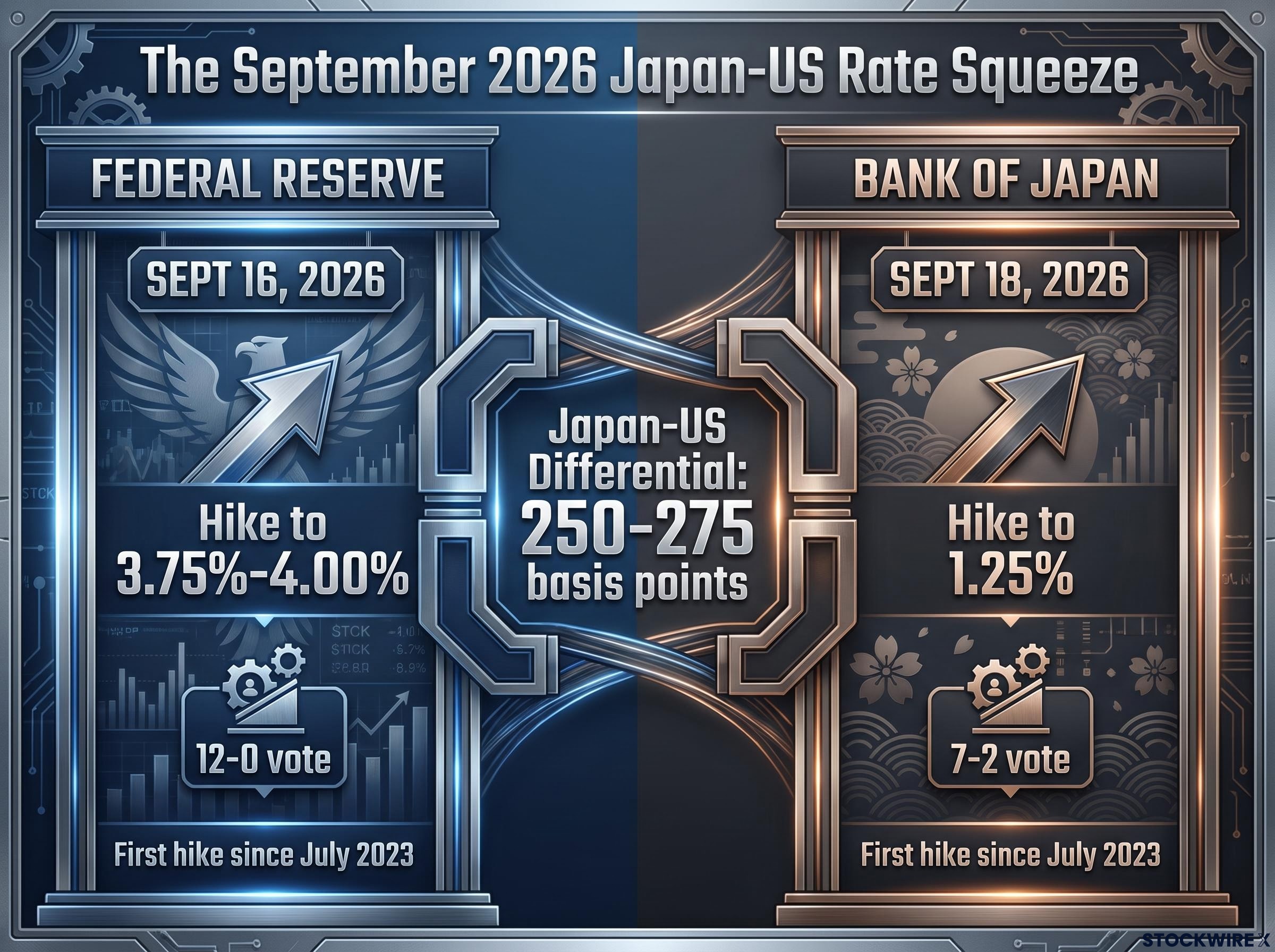
The simultaneous squeeze tells you this is structural, not episodic. With the Fed hiking and the BoJ hiking, and DBS analysts projecting the BoJ to move roughly once every three to four months, the conditions that made classic yen carry trades work are eroding faster than any single decision suggests. If you hold assets funded on cheap yen, or emerging market and crypto exposure that benefits from that funding sloshing around, this is not a temporary disruption to wait out.
For investors wanting to stress-test the $500 billion unwind estimate against historical precedent, our deep-dive into yen carry trade systemic risk examines how the 2024 episode resolved within weeks and provides a three-question diagnostic framework for separating genuine structural breakdown from headline-driven noise.
Three decades of near-zero rates: what the regime shift means beyond the next hike
Step back from the September meeting and the scale becomes clear. In 1995, Japan began cutting rates toward zero in response to the collapse of its property and asset bubble. Returning to 1.25% is the symbolic reversal of that entire era, a 31-year round trip back to where the descent started.
The bond market is confirming the shift. The 10-year JGB yield breached 2% for the first time since 1999 during the prior cycle, and DBS analysts project it moving toward 2.85% by year-end 2026. Two-year yields already sit at levels last seen in the mid-1990s.
The forward question is not whether Japan is normalising, but how fast it can afford to. The BoJ is navigating between two failure modes at once, and which one feels closer at each meeting will set the pace.
The BoJ rate hike path through 2027 is complicated by a structural distortion: Japan’s planned food consumption tax cut from 8% to 1% in April 2027 could mechanically suppress headline CPI by 1.0-1.5 percentage points, meaning the central bank needs to establish rate credibility before that distortion arrives and creates a false read on price stability.
The case for faster normalisation
One camp argues the BoJ is still too slow. With the yen hovering near 157, imported inflation risk persists, and carry trades have room to rebuild in the gaps between hikes.
A Reuters report on 15 September 2026 noted that some analysts had priced in the BoJ doubling its pace to once per quarter, climbing above 2% within a year. The same report warned that risks were “heavily skewed towards a market disappointment” if the central bank under-delivers on that pace.
Reuters characterised the balance of risk as “heavily skewed towards a market disappointment” should the BoJ fail to match the faster cadence markets had begun to price.
The case for caution
The opposing camp points to Japan’s structural constraints. BNP Paribas, in its “Difficult Normalization” analysis, flags the country’s high public debt, aging demographics, and fragile growth base as reasons aggressive tightening could destabilise both growth and public finances.
The dissent from Asada and Sato is the market signal that this caution has institutional representation inside the BoJ itself. For readers with exposure to Japanese government bonds or global fixed income, this tension between credibility and fiscal sustainability frames both the upside and downside for yen direction and JGB yields over the next year. Higher domestic yields could also pull Japanese capital home, drawing it away from US Treasuries.
What the 1.25% era actually changes for currency markets and global positioning
The analysis across this piece points to one reframe. Yen dynamics are driven by expectation gaps, not rate levels. Carry-trade unwinds are structural, not episodic. And the BoJ is caught between fiscal fragility and credibility, unable to solve one risk without inflaming the other.
That means the yen’s next major move will hinge less on the rate itself and more on whether forward guidance matches the roughly once-per-quarter cadence markets have now priced. Guidance is the variable that matters most.
Three signposts are worth monitoring rather than adopting a wait-and-see posture:
- BoJ forward guidance at the October or November meeting, and whether it confirms or disappoints the once-per-quarter cadence
- The Fed’s October decision, where CME FedWatch implies a 53-55% hike probability, and its effect on the 250-275 basis point Japan-US differential
- The 10-year JGB yield trajectory against the DBS projection of 2.85% by year-end, as a read on capital repatriation pressure
Success for the BoJ looks narrow: fast enough to signal yen credibility, slow enough to preserve fiscal stability, and clear enough in guidance that markets stop reading each hike as a letdown.
This article is for informational purposes only and should not be considered financial advice. Investors should conduct their own research and consult with financial professionals before making investment decisions. Past performance does not guarantee future results, and financial projections are subject to market conditions and various risk factors.