Every few months, the AI trade reinvents itself. Semiconductors were the obvious play, then power infrastructure, then enterprise software.
Now capital is making another move: out of memory chips and into cybersecurity, with Jensen Huang providing the narrative cover and CrowdStrike providing the all-time highs.
This is not simply a momentum story. The valuation gap between the two ends of the trade has become so wide that it raises a real question: is this a structural shift in where AI creates enterprise value, or a speculative sprint into the next crowded momentum category?
The answer matters, because the two outcomes demand entirely different positioning decisions.
What follows here is a framework for reading sector rotation dynamics in AI-adjacent markets, grounded in the specific valuation, rate sensitivity, and narrative data available as of September 2026. Not a call to chase or to fade, but a map of what the trade actually looks like from both ends.
How the rotation is actually moving: memory out, cybersecurity in
The clearest way to see this rotation is on the tape, not in the commentary. Money has been leaving memory-linked equities for weeks while cybersecurity software names have pulled in sustained buying.
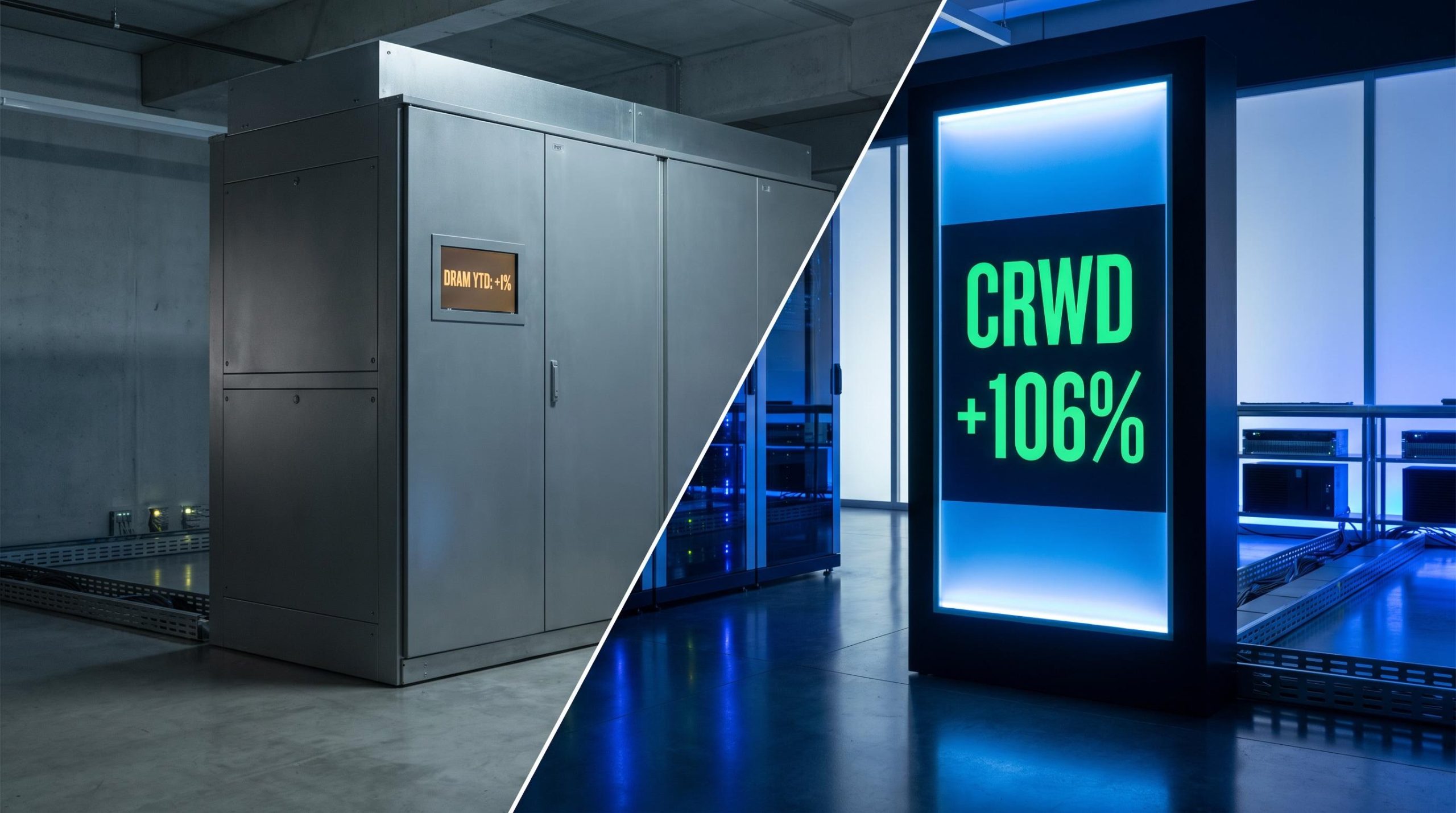
The price divergence is stark. The Roundhill Memory ETF (DRAM) has posted a flat year-to-date return, somewhere between 0% and 2%, and remains in negative territory over twelve months. CrowdStrike (CRWD), meanwhile, has returned roughly 106% so far this calendar year and about 117% over the trailing twelve months.
Providing the narrative cover for that move is Nvidia chief executive Jensen Huang. At the Goldman Sachs Communacopia and Technology Conference in San Francisco on 10 September 2026, Huang framed cybersecurity as AI’s next major use case, the successor to coding.
“We’re at an inflection point in cybersecurity.”
Jensen Huang, Nvidia CEO, speaking at CrowdStrike’s Fal.Con 2026 conference
His argument rests on a mechanical point: AI security systems scan and defend continuously, unlike coding assistants that wait for a prompt, so enterprises will pay to keep them running around the clock. The Nvidia-CrowdStrike SafeMind platform partnership gave that thesis an institutional stamp.
The numbers below show how far the two ends have diverged as of mid-September 2026.
| Metric | CrowdStrike (CRWD) | Roundhill Memory ETF (DRAM) |
|---|---|---|
| Year-to-date return | ~106% | 0% to 2% (flat) |
| 12-month return | ~117% | Negative |
| Approx. current price | ~$241 | $55 to $56 |
Here is the detail that should reframe how you read the trade. The DRAM ETF carries a 52-week range of $26.14 to $81.34. That tells you memory is not simply lagging; it has already completed a full speculative cycle, running up and rolling over.
Memory chip earnings surged more than 900% year-on-year in Q1 2026, with DRAM contract prices rising 90-95% in that quarter alone, a fundamental performance that makes the sector’s flat-to-negative price return in 2026 a story about capital rotation rather than deteriorating business results.
Where capital is arriving in cybersecurity now looks a lot like where memory sat roughly 18 months ago. Knowing where the rotation stands within its own cycle, not just its direction, is what separates a useful read from momentum-chasing.
When big ASX news breaks, our subscribers know first
What the valuation gap actually tells you
Put the two multiples side by side and the contrast does the talking. CrowdStrike trades at a forward price-to-earnings ratio of 150x to 170x, a level that only makes sense if you accept the market is pricing a future, not a present.
The company has moved into GAAP profitability, but its absolute net income is modest against its market capitalisation. Its annual recurring revenue (ARR), the predictable subscription revenue booked on an annualised basis, sits at $5.25 billion, up 24% year over year, with subscription gross margins of 78% to 81%.
Now the other end. The DRAM ETF screens at a weighted P/E of 9.8x to 30x depending on methodology, against roughly 26x for the broader technology sector. Western Digital, the consolidated home of the memory assets, reported a Q4 gross margin of 54.4% and a full-year gross margin near 49%, with Q2 FY2026 revenue of $3.017 billion.
| Metric | CrowdStrike (CRWD) | Western Digital (memory proxy) |
|---|---|---|
| Forward P/E | 150x to 170x | ~9.8x to 30x (via DRAM ETF) |
| Gross margin | 78% to 81% (subscription) | ~49% full-year |
| EV / forward revenue | 14x to 22x (sector) | Not publicly reported |
So what is the cybersecurity premium actually encoding? Three structural factors do most of the work.
- Non-discretionary demand: enterprises cannot switch off security spend in a downturn the way they can trim marketing software.
- High retention rates: entrenched platforms keep customers, which underwrites the recurring revenue base.
- Regulatory tailwinds: compliance mandates keep expanding the addressable market.
Those factors help explain why cybersecurity leaders trade at 14x to 22x enterprise value-to-forward revenue, a 20% to 40% premium over general software-as-a-service peers at 4.5x to 7x.
The offence-defence asymmetry in AI security is structural rather than cyclical: attackers can deploy vulnerability tools at current accuracy levels, while defenders require near-zero false-positive rates to avoid analyst overload, a constraint that entrenches platform consolidators with broad telemetry and validated detection over point-solution vendors.
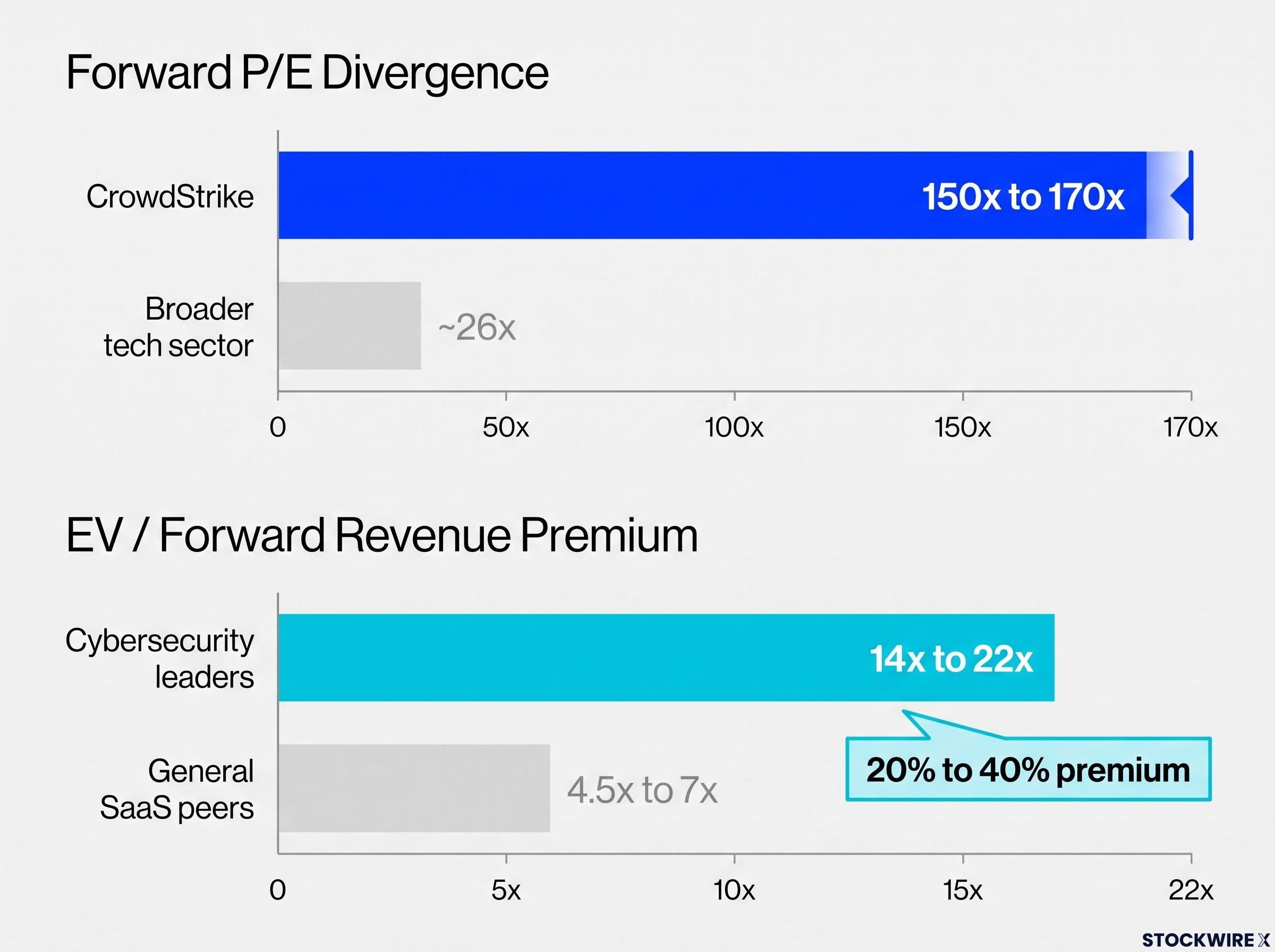
Here is what a 150x forward P/E on a company with modest absolute profits tells you. The market is not pricing what CrowdStrike earns today; it is pricing what it believes the AI security category will be worth at full scale. That makes the thesis fragile to any evidence the category turns out smaller or slower than assumed.
Why momentum can stretch valuations further than logic suggests it should
If a 150x multiple feels irrational, history says the market can sustain that irrationality for a surprisingly long time. Strong conviction in a structural business model has repeatedly kept valuations elevated well past the point traditional metrics would allow.
Three analogues make the point:
- Amazon, which defied conventional valuation for years as investors backed its structural model.
- Nvidia, which held stretched multiples through its own AI ascent before any reassessment.
- The current cybersecurity rotation, following the same conviction-led dynamic.
The mechanical explanation comes from Dhaval Joshi, macro strategist at BCA Research, who argues the market is not experiencing a single AI bubble but something more sequential.
The market is living through a “rolling sequence of bubbles” across AI-adjacent supply chains, from semiconductors to software to commodities.
Dhaval Joshi, macro strategist, BCA Research
Capital sprints into one trade, extracts its gains, and rotates into the next. Cybersecurity holds institutional conviction because the software sector has bifurcated: legacy models are being discounted as investors question their place in an AI-native world, while AI-native security platforms keep their premium on genuine structural demand.
Rolling bubble mechanics follow a repeatable structural pattern: explosive participation, record margin debt, proliferation of leveraged products, narrow sector leadership, and media saturation each appeared in measurable form before the KOSPI’s 26% collapse in under a month, and the same five signals apply directly to any AI-adjacent trade running on conviction rather than current earnings.
For you, the read is this. Treat the rotation not as a permanent judgment on fundamentals but as a capital flow dynamic with a finite duration. The question is not whether it ends but when.
What the options tape is signalling about rotation durability
The tape offers a clue on timing. Traders have been buying puts on high-multiple cybersecurity names at the same moment memory equities are being sold, options positioning that pays off if the richly valued end pulls back.
That is not simple momentum-following; it is hedging. It tells you some sophisticated participants already see the rotation as fragile and are quietly pricing in its reversal, even as the trade continues to run.
Three specific risks that could break the trade before it fully plays out
Understanding how the rotation works is one thing. Knowing what could terminate it is another, and each of these three risks carries a signal you can track in real time.
- Rising interest rates. High-multiple names carry the most sensitivity to the discount rate used to value future earnings. Thematic research on cybersecurity suggests a 50 to 100 basis point rise translates to roughly 10% to 15% downside through discount-rate effects, with current models embedding assumptions in the 8% to 9% range.
- Execution risk. CrowdStrike and its peers are priced for near-perfect delivery. With ARR growing 24% to $5.25 billion, even a modest deceleration in that figure is the most direct trigger for sharp multiple compression.
- Narrative fatigue. “AI-native cybersecurity” marketing is saturating. As buyers grow sceptical of undifferentiated AI claims, the willingness to pay an AI-justified premium can fade, undermining the multiples directly.
The central bank signal most investors are underweighting
The regulatory alarm has become notably loud. The Bank of England’s Financial Policy Committee, the European Central Bank, and the Monetary Authority of Singapore all warned across 2025 and 2026 that AI-focused tech valuations look stretched.
The Bank of England and the ECB explicitly compared current AI-focused tech valuations to the peak of the early-2000s dot-com bubble.
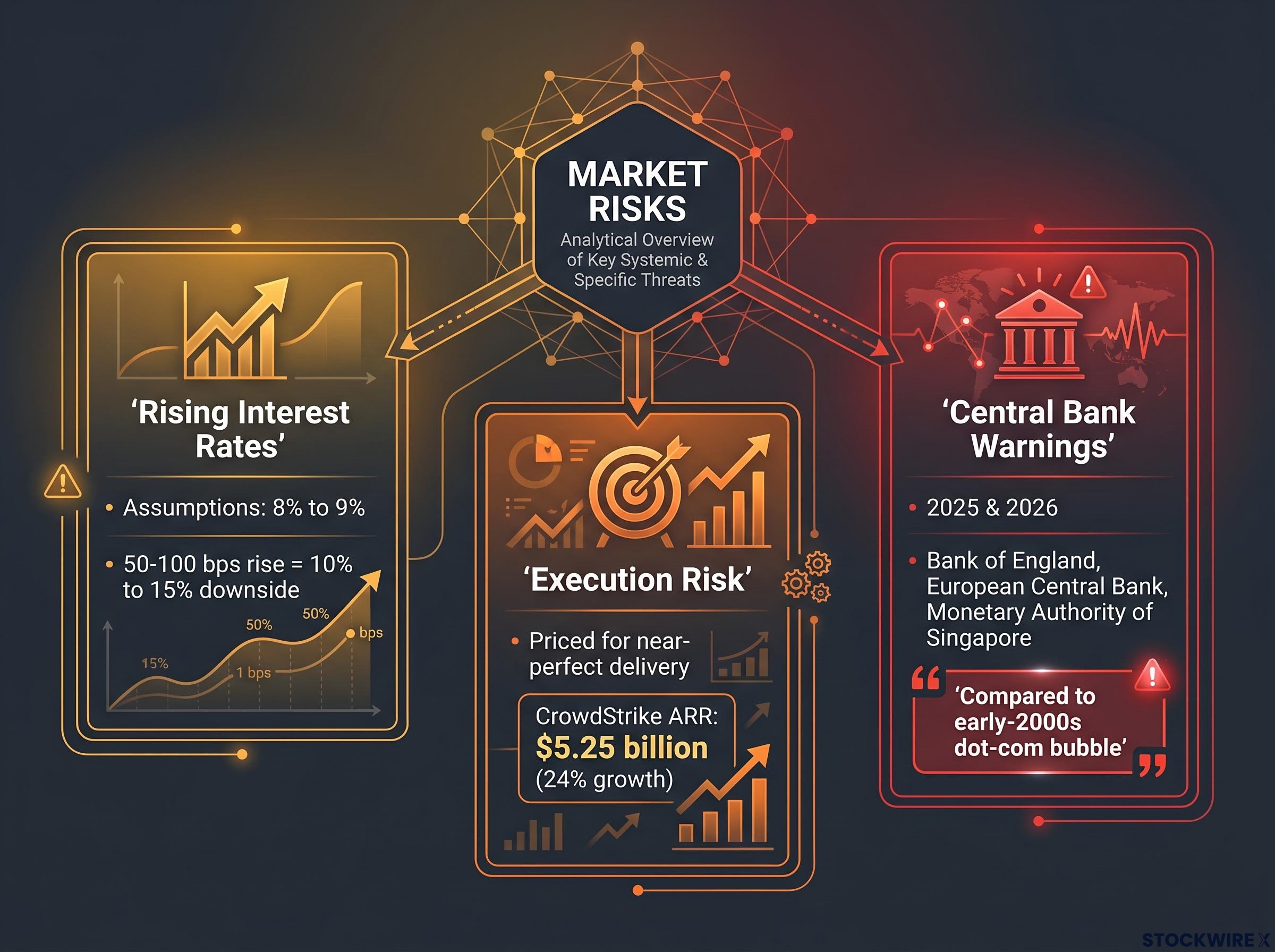
Three major regulators, across three jurisdictions, raising the same concern at the same time is not routine commentary. It signals coordinated worry about systemic valuation risk, and it is the piece most positioning appears to be underweighting.
Put those three together, the rate environment, the execution bar, and the narrative saturation, and the trade carries more breakage risk than its recent momentum implies.
Reading the rotation clearly without chasing it
The rotation from memory to cybersecurity is real. It is driven by genuine narrative catalysts and by structural enterprise demand that is not going away.
But the valuation gap between the two ends now prices in a near-perfect future, and that future carries specific, trackable breakage risks. Understanding the trade is not the same as acting on it.
If you grasp the rolling bubble dynamic, the rate sensitivity embedded in a 150x multiple, and the three risk variables, you are positioned to make a calibrated decision rather than a reactive one.
Three leading indicators will tell you whether this rotation has further to run or has already peaked: the interest rate trajectory, CrowdStrike’s ARR growth at its next earnings print, and enterprise AI security spend data. Watch those, and you will see the turn before it shows up in the price.
For investors wanting to understand how cybersecurity, semiconductors, and energy fit within a single investment framework, our dedicated guide to AI value chain layers maps all six segments of the AI supply chain, including their different S-curve positions, risk levels, and time horizons, so you can audit where your current holdings actually sit.
This article is for informational purposes only and should not be considered financial advice. Investors should conduct their own research and consult with financial professionals before making investment decisions. Past performance does not guarantee future results, and financial projections are subject to market conditions and various risk factors.