
On the day WTI crude was settling above $103 per barrel, a commodity level that should have put a firm floor under the Canadian dollar, USD/CAD surged 48 pips and came within a few ticks of the psychologically significant 1.4000 level. Oil lost the argument. The rate differential won.
The Federal Reserve held its target range at 3.50%-3.75% on 29 July 2026, while the Bank of Canada has sat at 2.25% through seven consecutive meetings. That roughly 1.25-percentage-point gap has become the governing force in this currency pair, powerful enough to override Canada’s terms-of-trade advantage from elevated crude prices.
Understanding which force dominates, and when, is the practical edge that separates reactive forex trading from informed positioning.
Here is what the price action reveals about the hierarchy of forces driving USD/CAD, and what it means for positioning ahead of the Bank of Canada’s next decision on 28 October 2026.
The 48-pip move: what the price action tells you before the analysis does
For roughly eighteen hours before the Fed decision, USD/CAD went almost nowhere. The pair traded inside a range of about 25 pips, the kind of tight coil that tells you the market had already positioned and was waiting for a catalyst rather than debating direction.
Then the decision landed, and the coil released.
USD/CAD surged around 48 pips from its pre-release level, driving to a high just below 1.4000. That was the primary event of the session. The session low, recorded before midday, sat roughly 62 pips below the post-decision high and was never revisited after the announcement crossed the wires.
The five-minute momentum gauge told the same story with a single number.
Momentum reading of 72 The five-minute momentum gauge hit 72 immediately after the announcement, a level not sustained for more than a few minutes at any other point in the session. That is conviction behind the move, not noise around it.
Here are the numbers that framed the session:
- Pre-announcement range: approximately 25 pips over roughly 18 hours
- Post-announcement surge: approximately 48 pips, high just below 1.4000
- Session low versus post-decision high: approximately 62 pips lower, not revisited
- Five-minute momentum reading: 72 post-announcement
- WTI crude on the day: $102.93-$103.37 per barrel (MarketWatch and Investing.com, 15-16 September 2026)
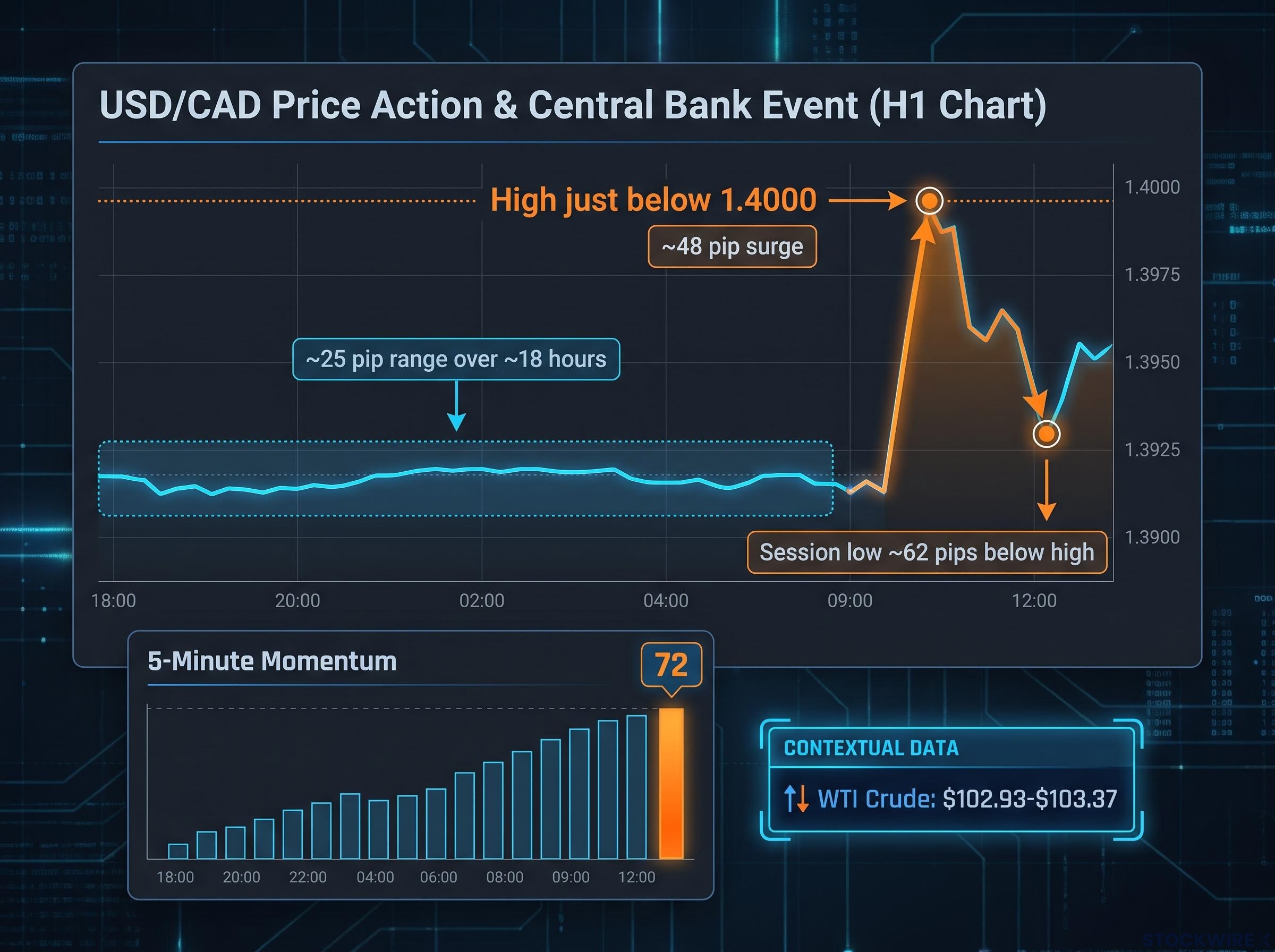
The contrast is the point. Eighteen hours of stasis followed by a 48-pip surge in minutes tells you the market had already priced in the oil support and was waiting specifically for the rate signal to dictate direction. When a scheduled central bank event produces this shape, you are looking at pre-positioned conviction being confirmed, not fresh uncertainty being resolved.
Labour data divergence can compress the same repricing dynamic into a single session: when US payrolls beat by 106,000 jobs while Canada simultaneously shed 41,700, USD/CAD surged roughly 80 pips in one window, a move structurally similar to the post-Fed surge analysed here but driven by the data layer rather than the policy layer.
When big ASX news breaks, our subscribers know first
Why the rate differential outranks oil as a USD/CAD driver
The mechanism starts with something simple: money follows yield.
When US interest rates sit well above Canadian rates, holding US dollar assets pays more. Capital rotates toward the higher-yielding currency, lifting demand for the US dollar regardless of what oil is doing. That is the structural logic behind USD/CAD’s persistent elevation, and it operates whether or not Canada is exporting crude at strong prices.
The current spread makes that logic concrete. The Fed’s midpoint of 3.625% against the BoC’s 2.25% produces a differential of approximately 1.375 percentage points, or ~125 basis points. A basis point is one hundredth of a percentage point, so this is a wide, structural gap by recent standards, not a fleeting divergence.
Here is how the competing drivers stack up:
| Driver | Current Level | Directional Bias | Primary Research Source |
|---|---|---|---|
| US-Canada rate differential | ~125 bps | Higher USD/CAD | FXMacroData |
| WTI crude oil price | ~$103/bbl | Lower USD/CAD (secondary) | RBC Capital Markets |
| FX risk premium | Elevated | Higher USD/CAD | Bank of Canada MPR |
| Trade / USMCA uncertainty | Ongoing | Higher USD/CAD (safe-haven) | Morningstar |
The Bank of Canada itself adds a wrinkle worth understanding. Its January 2025 Monetary Policy Report and a February 2025 analytical note found that the FX risk premium, the extra return investors demand for holding a currency they view as riskier, explained more of the Canadian dollar’s depreciation than the rate spread alone. That means the differential matters through two channels: the direct yield effect and the risk premium it feeds.
The Bank of Canada itself adds a wrinkle worth understanding. Its January 2025 Monetary Policy Report and a February 2025 analytical note found that the FX risk premium, the extra return investors demand for holding a currency they view as riskier, explained more of the Canadian dollar’s depreciation than the rate spread alone. The FX risk premium channel matters because it collapsed roughly two-thirds of the Canadian dollar’s 7.7% slide against the USD in 2024, dwarfing the contribution from the interest rate spread during the same period.
What FXMacroData’s differential thresholds tell you about the current level
FXMacroData codifies the relationship into thresholds you can actually use. When the differential runs above 175 basis points, USD/CAD has historically held structurally above 1.40. When it narrows below 100 basis points, that has been the signal for a Canadian dollar recovery.
The current ~125-basis-point spread sits between those two markers. That tells you USD/CAD is in an elevated zone but not yet at the level where the rate gap alone locks in a structurally higher pair without the risk premium channel doing part of the work.
The practical read is this. If you rely on oil prices alone as a directional signal for the loonie, you will be caught offside repeatedly while the differential runs this wide. Knowing which variable sits higher in the hierarchy is what prevents that error. As AInvest noted in February 2026, oil’s cash-flow surge can be offset entirely when lower Canadian yields reduce the income appeal of holding Canadian assets.
The Bank of Canada’s seven-hold streak and what it means for the pair going forward
The mechanism explains why USD/CAD moved. The Bank of Canada’s posture explains how long this dynamic is likely to persist.
The BoC has now held the overnight rate at 2.25% through seven consecutive meetings, most recently on 2 September 2026, with the Bank Rate at 2.50% and the deposit rate at 2.20%. This is not a fresh pause. It is an entrenched stance, and a Reuters poll published on 28 August 2026 found economists expecting rates to stay unchanged for at least another year.
The BoC hold through 2026 is not a surprise to fixed-income markets: TD Securities projected 2.25% through every quarter of 2026 and 2027, with the first move a hike in January 2027, a forecast that shifts the risk profile materially from what many investors assumed at the start of the year.
Where analysts split is on which direction the eventual move goes. Those disagreements are not contradictions to resolve; they map the range of scenarios worth pricing in:
- RBC (Claire Fan, January 2026): the easing cycle is over, and the next move is more likely a hike in 2027
- BMO (Douglas Porter): the risk of a cut cannot be dismissed if growth or inflation surprises to the downside in 2026
- Scotiabank (July 2026 FX Outlook): 75 bps of BoC tightening paired with Fed easing is the scenario that pulls USD/CAD toward 1.37 in Q4 2026
- C.D. Howe Monetary Policy Council (July 2026): hold at 2.25% into early 2027, rising to 2.50% only by July 2027
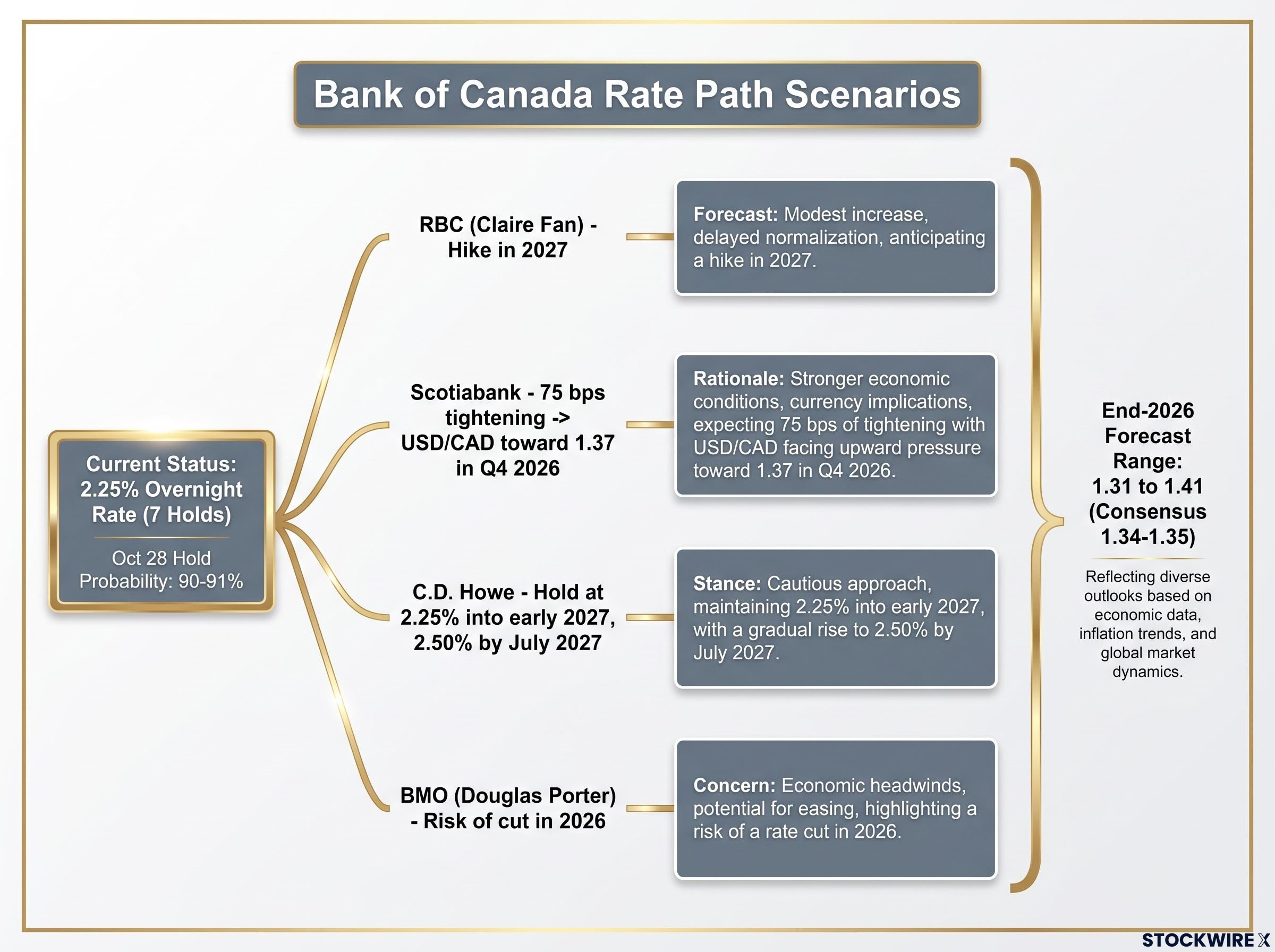
The next scheduled decision, on 28 October 2026, arrives with a fresh Monetary Policy Report. Money-market pricing is not treating it as a coin toss.
Roughly 90-91% implied probability of a hold Money-market pricing puts the odds of the BoC holding at 2.25% on 28 October at approximately 90-91%. The market has all but ruled out a move.
That number reframes what the meeting is actually about. With a hold this heavily priced and no obvious trigger for a shift, 28 October matters not for whether the BoC moves but for what its forward guidance signals about the timing and direction of the eventual move.
For anyone trading the pair, the value sits in the language, not the decision. Watch how the BoC characterises growth and inflation for any sign the consensus hold scenario is beginning to crack. The extended hold has anchored both market expectations and the rate differential simultaneously, and the first hint of a change in tone is what would loosen that anchor.
Oil, trade, and the factors that could shift the equation before year-end
None of this makes the rate differential thesis bulletproof. It sets the conditions under which oil could reassert itself, and those conditions are specific.
For crude to reclaim its role as the dominant Canadian dollar driver, three things would need to line up:
- The rate differential narrows below 100 basis points, via Fed cuts, BoC hikes, or both
- WTI holds sustained above current levels, having climbed from $100.05 on 11 September to $103.37 by 16 September
- Trade and USMCA uncertainty eases enough to stop feeding US dollar safe-haven demand
That third point deserves attention, because trade risk works differently than it first appears. USMCA and tariff uncertainty is not only a Canadian growth headwind. It also amplifies US dollar safe-haven demand, which can keep USD/CAD elevated even if oil stays strong. Morningstar flagged in January 2026 that lower oil prices and trade risks remain the key headwinds for the loonie, even in a world where Fed easing narrows the differential.
The forecast range reflects how unsettled this is:
| Scenario | Key Assumption | USD/CAD Implied Direction |
|---|---|---|
| Base case | Differential holds, BoC on hold | Elevated near 1.40 |
| BoC hike (Scotiabank) | 75 bps tightening, Fed easing | Toward 1.37 in Q4 2026 |
| BoC cut (BMO risk case) | Growth or inflation surprises down | Higher, differential widens |
| Fed accelerates cuts | Differential narrows fast | Lower toward 1.34-1.35 |
The end-2026 consensus clusters around 1.34-1.35, but the full range runs from 1.31 to 1.41, per CanAmCurrencyExchange in March 2026. Scotiabank targets 1.37 for Q4 2026 under its narrowing-differential scenario, while BofA in September 2026 held a bullish bias above bank consensus. Rabobank anticipated the spread narrowing from 175 bps toward roughly 75 bps by year-end, associated with USD/CAD in the 1.34-1.36 band.
That dispersion is itself the signal. A spread of ten cents in end-year forecasts reflects genuine uncertainty about the sequencing of Fed cuts and BoC action, and it tells you this pair’s direction is not settled by current data alone. The trader watching only today’s rate gap risks missing the transition point: when the differential starts to close and oil holds above $100, the structural support dissolves faster than any single data point suggests.
What 28 October means for positioning, and where the pair stands now
Trace the threads together and the balance of forces is clear. The rate differential sits at the top of the hierarchy, the BoC hold is heavily consensus-priced, and oil remains a secondary modifier that cannot outrank a roughly 125-basis-point spread on its own. That is why USD/CAD closed the post-Fed session roughly four pips below 1.4000.
The differential does not change on 28 October 2026. The market’s pricing of its future path might, and that is the specific signal worth monitoring.
With a hold already priced at 90-91%, positioning intelligently means reading the accompanying language, not the decision. Watch these indicators in the statement and Monetary Policy Report:
- Any shift in how the BoC frames inflation persistence within the 1-3% band
- The output gap framing, and whether the tone hardens or softens
- The growth characterisation, currently described as “modest”
- Any explicit forward-guidance change hinting at the timing of the eventual move
Knowing the dominant force is not the same as knowing the outcome. With end-2026 forecasts still spanning 1.31 to 1.41, this framework is probabilistic by design. The differential tells you where the weight sits; the BoC’s language on 28 October tells you whether that weight is about to shift.
For traders wanting a structured process to apply these signals before the 28 October announcement, our comprehensive walkthrough of pre-event positioning covers how to use OIS curve pricing, CFTC data, and options risk-reversal skew to assess whether a trade is already crowded before a scheduled central bank decision.
This article is for informational purposes only and should not be considered financial advice. Investors should conduct their own research and consult with financial professionals before making investment decisions.
Past performance does not guarantee future results. Financial projections are subject to market conditions and various risk factors, and forward-looking scenarios are speculative and subject to change based on market developments.