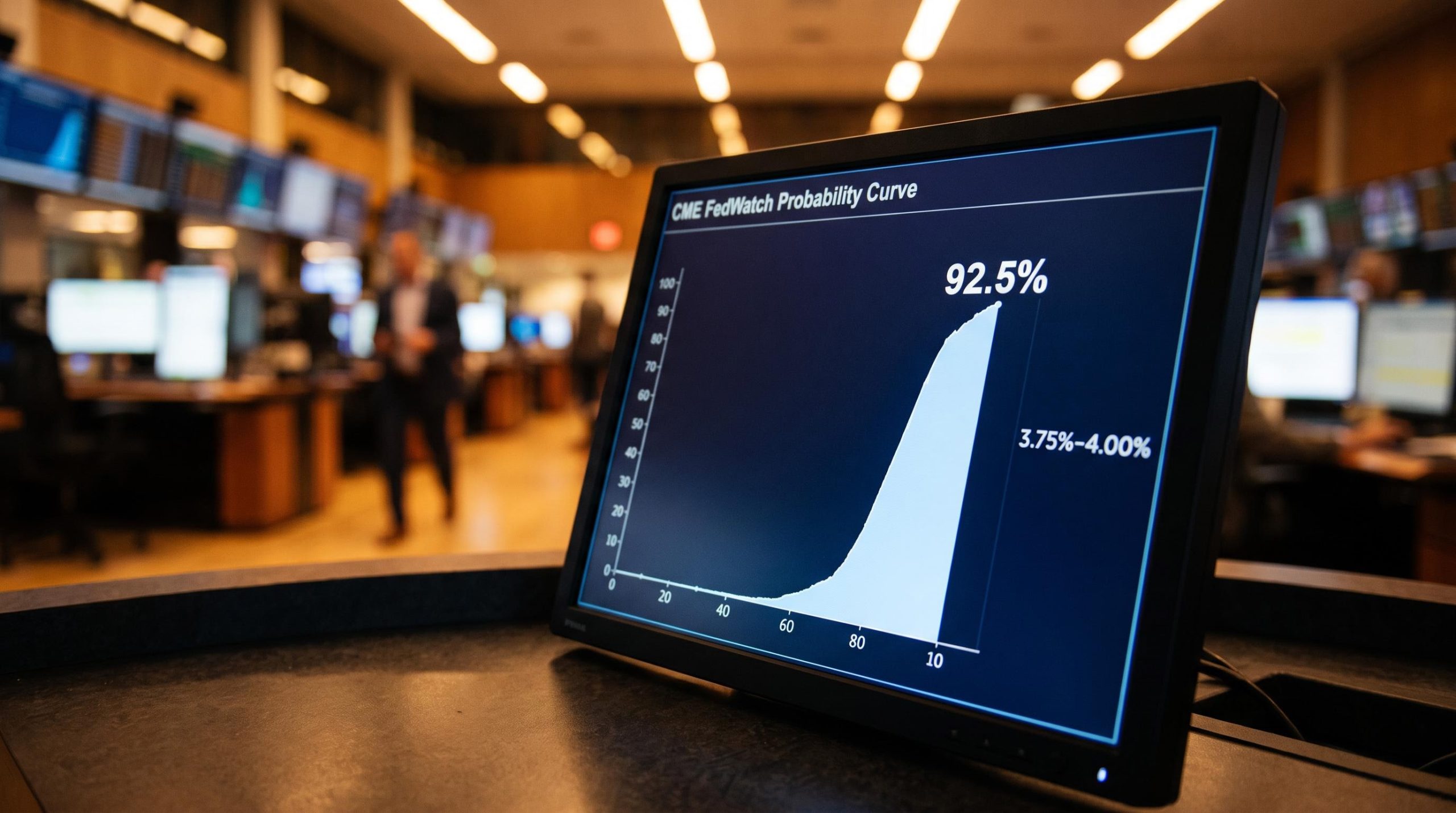
Markets pinned the odds of a September rate hike at 92.5%, yet Fed Chair Kevin Warsh spent the entire hold period refusing to tell them it was coming. That gap between near-certain market prediction and deliberate official silence is the defining feature of this decision, and it is what makes the Fed rate hike impact so difficult to position around.
The move brings the federal funds target range to 3.75%-4.00%, the first increase after five consecutive meetings of holding steady. It arrives under a Chair who has explicitly stripped forward guidance out of the committee’s toolkit, meaning markets had to infer this hike from speeches and data rather than from any official signal.
And this is not being read as a one-off. Deutsche Bank strategists now price roughly 90 basis points of additional tightening through the June 2027 meeting, which tells you the market sees this as the opening beat of a cycle. After this, you will understand why the absence of a reaction function makes this particular move harder to trade around than any comparable hike in the past decade, because the analysis ahead is about navigating a new information environment, not just interpreting a rate number.
Why the Fed moved now, after five meetings of doing nothing
Warsh built his case across two public appearances in the summer of 2026, and the logic rested on two pillars he stated plainly. The Fed did not act on inflation improving. It acted on inflation not improving enough.
His two-factor argument, drawn from his Jackson Hole remarks on 28 August 2026 and reported by Euronews and CNN, breaks down as follows:
Warsh’s Jackson Hole remarks on 28 August 2026 made the framework shift explicit, with the Chair stating his long-standing discomfort with early pronouncements of future policy decisions and arguing that transparency about future rate moves is not a virtue unto itself.
- Underlying inflation has not meaningfully improved, which Warsh described as the Fed’s biggest problem.
- Financial conditions remain insufficiently restrictive, meaning current rates were not yet doing the work of pulling inflation back to target.
That second point is the one that pushed the committee off the sidelines. If conditions are too loose to bring inflation down, holding steady is not neutral. It is passive accommodation.
The timeline shows how fast the market caught up. Before Jackson Hole, CME FedWatch put the odds of a September hike at roughly 34%-35%. After Warsh’s 28 August speech, Euronews reported traders lifted that to 55%. By the meeting itself, the probability had reached 92.5%.
That repricing from roughly 35% to 92.5% in about three weeks tells you something uncomfortable: markets were not positioned for this hike until very late. The true adjustment cost fell on anyone who waited for official confirmation that, by design, was never going to arrive.
Because the whole point of Warsh’s framework is that no pre-commitment exists. During the hold period, he gave markets nothing to anchor to.
“No forward guidance, no forward guidance.”
Kevin Warsh, quoted by CNN, July 2026
That is not a communications gap. It is the strategy. The hike arrived without official preparation because Warsh has decided official preparation is not the Fed’s job. Understanding this reasoning is the minimum required context for judging whether the 90 basis points priced through 2027 is rational or overdone. Without Warsh’s own stated logic, that forward number is just a figure floating on its own.
When big ASX news breaks, our subscribers know first
How markets priced the cycle before and after Jackson Hole
The repricing did not happen smoothly. It happened in one concentrated jump, and the shape of that jump is the pattern worth recognising.
Before Warsh spoke at Jackson Hole, the market barely believed a September move was likely. CNN reported a 34% implied probability on 28 August 2026 via CME FedWatch, reflecting a pre-speech or alternative snapshot. The dominant assumption was continuation of the hold.
The speech changed that in hours. Euronews put the post-speech probability at 55%, a jump driven entirely by Warsh’s language on inflation and financial conditions, not by any new data release. Markets were forced to reprice off rhetoric alone.
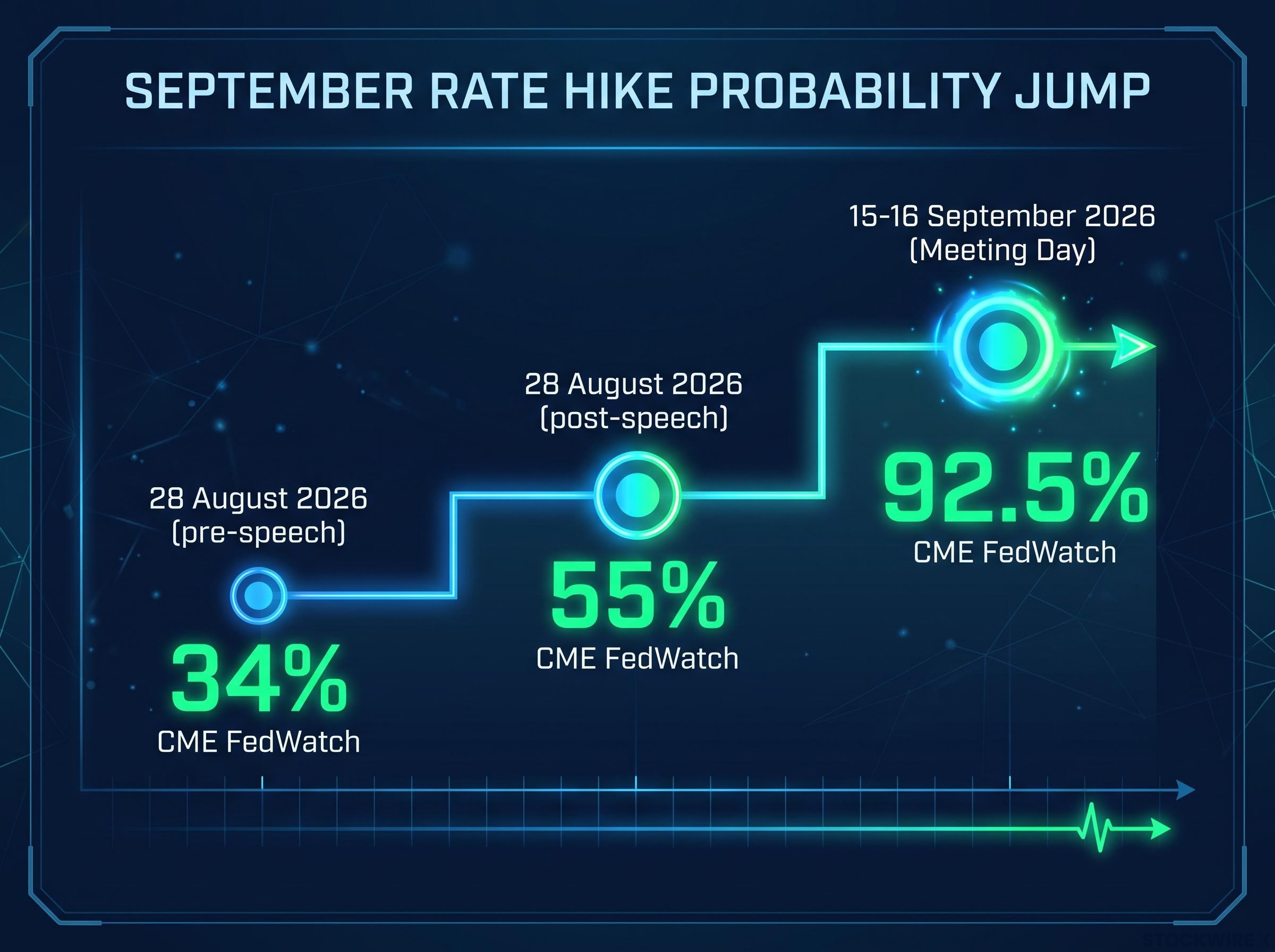
By meeting day, CME FedWatch showed 92.5%. The sequence looked like this:
| Date | Event | CME FedWatch Probability |
|---|---|---|
| 28 August 2026 (pre-speech) | Before Jackson Hole remarks | ~34% |
| 28 August 2026 (post-speech) | After Warsh’s Jackson Hole speech | 55% |
| 15-16 September 2026 | FOMC meeting day | 92.5% |
The single most consequential read, though, sits beyond the meeting itself.
Deutsche Bank strategists estimate approximately 90 basis points of additional tightening is now priced into market expectations through the June 2027 Fed meeting.
That figure tells you markets are treating this as a genuine cycle resumption, not an isolated recalibration. But notice what it rests on. Deutsche Bank built that projection without a rate path, without a dot from Warsh, and without any official commitment to a trajectory. It is an inference stacked on inflation data and Warsh’s past rhetoric.
That makes the 90 basis points inherently fragile. For a fixed-income holder, this matters directly for duration risk, the sensitivity of a bond’s price to changes in interest rates. A tightening expectation built without guidance can reprice sharply the moment incoming inflation data disappoints, and there is no official anchor to slow the swing.
Duration risk, the sensitivity of a bond portfolio’s price to changes in interest rates, becomes the central management variable when no official rate path exists to hedge against, with each year of duration representing approximately 1% in price loss per 1 percentage-point rate move.
There is also a genuine gap in what can be assessed right now. Post-decision 2-year and 10-year Treasury yields are not yet confirmed in accessible sources, which means the full market reaction to the actual hike is still being absorbed. That absence is analytically relevant, not a detail to gloss over: until those yields print, the market’s real verdict on the 90 basis points path remains unread.
What the end of forward guidance actually means for how markets work
Here is the structural shift that everything else follows from. Forward guidance is gone, and Warsh has withheld his dot projection entirely.
Forward guidance, for context, is the practice of the Fed signalling its likely future rate path so markets can adjust gradually along an expected route. It historically gave investors a policy anchor. Remove it, and markets are left to operate on inference from speeches and incoming data, which is exactly why the repricing around Jackson Hole was so concentrated rather than spread out.
The two clearest forward guidance failures in the documented record, the 2013 taper tantrum and the 2021-2022 transitory inflation episode, both originated from the gap between prior guidance and subsequent action, which is precisely the dynamic Warsh is now structuring around by removing the commitment mechanism entirely.
The June 2026 FOMC statement made the change concrete. The Hill reported that forward-guidance language was removed and that Warsh declined to submit his own dot projection, arguing such forecasts are not helpful in the conduct of policy. GFMag described the resulting statement as shorter and simpler, focused on the facts as best the committee could judge them.
Three structural consequences follow mechanically from this framework, and they arrive in a logical order:
- Enhanced Fed independence. By removing guidance and dots, Warsh insulates the committee from being anchored to prior commitments or market consensus.
- Maximum policy flexibility. Without a committed path, the Fed retains full discretion to hike, hold, or cut based on data at each individual meeting.
- Higher volatility and abrupt repricing risk. Yahoo Finance, CNBC, and the Associated Press all warn that investors now face a greater chance of surprise moves and harder-to-hedge interest-rate risk.
For a reader holding duration in a fixed-income portfolio, the practical implication is blunt. Without a reaction function, there is no clean hedging signal, and the cost of being caught long duration through a surprise hike is higher than under any recent Fed communications framework.
The credibility problem Warsh has not yet resolved
CNBC raises the sharpest concern. Warsh left rates unchanged twice without ever clarifying what would trigger a move, then hiked. That sequence creates ex-post rationalisation risk, where markets cannot trust the pattern because they cannot link the action to any stated criteria.
This is distinct from the flexibility benefit, and the distinction matters. Flexibility and credibility are not complementary when the reaction function is opaque; they are in tension. Yahoo Finance framed Warsh’s silence as something that should worry markets precisely because bond investors assume inaction until a hike lands, then scramble. The more discretion Warsh keeps, the harder it becomes for markets to price him, and the risk premium on rate-sensitive assets rises to compensate.
The tension between credibility versus flexibility is not unique to the Warsh era: Bernanke, Yellen, Carney, and Powell each made explicit guidance commitments that were later reversed, and those reversals produced the precise credibility damage that critics now attribute to Warsh’s silence rather than to the guidance regime itself.
The political dimension and what it does not change about the policy calculus
There is a political backdrop, and it is worth stating plainly before setting it aside. President Donald Trump, per Business Standard citing his remarks at the Irish Open golf tournament, has said he believes the US should carry the world’s lowest interest rates regardless of prevailing inflation or economic data.
That is a direct pull in the opposite direction of what Warsh just did. And yet, on current evidence, it changed nothing.
Signals from the White House suggest acceptance of higher borrowing costs, and Warsh has proceeded with a hawkish stance regardless. His stated priority is unambiguous: he described inflation as the biggest problem at Jackson Hole, per CNN, and he acted on that framing rather than on political preference.
The most useful lens on the whole approach comes from the Associated Press.
The Associated Press characterises Warsh’s broad strategy as a “gamble,” a quieter Fed willing to accept more volatile markets going hand in hand with higher interest rates.
That framing captures the real trade-off. Warsh is accepting market volatility as the price of independence, with price stability chosen over predictability and over political accommodation.
For readers, the political noise matters mainly as a risk factor rather than a live input. On the evidence available, Warsh is acting as if White House commentary does not enter his calculus, and that assessment is precisely what underpins the forward pricing of 90 additional basis points through 2027.
Dismiss this section as colour and you miss the embedded scenario. If political pressure eventually does bend Warsh’s decisions, that 90 basis points of priced tightening unwinds sharply. That asymmetry is worth holding in mind when positioning around the rate path, because the market is currently pricing independence as a near-certainty.
Three variables that will determine whether 90 basis points of additional tightening actually arrives
The retrospective is settled. What matters now is the forward read, and in a no-guidance environment the list of legitimate signals is short.
Whether Deutsche Bank’s 90 basis points projection is validated or revised comes down to three variables, in order of weight:
- Incoming inflation readings. This is the criterion Warsh has explicitly flagged as primary. Every print now carries outsized influence because it is the clearest input markets have between meetings.
- Financial conditions. Warsh’s second stated criterion. If conditions tighten on their own, the case for further hikes weakens; if they stay loose, the pressure to keep moving persists.
- The evolution of Warsh’s communication style. Watch for any reaction-function elements creeping back into his public statements. Even a hint of stated criteria would let markets reprice more smoothly.
Each variable carries disproportionate weight for one reason: without a dot projection or forward guidance, these are the only inputs markets have to update expectations. There is nothing else to lean on.
The first clean read on whether markets accepted the 90 basis points path will come from post-decision Treasury yields, which are not yet confirmed in accessible sources. Watch the 2-year in particular. It is the segment of the curve most sensitive to near-term Fed expectations, so if markets begin fading the tightening path, the 2-year is where it will show first.
If you are managing rate-sensitive exposure right now, treat these three as your dashboard. Inflation prints, financial conditions indices, and any shift in Warsh’s language are the only genuine signals available, and each should be tracked at every data release between now and the next FOMC meeting.
For investors wanting to rebuild their rate-expectations toolkit from the ground up under the Warsh regime, our dedicated guide to investor strategy without Fed guidance walks through the specific instruments, data sequences, and portfolio adjustments that replace the guidance anchor across rates, equities, credit, and FX.
This article is for informational purposes only and should not be considered financial advice. Investors should conduct their own research and consult with financial professionals before making investment decisions. Past performance does not guarantee future results. Financial projections are subject to market conditions and various risk factors, and forward-looking market pricing is speculative and subject to change.
What the correction changes, and what it does not
The 25 basis point hike matters less in isolation than the communications regime it arrived inside. The rate is now 3.75%-4.00%, but the genuinely new feature is opacity by design, and that is the structural shift with lasting implications for how interest-rate risk must be managed.
Plenty has not changed. The Fed’s mandate is intact, Warsh’s inflation-first priority is consistent, and markets still price rate expectations from whatever data they can gather. What changed is the quality and official character of the signal, not the underlying machinery.
That leaves one clear forward marker. The next inflation print is now the single most important data event between meetings, because in a no-guidance world it is the closest thing markets have to a policy statement. Treat it as such, whatever your positioning.