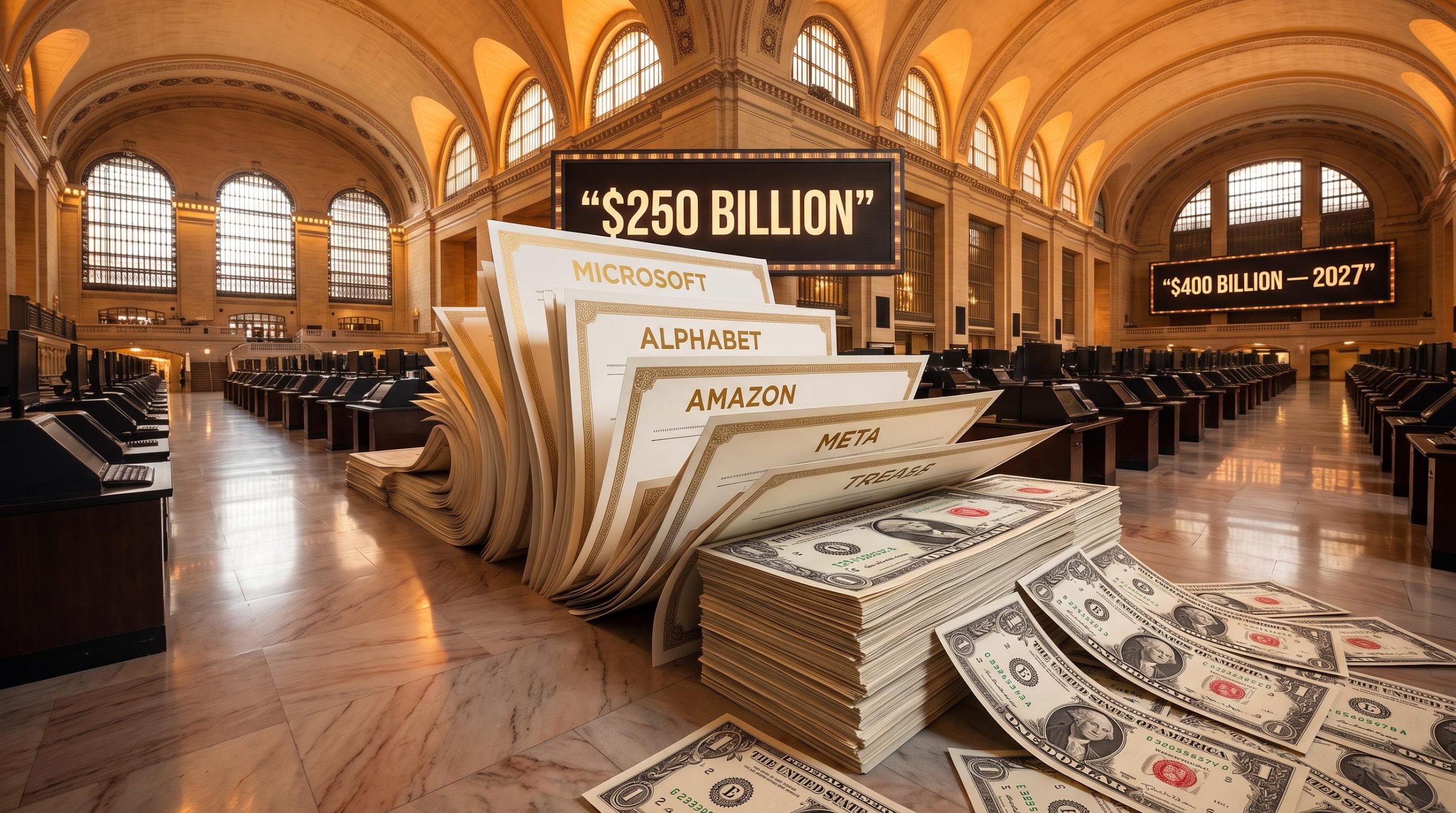
The companies building the AI future are borrowing on a scale that is quietly making money more expensive for everyone else. Goldman Sachs estimates the five largest hyperscalers will issue roughly $250 billion in bonds during 2026 alone to fund their AI data centre buildout.
That borrowing is landing at an awkward moment. The 10-year US Treasury yield has been testing the psychologically important 5% threshold through September 2026, and the timing of this debt wave amplifies the pressure already building in bond markets.
This is not a theoretical future risk. It is a dynamic unfolding right now, and it connects Silicon Valley boardrooms to your financial life more directly than you might think.
Here is what the mechanics actually reveal: how a decision to build another data centre ends up in your mortgage rate, your bond fund returns, and the yield on your savings. By the time you finish this, you will know which forces are really moving yields, and which are noise dressed up as headlines.
The numbers behind the AI debt machine
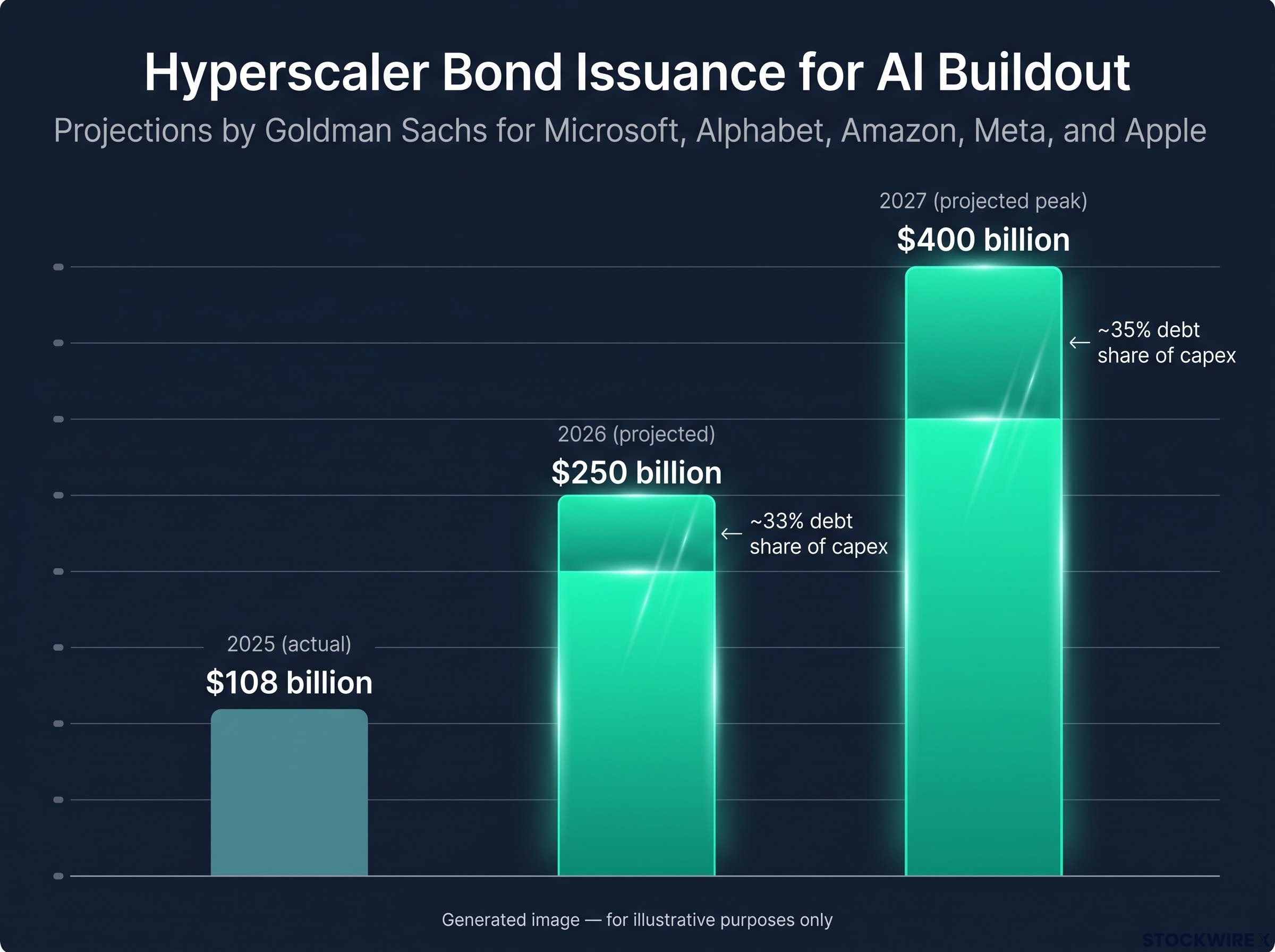
Start with what already happened. In 2025, the five leading hyperscalers, Microsoft, Alphabet, Amazon, Meta and Apple, issued approximately $108 billion in investment-grade bonds to finance their AI infrastructure, according to Goldman Sachs.
That figure was large. What comes next makes it look modest.
Goldman Sachs projects those same companies will issue roughly $250 billion in bonds during 2026, more than double the prior year’s volume. Overall AI-related debt issuance is approaching $500 billion for the year once you include the wider ecosystem of borrowers feeding the buildout.
Then the acceleration continues. Goldman expects hyperscaler bond issuance to reach roughly $400 billion in 2027, which it identifies as the anticipated peak of this supply wave.
The projected peak Goldman Sachs expects hyperscaler bond issuance to hit roughly $400 billion in 2027, the high-water mark of the current AI debt cycle.
The share of capital expenditure being funded by debt is climbing alongside the volume. Goldman estimates about 33% of hyperscaler capex will be financed by borrowing in 2026, rising to roughly 35% in 2027.
| Year | Bond issuance volume | Debt share of capex |
|---|---|---|
| 2025 (actual) | $108 billion | Below 2026 level |
| 2026 (projected) | $250 billion | ~33% |
| 2027 (projected) | $400 billion | ~35% |
The progression from $108 billion to $400 billion in two years is not just a corporate finance story. It means the bond market is being asked to absorb a volume of high-quality debt that did not exist three years ago, and that absorption comes at a price. Someone has to buy all of it, and the terms on which they buy shape yields across the market.
The practical evidence of this supply pressure is visible in how individual bonds are pricing: investment-grade credit signals are distorting, with Meta’s 2036 bonds trading at triple-B-equivalent spreads and Amazon’s long-dated debt pricing like a single-A credit despite official double-A ratings.
When big ASX news breaks, our subscribers know first
How a corporate bond sale pushes your Treasury yield higher
Follow the chain from a single decision. A hyperscaler decides to issue a 30-year bond to fund a new data centre. That bond has to find a buyer, and the buyers are the same pension funds, insurers and asset managers who also buy US Treasuries.
Here is the pressure point: those investors have finite balance sheets. Every dollar they put into a Microsoft 30-year bond is a dollar they did not put into a 30-year Treasury.
Market strategists describe this as “duration supply.” When hyperscalers flood the market with long-dated, high-quality paper, they introduce a wall of new supply that competes directly for the same pool of long-term capital.
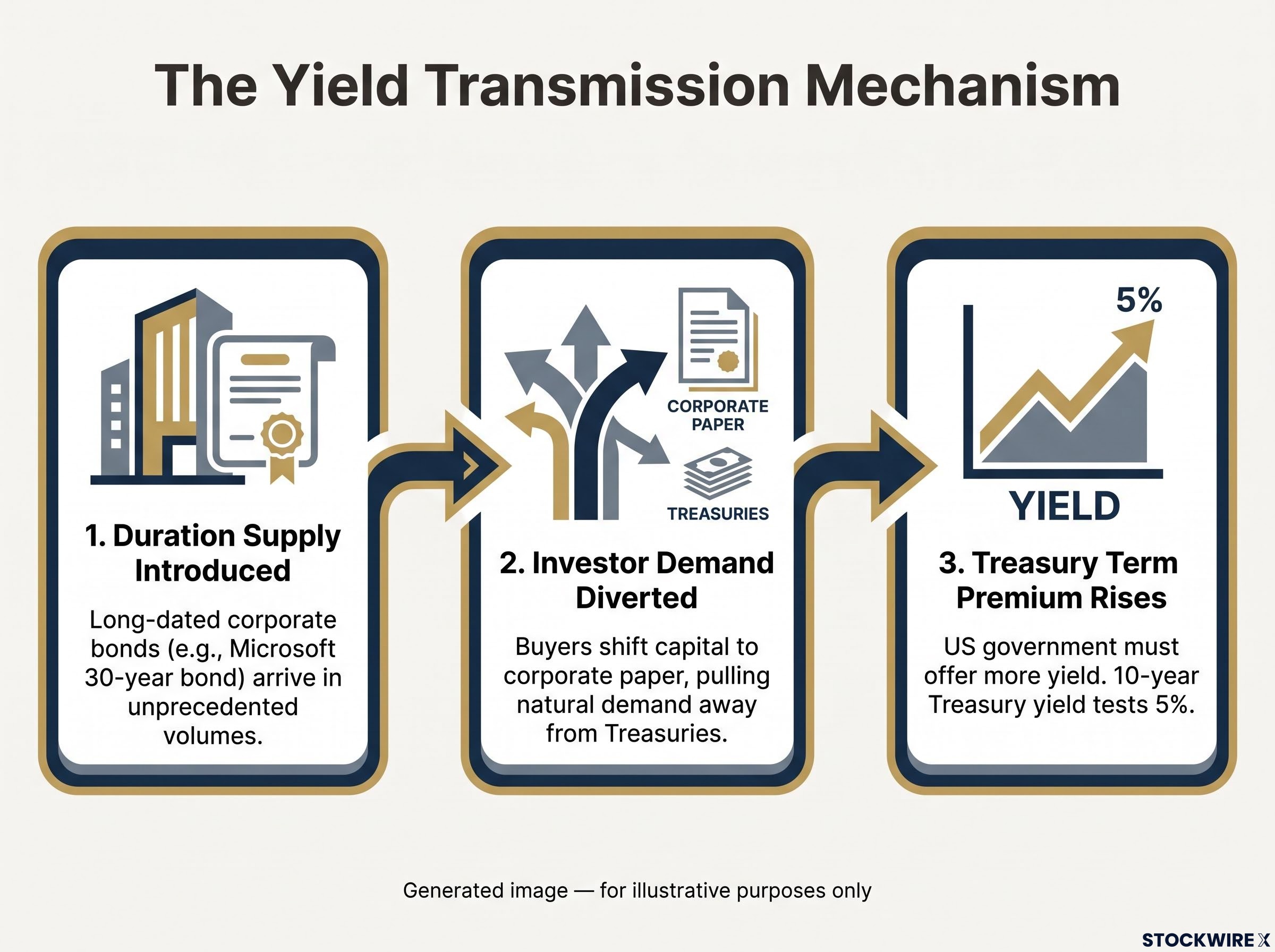
The transmission works in three steps:
- Duration supply is introduced. Long-dated corporate bonds arrive in volumes the market has not previously absorbed.
- Investor demand is diverted. With finite capital, buyers shift toward the new corporate paper, pulling natural demand away from Treasuries.
- The Treasury term premium rises. With one fewer natural buyer, the US government must offer more yield to place its debt, and investors demand extra compensation for holding long sovereign bonds.
BNY Mellon tracks this dynamic directly. It notes that long-maturity AI-related corporate issuance is on pace to outrun 30-year Treasury issuance, intensifying competition at the long end of the curve. BNY Mellon reports hyperscaler debt rising from $93 billion in 2025 to $157 billion year-to-date by mid-2026.
AI-related corporate issuance now represents roughly a quarter of gross investment-grade supply in 2026. That is a structural shift in who is competing for the market’s capital.
The 10-year Treasury yield has been testing 5% through September 2026, clustering in the 4.96% to 4.99% range in the days before the Federal Reserve’s mid-September meeting.
What “term premium” means and why it is moving
The term premium is the extra yield investors demand for locking their money into long-duration bonds rather than rolling over short-term ones repeatedly.
When the supply of long-duration, high-quality bonds rises sharply, the term premium tends to rise with it. Buyers gain bargaining power, and they use it to demand more yield before committing their capital for decades. That is the lever the AI issuance wave is pulling.
When a pension fund buys a Microsoft 30-year bond instead of a 30-year Treasury, the Treasury market loses a natural buyer, the US government pays more to borrow, and that higher cost ripples into every rate-sensitive asset you hold.
What the analysts actually disagree about
Here is where the story gets less tidy, and more honest. The firm producing the alarming issuance projections is also the firm cautioning against overstating their effect.
Goldman Sachs finds limited evidence that corporate bond supply meaningfully moves the broader level of Treasury yields. Its rule-of-thumb suggests the entire AI issuance wave might lift broader corporate borrowing costs by only around 5 basis points.
The limited-magnitude qualifier Goldman Sachs estimates the AI issuance wave may raise broader corporate borrowing costs by roughly 5 basis points, a modest figure against the larger narrative of AI bond supply dominating yields.
That is a small number against a big headline. It suggests the AI supply story is real but not the main event.
Mainstream macro analysts largely agree. They argue that persistent Treasury yields in the 4.9% to 5.0% range are driven primarily by Federal Reserve policy, inflation expectations and oil prices rather than tech sector borrowing.
The two camps line up like this:
- AI issuance as yield driver: AI-related bonds make up roughly 25% of gross investment-grade supply in 2026, and long-maturity deals are on pace to outrun 30-year Treasury issuance.
- Macro forces as yield driver: The Federal Reserve has held its benchmark rate in the 3.50% to 3.75% range through mid-September 2026, and inflation plus energy prices are doing the heavy lifting on yield levels.
Sources differ on the exact upper bound of the Fed’s target range, with some placing it at 4.00%, so treat the near-term policy figure as approximate.
The honest takeaway is that AI bond issuance is a genuine contributing force, not a dominant one. Understanding which lever is which helps you evaluate yield forecasts without crediting the tech sector for too much, or too little. When financial media tells you AI bonds are “pushing yields to 5%,” that is a simplification worth questioning.
The risks that could make this debt cycle genuinely dangerous
The modest yield effect is only half the picture. The bigger question is what happens to the debt itself if the AI revenue story disappoints.
Columbia Threadneedle flags a structural vulnerability at the heart of the buildout: an asset-liability mismatch. Companies are signing compute contracts lasting three to four years while committing to data centre leases running five to 20 years.
That gap creates a maturity wall. If revenue growth falls short when those short contracts expire, issuers face refinancing risk against long-dated obligations they cannot easily unwind.
There is also a crowding-out dynamic. Hyperscaler bonds carry credit ratings comparable to US Treasuries, so they displace not just sovereign demand but also squeeze out high-yield and industrial issuers, lifting borrowing costs across the wider economy. The estimated $7 trillion AI capex boom over less than five years is a genuine drain on market capacity.
Major institutions have put their concerns on record:
- The Bank for International Settlements (BIS) warns that a prolonged AI investment slump could heighten global financial stability risks.
- The Bank of England has flagged the danger of a sudden pullback in funding if data centre utilisation disappoints.
- Fitch Ratings cautions that reversing AI optimism could trigger a wave of credit downgrades.
The BIS has separately flagged circular financing loops within the AI ecosystem, where hyperscaler-to-neocloud compute arrangements may mask the true level of independent end-user demand, a structural risk that sits beneath the headline issuance volumes discussed here.
How the market reacted to Amodei’s September warnings
The risk stopped being abstract on 12 September 2026, when Anthropic co-founder Dario Amodei published an essay titled “We Must Pace the Frontier,” formally calling for frontier AI companies to slow their capability development. He has separately warned that spending at current rates to build data centres could prove “ruinous” if AI revenue forecasts fall short.
“Ruinous” is how Amodei characterised the risk of current spending levels if AI revenue growth disappoints.
The market moved in response. Global AI equities fell sharply in mid-September as investors priced in potential constraints on growth and monetisation.
Treasury yields pulled back modestly in parallel, as markets reconsidered the pace of AI-driven debt issuance if a slowdown takes hold. Credit default swap spreads, the cost of insuring against a borrower defaulting, widened on AI-exposed hyperscalers relative to the broader market.
When a CEO issuing this debt publicly questions whether the spending is sustainable, CDS markets widen and anyone holding hyperscaler bonds from earlier in the cycle is sitting on a position whose risk profile just shifted underneath them.
The dot-com parallel that credit markets are watching
History offers a specific warning here, and the numbers are worth sitting with before you draw the comparison.
During the telecom build-out of the late 1990s and early 2000s, telecom, media and technology (TMT) borrowers reached 40% to 50% of high-yield bond issuance at the peak in 2000. Investors who held that debt ultimately recovered only about 20 cents on the dollar.
More than $100 billion of investment-grade debt issued during that boom was downgraded to junk by 2002. Speculative-grade default rates in that cycle peaked at 9.98% in 2001, with telecom leading defaults for five consecutive years.
Now place today’s AI cycle beside it. Roughly 38% of current high-yield issuance is tied to AI, tracking uncomfortably close to that telecom peak.
| Metric | Telecom / dot-com cycle | Current AI cycle |
|---|---|---|
| Share of high-yield issuance at peak | 40%-50% (2000) | ~38% (2026) |
| Primary issuer credit profile | Capital-light, revenue-thin | Investment-grade, strong cash flows |
| Investor recovery / position | ~20 cents on the dollar | Position still open |
| Default rate at stress peak | 9.98% (2001) | Not yet tested |
The differences matter as much as the similarities. Analysts note that today’s hyperscalers carry vastly stronger cash flows, investment-grade ratings and the capacity to service their debt even through a revenue slowdown, unlike the revenue-thin telecom operators of the era.
Research by the IMF and Federal Reserve also shows that in past sector-specific stress cycles, corporate and sovereign yields often decoupled as investors fled to the safety of Treasuries. The relationship you have been reading about can reverse under stress.
The parallel does not make a repeat inevitable. It does mean you should know that the last time bond markets absorbed a sector-concentration build-out on this scale, the exit was disorderly for the investors holding the debt.
What this means for US investors watching yields in late 2026
You now understand three forces acting on yields: Federal Reserve policy, macro inflation dynamics, and the AI bond supply wave. The skill is weighting them correctly when you read the next headline about yields hitting 5%.
The Fed and macro conditions are doing most of the work on the level of yields. The AI supply wave is a real but secondary structural pressure, and Goldman’s own 5 basis point estimate keeps it in proportion.
Treasury buyback operations have been scaled up to resist long-end pressure, with the per-operation cap doubled to $4 billion targeting 10-, 20-, and 30-year maturities, but at that volume against a $40 trillion debt stock the intervention functions as a signalling tool rather than a mechanical ceiling on yields.
Three signals would tell you the AI issuance effect is intensifying rather than fading:
- Widening spreads between long-maturity corporate and Treasury yields, showing the duration supply competition biting harder.
- Rising CDS costs on hyperscalers, signalling that credit markets are pricing more default risk into AI-linked debt.
- Issuance pace tracking at or above Goldman’s projections, confirming the supply wave is building toward its peak rather than stalling.
Your forward marker Goldman Sachs projects the supply peak in 2027 at roughly $400 billion, which sets the time horizon for this structural pressure.
If you hold bond funds or individual Treasuries, understand that this supply wave is a headwind for prices running through at least 2027 on current projections. If you are weighing a mortgage or credit decision, you are facing a rate environment shaped by more than the Fed alone.
For readers wanting to understand how the current yield environment fits into the longer structural deterioration in fixed income, our full explainer on the historic bond bear market covers the 71-month Bloomberg Aggregate drawdown, broken stock-bond correlations, and practical duration adjustments for portfolios navigating the repricing.
The Fed is expected to hold rates steady at its September 2026 meeting, with the 10-year yield starting from roughly the 4.93% to 5.01% range. That is your reference point for everything that follows.
This article is for informational purposes only and should not be considered financial advice. Investors should conduct their own research and consult with financial professionals before making investment decisions. Past performance does not guarantee future results. Financial projections are subject to market conditions and various risk factors.
The rate environment will not simplify before the issuance peak
The core argument holds together like this. AI infrastructure debt is a structural, multi-year contributor to yield pressure that does not resolve until at least 2027, and it operates alongside the macro forces you already watch, not instead of them.
That means you should not treat the AI bond wave as the whole story, nor dismiss it as a passing headline. It is a durable pressure with a defined timeline and measurable signals.
The single variable most likely to change the trajectory is not Fed policy. It is whether AI revenue materialises at a scale that justifies the debt being issued to build it, the exact question Amodei raised when he called current spending potentially “ruinous.”
That reframes what it means to read the bond market accurately in late 2026. Paying informed attention to issuance volumes, credit spreads and executive signals from inside the AI sector is now part of the job, right alongside watching the Fed.