

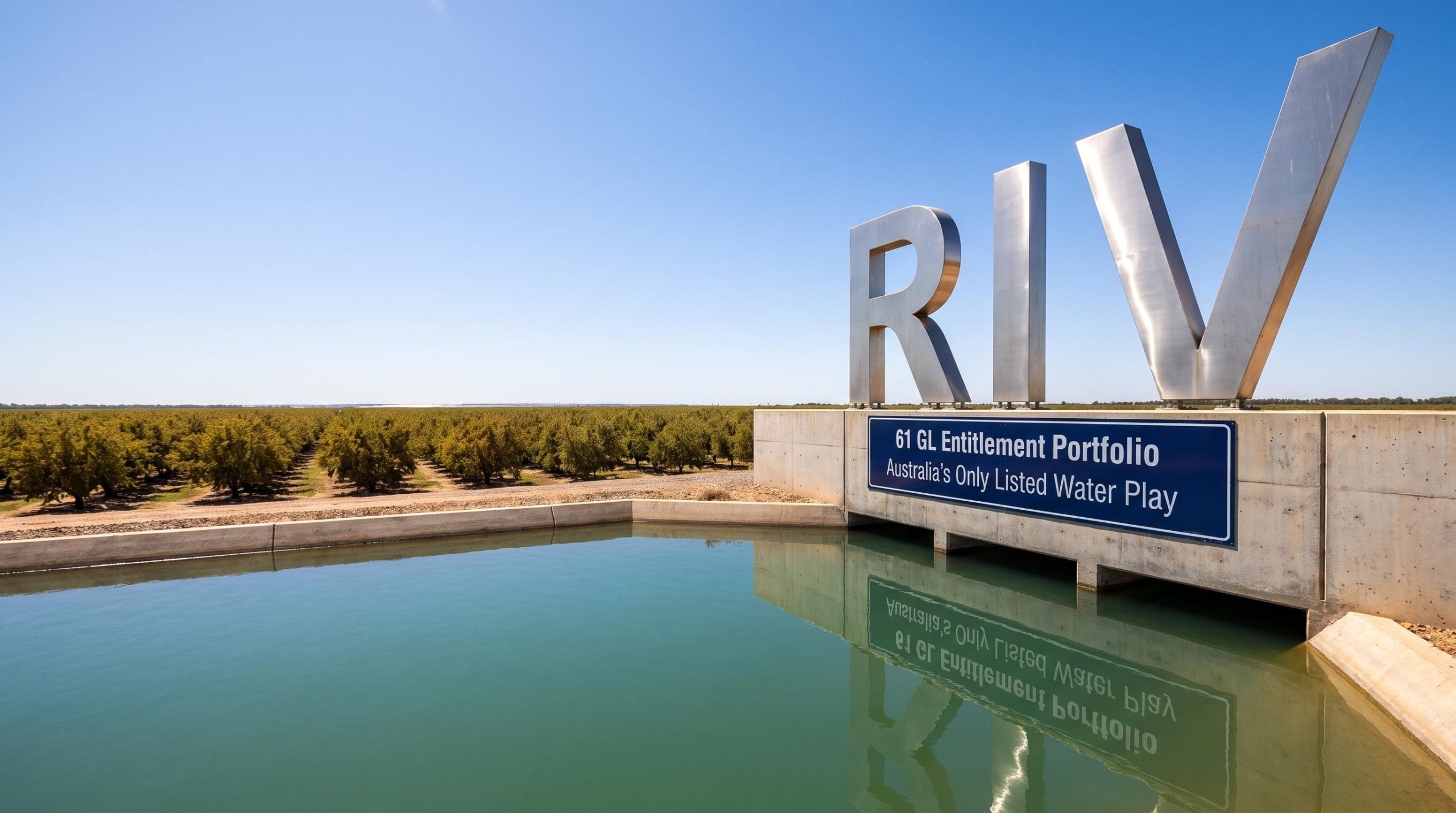
Australia’s only listed water play lays out its investment case
In its September 2026 investor presentation, Rivco Australia (ASX: RIV) positioned itself as the sole ASX-listed company providing investors with direct exposure to Australian water entitlements. The update outlined a 61 GL entitlement portfolio held entirely within the southern Murray-Darling Basin (MDB), approximately $309m in gross assets, and a pre-tax NAV total return of 9.4% p.a. since the company’s listing in September 2016.
The presentation also detailed two structural changes completed in the prior 12 months: a rebrand from Duxton Water to Rivco Australia in October 2025, and the internalisation of management in November 2025, which eliminated external management and performance fees. The company has paid 19 consecutive dividends since inception.
When big ASX news breaks, our subscribers know first
Why water? The structural case for an overlooked asset class
The presentation’s investment thesis rested on a single proposition: Australian water entitlements sit at the intersection of capped supply and structurally growing demand, with price as the only mechanism available to resolve shortfalls.
Supply is capped and shrinking
Australia’s water markets operate under a cap-and-trade system in which the consumptive pool (the volume of entitlements available for productive use) is fixed by regulation. No new entitlements can be created, meaning higher prices cannot induce additional supply.
The presentation detailed that, since 2007, the government has acquired approximately 25% of entitlements on issue for environmental purposes. The 450 GL recovery programme has approximately 70 GL remaining, with completion required by 31 December 2027. This programme is expected to reduce the Lower Murray consumptive pool by 7% to 8%.
Beyond that, the SDLAM supply projects face a shortfall of 190 to 314 GL. If those projects fail to deliver by their deadline, the presentation noted that further government water buyback programmes may be required to close the gap.
| Component | Target | Recovered | Remaining |
|---|---|---|---|
| Bridging the Gap | 2,075 GL | 2,062 GL | 13 GL |
| 450 GL recovery | 450 GL | 380 GL | 70 GL by Dec 2027 |
| SDLAM projects | 605 GL | 291–415 GL | 190–314 GL short |
Source: DCCEEW update, July 2026.
Demand is growing and becoming more water-intensive
While supply contracts, permanent plantings across the southern MDB are expanding and shifting toward crops with higher water requirements. The presentation highlighted that almond plantings grew from 53,806 ha in 2021 to 69,969 ha in 2026, a rise of +30%. Almonds now represent approximately 43% of permanent plantings by area, up from around 36% in 2021.
| Crop | 2021 (ha) | 2024 (ha) | 2026 (ha) | Change 2021–26 |
|---|---|---|---|---|
| Almonds | 53,806 | 60,747 | 69,969 | +30% |
| Citrus | 23,308 | 28,018 | 28,907 | +24% |
| Grapes | 73,056 | 70,066 | 63,586 | -13% |
| Total | 150,170 | 158,831 | 162,462 | +8% |
Source: WSP/Ricardo (2025); SunRISE (2025); Almond Board of Australia; Citrus Australia; Wine Australia. 2026 figures are preliminary and subject to confirmation.
A further +32,000 ha of immature plantings have yet to reach full water demand, which the presentation estimated would add +136 GL of annual demand at maturity. The shift away from wine grapes is also intensifying water use per hectare: the vines being removed use 8 to 10 ML/ha, compared with up to 14 ML/ha for the orchards replacing them.
The presentation also referenced California as a real-world illustration of water scarcity dynamics. The Sustainable Groundwater Management Act (SGMA) is requiring the state’s most stressed groundwater basins to achieve long-term sustainability by 2040. Between 2022 and 2025, approximately 105,000 ha of almond orchards were removed in California in response to tighter water availability. With California producing approximately 80% of the world’s almonds, the reduction in supply contributed to almond prices reaching approximately AUD $10.50/kg as of August 2026, a ten-year high. Australia is the world’s second-largest almond producer, and the presentation noted that expansion of Australian acreage remains constrained by access to secure water.
How Rivco is positioned to capture the opportunity
Portfolio deliberately concentrated where scarcity is sharpest
The presentation detailed that Rivco’s 61 GL portfolio is held entirely within the southern MDB, with approximately 61% of portfolio value concentrated in the Lower Murray. Approximately 80% of portfolio value is held in high security entitlements.
The Lower Murray’s significance was explained through the Barmah Narrows, a physical constraint that limits the volume of water that can flow into the region from upstream. Against permanent crop demand of approximately 1,494 GL at maturity, the presentation outlined that post-buyback deficits in the Lower Murray emerge in four of the five climate scenarios modelled, ranging from 137 GL in an average year to 1,054 GL under extreme dry conditions.
Rivco Australia, September 2026 Investor Presentation
“In a capped system, deficits cannot be closed with new supply. They can only be resolved through price.”
Leasing model locks in recurring income
The presentation outlined Rivco’s buy-and-lease business model, which management described as designed to generate stable, recurring revenue across all climate scenarios. Key parameters of the framework include:
- Target 70–80% of portfolio leased by value
- Target Weighted Average Lease Expiry (WALE) of 3+ years
- No single lessee to exceed 25% of lease income
- Management expense ratio of 0.4%
- Target total return of 10% p.a. pre-tax (NAV growth plus dividends), described as an objective through the cycle, not a forecast, and not guaranteed
The Select Harvests lease agreement, a five-year deal valued at approximately $11.7 million in contracted revenue running through to 2031, was the single largest contributor to Rivco reaching its 82% leased portfolio milestone and illustrates the type of institutional-scale lessee relationship the company is targeting in its medium-to-long term roadmap.
Competitive returns with low correlation
The presentation provided a ten-year total return comparison to 30 June 2026. Australian water returned approximately 12% p.a. over the period, comprising 8% p.a. capital growth per the WSP Entitlement Index and a 4% p.a. assumed income yield (a Rivco assumption, not a WSP figure). This compared with 13.6% p.a. for the S&P 500, 8.6% p.a. for the ASX 200, and 5.6% p.a. for A-REITs over the same period.
The diversification case was supported by correlation data. Since 2008, water entitlements have exhibited correlations of between -0.16 and +0.07 against major asset classes modelled. RIV’s equity beta was noted at 0.27, indicating the company’s share price has historically exhibited materially lower sensitivity to broader equity market movements.
Evolved dividend framework and the path forward
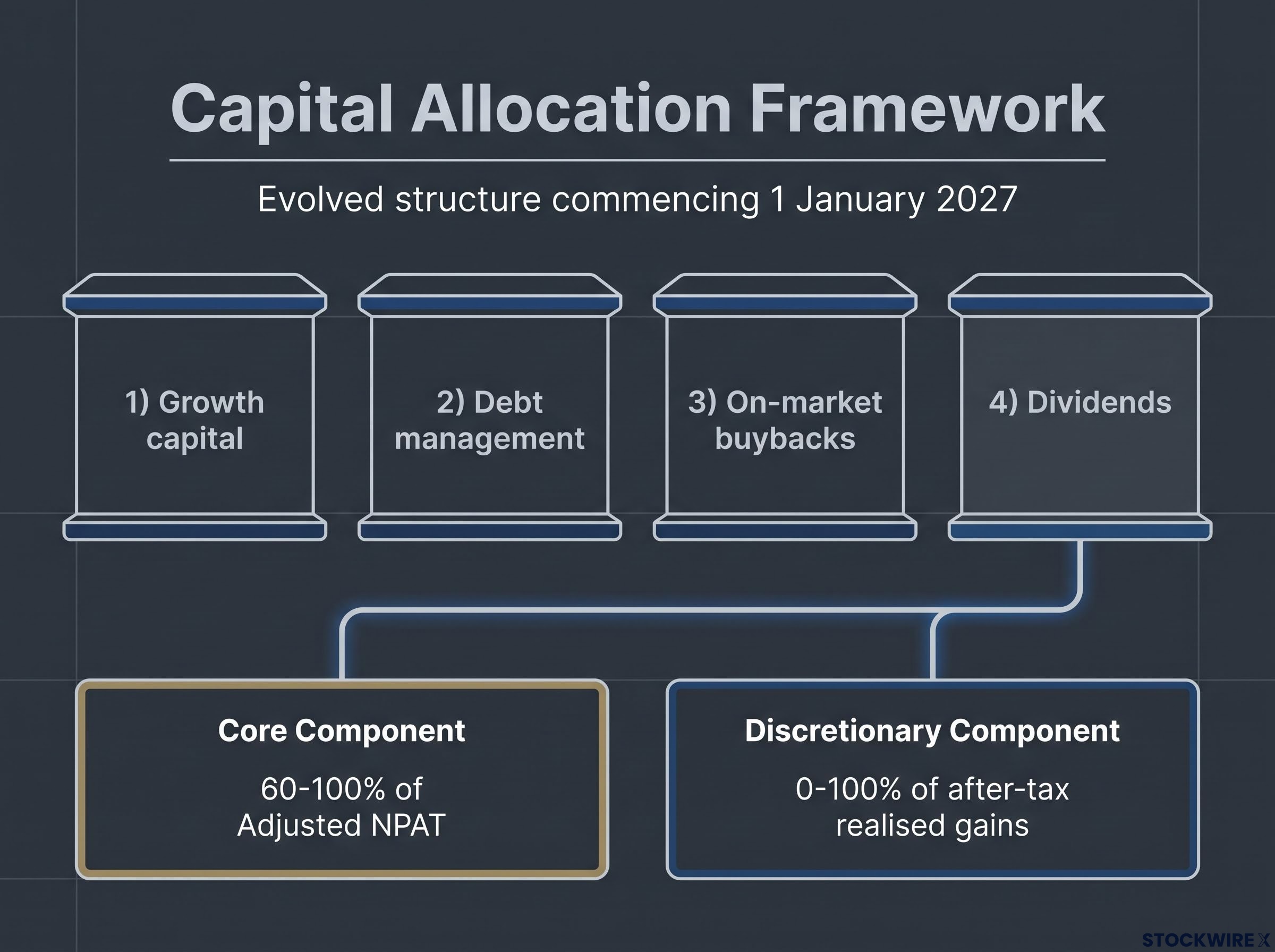
The presentation outlined the Company’s intention to introduce an evolved dividend framework commencing 1 January 2027, with semi-annual payments expected in April and October from FY2026 results onward.
The Capital Allocation Framework sets out four primary uses of capital:
- Growth capital: selectively allocate capital to well-priced opportunities that complement the existing portfolio and are expected to be accretive on a per-share basis.
- Debt management: prudent use of debt to optimise returns, minimise financing costs, and preserve balance sheet flexibility.
- On-market buybacks: deployed when the share price trades at a discount to NAV, to enhance per-share value for remaining shareholders.
- Dividends: return surplus retained earnings to shareholders where appropriate, including through special dividends linked to specific events or transactions.
Under the evolved dividend structure, the core component is set at 60–100% of Adjusted NPAT (statutory NPAT excluding impairments and after-tax capital gains), designed to anchor the dividend to operational earnings rather than capital gains. The discretionary component covers 0–100% of after-tax realised gains, assessed by the Board against prevailing market conditions and strategic objectives. The presentation noted this component should not be relied upon each year.
Gearing at 30 June 2026 stood at 12% (net debt to water ratio), within the Company’s target range of 0–20%. Management internalisation, completed November 2025, eliminated external management and performance fees entirely.
The strategic roadmap presented short and medium-to-long term targets across five pillars:
- Short term (FY26): achieve 70%+ of portfolio leased by value with a WALE of 3+ years; establish a sustainable dividend policy underpinned by operational earnings.
- Medium to long term (FY27+): grow toward an institutional-scale asset base; build a lease portfolio that includes 10 of Australia’s largest irrigators as lessees; support closer alignment between share price and net asset value.
Don’t Miss the Next Utilities Sector Opportunity on ASX
Big News Blast delivers FREE breaking ASX news straight to your inbox within minutes of release, complete with in-depth analysis already done for you. Join 20,000+ subscribers staying ahead of market-moving announcements across utilities and beyond. Click the “Free Alerts” button to start receiving alerts the moment news breaks.