

Optimatrix clears its first preclinical hurdle in cataract surgery
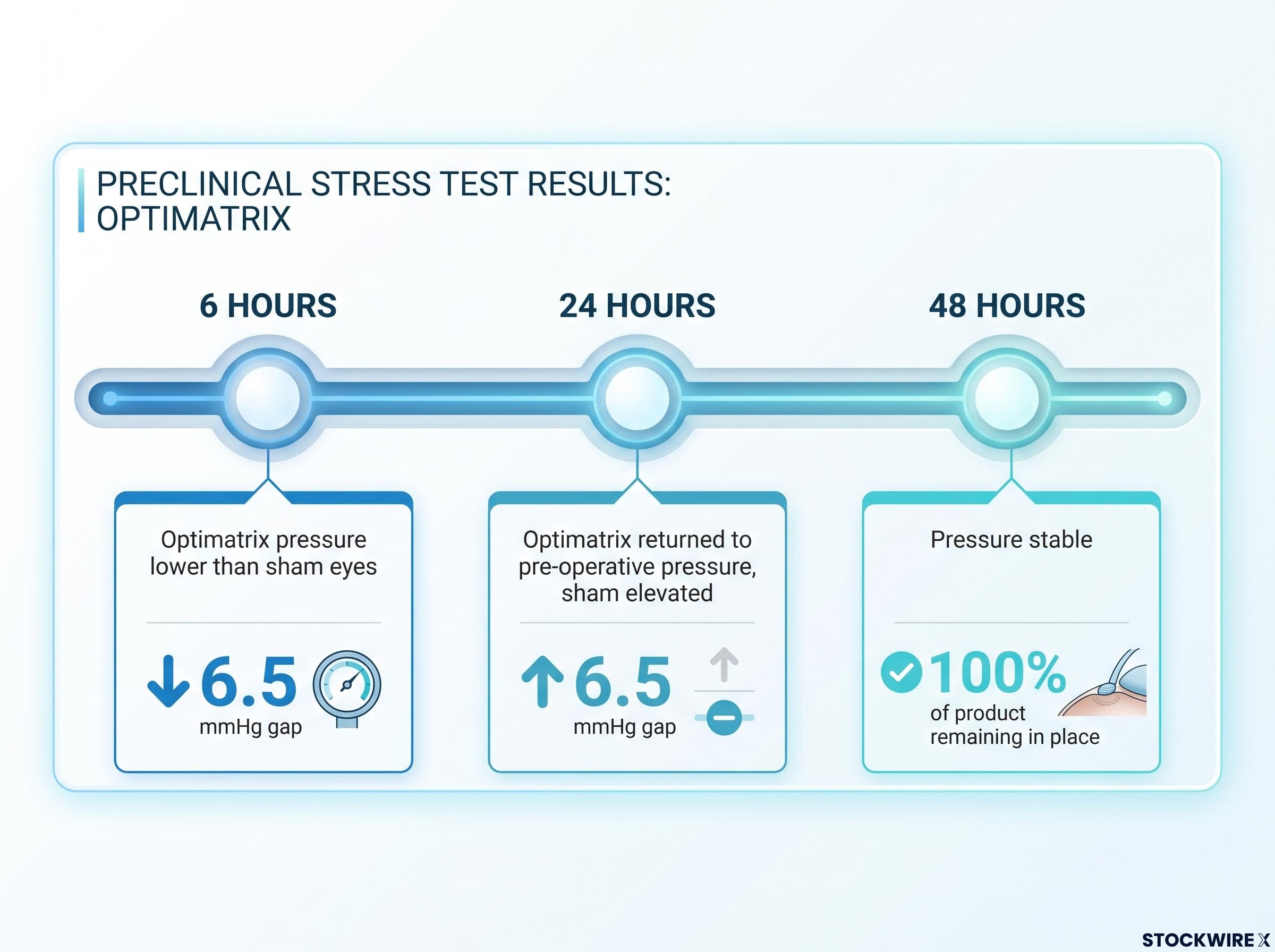
Tetratherix (ASX: TTX) has completed its first independent preclinical performance study for Optimatrix in cataract surgery, using a recognised animal model. In a deliberate stress test of the product’s safety profile, Optimatrix was left inside the eye in full rather than washed out, with intraocular pressure returning to pre-operative levels within 6 hours and remaining stable at 48 hours, despite 100% of the product remaining in place.
The result represents an early but material step in TTX’s commercial pathway into ophthalmology, targeting the ophthalmic viscosurgical device (OVD) market used in over 20 million cataract operations annually. The addressable market is approximately US$3 billion.
Dr Ali Fathi, Founder and CTO, Tetratherix
“Surgeons are forced by current OVDs to solve the same problem at the end of every case: remove the applied product completely or risk a spike in eye pressure for the patient. We set out to help surgeons reduce that risk. We asked the question ‘what if we did not need to spend so much time making sure every last trace of the OVD was removed for the patient’s safety?’. Our results show that with Optimatrix the eye settled back to where it started inside a day with zero product removed, reinforcing the safety profile of the entire Tetramatrix™ platform. I am excited to further investigate how the technology can help patients, simplify surgeries, and avoid the use of animal-derived products in its formulation.”
When big ASX news breaks, our subscribers know first
What OVDs do — and why the current market has a problem
In cataract surgery, the eye’s natural clouded lens is broken up, removed, and replaced with an artificial one. To do that safely, the surgeon needs the front chamber of the eye to remain open, deep, and stable throughout the procedure. That is the job of an OVD: a clear gel injected through a small incision of 2 to 3 mm that fills the chamber, holds tissue apart, and coats the inside of the cornea while the lens is removed. At the end of the operation, the OVD is washed and suctioned back out.
The reason removal matters is structural. The eye continuously produces fluid and drains it through a filter at the edge of the front chamber. Material left behind that causes inflammation can block that filter, producing a rise in intraocular pressure in the hours after surgery. This is the most common early complication of cataract surgery.
This dynamic creates the central trade-off in the existing OVD market. Devices that protect the eye best tend to be the hardest to remove; devices that come out cleanly tend to protect less. Surgeons must choose between the two, or use both in the same operation. All currently marketed OVDs are built from naturally derived polysaccharides, specifically sodium hyaluronate, chondroitin sulfate, or hydroxypropyl methylcellulose. None is a fully synthetic polymer. This is the gap Optimatrix is designed to address.
How Optimatrix works — and what makes it different
A synthetic gel designed to hold firm and release on command
Optimatrix is formulated from TTX’s proprietary Tetramatrix™ platform polymer. It is a fully synthetic, water-based solution that arrives at the surgical field as a liquid and transforms into a clear, cohesive gel at body temperature, holding the chamber open and stable through every step of the operation.
Removal is straightforward: irrigating the eye with cooled saline returns the gel to a liquid, which washes away without additional equipment, suction, or specialised technique. The same property that sets the gel also releases it, making removal a change of temperature rather than a technical challenge.
Key product characteristics:
- Fully synthetic, water-based solution
- Delivered as a liquid in a ready-to-use syringe
- Sets to a clear gel at body temperature
- Removed by irrigating with cooled saline
Why being fully synthetic matters commercially
All three polysaccharides used in currently marketed OVDs carry sourcing dependencies: sodium hyaluronate is derived from animal tissue or bacterial fermentation; chondroitin sulfate is animal-derived, primarily from shark fins; and hydroxypropyl methylcellulose is a semi-synthetic plant-cellulose derivative. Optimatrix eliminates these inputs entirely.
Three commercial advantages follow from full synthetic formulation. First, supply reliability: a synthetic polymer is manufactured to specification batch after batch, without dependence on animal tissue or a living fermentation process. Second, consistency: properties such as clarity, viscosity, and release behaviour are set by design rather than by biological variability. Third, traceability: removing animal-derived inputs removes an entire category of sourcing questions from the regulatory file and eliminates a known source of inflammatory and foreign body reaction that can affect a product’s safety profile.
Two new patents covering composition of matter and the use application for cataract surgery have been lodged and are currently in the PCT phase.
| Feature | Current OVDs | Optimatrix |
|---|---|---|
| Origin | Animal or fermentation-derived | Fully synthetic |
| Removal method | Active wash and suction | Cooled saline irrigation |
| Pressure risk if residue left | Principal cause of post-operative pressure spike | Returned to pre-operative baseline within 6 hours |
Study design, results, and what comes next
How the study was structured
Animals underwent cataract surgery in both eyes on the same day and by the same surgeon. In one eye, Optimatrix was used and then left inside in full. In the other eye, a sham balanced-salt procedure was performed and removed at the end of the operation as normal practice. Because both eyes of the same animal were operated on together, each animal served as its own control.
Intraocular pressure was measured before surgery and at intervals through to 48 hours afterwards. Eyes were examined and photographed throughout.
Results — pressure profile and what it tells investors
In every animal, pressure in the Optimatrix-treated eyes was lower than in the sham eyes as early as 6 hours post-surgery. By 24 hours, Optimatrix eyes had returned to their pre-operative pressure, while the sham group remained elevated. The gap between the two groups measured 6.5 mmHg at both the 6-hour and 24-hour marks.
The commercial intent behind this study design is important to understand. TTX does not intend surgeons to leave Optimatrix inside the eye. The study was constructed to answer the first question any surgeon or commercial partner asks of a material that might be retained: does the eye tolerate it. On this evidence, it does, even at an artificial 100% retention level. This de-risks the product’s safety profile and strengthens the evidence package being assembled for partner engagement.
Regulatory pathway and commercialisation model
TTX has engaged the FDA through its routine pre-submission strategy to confirm the Optimatrix product code and the preclinical studies required. The formal preclinical study is now underway, following the standard clinical approach in which Optimatrix is removed at the end of the operation and compared against the standard of care over 90 days to assess safety and local tissue response.
Consistent with TTX’s platform-to-product model, Optimatrix is intended for commercialisation through partnership. TTX generates the proof-of-concept and pilot data; the commercial partner owns regulatory approval, reimbursement, and market planning. The data from this study forms part of the evidence package supporting ongoing engagements with market leaders, described as now in full swing.
Next steps in sequence:
- Formal preclinical study (underway): Optimatrix removed post-operation, compared to standard of care over 90 days
- Clinical studies to support FDA approval
- Commercialisation via partnership with market leaders
What this milestone means for TTX investors
Optimatrix is not a standalone product bet. It is built on the Tetramatrix™ platform polymer TTX already manufactures across its product range, meaning each application leverages existing platform infrastructure rather than requiring a ground-up development effort.
The Tetramatrix platform polymer has already reached commercial production scale, with TTX completing its first export shipment to US partner Superpower Health following FDA UNII registration of the material in June 2026.
The scale of the opportunity is material. With over 20 million cataract operations performed worldwide each year and an addressable OVD market of approximately US$3 billion, even a partial capture of market share through a partnered commercialisation route represents a significant commercial outcome.
The partnership model is deliberately capital-efficient. TTX bears the discovery and proof-of-concept cost; the commercial partner absorbs the regulatory approval, reimbursement, and market access burden. This preclinical result is one evidence layer in a building commercial package, with market leader engagement already described as underway.
Don’t Miss the Next Healthcare Breakthrough
Big News Blast delivers FREE breaking ASX healthcare news directly to your inbox within minutes of release, complete with in-depth analysis already done for you. Join 20,000+ subscribers who stay ahead of the market on moves like this one. Click the “Free Alerts” button to start receiving real-time alerts the moment ASX healthcare announcements hit.