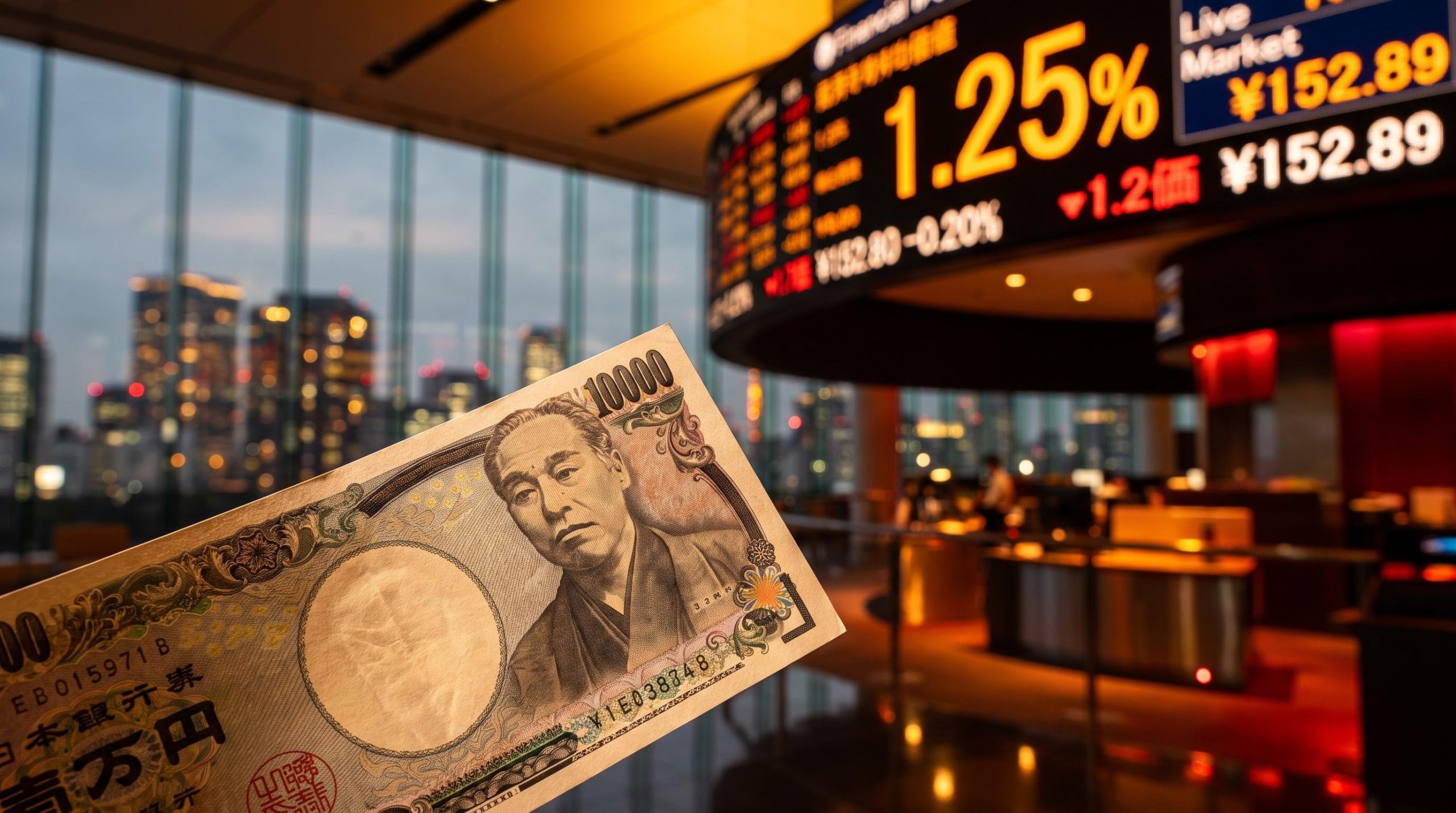
The Bank of Japan is expected to raise its benchmark interest rate to 1.25% on 18 September, a level the country has not seen since 1995, and the move is so widely anticipated that it has already begun shifting global markets before a single vote is cast.
With real wages rising at their fastest pace in five years, inflation trending toward the BoJ’s 2% target, and the yen strengthening sharply in anticipation of tighter policy, the September meeting is less about whether the central bank acts and more about what it signals next.
That distinction is where the money is. The pace of subsequent hikes, not the single 25 basis point move, is what will determine the trajectory of Japanese government bond yields, yen carry trades, and risk assets across the world. Here is what the data driving the hike actually says, what institutional forecasters expect the BoJ to signal about future moves, and what the decision means in practical terms for anyone holding Japanese assets or positions sensitive to yen movements.
A 25 bp hike that markets have already priced in
Rarely does a central bank walk into a policy meeting with this little suspense attached to the headline number. A Reuters poll conducted 1-8 September 2026 found that 66 of 68 economists, roughly 97%, expect the BoJ to lift its policy rate to 1.25% at the 17-18 September meeting. A Bloomberg survey published on 11 September went further still: all 52 of its BoJ watchers see a hike coming the following week.
Market pricing tells the same story. Reuters described the 25 bp move as “nearly fully” discounted by the time the meeting arrives, which means the decision itself is unlikely to move much of anything on the day.
The current benchmark of 1.0% was reached at the June meeting, and that level already stands as the BoJ’s highest since 1995. Another quarter-point extends what has become a historic shift in Japanese monetary policy, one that ends decades of near-zero and negative rates.
The July rate hold produced an 8-1 vote with sole dissenter Hajime Takata explicitly pressing for an immediate move to 1.25%, a named dissent that compressed the perceived distance to September and established the policy trajectory the current meeting is expected to confirm.
Standard Chartered analysts Chong Hoon Park and Nicholas Chia frame the anticipated move as an insurance policy rather than the opening shot of an aggressive tightening campaign. The BoJ, in their reading, is expected to avoid pairing the hike with an overly hawkish signal.
Standard Chartered’s read The bank sees the September move as “precautionary in nature,” designed to get ahead of potential risks rather than react to them, with the BoJ expected to avoid communicating an aggressive tightening signal alongside the decision.
Here is what that near-total consensus means for you. The hike itself will generate almost no surprise, because it is already sitting in asset prices. The genuinely uncertain part, the part that still carries information, is the language and tone of the statement that lands alongside it. Watch the words, not the number.
When big ASX news breaks, our subscribers know first
The economic data that gave the BoJ its opening
The case for acting now was built one release at a time, and the most symbolically important brick is wages. Labour Ministry data published on 8 September showed real wages up 2.4% year-on-year in July, the largest gain since May 2021 and the seventh consecutive monthly increase. Nominal average monthly cash earnings rose 4.7% year-on-year to 436,401 yen.
That seventh straight month is the figure that matters most. The BoJ has repeatedly said sustained wage growth is the precondition it needs before committing to durable normalisation. Rising real wages tell you domestic purchasing power is finally building rather than being eroded by inflation, which is exactly the signal the bank has been waiting for.
Inflation is moving in the same direction. Core CPI, which strips out fresh food but keeps energy, rose 1.8% year-on-year in July, up from 1.6% in June. Core-core CPI, which excludes both fresh food and energy and gives a cleaner read on underlying demand, climbed to 1.9% from 1.7%. Both are trending up, and both are closing in on the 2% target from below.
Growth gave the BoJ its final piece of cover
The Cabinet Office’s second estimate for second-quarter GDP, released on 8 September, revised annualised growth up to 1.4% from an initial 1.1%, driven largely by stronger capital expenditure than first estimated. An economy expanding faster than believed, with firms still investing, removes the last excuse for waiting.
| Indicator | July 2026 Reading | Prior Reading | Trend Direction |
|---|---|---|---|
| Real wages (y/y) | 2.4% | Seventh consecutive gain | Rising |
| Core CPI (y/y) | 1.8% | 1.6% (June) | Rising |
| Core-core CPI (y/y) | 1.9% | 1.7% (June) | Rising |
| Q2 GDP (annualised) | 1.4% | 1.1% (initial) | Revised up |
Taken together, the three pillars explain why the BoJ has the confidence to move now rather than wait. They also set the baseline against which every future release will be judged, because the same data that justified September is what subsequent hikes will be measured against.
The shift in the BoJ rate decision framework became explicit when Deputy Governor Himino declared the bank does not need complete information before acting, a structural departure from a decade of data-confirmation-first communication that lowered the threshold for every future move.
What comes after September, and how fast
The consensus breaks apart the moment the conversation shifts from the September hike to the pace of everything after it. Forecasters agree on the destination but not the speed of getting there, and that disagreement is where the real risk lives.
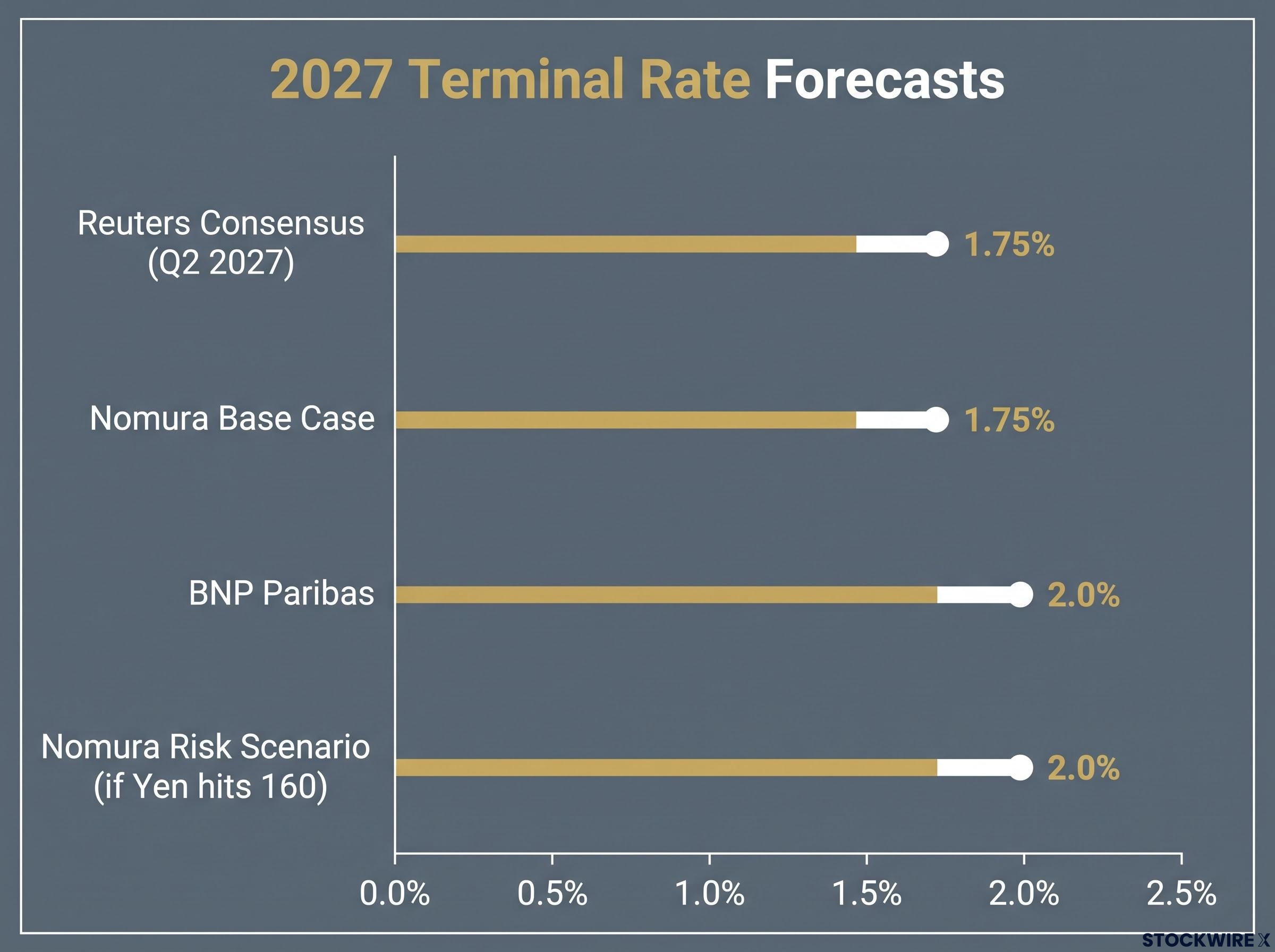
The base case is well anchored. The Reuters poll consensus sees the rate reaching 1.5% by end-March 2027 and 1.75% in the second quarter of 2027, with most economists placing the terminal rate at 1.75% or higher. Bloomberg’s survey found roughly 93% of BoJ watchers expecting another hike by January 2027, some as early as December.
Nomura’s Yujiro Goto holds a similar baseline: hikes in September, January, and April 2027, landing near 1.75%. But Goto also flags a risk scenario worth watching. If the yen slides toward 160 per dollar and reignites imported inflation, Nomura sees up to four hikes in 2026, pushing the rate to 1.50% by year-end and 2.0% by the close of 2027.
Credit Agricole’s Takuji Aida, who advises Prime Minister Sanae Takaichi, expects a September hike followed by quarterly moves until January 2027, then roughly one every six months. BNP Paribas is in the same neighbourhood, forecasting two 25 bp hikes in 2026 and three in 2027 for a terminal rate of 2%. Aida’s warning captures the caution running through the more measured camp.
Credit Agricole’s caution Takuji Aida warns that a “premature, accelerated pace of rate hikes would weigh on the economy,” reflecting concern that moving too fast could damage already soft private consumption.
The spread between the gradual base case and Nomura’s accelerated scenario is precisely what makes September a threshold moment for you as an investor. The BoJ’s communications this week will either lock expectations onto the slow path or leave the door open to a faster sequence, and those two outcomes carry very different implications for JGB yields and the yen.
Structural limits on how fast the BoJ can move
Even the more hawkish forecasters expect gradualism to win, because the BoJ is boxed in by constraints that are not theoretical. They are already visible in market data.
- Fiscal sustainability. With the 10-year JGB yield at approximately 2.99% as of 14 September, and having briefly touched 3% on 1 September for the first time since 1996, rising debt-servicing costs are squeezing Japan’s fiscal space against a backdrop of record budget requests.
- Bond-market stability. The BoJ has said it will respond “nimbly” with JGB purchases if long-term yields rise rapidly, an implicit admission that its rate path is constrained by the need to keep the bond market orderly.
- Muted private consumption. Domestic demand remains soft, and aggressive tightening risks choking off a recovery that is still finding its feet.
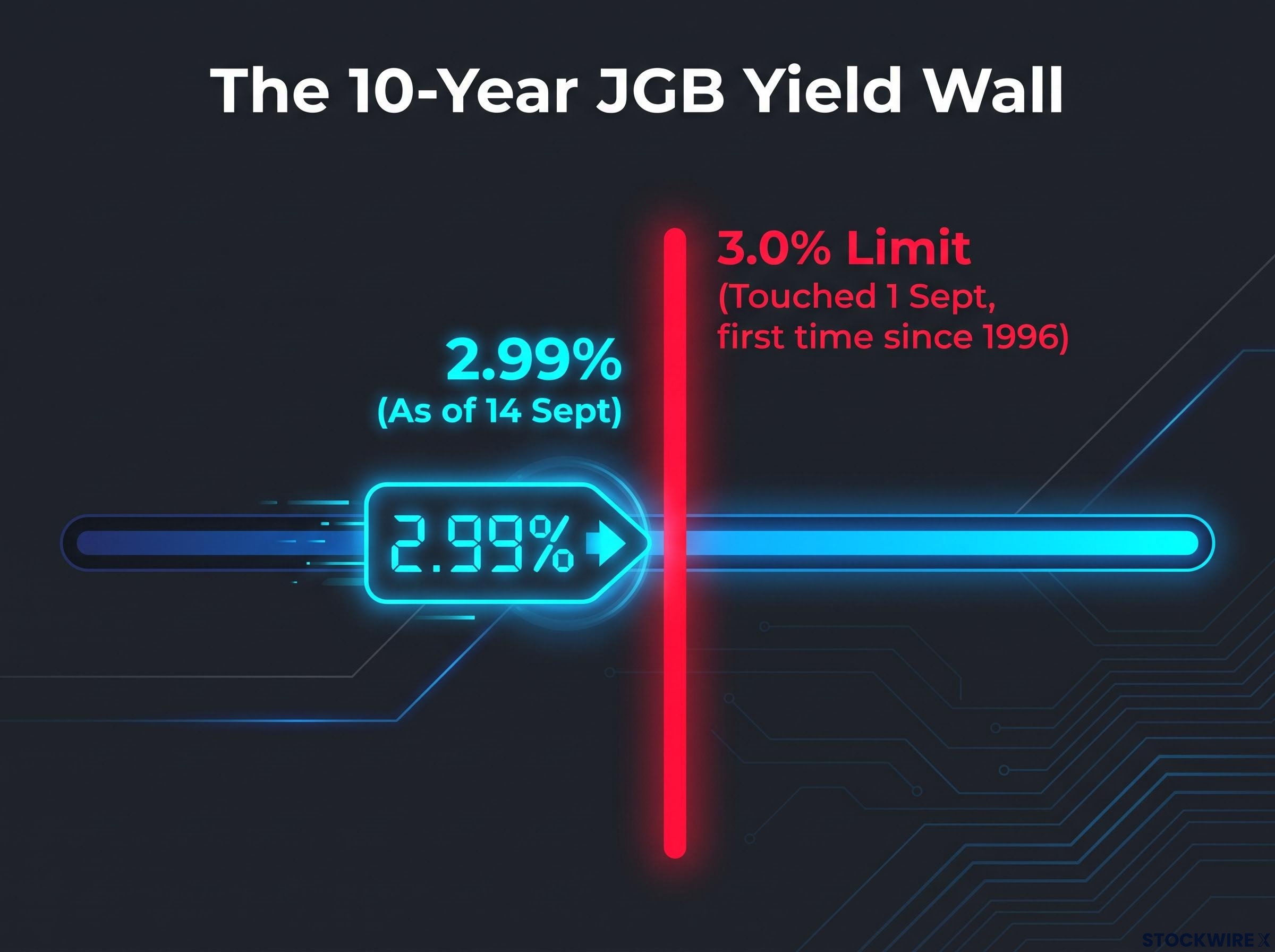
These pressures are live. The Ministry of Finance’s 1 September auction confirmed the market’s move into the 3% zone, and former BoJ policymaker Seiji Adachi has warned that yields breaking decisively above 3% could trigger political pressure for resumed bond-buying. That is the wall the BoJ is trying not to hit.
What the BoJ decision means for yen positions, carry trades, and global markets
A domestic Japanese rate decision becomes a global market event through one channel above all others: the yen carry trade. For years, investors borrowed yen cheaply and parked the proceeds in higher-yielding assets abroad. When Japanese rates rise and the yen strengthens, those positions lose on both legs at once, forcing investors to unwind them and repatriate funds.
This is not a hypothetical risk. In July 2024, a BoJ rate hike paired with plans to cut bond purchases triggered a sharp yen rebound and a global risk-asset sell-off, a reminder of how quickly a Japanese policy shift can ripple through the world.
And the unwinding has already started. Reuters reported on 9 September that the yen surged roughly 4.5% in a week, briefly touching 152.89 per dollar, a seven-month high, before settling near 153.69. It also rose nearly 5% against the Mexican peso and Turkish lira, both classic carry-trade destinations, evidence that leveraged positions are being cut before the vote is even cast.
The September yen move displayed the diagnostic signature of carry-trade repricing rather than forced liquidation: speculative short positions in yen futures grew by 28,900 contracts to 92,200 in the week ending 1 September, the opposite of the position collapse seen in a genuine unwind event.
Saxo’s warning Charu Chanana notes that positioning remains sizeable and that “further yen strength can turn a gradual reduction in leverage into a much faster, self-reinforcing unwind.”
Whether this becomes a repeat of 2024 is contested. Commentators including ChosunBiz argue that carry-trade leverage in Japan’s financial system is smaller now, making a full replay less likely. BCA Research, meanwhile, points to unwinds in 2008, 2015, and 2020 as reminders that these episodes can turn violent when they cascade. The risk channel is open even if the odds of a full-blown shock are lower than last time.
If you hold any of the following, this meeting is your meeting, not a regional footnote:
- Yen carry trades and FX positions, where the recent move has already inflicted losses.
- Japanese equities, where a stronger yen pressures exporters even as higher rates and rising real wages may favour domestic financials over time.
- Global rate-sensitive assets and EM currencies, where Capital Group notes that Japanese yields rising relative to easing global peers could pull repatriation flows out of overseas bonds and equities.
Here is the practical read. The yen has already strengthened materially before the vote, which means carry-trade holders are already absorbing losses. What the BoJ says on 18 September about future hikes will decide whether those positions face further pressure or catch a reprieve as the immediate uncertainty clears.
Whether the BoJ threads the needle depends on what it says, not just what it does
The single most useful way to think about this meeting is to stop treating it as a rate event and start treating it as a communication event. The 25 bp move is consensus and already priced. The forward guidance is not priced with anything like the same certainty, and that is where the meeting’s real output lands.
Scotiabank strategists identified the forward guidance signal as the true pricing catalyst at the September meeting, with hawkish language narrowing rate differentials and supporting yen appreciation while cautious phrasing risks a sell-the-news selloff even if the hike is delivered as expected.
Three variables will determine the pace of everything that follows, and they are worth watching in order:
- The yen’s trajectory against the 160 threshold. Nomura has flagged 160 per dollar as the level that could trigger an accelerated hiking sequence, so exchange-rate direction is the fastest-moving signal.
- Core CPI persistence across the September and October releases. Sustained readings near or above 2% would validate the gradual path; a rollover would give the doves ammunition.
- JGB yield stability relative to 3%. With the 10-year already at 2.99% and above the neutral-rate corridor per BNP Paribas, yields breaking higher would activate the fiscal pressures that constrain how far the BoJ can go.
The broader point is that Japan is not the Fed or the ECB. Very high public debt, newly liberalised long-term yields, and a large stock of yen-funded external assets mean the BoJ is navigating constraints those central banks never faced. The IMF backs gradual hikes toward a neutral rate but warns that rate cuts could be warranted if growth and inflation undershoot. The gradual path most closely resembles the moderate tightening cycles that academic work links to soft landings, not the rapid front-loaded episodes tied to hard ones.
So if you treat the September hike as a resolved event and move on, you are making a structural error. The meeting’s real output is the BoJ’s forward framing, and that framing will either confirm the gradual base case or open a door that global markets are not fully positioned for. Watch the yen, the core CPI trajectory, and JGB yield stability in the weeks after 18 September, and you have a framework for updating your positioning rather than reacting to each headline in isolation.
This article is for informational purposes only and should not be considered financial advice. Investors should conduct their own research and consult with financial professionals before making investment decisions.
Past performance does not guarantee future results. Financial projections are subject to market conditions and various risk factors. These statements are speculative and subject to change based on market developments and central bank decisions.