Most investors assume the Federal Reserve is a domestic story. Rate decisions in Washington move US mortgages, US bonds, US stocks, and the calculation ends there.
That assumption is being tested on trading screens right now. As of mid-September 2026, the US 10-year Treasury yield is pushing toward 5% and the US Dollar Index has climbed back into the 99-100 range, and the shockwaves are landing hardest thousands of miles away.
The pressure is showing up in emerging market currencies. A hawkish repricing of Fed expectations has turned the dollar into a magnet for global capital, and currencies from Santiago to Johannesburg are absorbing the strain.
This piece lays out exactly how US rates and emerging market currencies are connected. Here is what the data actually tells you about the transmission mechanics that break currency markets, the four currencies most exposed right now, and how today’s stress compares to past crises so you can gauge the real contagion risk to any international holdings you own.
The US macro setup driving dollar dominance
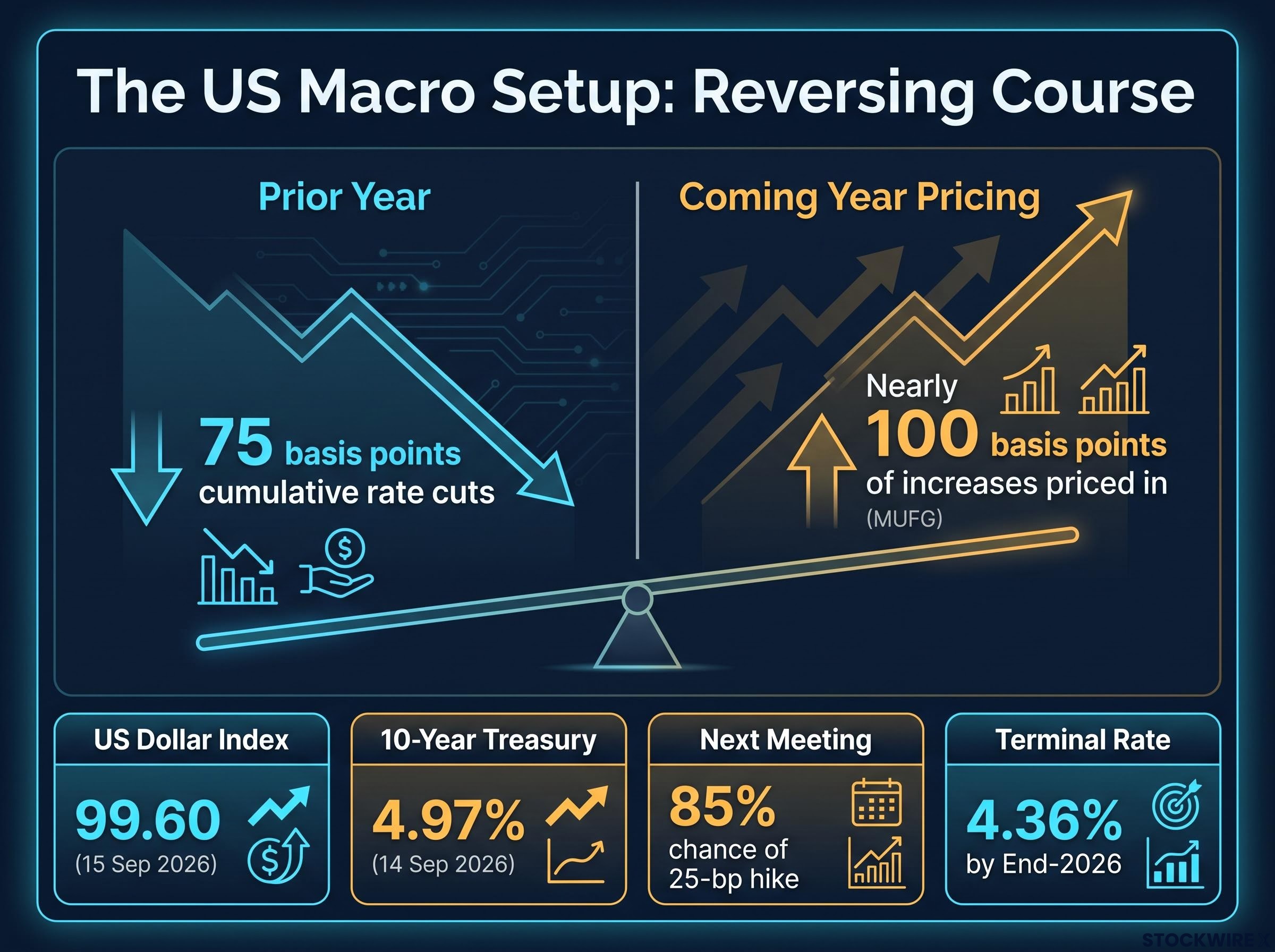
The starting point is a fast, decisive shift in what markets expect from the Federal Reserve. Over the prior year, the Fed delivered 75 basis points of cumulative rate cuts. According to MUFG analyst Lee Hardman, rate markets are now pricing in nearly 100 basis points of increases over the coming year, effectively erasing that easing and then some.
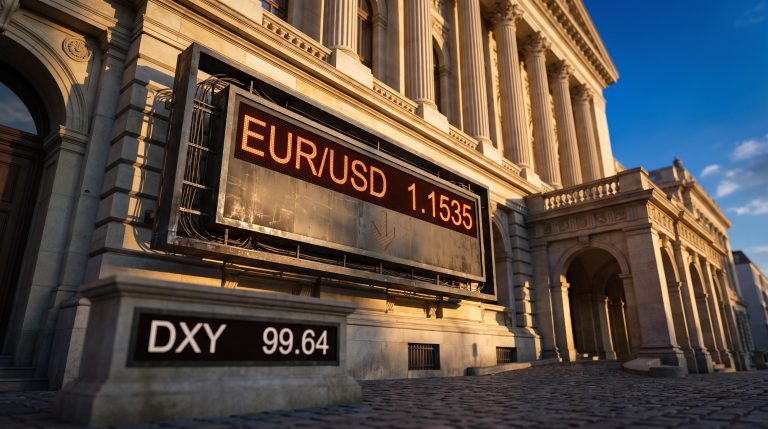
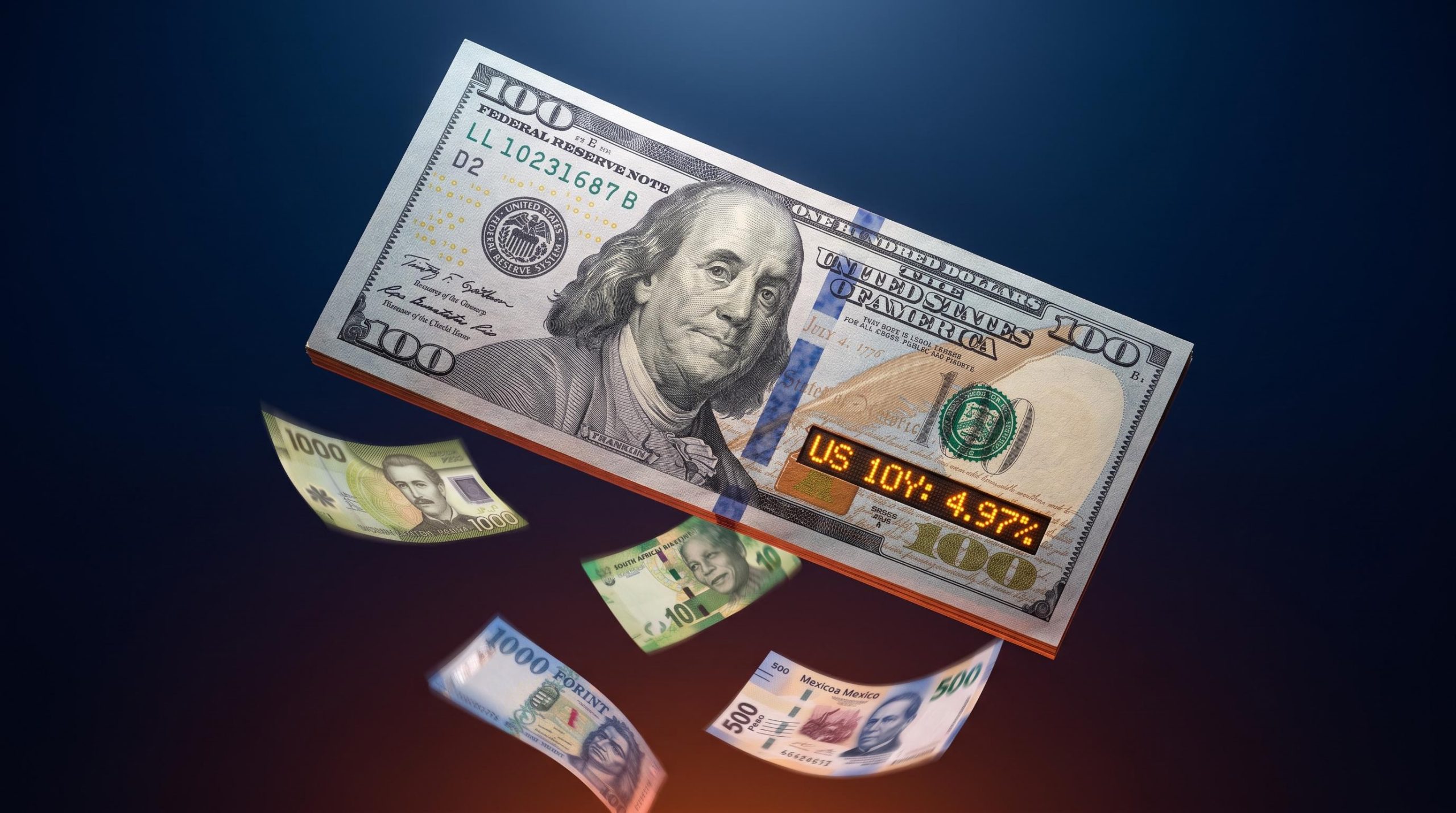
The dollar has responded exactly as you would expect. The US Dollar Index has rebounded into the 99-100 area, with MarketWatch showing a reading of 99.60 on 15 September 2026. The 10-year Treasury yield sits at roughly 4.97% as of 14 September 2026, near its highest level since October 2023.
Federal Reserve Governor Waller’s September 2026 outlook, delivered two weeks before the September meeting, signalled that policymakers were watching incoming inflation data closely before committing to further rate adjustments, reinforcing the hawkish repricing markets had already begun.
Higher yields on the world’s safest large asset change the maths for every investor on the planet. When US government debt pays close to 5%, the incentive to hold riskier assets elsewhere shrinks.
What the Fed futures market is pricing
The near-term picture is aggressive. A Reuters report dated 11 September 2026 noted that short-term interest-rate futures were pricing an 85% chance of a 25-basis-point hike at the Fed’s 15-16 September meeting, with a second hike also implied for December.
September Fed hike odds crossed above 60% in a single morning after the August payrolls report showed 162,000 jobs added, a repricing that moved faster than most currency hedges could adjust and that pushed the dollar bid visible in emerging market screens by mid-month.
Rate tools point in the same direction. The Fisclear Fed Rate Monitor put the terminal rate for end-2026 at approximately 4.36%, consistent with roughly 40-50 basis points of net tightening priced across the next 12 months.
The speed of this repricing tells you that global capital has found an attractive, low-risk destination. When money flows toward US dollar assets on this scale, it drains liquidity from everywhere else, and you need to factor that pull into any thesis you hold on international markets. That liquidity drain is precisely where the damage to developing economies begins.
When big ASX news breaks, our subscribers know first
The transmission mechanics squeezing emerging markets
Step back from the daily price moves and the mechanism becomes clearer. A stronger dollar and higher US yields do not hurt developing economies at random. They travel through specific, well-documented channels.
The dollar’s outsized role in global finance is the foundation for understanding why US rate moves hit Santiago and Johannesburg before they hit Wall Street; dollar dominance mechanics, including the currency’s 89% share of all global FX trades, mean that a Fed pivot in either direction ripples through every asset class on the planet.
There are three worth understanding, because they are the same mental model institutional investors use to predict currency stress.
- The capital flow channel. Higher US yields pull money out of riskier markets as investors reallocate toward safer dollar assets. IMF research documented in the working paper “Why Follow the Fed?” finds that a one-percentage-point rise in US rates from a policy surprise tends to immediately lift long-term rates by about a third of a percentage point in the average emerging market, and roughly two-thirds of a percentage point in lower-rated ones. Those outflows push local currencies down against the dollar.
- The balance sheet effect. Many developing nations borrow in US dollars. When the dollar rises, the real cost of repaying that debt climbs even if nothing else changes. An IMF study on dollar strength and emerging market growth links periods of dollar appreciation to weaker growth, partly because of this heavier debt burden.
- Carry trade unwinding. Investors who borrowed cheaply to buy high-yielding emerging market debt abandon the trade once US Treasuries offer a comparable, safer return. BIS research finds that the dollar’s role as a barometer of global risk appetite matters more for these flows than interest-rate differentials alone.
Carry trade repricing does not always signal systemic liquidation; in early September 2026, speculative short positions in yen futures grew by 28,900 contracts even as USD/JPY fell close to 4% in ten days, a pattern that looks very different from the forced deleveraging that punished emerging market bondholders in 2013.
The scale of the currency channel is substantial. BIS work on US yield shocks quantifies it directly.
A 100-basis-point increase in the US term premium is associated with roughly a 6% depreciation in emerging market currencies, a 5% fall in domestic equity prices, and sizeable bond and equity outflows.
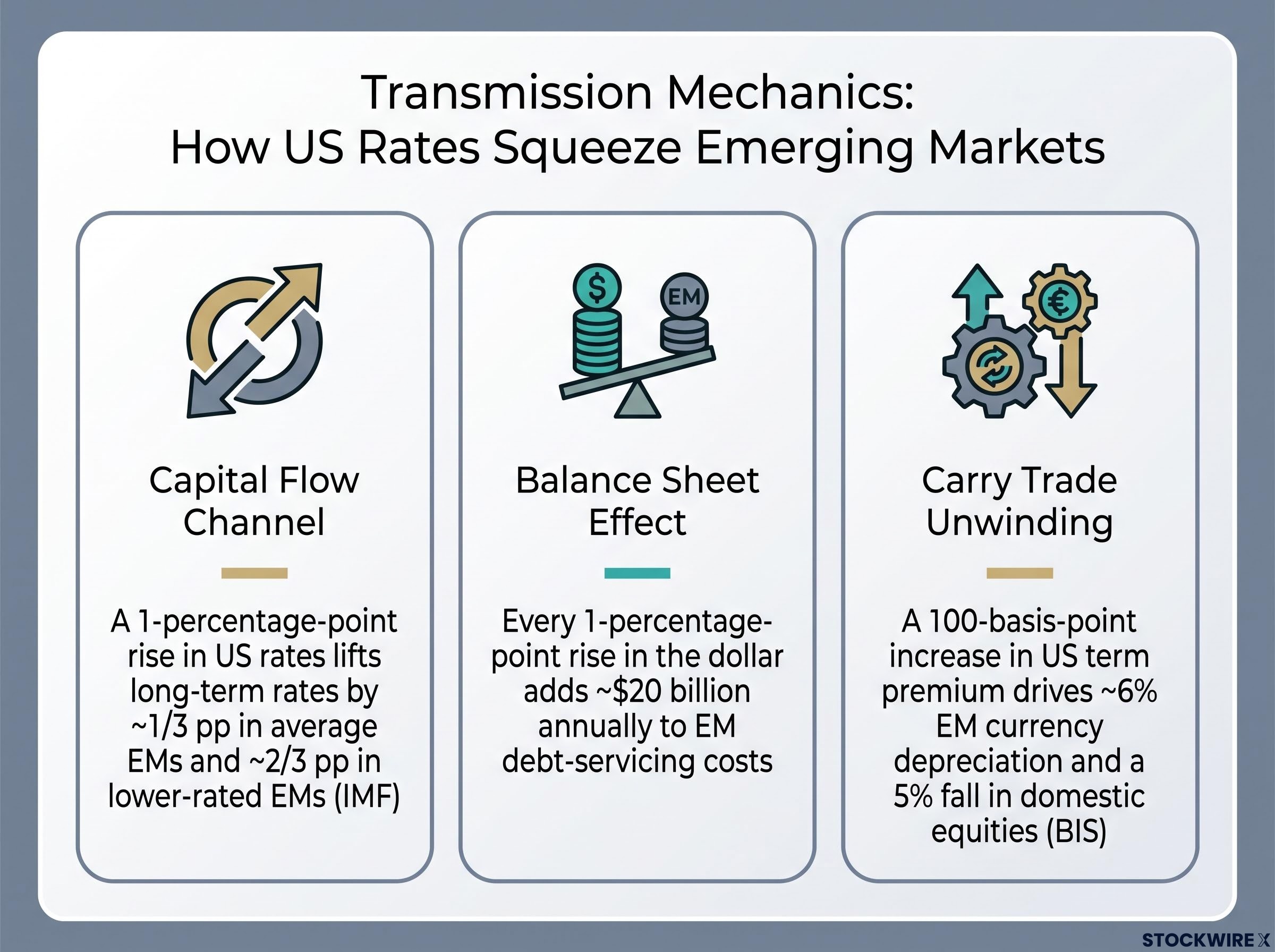
The debt side is just as real. One 2026 analysis estimates that every one-percentage-point rise in the dollar adds approximately US$20 billion annually to emerging market debt-servicing costs, though this figure is not independently confirmed.
Here is the practical read. When you watch the dollar rally on a chart, you are watching the debt-servicing costs of entire nations climb in real time. That rising burden is a direct threat to the stability of any international asset you hold, and it explains why not all emerging markets feel the squeeze equally.
Why commodity and high-yield currencies are feeling the heat
The dollar is the aggressor, but the damage it inflicts depends entirely on the target. Two types of currency are absorbing the worst of it right now, and they suffer for different reasons.
The first group is commodity-linked currencies. Their fate is tied to raw material prices, and energy is doing them no favours. When oil and metals prices swing, so does a country’s terms of trade, the ratio of what it earns from exports to what it pays for imports.
The second group is pure high-yielders. These currencies attracted carry trade money precisely because their bonds paid well, and that money is now leaving as US Treasuries close the gap.
The strain became visible in mid-August 2026. A Bloomberg report on 18 August 2026 described an emerging market rally stalling as US 10-year yields climbed toward 5% and Brent crude hovered around US$91 per barrel, with MSCI’s emerging market stock index falling 0.9% and nearly every currency weakening against the dollar. MUFG analysis identified commodity-linked and high-yielding currencies as the primary underperformers.
Energy exposure is the dividing line, and it cuts both ways:
- Net energy importers face a double hit. A strong dollar makes their imports pricier, and rising oil prices widen their trade deficits, deepening currency weakness.
- Net energy exporters get a partial cushion. Higher energy prices boost export revenues and support external accounts, softening the blow even as carry trade money exits.
The lesson is that a country’s export profile is its defence mechanism against a strong dollar. You cannot treat emerging markets as one uniform asset class when you assess your portfolio risk, because two currencies facing identical US pressure can end up in very different places. Four specific currencies make that point concrete.
Four currencies on the frontline: CLP, ZAR, HUF and MXN
Theory becomes tangible when you look at live currency levels. MUFG specifically flagged the Chilean peso, South African rand, Hungarian forint, and Mexican peso as currencies at risk. Each tells a different story about vulnerability and defence.
| Currency | Current level (mid-Sep 2026) | Primary vulnerability | Structural buffer |
|---|---|---|---|
| Chilean peso (CLP) | USD/CLP 940-959 | Copper price swings, terms-of-trade deterioration | Comparatively sizeable reserves |
| South African rand (ZAR) | USD/ZAR ~16.24 | Weak reserves, external deficits, high FX pass-through | Limited; earlier YTD resilience now fading |
| Hungarian forint (HUF) | USD/HUF 318.02-318.39 | Spillovers from euro-area and US yields | 7% prior YTD appreciation, EU integration |
| Mexican peso (MXN) | USD/MXN 16.99-17.14 | Carry trade unwinding | Energy export cushion |
The Chilean peso
The peso is trading in the 940-959 range per dollar, weakened into the high-900s. Chile’s economy is closely tied to copper, so falling commodity prices alongside a strong dollar squeeze its terms of trade from both sides. The offsetting factor is that Chile holds comparatively sizeable reserves, which makes it less crisis-prone than its history might suggest.
The South African rand
The rand sits around 16.24 per dollar. It screens as the most vulnerable of the four, grouped by IMF vulnerability charts alongside economies with higher external risks. Weak reserve metrics, external deficits, and strong exchange-rate pass-through to inflation all work against it. It did show earlier resilience, trading roughly 2.3% stronger year-to-date as of mid-August 2026, but that buffer has thinned as the dollar strengthened.
The Hungarian forint
The forint trades at 318.02-318.39 per dollar and is the standout for relative resilience. According to a Tradingpedia analysis from 27 May 2026, it had appreciated more than 7% year-to-date, making it the strongest performer in Central and Eastern Europe at that point. That prior strength, combined with EU integration and improved inflation trends, gives Hungary’s central bank more room to manoeuvre.
The Mexican peso
The peso is trading between 16.99 and 17.14 per dollar, still carrying echoes of the “super peso” narrative that defined much of 2026. Carry trade unwinding is a genuine pressure, but Mexico’s energy exports cushion the fiscal and external accounts, giving the peso a defence that the rand simply lacks.
Set the rand against the forint and the point lands immediately. One currency is exposed on nearly every front; the other entered the stress period from a position of strength. That contrast is how you identify which international exposures in your own portfolio actually need hedging.
Reading the contagion risk as year-end approaches
The obvious question is whether this pressure wave breaks the global system or merely tests it. History offers a roadmap.
The clearest parallel is the 2013 Taper Tantrum. When the Fed first signalled it would slow bond-buying, emerging market currencies fell about 6% against the dollar in just four months, hit hardest where reserves were thin and foreign-currency debt was high. The 2018 selloff repeated the pattern, with US shocks and rising global risk aversion driving broad emerging market weakness.
The second-order effects are where the real economic damage sits. To defend their currencies, emerging market central banks often raise local rates, which cools domestic growth and lifts sovereign risk premia. IMF analysis links US yield surprises to measurable increases in the probability of emerging market currency crises in the following year.
There is a genuine reason today’s setup may prove less severe. IMF research on reserve adequacy finds that a one-standard-deviation increase in international reserves cuts the probability of a currency crisis by roughly 8%, and buffers across the emerging market universe are broadly stronger than they were in 2013.
The read for you is this. Historical parallels give you a template for how contagion spreads, but the stronger modern reserve buffers suggest you should prepare for targeted, country-specific volatility rather than a systemic 2013-style collapse. The pinch point to watch is the US 10-year yield: a decisive break above 5%, especially with energy prices high, is the trigger analysts flag for broader de-risking across emerging market equities and credit.
Mapping your exposure to the sovereign stress test
Strip everything back and one relationship dominates. US rate expectations are the ultimate driver of emerging market currency health, and the dollar is the channel through which that force travels.
What separates the survivors from the casualties is structure. Reserve buffers, export profiles, and prior currency strength matter more today than at any point in the past decade, which is why the forint holds firm while the rand strains under identical US pressure.
The practical step is to review your international stock and bond exposure through this framework. Ask which of your holdings sit in commodity-linked or high-yielding currencies, which carry dollar debt, and which have the reserves to defend themselves. That single audit tells you where your real risk sits ahead of any year-end volatility.
EM local-currency bonds returned approximately 19% in 2025 per the J.P. Morgan GBI-EM Global Diversified Index and pulled in $11.4 billion in Q1 2026 flows, illustrating that when the dollar cycle turns, the instrument choice matters as much as the directional call on emerging markets.
This article is for informational purposes only and should not be considered financial advice. Investors should conduct their own research and consult with financial professionals before making investment decisions.
Past performance does not guarantee future results, and financial projections are subject to market conditions and various risk factors. Forward-looking statements about rate paths and currency movements are speculative and subject to change based on market developments.