

FDA clears CurveBeam AI’s CT-based bone density technology — SaaS pathway opens
CurveBeam AI Limited (ASX: CVB) has received FDA 510(k) clearance for its CT-based Bone Mineral Density (BMD) technology using multidetector CT (MDCT) supine scans. The clearance marks the first of two regulatory steps the company has identified as necessary to bring its SaaS-based bone health products to market, establishing an FDA-cleared foundation for future BMD applications across its CT portfolio.
When big ASX news breaks, our subscribers know first
What this clearance means — and what comes next
The regulatory pathway CurveBeam AI is pursuing involves two distinct stages. The first, now completed, is FDA 510(k) clearance for CT-based BMD measurement using multidetector CT (MDCT) supine scans. The second is extending that cleared technology to weight bearing CT BMD on the company’s HiRise™ platform, which the company will now progress toward.
SaaS revenue from bone health products is expected to follow upon achieving HiRise™ clearance, not from the current clearance alone.
The HiRise™ connection
HiRise™ is CurveBeam AI’s flagship CT scanner, designed to provide weight bearing CT imaging of the lower extremity. Extending BMD measurement to a standing examination is clinically meaningful because it assesses bone quality in the weight bearing environment, which is directly relevant to orthopaedic decision-making and surgical preparation.
The company believes this could support a “one visit, one scan” model, in which a single CT examination potentially provides anatomical, alignment, and bone health information without requiring the patient to attend a separate DXA appointment.
CurveBeam AI has stated it will progress regulatory planning for a CT BMD 510(k) submission for HiRise™, including assessment of the appropriate regulatory pathway, clinical evidence requirements, and validation activities.
Longer-term surgical workflow opportunity
Looking further ahead, the company believes quantitative BMD data could become an additional data layer within broader digital orthopaedic workflows. CT examinations are increasingly used to generate patient-specific three-dimensional anatomical models for advanced surgical planning, including robotic-assisted orthopaedic surgical planning workflows.
Subject to appropriate regulatory clearances and clinical validation, deriving quantitative BMD information from the same CT dataset could provide surgeons and planning systems with additional information alongside patient anatomy and alignment. This integration should not be interpreted as imminent; it represents a longer-dated strategic opportunity contingent on further regulatory and clinical steps.
Greg Brown, CEO and Managing Director
“This is a significant milestone for CurveBeam AI, being our first clearance of the two necessary steps to take our SaaS based bone health products to market. Achieving our first FDA 510(k) clearance for CT-based BMD establishes an important regulatory foundation for the Company and demonstrates our ability to bring quantitative bone health capabilities through the FDA pathway. Our next objective is to take this capability to the HiRise™ platform and pursue clearance for weight bearing CT BMD. This is particularly exciting because it aligns quantitative bone health assessment with the weight bearing imaging environment that is central to the HiRise™ proposition.”
Why bone mineral density assessment matters — and the access problem it solves
Bone Mineral Density (BMD) is a quantitative measure of the amount of mineral in bone tissue, used clinically to assess bone health, screen for osteoporosis, and inform surgical preparation for procedures such as total joint replacement. Accurate BMD data helps clinicians understand whether a patient’s bone quality is sufficient to support implants and guides broader treatment decisions.
Conventional BMD assessment is typically performed via Dual-Energy X-ray Absorptiometry (DXA), a standalone imaging modality that requires a separate appointment. Access to DXA can involve significant delays. A U.S. study of more than 10,000 DXA examinations found that the mean time from initial order to completion increased from 79.1 days before the COVID-19 pandemic to 88.8 days during the pandemic (Hisatomi et al., 2022), illustrating the potential for delays in accessing conventional bone density assessment.
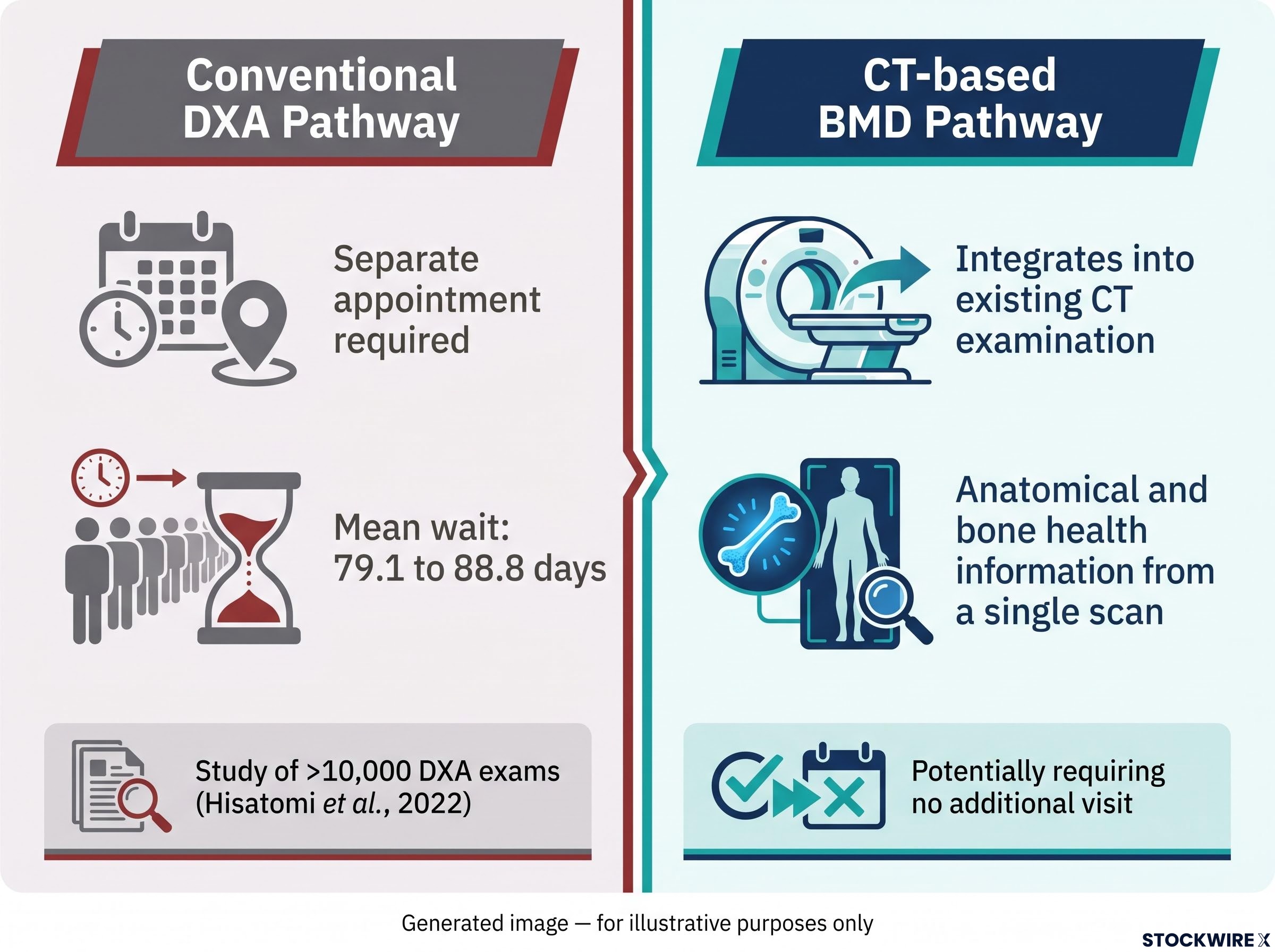
CurveBeam AI’s cleared CT-based BMD technology offers an alternative pathway by integrating bone density assessment into CT imaging that is already being acquired for orthopaedic evaluation:
- Conventional DXA pathway: Separate appointment required, mean wait of 79.1 days before the COVID-19 pandemic and 88.8 days during the pandemic, standalone result not integrated with anatomical imaging
- CT-based BMD pathway: Potential to integrate into an existing CT examination already acquired for orthopaedic assessment, potentially requiring no additional visit, anatomical and bone health information from a single scan
Regulatory milestones and the road to SaaS revenue
The following staged pathway outlines what investors should monitor as CurveBeam AI progresses its bone health strategy:
- FDA 510(k) clearance received — CT-based BMD (MDCT supine) ✓
- Regulatory planning underway — CT BMD 510(k) submission for HiRise™ (weight bearing)
- SaaS revenue launch — upon HiRise™ clearance
- Longer-term — integration of quantitative bone quality data into advanced 3D and robotic-assisted orthopaedic surgical planning workflows (subject to regulatory clearance and clinical validation)
No financial figures, SaaS pricing, or revenue projections have been disclosed in the announcement.
The WEGO Orthopaedics partnership, secured at a five-times premium to market price, signals that international strategic partners have already placed significant conviction on the HiRise platform’s commercial potential ahead of weight bearing CT BMD clearance.
| Stage | Technology | Platform | Regulatory Status | Commercial Implication |
|---|---|---|---|---|
| 1 | CT-based BMD | Multidetector CT (MDCT) supine | FDA 510(k) clearance received | Establishes FDA-cleared regulatory foundation |
| 2 | Weight bearing CT BMD | HiRise™ | Regulatory planning underway; submission to be progressed | SaaS revenue launch expected upon clearance |
| 3 (longer-term) | Quantitative BMD data layer | Advanced 3D and robotic surgical planning | Subject to further regulatory clearance and clinical validation | Potential integration into robotic-assisted orthopaedic surgical planning workflows |
The current clearance establishes an FDA-cleared foundation for CurveBeam AI’s bone health ambitions. The company’s CT portfolio, anchored by HiRise™, has the potential to evolve from hardware sales toward recurring SaaS revenue once HiRise™ BMD clearance is achieved. Integration with robotic-assisted surgical planning workflows represents a longer-dated opportunity, contingent on further regulatory and clinical milestones that the company has indicated it will provide updates on as the programme progresses.
Don’t Miss the Next ASX Healthcare Breakthrough
Get FREE breaking ASX healthcare news delivered to your inbox within minutes of release, complete with in-depth analysis. Join 20,000+ subscribers already staying ahead of the market. Click the “Free Alerts” button at StockWire X to receive the latest ASX healthcare announcements the moment they drop.