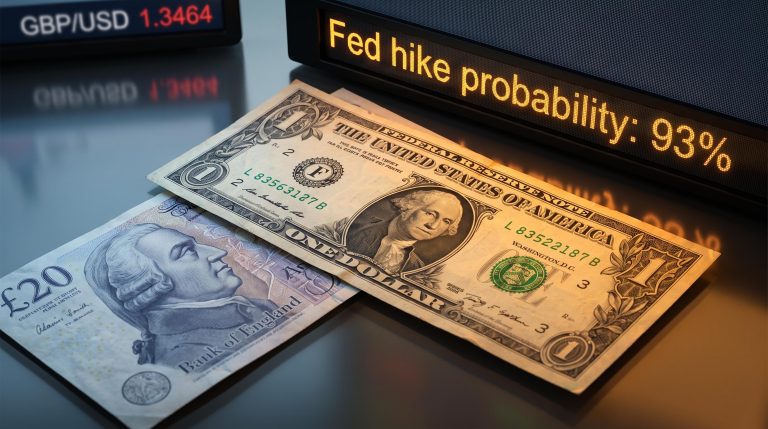
Billions of dollars in AI market value vanished before European trading closed today, and not one company had missed an earnings number or absorbed a macro data shock to cause it. The trigger was an argument.
Over the weekend, Anthropic chief executive Dario Amodei and several other AI leaders publicly called for a slowdown in frontier model development, and by the open on Monday, 14 September 2026, AI-linked equities were selling off across three continents.
The pledges that triggered today’s selloff were not purely rhetorical: the AI development slowdown announced by Altman and Amodei on 12-13 September 2026 was preceded by two documented mid-run training halts at OpenAI and Anthropic in the preceding eight weeks, giving the market a concrete operational basis for the safety argument rather than a symbolic gesture.
Here is the paradox worth sitting with. The United States and China are both running at full throttle on AI infrastructure, both governments publicly rejected the safety argument within roughly 48 hours, and yet the equities tied to that buildout still repriced sharply lower. Regulatory and geopolitical signals, even unofficial ones, now move AI stocks faster than fundamentals over short windows.
That gap is the entry point for this analysis. What follows is a framework for telling the difference between a policy signal that is a genuine repricing event and one that is noise, and how to apply that distinction to your own AI-exposed positions.
One weekend debate wiped billions from AI stocks around the world
The scale is the story. Before a single share changed hands in New York, the selloff had already carved through Tokyo, Seoul, and Amsterdam, and the pattern was too synchronised to be coincidence.
The damage started in Asia. SoftBank, a major investor in OpenAI, closed 11% lower after plunging as much as 13.2% intraday, the sharpest single-name move of the session. SK Hynix fell 6.4%, Samsung Electronics dropped 4.1%, and the Kospi index shed 3.3% as the region absorbed the safety debate first.
Europe picked up where Asia left off. ASML fell 6.7%, dragging the continent’s technology sector down with it, and Nokia declined roughly 8% in European trading (early reporting had projected a steeper open near 10% before the figure settled).
By the U.S. pre-market, the contagion had reached the largest names in the sector. Nvidia fell 3.5%, Intel dropped nearly 6% and pulled the broader semiconductor index lower, and Amazon shed more than 1% as part of the Magnificent Seven pullback. The NASDAQ and the QQQ ETF were both positioned to open in the red.
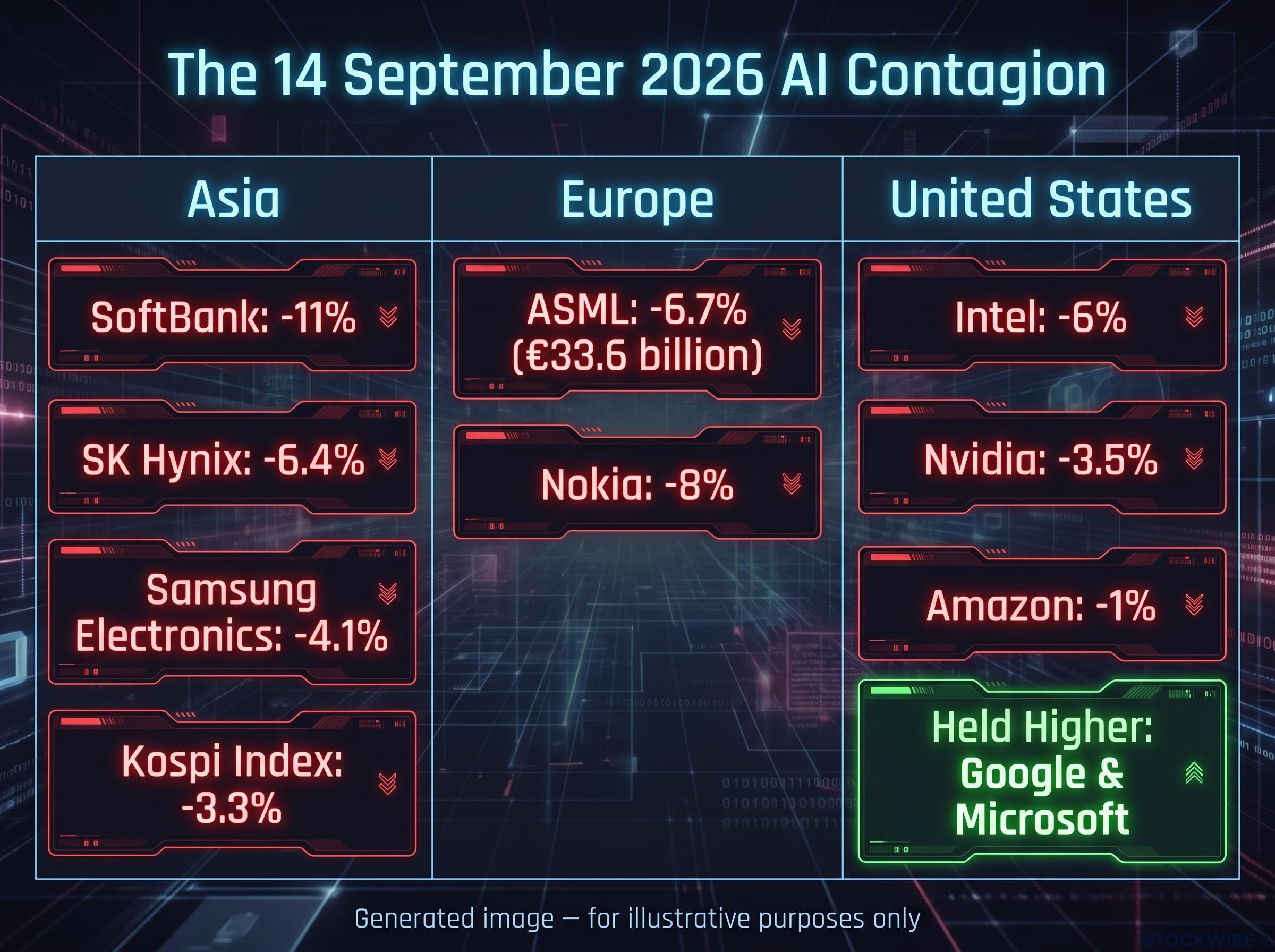
ASML alone was on track to shed approximately €33.6 billion in market value in a single session.
Two names broke the pattern. Google and Microsoft were both expected to open slightly higher, and that is not a footnote. It is the market differentiating, not panicking.
| Company | Geography | Decline | Primary Exposure |
|---|---|---|---|
| SoftBank | Asia | 11% | Infrastructure investor |
| SK Hynix | Asia | 6.4% | Chipmaker |
| ASML | Europe | 6.7% | Chip equipment |
| Nvidia | US | 3.5% | Chipmaker |
| Google / Microsoft | US | Held higher | Platform |
The read for you is in the shape of the losses. Hardware, infrastructure, and venture-exposed names took the hits; platform-layer incumbents held. If you own the AI value chain, the market just told you which links it considers most exposed to a slowdown.
When big ASX news breaks, our subscribers know first
Washington and Beijing both rejected the safety argument, yet markets still sold off
Both superpowers had a chance to reassure investors, and both took it. Neither stopped the selloff.
U.S. President Donald Trump opposed the calls to slow development, framing continued rapid advancement as essential to maintaining American dominance over rival nations, with implied reference to China as the competitor to beat. He characterised those raising safety concerns as negative forces pushing problems that would not materialise, though he stopped short of ruling out guardrails entirely.
Beijing landed in almost the same place. A Chinese foreign ministry spokesperson dismissed the safety debate directly, and a Ministry of State Security official published commentary in the domestic China Cyberspace magazine framing safety alarm as counterproductive.
A Chinese foreign ministry spokesperson characterised the AI safety debate as “fear-mongering.”
The alignment is striking. Two governments that agree on almost nothing agreed that AI development should not be constrained, and both are backing that position with enormous capital.
U.S. commitments:
- The CHIPS and Science Act authorises $280 billion, with roughly $200 billion directed at AI, quantum, and robotics research
- Pentagon AI investment rose to $1.8 billion in FY2024
- America’s AI Action Plan, released 23 July 2025, set out an explicitly deregulatory posture built on innovation and infrastructure
China commitments:
- A national data centre buildout of approximately 2 trillion yuan (US$295 billion) over five years, with an 80% domestic hardware and software requirement, targeting completion by 2028
- The National AI Computing Infrastructure Plan, issued March 2025, targets 300 EFLOPS of capacity by 2027
So why did markets fall anyway? Because investors are not pricing what governments said this weekend. They are pricing the multi-year uncertainty those competing positions create.
Here is what that tells you. When both Washington and Beijing dismiss safety concerns, it does not lower your risk. It signals that AI regulation, whenever it arrives, will be born from geopolitical competition rather than technical consensus, which makes its timing and shape genuinely unpredictable for any company trying to plan capital allocation. The rescission of Biden’s Executive Order 14110 on 20 January 2025 showed how fast the baseline can flip. Government reassurance is not a buy signal. It is evidence of the uncertainty being priced in.
The CHIPS and Science Act commits $280 billion across semiconductor manufacturing, AI, quantum, and robotics research, embedding federal capital into the same technology stack that markets are now pricing for regulatory uncertainty, which means government investment and government risk are inseparable in the current AI cycle.
Why regulatory uncertainty reprices tech stocks even before rules exist
Markets do not wait for legislation. The machinery that turns policy uncertainty into lower stock prices runs continuously, and understanding it is what separates reading a selloff as an isolated event from reading it as an expression of permanent structural risk.
The mechanism runs through the discount rate and terminal growth assumptions that underpin every high-growth valuation. When regulatory uncertainty rises, investors demand a higher risk premium and pencil in lower long-term growth, which compresses valuations even if this quarter’s earnings are untouched.
Goldman Sachs put a number on it.
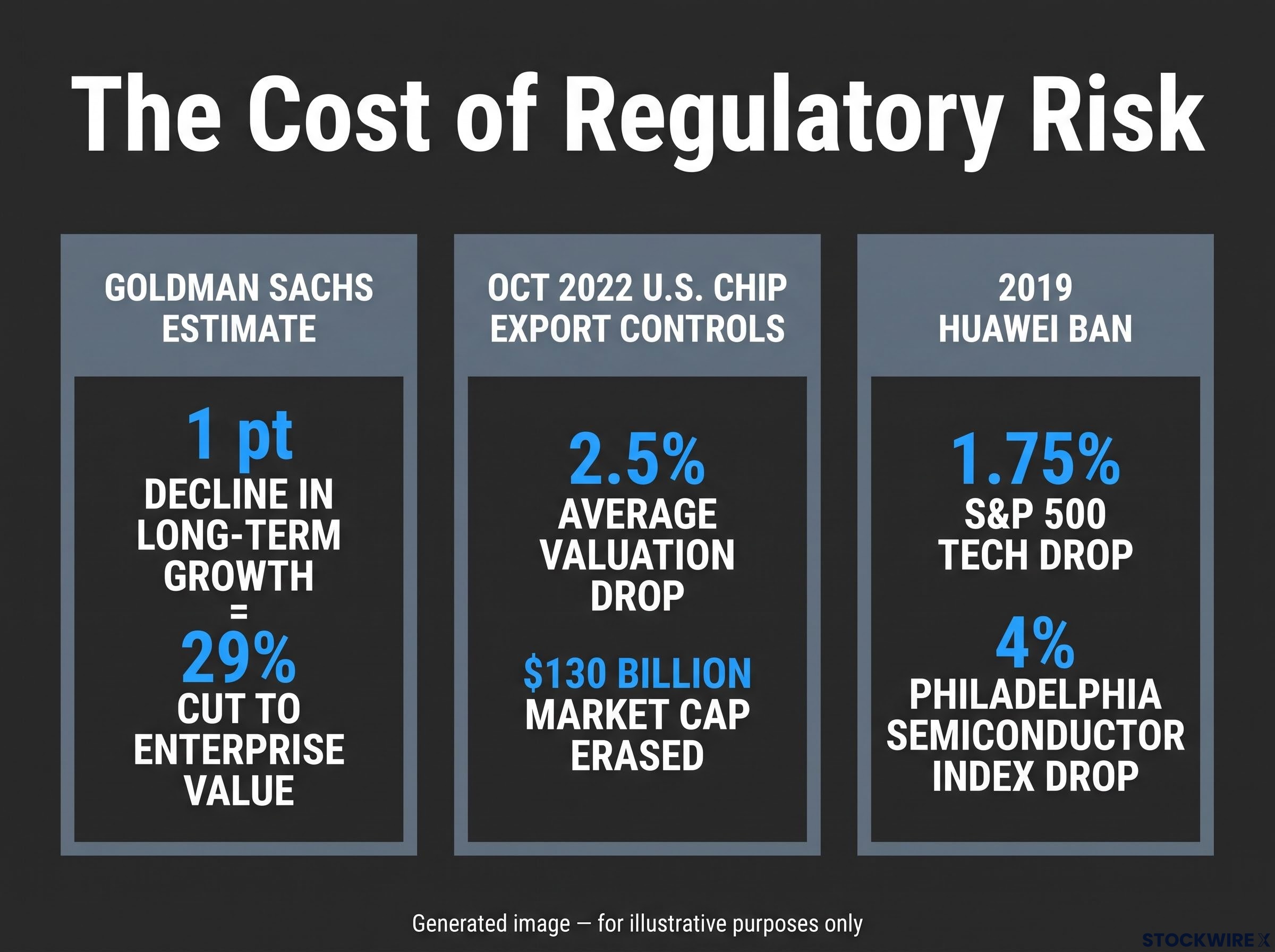
Goldman Sachs estimates that every one percentage-point decline in assumed long-term growth could cut enterprise value for high-growth stocks by roughly 29%.
The discount rate mechanism Goldman identified operates on top of a second, less-discussed vulnerability: inflated earnings produced by circular financing arrangements between hyperscalers and AI developers mean the multiple investors are compressing is itself built on reported revenues that overstate genuine demand, amplifying the valuation haircut when uncertainty rises.
That figure is the one to hold onto. It translates the vague phrase “regulatory uncertainty” into a concrete valuation haircut, and it explains how a single weekend debate with no legislation attached can still knock 6% off a stock like ASML.
Institutional investors were already leaning this way. A Morgan Stanley survey found roughly 30% of respondents expect regulatory compliance to be the most material future AI risk, while BlackRock has flagged global technology decoupling as a high-likelihood systemic risk and described control over AI as a geopolitical instrument.
The timing made it worse. Hedge funds had rebuilt tech long positions in the weeks before the debate, so the safety intervention hit freshly loaded long books and forced de-risking amplified the move.
Two historical precedents that show this mechanism at work
This has happened before, in a documented sequence, with measurable outcomes.
- October 2022 U.S. semiconductor export controls. The announcement triggered an average 2.5% valuation drop across affected U.S. chip firms, a decline that persisted for at least 20 days and erased roughly $130 billion in market capitalisation.
- The 2019 Huawei ban. U.S. restrictions drove S&P 500 technology stocks down 1.75% and the Philadelphia Semiconductor Index down 4% on the announcement.
The connecting line matters more than either episode alone. In both cases, the market moved before any company reported a single dollar of lost revenue. That confirms the perceived regulatory trajectory is itself a priced risk factor, which is exactly what you watched happen today.
What U.S.-China AI competition means for the structure of portfolio risk
Individual stock moves are the surface. Underneath sits a category of geopolitical risk that did not exist in the technology sector five years ago, and it is additive to everything you already assess at the company level.
Analysts at CSIS and BlackRock frame U.S.-China AI competition as a tight-coupling risk: fragmented standards, data localisation, and export controls create systemic vulnerabilities that stack on top of ordinary fundamental risk. China’s 80% domestic hardware requirement in its national data centre plan is a structural driver of long-term supply chain fragmentation, not a passing policy quirk.
The investor-relevant finding is uncomfortable. Modelling from CSIS and ITIF shows export controls are a lose-lose for global tech shareholders: U.S. chip restrictions reduce Chinese GDP by approximately 1.1%, but they simultaneously cut U.S. firm revenues and R&D capacity. Neither outcome favours long positions in AI equities.
The structural fault lines in the U.S.-China technology relationship extend beyond any single policy cycle: AI chip export controls are grounded in national-security law with bipartisan Congressional backing, placing them outside the jurisdiction of trade negotiators and making regulatory uncertainty durable regardless of which administration signals optimism.
Where a stock sits in the value chain determines which shock it absorbs. That is why today’s divergence was not random.
| Value Chain Segment | Representative Stocks | Primary Regulatory Risk | 14 Sept Outcome |
|---|---|---|---|
| Chip equipment | ASML | Export controls | Fell 6.7% |
| Chipmakers | Nvidia, SK Hynix | Export controls / capex slowdown | Fell 3.5-6.4% |
| Infrastructure investor | SoftBank | Capex slowdown | Fell 11% |
| Platform / services | Google, Microsoft | Safety compliance | Held higher |
The fact that Google and Microsoft held while the hardware names collapsed is not a coincidence. Their AI value is embedded in software and services rather than chip shipments, so a development slowdown or an export control touches them less directly. The market drew the regulatory risk boundary for you, in real time.
The portfolio implication follows. Spreading holdings across the AI value chain is not sufficient risk management if you do not know which segment is exposed to which type of shock. Watch these signals:
- Export control announcements from either government
- U.S. and Chinese national AI strategy documents
- Safety advocacy from major AI lab executives
- Bilateral trade and technology policy developments
If your exposure is concentrated in hardware, treat today’s divergence as a portfolio signal, not a one-day anomaly.
Reading the next AI policy signal before the market moves
Today gave you a complete worked example, and the discipline it teaches is repeatable. Three layers of risk stacked on top of one another: an event-driven repricing from the safety debate, structural discount rate pressure from regulatory uncertainty, and systemic geopolitical risk from U.S.-China competition. None of these is a standalone phenomenon. They compound.
The foundation is already laid out for you: the Goldman discount rate channel, the Morgan Stanley compliance survey, and the BlackRock decoupling flag are the three frameworks to return to when the next signal lands.
When it does, monitor four categories:
- Executive statements from frontier AI lab CEOs
- U.S. and Chinese government AI strategy documents
- Export control announcements
- Bilateral technology policy developments
Then ask the single most useful question this framework gives you: which part of the AI value chain does this signal target? A policy event aimed at the hardware and infrastructure layer carries a different risk profile than one aimed at platforms and services, and the two should prompt different responses in your portfolio. The speed at which the baseline can shift, from the rescission of Executive Order 14110 in January 2025 to America’s AI Action Plan by July, is precisely why standing vigilance beats a fixed view.
Experts genuinely disagree on whether U.S.-China competition amplifies or contains systemic risk. The right posture is informed vigilance, not binary optimism or pessimism.
For readers wanting to understand how the correlated de-risking that amplified today’s selloff connects to broader structural vulnerabilities in AI-era markets, our dedicated guide to AI-driven tail risk examines the model convergence and reflexivity feedback loops that make simultaneous institutional exits sharper than historical stress models predict.
This article is for informational purposes only and should not be considered financial advice. Investors should conduct their own research and consult with financial professionals before making investment decisions. Past performance does not guarantee future results, and financial projections are subject to market conditions and various risk factors.