Big pharma has an arithmetic problem it cannot outrun. Blockbuster franchises throw off enormous cash, but when a single therapeutic category generates the bulk of a company’s revenue, that success becomes a strategic liability. The only credible fix is to buy your way into new categories before the concentration risk shows up in the share price.
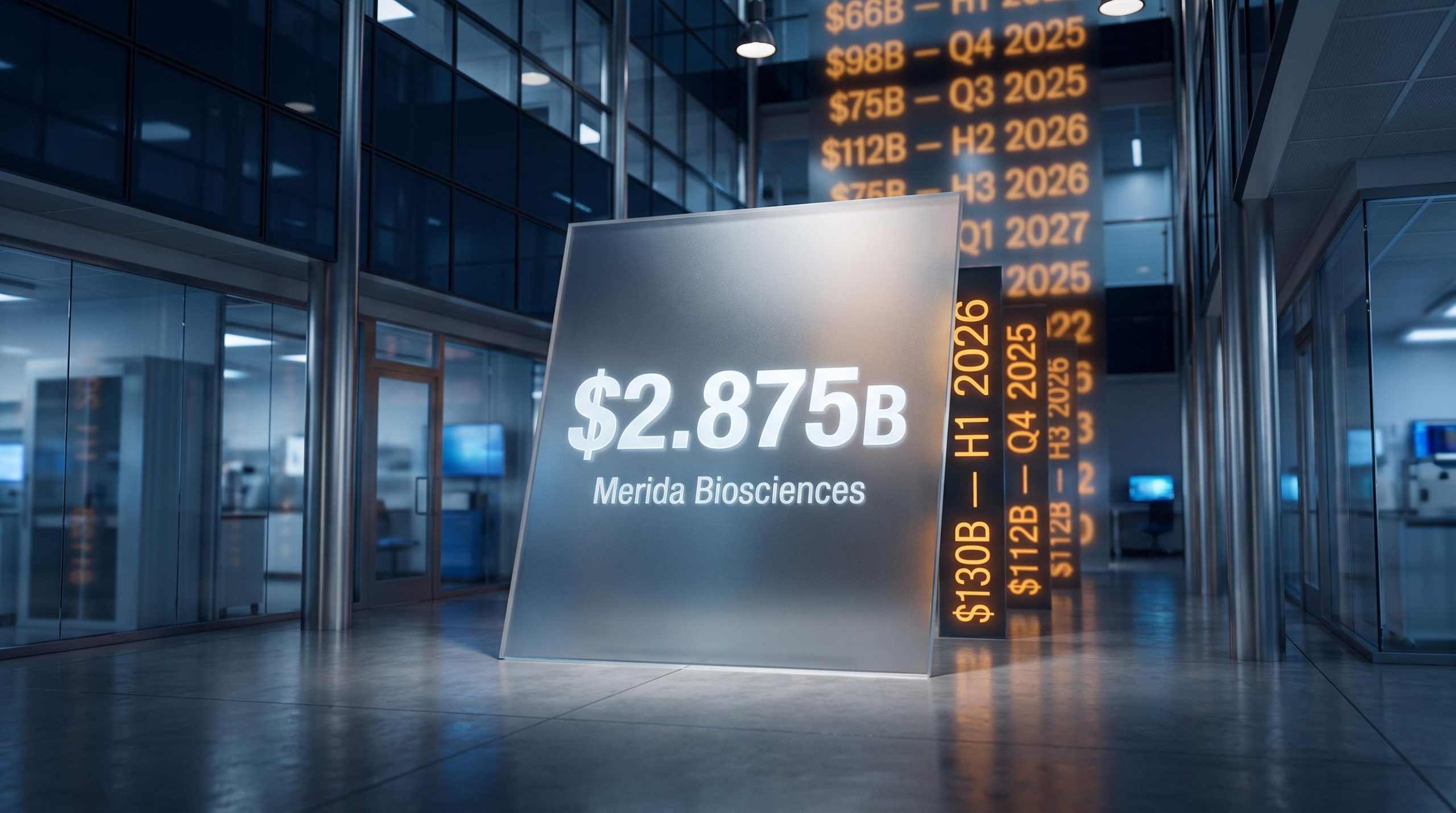
Eli Lilly’s agreement to acquire Merida Biosciences for up to $2.875 billion, announced on 31 August 2026, is the sharpest illustration of that logic this quarter. It is also Lilly’s tenth acquisition of 2026 alone, against a market where first-half biopharma M&A already reached $130 billion across 42 deals, according to IQVIA, nearly matching the entire 2025 total in half the time. With the Merida close expected before year-end, Q4 2026 is shaping up as an unusually compressed dealmaking window.
Here is a practical lens for reading the current cycle: where the deals are going, what is driving the pace, and which signals let you position ahead of the next transaction rather than chasing the premium after it lands.
Why Eli Lilly keeps buying: the GLP-1 concentration problem
Lilly is in an enviable position that carries a hidden cost. Its GLP-1 obesity and diabetes franchises generate the cash flows underwriting an aggressive acquisition programme, but leaning that heavily on one category is a recognised strategic risk the company is actively managing. The Merida deal is what that management looks like in practice.
Lilly’s full-year 2026 revenue guidance of $82-$85 billion is built almost entirely on tirzepatide, and the GLP-1 concentration risk that makes the Merida acquisition strategically necessary also explains why the stock trades at roughly 40 times earnings despite a market cap approaching $1 trillion.
The structure matters as much as the price. The $2.875 billion is all-cash, but it splits into an upfront payment plus contingent development and regulatory milestone payments. GuruFocus commentary makes the point plainly.
The milestone-heavy structure obscures Lilly’s immediate cash outlay and the valuation assigned to clinical success.
That detail tells you something useful about the target universe. When a large acquirer can stage payments against clinical outcomes, it becomes willing to pursue earlier-stage, higher-risk platforms it might have passed over if full consideration were due upfront. For a portfolio investor, that widens the field of names that could plausibly attract a bid.
Merida is not a single-asset bet. Globe and Mail sourcing frames it as the tenth acquisition Lilly has completed this year, and that cadence signals deliberate portfolio-building rather than opportunistic dealmaking.
What Merida’s platform gives Lilly that GLP-1 cash flows cannot
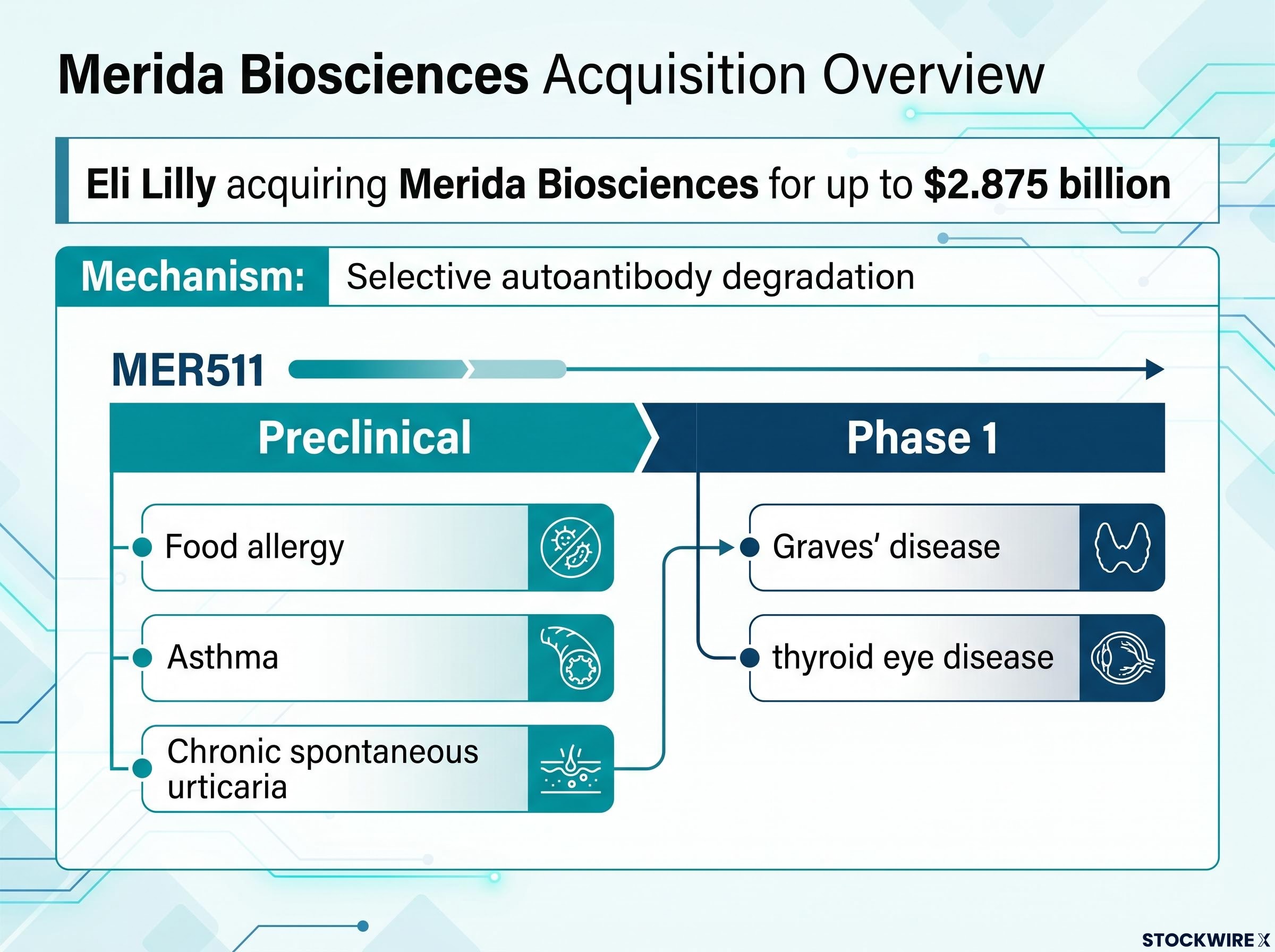
Merida develops therapeutics that selectively degrade disease-causing autoantibodies rather than broadly suppressing the immune system. According to PharmExec, that selective mechanism is the differentiator that drew Lilly’s interest, because broad immunosuppression carries side-effect burdens that a targeted approach can sidestep.
The lead asset, MER511, is a Phase 1 clinical-stage biologic. Its indications and the surrounding preclinical work give Lilly optionality across autoimmune and allergic disease:
- MER511 in Graves’ disease and thyroid eye disease (Phase 1)
- Preclinical programmes in food allergy
- Preclinical work in asthma
- Preclinical work in chronic spontaneous urticaria
That breadth is the point. GLP-1 cash flows can fund the purchase, but they cannot manufacture a differentiated immunology platform. Buying one is faster than building one, and that calculation is what keeps Lilly at the deal table.
When big ASX news breaks, our subscribers know first
The M&A numbers behind the buying spree
To judge how unusual the current environment is, start with the 2025 baseline. IQVIA’s focused M&A dataset, the authoritative reference for large-cap pharma activity, recorded $133 billion across 50 deals in 2025, an average of $2.7 billion per deal. That represented a 133% increase on 2024’s implied figure of roughly $57 billion.
Then came the acceleration. IQVIA’s mid-year update, published 8 July 2026, put first-half 2026 M&A at $130 billion across 42 deals. Read that against the full 2025 count and the pace becomes clear.
- Full-year 2025: $133 billion across 50 deals (IQVIA)
- First half 2026: $130 billion across 42 deals (IQVIA, 8 July 2026)
- First half 2026, broader definition: $106 billion across 201 deals (PitchBook, via CNBC, through early June 2026)
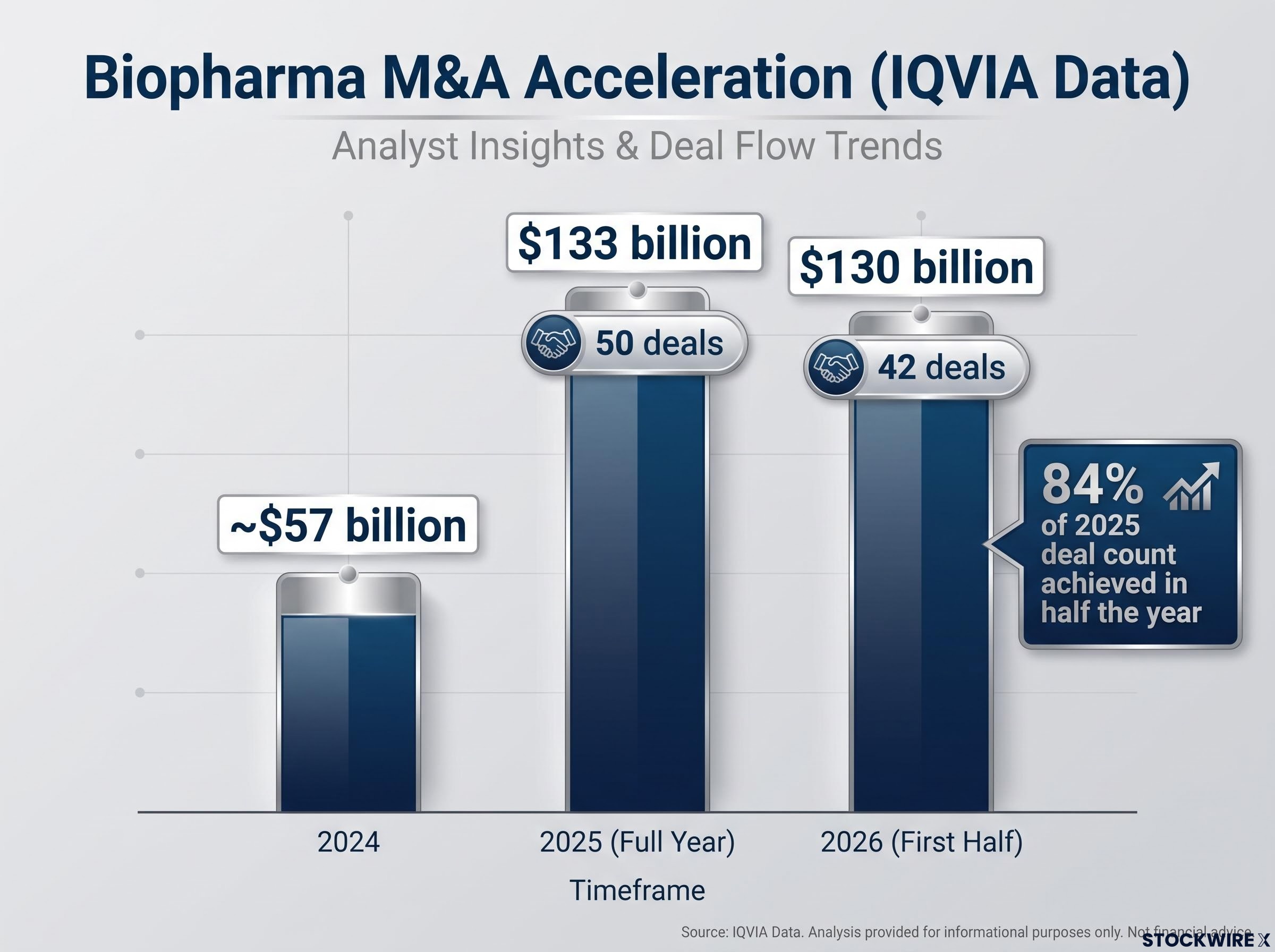
Those 42 first-half deals amount to 84% of the entire 2025 deal count, achieved in roughly half the year. That tells you this is not a normalisation from a depressed base. It is an acceleration compressing into fewer months, which raises the probability of further announcements before year-end.
The two datasets measure different universes but point the same way. IQVIA tracks larger transactions; PitchBook’s broader biotech definition captures more deal types, which is why its volume count is higher and its aggregate value lower. CNBC’s June coverage captured the market temperature directly.
Biotech M&A is on track for its best year since before Covid, with acquirers buying stuff like it’s going out of fashion.
The pattern of large-cap acquirer meeting small-cap target runs through the six headline deals IQVIA highlighted from the first half, with Lilly appearing twice.
| Acquirer | Target | Deal Value |
|---|---|---|
| Gilead Sciences | Arcellx | $7.8 billion |
| Eli Lilly | Centessa | $7.8 billion |
| Eli Lilly | Kelonia | $7.0 billion |
| Merck & Co. | Terns | $6.7 billion |
| Biogen | Apellis | $5.6 billion |
| Gilead Sciences | Tubulis | $5.0 billion |
Zoom out further and the partnering climate looks even busier. The BIO BIG Summit reported 4,341 total biopharma deals in 2025 including licensing, carrying a $606 billion headline value. That figure covers a wider deal universe than the M&A numbers above, but it confirms the same directional read: dealmaking conditions have shifted hard in acquirers’ favour.
The platform acquisition logic Lilly is applying to immunology through Merida mirrors the rationale that drove over $6.5 billion in radiopharmaceutical M&A by Novartis, Lilly, and Bristol-Myers Squibb between 2023 and 2025, where the common thread was buying proprietary delivery or targeting mechanisms that internal R&D could not replicate at pace.
How deal flow moves biotech indexes and what drives the read-through
Documenting the trend is one thing. Understanding how it transmits to the prices you actually hold is another. The mechanism starts with the acquisition premium.
When Lilly pays up to $2.875 billion for a Phase 1 platform, the market reads a signal about the value of selective autoantibody degradation as a mechanism. Investors then re-rate peer companies in the same mechanistic niche, and because sector ETFs and indexes hold baskets of similar names, that re-rating lifts the whole basket. One deal moves many prices.
Volume amplifies the effect. When IQVIA and PitchBook publish numbers showing an unusually active takeout environment, generalist capital tends to flow into diversified biotech ETFs, positioning for continued deal flow without picking individual winners. That momentum inflow can lift index levels on optionality alone, before any specific deal is even rumoured.
There is a feedback loop underneath all of it. GLP-1 revenues fund Lilly’s immunology acquisitions, and each purchase simultaneously validates a specific technology and signals continued acquirer appetite. IQVIA’s structural interpretation is that large biopharma has embedded external M&A into strategy rather than treating it as a cyclical reaction, which keeps the loop turning.
Where the sector read-through logic breaks down
The premium works in both directions. The same mechanism that lifts peer valuations on deal news can reverse sharply on a Phase 2 failure or a rejected new drug application. Cap Edge and Fintel sourcing notes that negative pipeline events at one company can drag down peers across the entire therapeutic space, which means you should calibrate sector exposure accordingly rather than treating M&A volume as a one-way tailwind.
Biotech position sizing in a high-M&A environment carries a specific asymmetry: 64% of negative clinical catalysts produced single-day declines greater than 20% in a 2025 William Blair review, while only 22% of positive catalysts generated equivalent gains, meaning the sector read-through from deal flow does not neutralise the binary risk of holding individual catalyst-stage names.
Several risks temper the bullish read:
- Execution and integration risk: milestone-heavy structures make immediate cash outlay and the valuation of clinical success less transparent, per GuruFocus, so headline deal values are not guaranteed outlays.
- Valuation and reimbursement risk: MarketBeat cautions that buying assets does not neutralise pricing, reimbursement, or competitive pressure on those assets.
- Overinterpretation of single deals: one high-profile transaction does not mean every peer in the indication space is a target.
- Deal-quality dispersion: IQVIA notes significant dispersion in deal quality even when headline volumes run high.
Understanding this distinguishes durable re-rating, driven by structural acquirer demand for a validated mechanism, from sentiment-driven spikes that reverse on the next negative headline. That distinction is what sharpens your entry and exit discipline on biotech positions.
Five signals that flag a small-cap biotech as a likely acquisition target
The 2025-2026 deal record yields a practical screen. These are not generic M&A heuristics; each is anchored to a named transaction, ranked from most directly observable to most reliant on active monitoring.
- Strategic fit with an acquirer’s priority therapeutic areas. Merida plugs directly into Lilly’s stated immunology platform build, just as Gilead’s $7.8 billion Arcellx acquisition fed its existing oncology and cell-therapy infrastructure.
- A differentiated, first- or best-in-class mechanism. MER511’s selective autoantibody degradation stands apart from broad immunosuppression, and PharmExec makes the case for why that matters.
- Clinical-stage assets with clear milestone paths. MER511’s Phase 1 work in Graves’ disease and thyroid eye disease offers near-term data readouts. IQVIA data shows proof-of-concept or registrational-ready assets rank highest with acquirers.
- A deal-friendly capital structure enabling milestone risk-sharing. Earlier-stage targets become viable when acquirers can stage payments, exactly the structure GuruFocus flagged in the Lilly deal.
- Institutional accumulation as a leading indicator. Entities such as Adar Capital Management and Perceptive Advisors often build positions ahead of anticipated clinical or regulatory milestones, trackable through Cap Edge, Fintel, and BioPharm Catalyst.
Merida’s selective autoantibody degradation, rather than broad immunosuppression, is the kind of mechanistic differentiation that commands a premium over me-too assets.
No single signal is sufficient. The most acquirable targets tend to exhibit three or more at once, which makes this a confluence test rather than a checklist. A small-cap that scores on three or more sits in the zone where large pharma’s build-versus-buy calculus increasingly favours buying, and that confluence is a reason to look harder, not a guarantee of a deal.
What the Q4 2026 pipeline tells investors about the cycle’s durability
Read the forward view as a probability assessment, not a prediction. The post-Labor Day window into Q4 has historically been a compressed period for deal announcements, and the Merida deal, announced 31 August 2026 with a Q4 close expected, is an on-point example of activity continuing through what is traditionally a quieter stretch.
The bigger question is durability, and two camps answer it differently.
| Structural interpretation | Cyclical interpretation | |
|---|---|---|
| Primary evidence base | IQVIA: external M&A now embedded in large-pharma strategy | CNBC/PitchBook: 2026 as a rebound from post-pandemic lows |
| Implied timeline | Sustained, multi-year deal demand | Window that closes as valuations normalise |
| Portfolio positioning | Justifies sustained small-cap biotech exposure | Favours selectivity on names, ETFs, and entry valuations |
With first-half 2026 already at $130 billion, full-year totals could materially exceed the $133 billion 2025 figure. The BIO BIG Summit’s read that 2026 is keeping up the momentum of 2025’s 4,341 deals and $606 billion headline value points the same direction. The Globe and Mail offers a useful counterweight, questioning whether Lilly’s tenth acquisition can meaningfully reduce its revenue concentration at all.
Regulatory headwinds that could slow the pace
Antitrust review sits as a ceiling on how far consolidation can run. Every announced deal, Merida included, flags regulatory approval as a gating condition. Horizontal consolidation between direct competitors tends to attract heavier scrutiny than cross-category platform acquisitions like Merida, where a metabolic-disease giant buys into immunology, which helps explain why platform deals keep clearing.
The FTC and DOJ Merger Guidelines establish the formal framework regulators apply when assessing whether a transaction may substantially lessen competition, and cross-category platform deals like Lilly acquiring Merida into immunology face a materially different scrutiny threshold than horizontal consolidation between direct rivals in the same therapeutic space.
If you believe the structural interpretation holds, sustained biotech exposure is easier to justify even after the current cycle’s marquee deals close. If you read this as a cyclical peak, the case for selectivity strengthens.
Positioning for the dealmaking window without chasing the premium
The threads converge into a stance you can act on. The five-signal screen, the structural-versus-cyclical debate, and the sector read-through mechanics together tell you where to look and how much conviction to carry, with first-half 2026 at $130 billion across 42 deals as the baseline and Merida the most recent data point in that sequence.
Your approach depends on what kind of exposure you want:
- Individual target hunters: apply the five signals, treating three or more simultaneous flags as the threshold worth deeper research.
- Sector-level investors: biotech ETFs with a small-cap tilt benefit from the read-through dynamic without requiring single-stock selection.
- Acquirer-equity holders: judge whether Lilly’s tenth-acquisition-of-2026 cadence is adding long-term value or simply inflating the deal count.
The acquirer-equity valuation question runs beyond Lilly: Novo Nordisk’s Q2 2026 earnings sent shares lower despite a guidance upgrade, demonstrating that even dominant GLP-1 franchises can be punished when market expectations outpace reported progress, a dynamic that Lilly holders should track as the acquisition cadence raises its own expectation bar.
Monitoring tools such as Cap Edge, Fintel, and BioPharm Catalyst give you a way to track institutional accumulation and pipeline catalysts rather than waiting on deal announcements. The frequency of deals from a single acquirer is itself a signal about how far the buy-versus-build calculus has shifted. With the Merida close due in Q4, the post-Labor Day window is a period for active monitoring, not waiting.
This article is for informational purposes only and should not be considered financial advice. Investors should conduct their own research and consult with financial professionals before making investment decisions. Past performance does not guarantee future results, and financial projections are subject to market conditions and various risk factors.