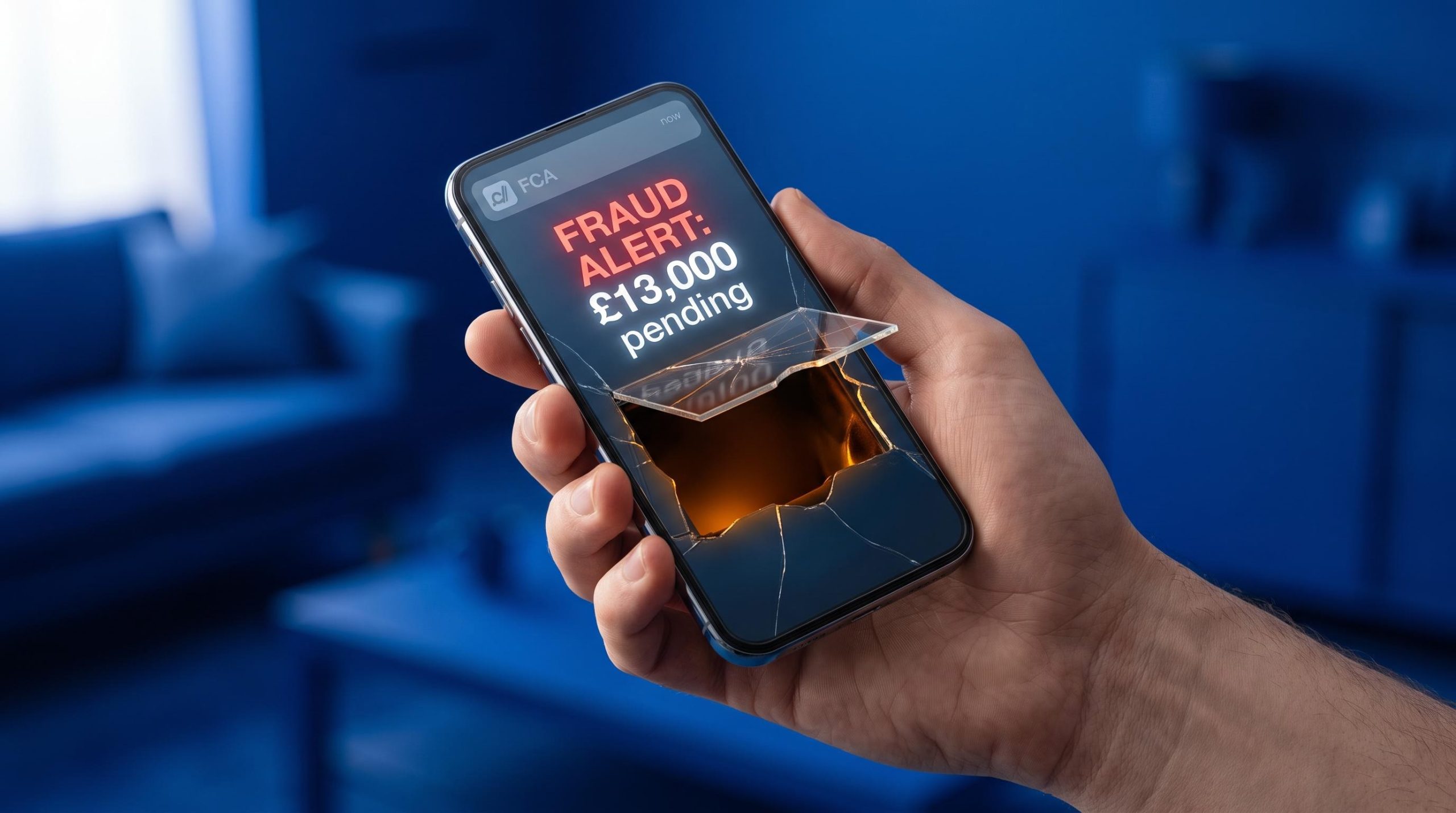
Here is an uncomfortable place to start: knowing a lot about money does not protect you from having it stolen. It may do the opposite. The scams built for people who “know better” are specifically designed to feel like they could only ever catch someone else.
That confidence is the trapdoor. In 2024, UK criminals stole over £1.17 billion through fraud, and in the year to March 2026 the Office for National Statistics estimated 3.8 million victims, a 10% rise. Investment scam losses alone jumped 34% to £144.4 million.
These are not numbers about careless people. They describe a mainstream risk that lands on the cautious and the informed as readily as anyone else. So the question worth answering is not “am I too smart to fall for this,” but “which mental mechanisms are being pulled, and what do I do about it.”
After this, you will understand exactly how scammers hijack the way your brain makes decisions, you will see the manipulation laid out step by step in a real case, and you will walk away with a short set of rules you can apply the next time something feels urgent, official, or too good to pass up.
Why your brain is the target, not your bank account
The real work of a modern scam does not happen in your account. It happens in your head, seconds before you authorise anything, in the gap between feeling and thinking.
Behavioural scientists lean on Daniel Kahneman’s dual-system model to explain why. Your brain runs on two systems: System 1 is fast, intuitive, and emotional, while System 2 is slow, deliberate, and analytical. Fraud is engineered to keep you locked in System 1.
The same dual-system vulnerability that fraud exploits also shapes everyday investment decisions: research into the psychology of investing shows that loss aversion alone costs investors roughly 1-2 percentage points per year, generated by the same emotional override that scammers deliberately trigger.
The way it does that is by manufacturing urgency. A threat that your account is compromised, or that a large charge is pending, spikes your emotional arousal and starves the analytical part of your brain of the resources it needs to spot inconsistencies. You are not being stupid. You are being denied the mental conditions required to think clearly.
The second lever is authority. When someone presents official logos, regulatory language, or the framing of an institution, your brain takes a shortcut and routes toward compliance rather than scrutiny. This tendency, described in the work of Robert Cialdini and demonstrated in Stanley Milgram’s obedience research, usually serves you well in ordinary life. Scammers weaponise it by posing as protectors: your bank, the FCA, the police.
The third lever is isolation. By keeping you on a continuous call, insisting on confidentiality, or coaching you on what to tell your bank, a fraudster removes the single most reliable fraud detector available to you: a calm second opinion from someone who is not emotionally involved.
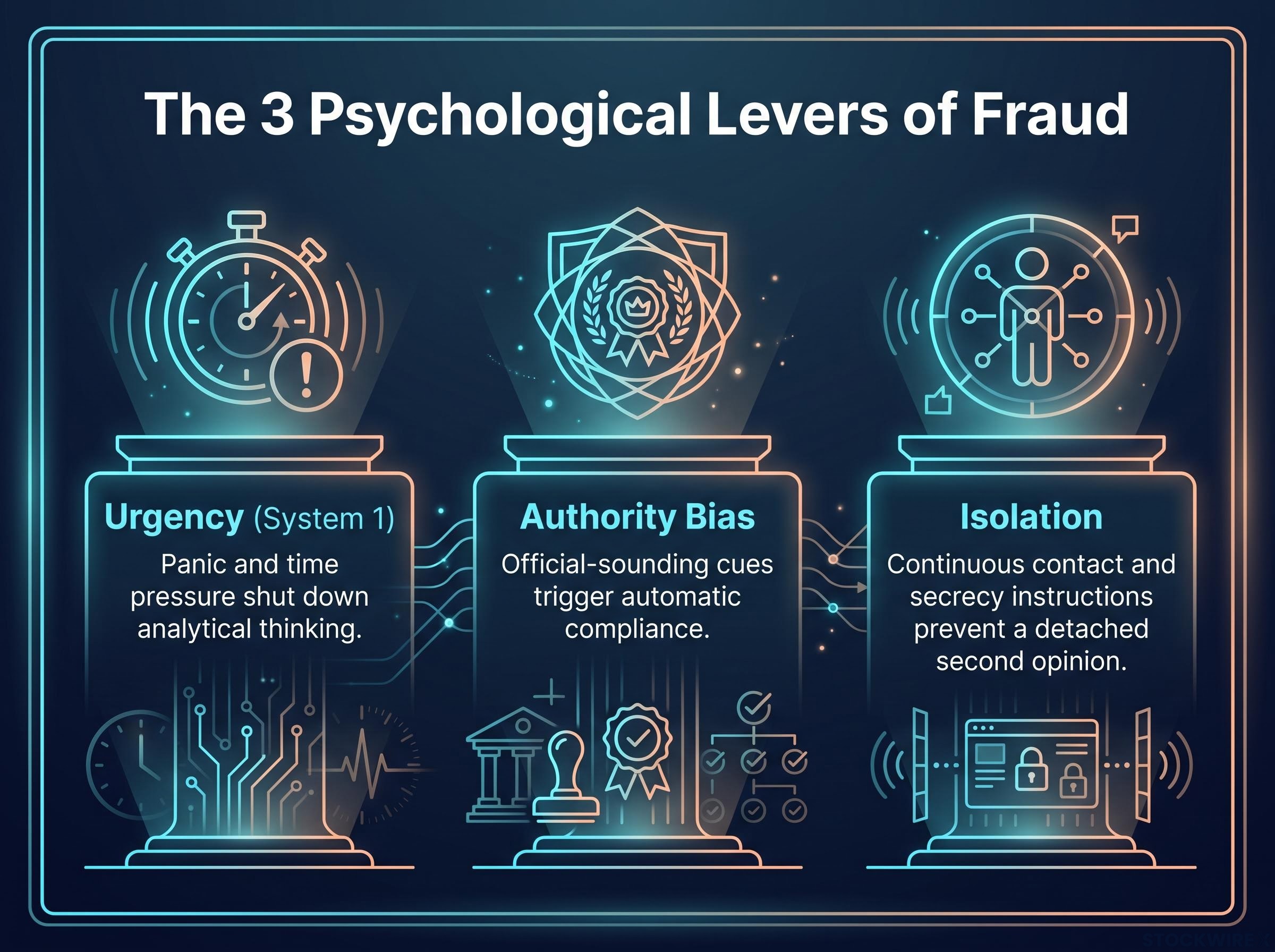
Here are the three levers, stripped down:
- Urgency (System 1): Panic and time pressure shut down your analytical thinking before you can evaluate the risk.
- Authority bias: Official-sounding cues trigger automatic compliance rather than questioning.
- Isolation: Continuous contact and secrecy instructions keep you away from the detached second opinion that would break the spell.
A December 2024 Payment Systems Regulator report found scammers actively coach victims on exactly what to say to bank staff to get past security checks and dismiss warnings as routine. That is the isolation lever operating at industrial scale.
And here is the finding that should reset your assumptions. Evidence submitted to the House of Lords by Revolut showed that 85% of customers ignore direct in-app fraud warnings, and 80% proceed with a fraudulent transfer even after speaking to a bank agent.
The uncomfortable statistic: 80% of people go ahead with a fraudulent transfer even after speaking directly with a bank agent.
What that tells you is blunt: knowing a warning exists does nothing to stop you complying once the emotional state has taken hold. The only reliable protection is a rule that activates before that state arrives, which is exactly where we are heading.
When big ASX news breaks, our subscribers know first
Inside a real scam: how the psychological playbook unfolds step by step
The tactics above are abstract until you watch them assembled against a real person. So walk through a recent Barclays and FCA impersonation case, and notice where you might have gone along with it.
This targeted a financially knowledgeable individual, which is the point. Each step was calibrated to make the next one feel reasonable.
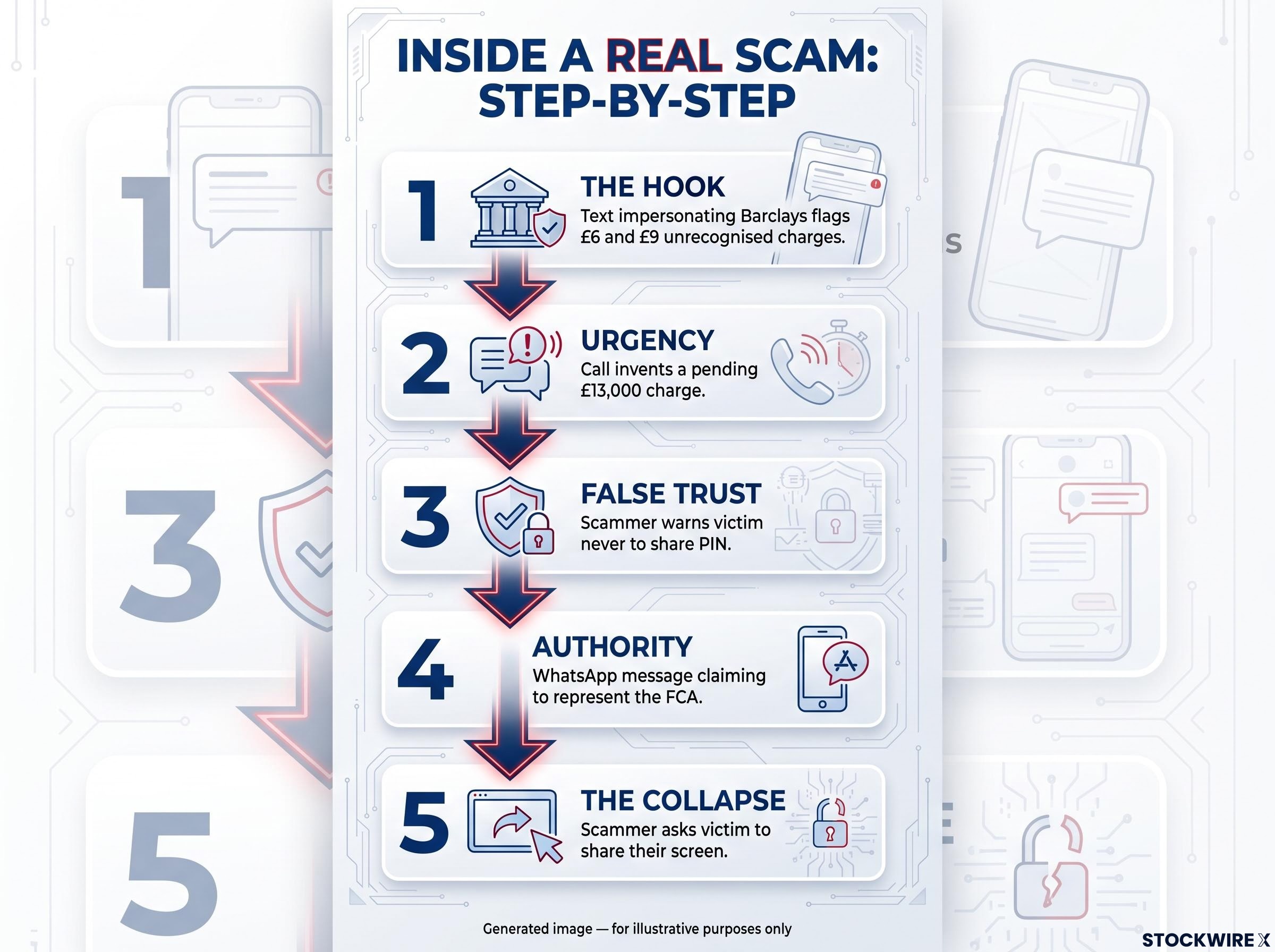
- The hook (false familiarity): A text impersonating Barclays flagged two small unrecognised transactions, £6 and £9, framed as dodgy subscription charges. Small, believable, and just alarming enough to earn attention.
- Manufacturing urgency (System 1): A call from the “bank security team” then invented a pending charge of £13,000, converting mild concern into full panic and shutting down analytical thinking.
- Establishing false trust (authority bias): The callers proactively warned the victim never to share a PIN or one-time password. Mimicking genuine consumer protection advice is a deliberate credibility-building move, not a slip. It makes the fraudster sound like the one protecting you.
- Layering authority: A second contact arrived via WhatsApp from someone claiming to represent the Financial Conduct Authority (FCA), stacking a regulator’s legitimacy on top of the bank’s.
- The collapse: The scheme only broke when the fraudsters asked the victim to share their screen. That request finally felt wrong.
For scale, investment scams like the ones these tactics feed into cost victims an average of roughly £18,500 each in 2024, with total losses rising 34% to £144.4 million. And it rarely ends at one theft: victims are frequently approached again by “recovery scams” demanding a fee to retrieve the money already lost.
The moment the illusion broke, and what that tells you
The scam depended on one thing above all: uninterrupted control of the victim’s attention and communication channel. Every step until the end asked only for verbal compliance, which fits smoothly inside a panicked phone call.
The screen-share request was different. It was the first demand that required a physical action outside the flow of the conversation, and that friction was enough to break the spell.
The defensive lesson, though, is not “watch out for screen-share requests.” That is too specific to be useful, because the next scam will end somewhere else. The real lesson is structural: independent contact at any earlier stage would have collapsed the entire architecture instantly. One call to the real bank, made by the victim, and the whole thing falls apart. That is the takeaway to carry forward.
Why financial confidence can make you more vulnerable, not less
If you have read this far feeling reasonably well-informed, this is the section designed to make you a little less comfortable, on purpose.
Cognitive biases do not check your qualifications first. The dual-system collapse under emotional pressure happens to trained professionals and financial experts exactly as it happens to novices, because it is a feature of how the human brain handles stress, not a gap in someone’s education.
Then there is the overconfidence paradox. Higher financial awareness tends to correlate with greater engagement in complex investment offers, and scammers design high-yield pitches precisely for people who believe they are equipped to evaluate them. Your sense that you can judge an offer is not a shield. It is the entry point.
The FCA has flagged a related risk: investors who are wrongly categorised as high-net-worth or sophisticated, and who are therefore exposed to high-risk products and crypto schemes without the standard retail protections that would otherwise apply.
The finding that should unsettle you: A Which? consumer psychology report found that many victims of authorised push payment scams believed they were “too savvy” to be scammed.
Here is the tension between what confident investors assume and what fraudsters actually exploit:
- What you assume: You can evaluate a complex or high-return offer on its merits and spot a fake.
- What the scammer exploits: That exact confidence, using it to lower your guard and justify engaging with an offer you would otherwise dismiss.
City of London Police make the point plainly: investment fraud victims range from novices losing small sums to highly experienced investors losing hundreds of thousands of pounds. And the trend is worsening, with £97.7 million stolen through investment scams in the first half of 2025, up 55% year on year against that £144.4 million annual baseline.
Investment scams that pass standard checks are a documented category, not an edge case: the Capital Guard fraud collected $17.4 million from roughly 80 investors while holding a genuine, current regulatory licence throughout the entire period of alleged misconduct.
So treat your own instinct that you would “obviously spot it” as a warning light rather than a defence. That confidence is not neutral. It is part of the mechanism these scams rely on.
The defensive rules that hold even when you are being manipulated
You cannot out-think a scam in the moment, because impairing your in-the-moment thinking is the entire design. So the answer is not sharper judgement under pressure. It is a small set of rules you commit to in advance, before any pressure exists.
Keep it to a handful you can actually hold in your head:
- Verify independently, always. Hang up. Find the number yourself, on the back of your card or in the official app, and call from scratch. Never use a number, link, or contact provided in the message itself.
- Apply the 24-hour rule. No legitimate institution requires an irreversible decision within the hour. Treat urgency itself as the red flag, and give System 2 the time it needs.
- Get a mandatory second opinion. Before any large or unusual movement of money, tell an emotionally detached person everything, including any instruction you were given to keep it confidential. Secrecy demands are themselves a warning sign.
- Verify voices, not just messages. AI voice cloning can make an emergency call sound exactly like family. Confirm through a separate channel or a pre-agreed private word before sending anything.
- Use the official checkers. Assess any financial contact through the FCA Firm Checker and report suspicions to Action Fraud.
Each rule works because it fires before the emotional state takes hold. You are not trying to detect every scam in real time. You are building tripwires that force a pause no matter how convincing the situation feels.
Here is how the three core levers map directly onto the rules that neutralise them:
| Tactic | What the scammer does | Your defensive rule |
|---|---|---|
| Urgency | Manufactures panic and time pressure to force an instant decision | Apply the 24-hour rule; treat urgency itself as the red flag |
| Authority | Impersonates your bank, the FCA, or police using official cues | Hang up and verify through a channel you locate yourself |
| Isolation | Keeps you on the line and demands secrecy from your bank or family | Get a mandatory second opinion; disclose any secrecy instruction |
There is good evidence that rules beat awareness. The cross-government “Stop! Think Fraud” campaign, launched in February 2024, produced a 27% immediate reduction in scam victimisation, but the effect decayed rapidly without reinforcement. That decay is precisely why an internalised rule outperforms a remembered slogan. Action Fraud’s updated social engineering guidance in July 2025 and the FCA’s move from its old ScamSmart campaign to the Firm Checker point the same way: the bank’s own warnings are not enough on their own, especially when scammers coach victims on how to dismiss them.
The AI voice cloning risk flagged in the defensive rules is one subset of a broader synthetic-media threat: deepfake celebrity endorsements now drive an entire category of investment fraud, following a consistent eight-stage sequence from initial hook to withdrawal lockout that mirrors the psychological playbook described here.
Your two UK verification resources: Check any firm through the FCA Firm Checker, and report fraud to Action Fraud.
This article is for informational purposes only and should not be considered financial advice. Investors should conduct their own research and consult with financial professionals before making investment decisions.
The rules protect you precisely because scams are designed to make you ignore them
The through-line of everything above is simple, and slightly deflating. Scams do not work because victims are foolish. They work because the architecture of fraud is calibrated to neutralise the defences of whoever happens to be in front of it, and that means the answer has to be structural rather than a matter of being vigilant in the moment.
The rules are not clever. That is their strength. Boring and automatic is exactly what defeats a threat engineered to make you feel that this particular situation is the exception to your usual caution.
Yes, they will occasionally feel unnecessary, or even a bit rude, in a genuine interaction. That is a cost worth paying. Briefly inconveniencing a real bank is trivial next to a false negative, and with the average investment fraud loss sitting around £18,500, the maths is not close.
This is a mainstream risk, not an edge case. With 3.8 million UK fraud victims in the year to March 2026, and tactics that will keep evolving as tools like AI voice cloning mature, the specific tricks will change. The defensive rules do not have to.
So here is the single action to leave with.
The next time anyone contacts you unexpectedly about your money with any hint of urgency, hang up, find the real number yourself, and call back. That one pre-committed choice dismantles every scam described in this piece, and it does not require you to be cleverer than the person trying to rob you. It only requires you to decide, now, before they can engineer the moment that makes a bad choice feel reasonable.
—