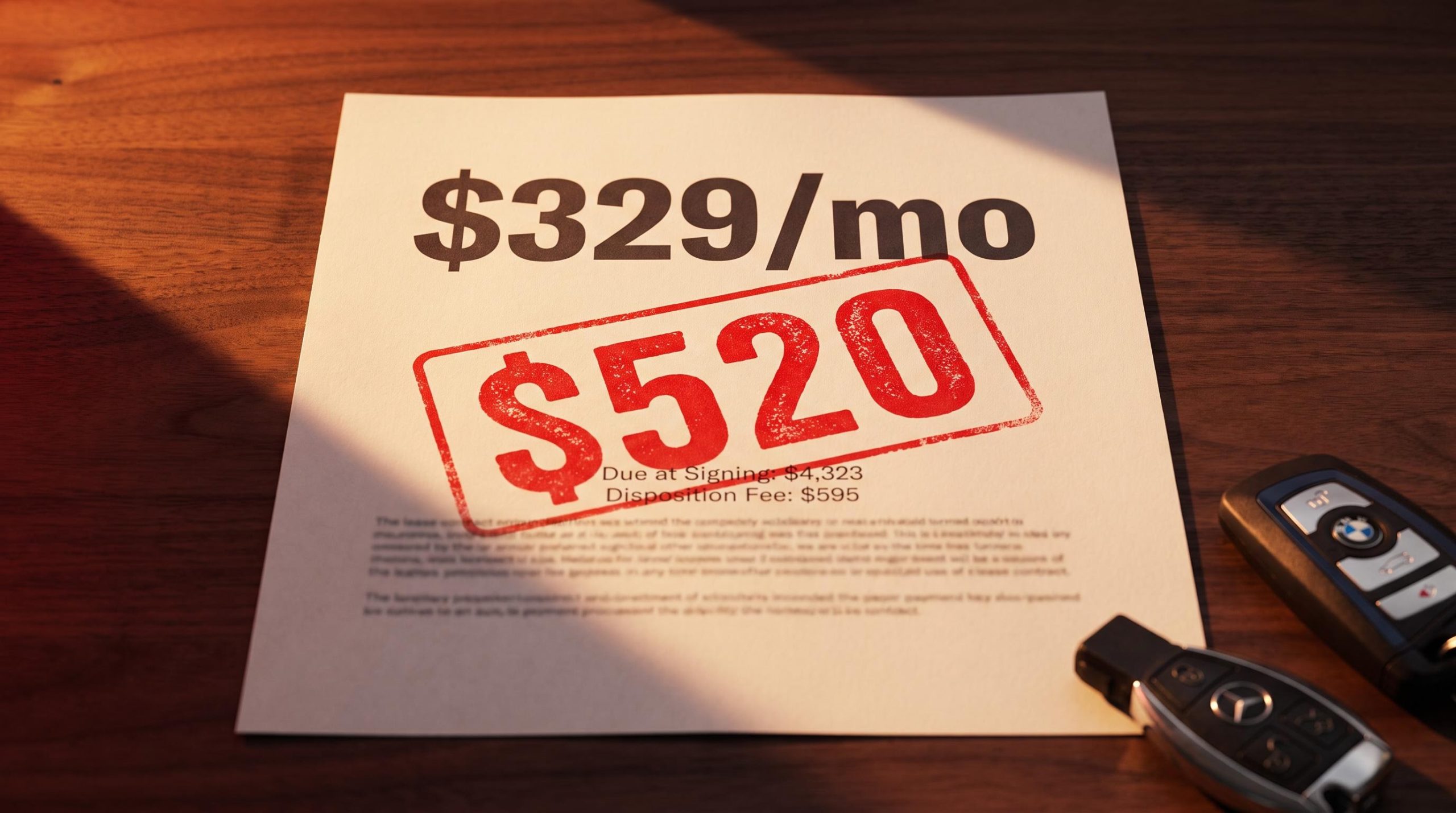
The advertised number was $329 per month. You signed. Twenty-four months later, you handed back the keys having paid closer to $520 a month once every fee was counted.
That gap is not an accident, and it is not the work of one dishonest salesperson. Advertised lease payments are engineered to exclude the costs that are hardest to notice: upfront cash you pay once, acquisition charges buried in the fine print, and end-of-lease fees that feel a long way off when you are signing. It is a feature of how leasing is marketed, not a glitch.
Here is what you will be able to do after reading this. Take any luxury lease offer, run one simple calculation, and know the real monthly number in under five minutes. You will also know exactly which fees to hunt for before you sign anything. The true cost of a car lease is knowable; the advertised figure just was not designed to make it easy.
Why the monthly payment on a lease ad is built to look smaller than it is
Start with how a lease payment is actually built. You are not paying for the whole car. You are paying for the slice of value the vehicle loses while you drive it, the difference between its price today and its projected worth at lease end (the residual value), spread across the term. On top of that sits a finance charge, which works like interest.
That is the part the ad shows you. What it tends not to show is everything you pay once rather than every month.
The three cost categories that never appear in the monthly payment headline
Three fee categories drive most of the gap between the headline and the truth:
- Acquisition fee: a one-time charge from the finance company at the start of the lease, often shown only in the “due at signing” line if it appears at all.
- Capitalised cost reduction: the upfront cash you put down to lower the monthly payment, which feels like a deposit rather than a cost even though it is money spent.
- Disposition fee: a charge for returning the car at lease end, months or years away at the point you sign, so it barely registers.
Each of these is a genuine part of what you pay. Each is either listed separately, tucked into fine print, or simply left out of the advertisement.
The same structural dynamic that makes hidden fees compound in brokerage accounts applies here: individually small charges, spread across a multi-year commitment, produce a total cost that looks nothing like the headline rate and can amount to thousands of dollars in forgone value.
Consumer-finance educators point to three structural problems with how this works:
- Fees like acquisition and disposition charges are necessary for lenders to cover administrative and resale costs, but they are also used as profit centres.
- These fees are often rolled into the capitalised cost or shown only in the “due at signing” total, so a low monthly figure hides their weight.
- Full-fee disclosure, showing the total drive-off amount and the effective monthly cost once upfront cash is spread over the term, is rarely offered voluntarily.
There is a further wrinkle. When fees are rolled into the capitalised cost instead of paid upfront, they increase the amount you finance and, in some places, raise the taxable portion of your payment because local sales tax is calculated on the monthly figure.
This matters more every year. Leasing made up roughly 24-25% of US new-vehicle sales by 2024-2025, up from 16.67% in 2022, which means more people than ever are navigating this structure. The advertised payment is not a summary of what leasing costs. It is a floor, built by choosing which costs to feature and which to shift onto a separate line. Read every lease ad with that in mind.
The broader context behind these numbers is sobering: auto affordability pressures have pushed subprime delinquencies to a 32-year high of 6.9% as of January 2026, a signal that the gap between what vehicles cost and what buyers can sustainably carry has widened well beyond the luxury segment.
When big ASX news breaks, our subscribers know first
How the fees stack up: a real lease decoded line by line
Picture yourself at the desk, the paperwork in front of you for the first time. The ad that brought you in promised $499 a month on a BMW X1 for September 2026, a car with a $47,750 sticker. Watch what happens as each fee gets added back.
First, the due-at-signing figure: $4,599. That is not one cost but three stacked together. $3,175 is a capitalised cost reduction, the cash lowering your monthly payment. $499 is your first month’s payment. And $925 is the acquisition fee, consistent with BMW Financial Services’ base rate and the $800-$1,100 range most drivers see once dealer markup is included.
Then the payments themselves: $499 a month across the 39-month term. And waiting at the finish line, a disposition fee of up to $495 when you return the car.
Now spread all of it across the lease. Here is how each piece translates into a monthly figure.
| Cost component | Amount | When paid | Monthly equivalent (over 39 months) |
|---|---|---|---|
| Capitalised cost reduction | $3,175 | At signing | ~$81 |
| Acquisition fee | $925 | At signing | ~$24 |
| First month payment | $499 | At signing | Included in $499 x 39 |
| Remaining payments | $499 x 38 | Monthly | $499 |
| Disposition fee | $495 | Lease end | ~$13 |
| True monthly cost | ~$617 |
The arithmetic behind that final row is simple enough to run yourself on any offer.
The formula: (total upfront cash + total of all scheduled payments + end-of-lease fees) divided by the number of months = true monthly cost.
Run it on the X1 and you land at roughly $617 a month. That is $118 more than the advertised $499, or about 24% above the headline.
That $118 is not a rounding difference. It is the equivalent of a separate monthly subscription you never knowingly signed up for. Seeing it as a line item, rather than a footnote you skimmed, is what changes how you judge the next offer. Treat that 24% as a rough mental benchmark for what a luxury lease ad tends to leave out.
The term trap: why a 24-month lease costs more than it looks
Now compare the X1 with a Mercedes-Benz GLA on a shorter, cheaper-looking deal, and a pattern comes into focus. The GLA advertised at just $329 a month. Lower headline, better deal? Look closer.
Due at signing: $4,323. Turn-in fee at lease end: $595. Term: 24 months. Run the same all-in calculation and the true monthly cost lands at roughly $520, about 58% above the advertised figure.
Here is why the shorter term punishes you. Fixed upfront fees and end-of-lease charges do not shrink when the lease is shorter. The same acquisition fee, drive-off cash and turn-in charge simply get divided across fewer months. On a 24-month lease, they land far heavier per month than on a 36- or 39-month arrangement.
The two cars make the effect impossible to miss.
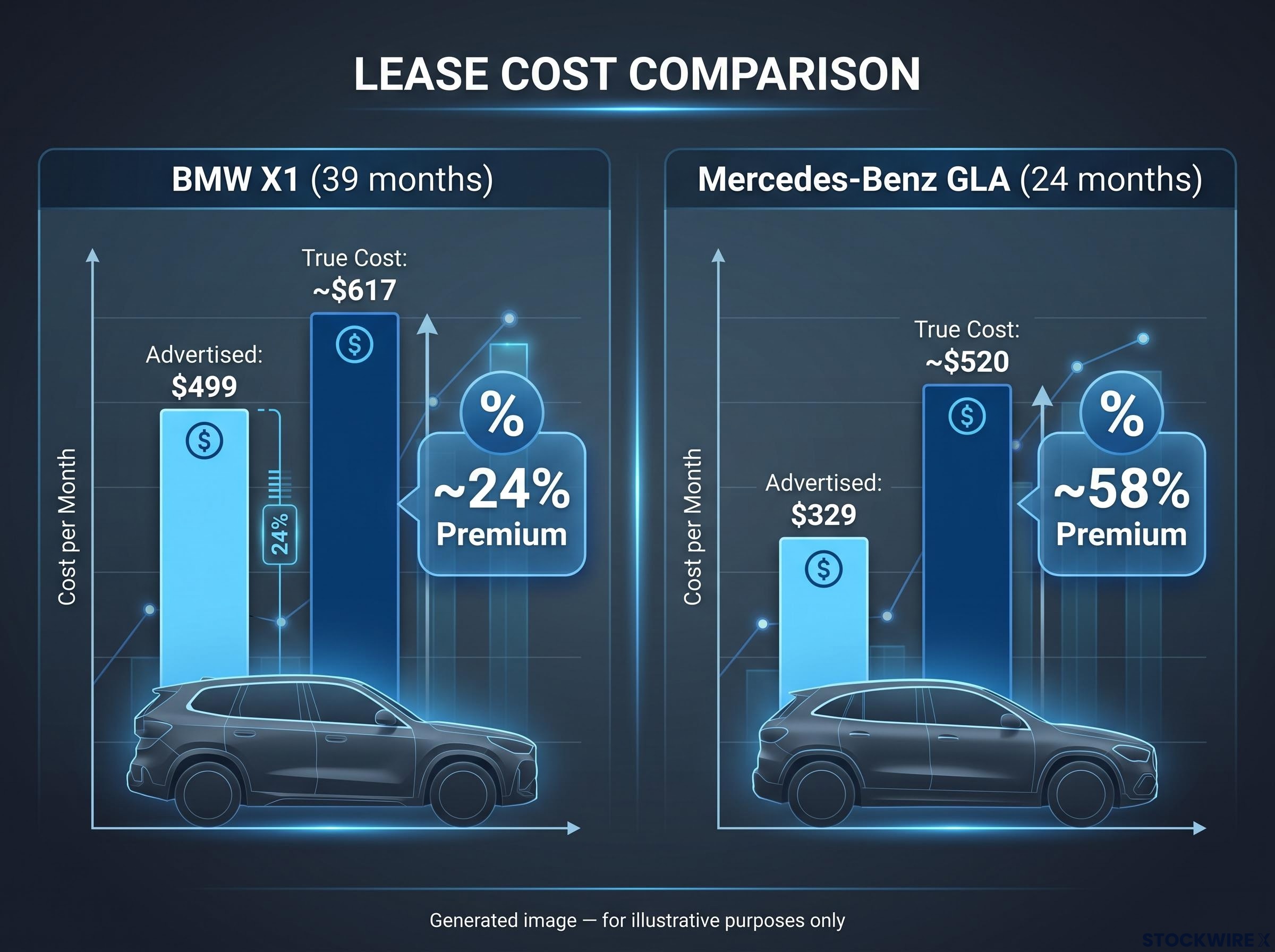
| Metric | BMW X1 (39 months) | Mercedes-Benz GLA (24 months) |
|---|---|---|
| Advertised payment | $499 | $329 |
| Due at signing | $4,599 | $4,323 |
| End-of-lease fee | Up to $495 | $595 |
| True monthly cost | ~$617 | ~$520 |
| Premium over advertised | ~24% | ~58% |
| Maintenance included | Yes (3 yr / 36,000 mi) | No |
Note too that the GLA’s $595 turn-in fee sits above the typical $300-$500 industry range that general guides cite. Individual brand fees can and do fall outside the ranges you read about, which is exactly why you calculate rather than assume.
Typical lease fee ranges by vehicle category show acquisition fees running from around $595 for economy brands up to $1,095 for luxury marques, and disposition fees sitting between $350 and $595, which is why the GLA’s $595 turn-in charge sits at the outer boundary of what most industry guides treat as standard.
When you are weighing offers of different lengths, the advertised payment is at its most misleading on 24-month deals. Run the all-in calculation before you treat a low headline on a short lease as a better deal than a higher one on a longer term.
One more cost the ads never mention: what you pay to service the car
There is a cost neither monthly figure captures at all. BMW includes scheduled maintenance for three years or 36,000 miles, which covers nearly the entire 39-month X1 lease. Your routine servicing, in effect, is already paid for.
Mercedes-Benz does not include complimentary routine maintenance on new vehicles. The GLA lessee funds oil changes, brake fluid and scheduled service out of pocket.
That is a real, recurring cost difference between two otherwise comparable luxury leases, and you cannot read a cent of it from the monthly payment on either advertisement.
The mileage variable: what happens when you drive more than the lease allows
Every fee so far is fixed the moment you sign. Mileage is different. It is the one major cost that depends entirely on how you actually use the car, and it keeps accumulating quietly right up until the day you return it.
Each lease sets an annual allowance. The BMW X1 permits 10,000 miles a year, or 32,500 miles across the 39-month term. Drive past that cap and every excess mile is billed at a set rate when you hand back the keys, in this case $0.25 per mile.
Say you drive 13,500 miles a year, hardly extreme for a commuter. Over the lease you rack up 11,375 excess miles. At $0.25 each, that is roughly $2,844 waiting for you at lease end.
A driver covering 13,500 miles annually on this lease would owe approximately $2,844 in overage charges at return, none of it visible in the $499 monthly payment.
Spread that across the term and it adds about $73 a month. Your effective monthly cost climbs from the $617 you calculated earlier to roughly $690. Drive 13,500 miles a year on a 10,000-mile luxury lease without reading the overage terms, and you are not leasing a $499 car. You are leasing a $690 one.
The luxury premium applies to overage rates too, not just sticker prices. Here is how the brands compare.
| Brand category | Example brands | Overage rate per mile |
|---|---|---|
| Standard luxury | BMW standard models, Mercedes-Benz standard models | $0.25 |
| High-performance luxury | BMW M series, Porsche | $0.30 |
| Mainstream | Toyota, Honda, Ford | $0.15 |
Mainstream brands charge roughly half the luxury rate. That gap means mileage management matters far more when you lease a BMW or a Mercedes than when you lease a Toyota.
The good news is that mileage is a cost you can manage before it manages you. Three steps, in order of priority:
- Buy additional miles upfront at signing. Purchasing extra allowance in advance is typically cheaper than paying overages at the rate-card price later.
- Monitor your mileage mid-lease. Track it against the allowance so you know early whether you are on course to breach the cap, while you still have room to adjust.
- Negotiate a higher annual mileage cap before signing. If you already know you drive more than the standard allowance, raise it while you still have leverage.
Know your annual mileage before you sign, and you can either negotiate better terms or walk away from an offer that would cost you thousands more than the headline suggests.
What to calculate before you sign any luxury lease
Everything you have read comes down to one calculation you can run on any offer, in about five minutes. This is the tool, not a summary.
The all-in monthly cost: (upfront cash + monthly payments x number of months + end-of-lease fee) divided by number of months.
That single figure is the only honest basis for comparing lease offers, especially across different term lengths. Consumer-finance educators consistently recommend evaluating deals on the effective all-in monthly cost rather than the advertised payment.
What to ask the dealer before accepting any payment figure
You cannot run the formula without the numbers, so ask for them directly. Request the full lease worksheet, not just the monthly payment and due-at-signing total. On that worksheet, confirm each of these lines:
- The acquisition fee, and whether it is the finance company’s base rate or a dealer markup (dealers commonly add $100-$300).
- The disposition or turn-in fee.
- The mileage cap and the overage rate per mile.
- The wear-and-tear standard document.
This checklist works at any dealership, whatever the badge on the car.
Three further risks belong in your decision, none of them visible in a monthly figure:
- Excess wear-and-tear charges. Luxury lease standards can be strict, and cosmetic damage at turn-in has left drivers with surprise bills running into four figures.
- Early termination penalties. Unwinding a lease is materially harder than selling a financed car, a real risk if your income or driving needs may shift over a 24-39 month period.
- Lease-end purchase option uncertainty. The residual value written into your contract may sit above or below the car’s market price at the time, so any decision to buy at lease end needs comparison shopping first.
One last note. If you roll the acquisition fee into the capitalised cost instead of paying it upfront, you increase the financed amount and may raise your taxable payment in some jurisdictions. The formula is not a technicality for spreadsheet enthusiasts. It is the only way to know what a lease actually costs, and it can spare you a multi-thousand-dollar mistake.
The number every luxury lessee should know before the pen touches paper
Two cars, one pattern. The gap between advertised and true monthly cost on a luxury lease is structural, not incidental, and it widens sharply as the term shortens.
The BMW X1 costs approximately $118 more per month than advertised, a 24% premium. The Mercedes-Benz GLA costs approximately $191 more per month than advertised, a 58% premium.
That difference between the two is driven almost entirely by the GLA’s shorter term amplifying its fixed fees.
This is not a niche concern. With leasing climbing from 16.67% of US new-vehicle transactions in 2022 to nearly 25% by 2024-2025, more buyers each year are making decisions off an advertised figure that understates the real cost by 24% to 58%, depending on term length.
Run the all-in calculation on the next lease you are shown, and you are not being paranoid. You are doing the minimum arithmetic the advertised figure was designed not to make easy. It takes five minutes, and it is the single most protective thing you can do before the pen touches paper.
Vehicle financing decisions sit at the intersection of lifestyle spending and long-term wealth accumulation; research shows that two households on identical incomes can produce a $201,000 ten-year wealth gap purely from how they structure and size their car commitments.
This article is for informational purposes only and should not be considered financial advice. Investors should conduct their own research and consult with financial professionals before making investment decisions. Figures cited reflect specific advertised lease offers and fee ranges reported by industry sources; individual lease terms, fees, and mileage rates vary by brand, dealer, and jurisdiction.