
Comparing two exchange stocks feels like a simple sector bet. Pick whichever dominant venue looks cheaper, and let the network effects do the rest. That instinct is wrong.
Intercontinental Exchange (ICE) and CME Group (CME) are both dominant pieces of market infrastructure, but owning one over the other is not a preference. It is a choice between two fundamentally different theories of what makes an exchange business worth holding for the long term.
Both companies delivered strong 2026 results. ICE reported Q2 revenue of $2.7 billion, up 5% year-on-year, with GAAP earnings per share up 14%. CME reported Q2 revenue of $1.7 billion and adjusted EPS of $2.99. Similar financial health, and yet two institutional portfolio managers have landed on opposite conclusions about which one belongs in a portfolio.
That disagreement is not noise. It maps directly onto a structural debate about business model design: focus versus diversification.
What follows here is a structured way to work through that decision, using the institutional arguments, the financials, and the historical evidence, so you can form your own view rather than accept one camp’s verdict.
Why exchange businesses do not behave like ordinary stocks
The intuition most investors bring is that exchanges are volume plays. More trading means more fees, fees mean revenue, and revenue tracks market activity. Clean and simple.
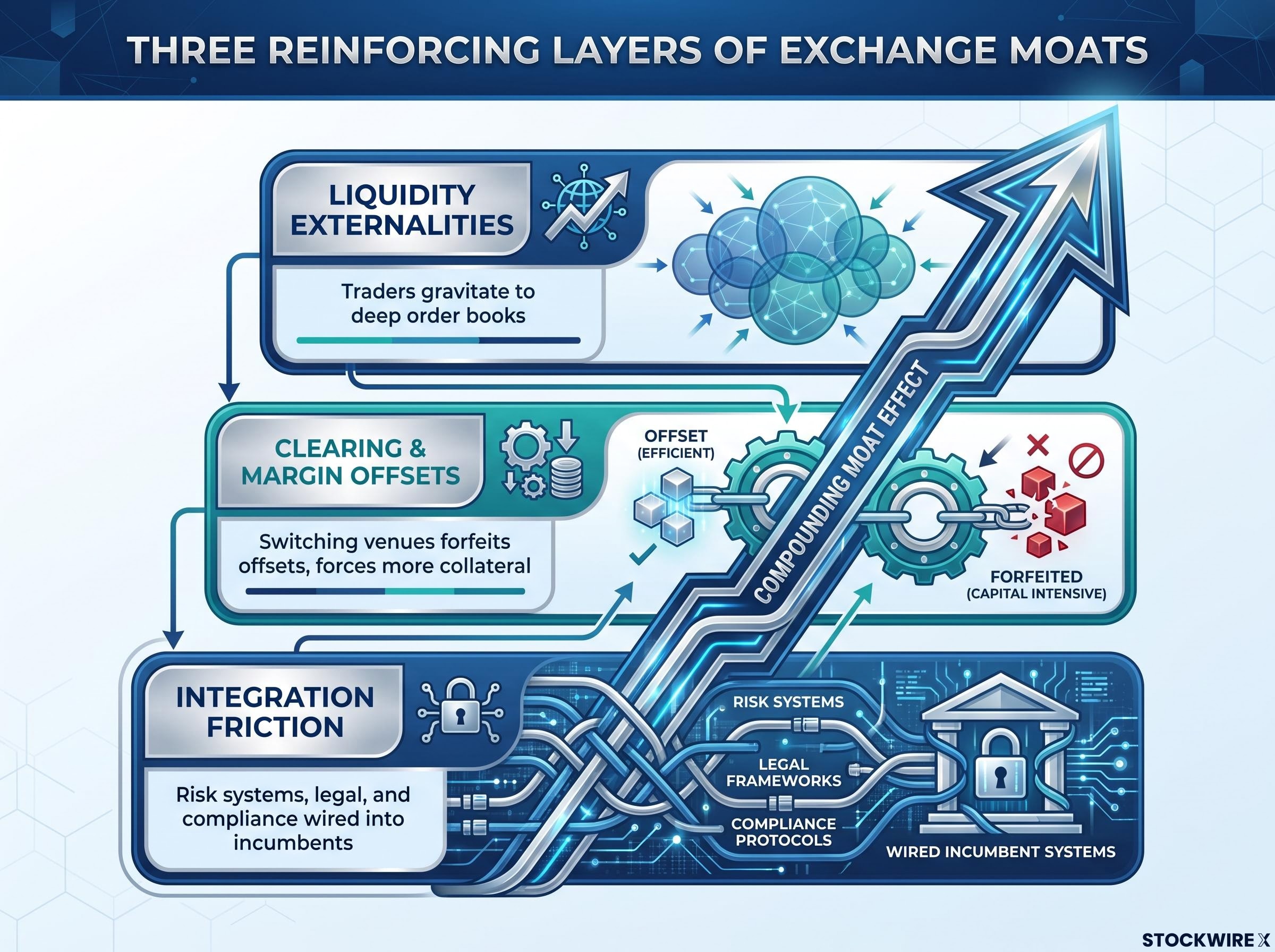
It is also incomplete. Centralised futures exchanges generate self-reinforcing dynamics that make them behave far more like infrastructure utilities with equity upside than like cyclical trading businesses. Three reinforcing layers explain why.
- Liquidity externalities. Traders gravitate to the venue with the deepest order book and the tightest spreads. As more of them concentrate there, liquidity improves, which pulls in still more traders. Once a benchmark contract achieves dominant liquidity, using a rival venue means visibly worse pricing and slippage.
- Clearing and margin offsets. Central clearinghouses offer portfolio margining across rates, equity index, and commodity contracts. Move a slice of positions to a challenger, and you often forfeit those offsets, forcing you to post more collateral. Switching becomes economically punitive.
- Integration friction. Banks and asset managers have risk systems, legal agreements, and compliance workflows deeply wired into incumbent venues. Onboarding a challenger means technology integration, risk-model validation, and operational change, all for uncertain benefit.
Understanding these three layers is what separates a genuine thesis about why these companies are defensible from a generic claim that they “have moats.” The three mechanisms compound, and that is the point.
The clearest recent proof is FMX, the challenger backed by Cantor Fitzgerald’s Howard Lutnik that targeted CME’s interest-rate futures franchise. Despite substantial funding and attention, FMX captured only around 1% market share. Strong backing was not enough to overcome the liquidity and clearing lock-in.
Liquidity moat durability across decades of disruption attempts is the core empirical case for why these franchises compound reliably; the MIAX Futures episode, where even financially incentivised traders declined to shift flow away from CME, provides a clean controlled test of the mechanism that the FMX episode reinforces.
History records exactly one clean case of an incumbent being overturned: Eurex displacing LIFFE in German Bund futures during the 1990s. It succeeded only because a genuine structural window was open, the transition from open-outcry floor trading to electronic execution, which LIFFE failed to match in time.
Morningstar’s read on CME Morningstar’s long-standing equity research characterises CME Group as having a “wide economic moat,” driven by network effects in its core markets and central-clearing infrastructure that creates high switching costs.
For you as an investor, the takeaway is that these moats are durable precisely because they are structural, not because trading was busy last quarter.
The economic moat framework Morningstar applies requires analysts to assess whether competitive advantages can sustain excess returns on invested capital for 20 years or more, a threshold that fewer than 20% of covered companies meet and that underpins the wide-moat designation both CME and ICE carry in its research.
When big ASX news breaks, our subscribers know first
The institutional debate: diversification engine or focused utility?
Here is where the analysis gets genuinely contested, because two credible portfolio managers look at the same industry and reach opposite conclusions.
Nick Healey, portfolio manager at WHAM, makes the bull case for ICE. His argument rests on winner-take-all liquidity dynamics, but it goes further. ICE runs a large energy trading business that tends to perform well when geopolitical disruption drives price uncertainty, and its mortgage-technology and data-services segments smooth earnings across cycles. Healey also noted that ICE’s shares had fallen roughly 9% over the preceding 12 months, which he framed as an attractive entry point.
Doug Isles, portfolio manager at GCQ, prefers CME and holds it instead of ICE. His logic is the mirror image. CME offers cleaner exposure to volatility, rate cycles, and hedging demand, without the integration and execution risk that comes with large technology acquisitions. It is a more legible business, and legibility has value.
The precise point of divergence is this: ICE’s diversification is either a strength or a liability, depending on how you weight the trade-off. Healey sees multiple moat sources and steadier earnings. Isles sees complexity, integration risk, and exposure to the mortgage cycle that has nothing to do with exchange economics.
The financials frame the tension rather than resolve it.
The tension between record operational results and compressed multiples is not unique to this comparison: exchange stock valuations across CME, ICE, and HKEX have all sold off sharply even as underlying revenue and earnings reached all-time highs, a divergence that raises the question of whether the bearish narratives reflect genuine franchise impairment or a sentiment-driven mispricing.
| Metric | ICE | CME |
|---|---|---|
| Q2 2026 Revenue | $2.7B (+5% YoY) | $1.7B |
| Q2 2026 Net Income | $958M | $1.0B |
| Q2 2026 Adjusted EPS | $1.90 (+5% YoY) | $2.99 (+1% YoY) |
| Business Model | Diversified infrastructure | Focused derivatives |
| Key Risk Factor | Integration / mortgage cycle | Volume / volatility dependence |
ICE’s larger revenue base reflects its broader footprint. CME’s higher net income on lower revenue reflects the extraordinary margins of a focused derivatives utility. Its Q1 2026 revenue of $1.9 billion was a record, evidence that the focused model delivers consistently through active rate cycles.
“CME is the cleaner business,” is the essence of the GCQ position: focused exposure to derivatives, without the technology-acquisition risk ICE carries.
There is no objectively correct answer here. Your own risk tolerance and your preference for business-model legibility should decide which argument persuades you. The job is to test each position against the numbers, not to pick a camp on instinct.
What history says about challenger exchanges and incumbent moats
The best way to stress-test a moat claim is to look at what has actually happened when challengers attacked one. The record is remarkably consistent, and it points in one direction.
Start with the exception. Eurex took the benchmark German Bund futures contract away from LIFFE in the 1990s, the one instance of a major incumbent being displaced. The structural condition mattered: the market was mid-transition from floor trading to electronic execution, and Eurex built for the new world while LIFFE clung to the old one. Displacement was possible because a technological inflection point cracked the door open.
Now the failures. ELX Futures, NASDAQ NLX, and Eurex US all tried to challenge CME in U.S. Treasury and short-rate futures. None gained meaningful liquidity. All eventually closed or pivoted, because no structural window existed and the incumbent’s liquidity, clearing memberships, and risk systems were already entrenched.
Equities and options tell a contrasting story. There, challengers like BATS and Chi-X won real market share with lower fees and better technology before folding into Cboe. The structural reason is decisive: equity and options markets permit multiple venues to quote the same underlying, so fragmentation works. Centrally cleared futures do not allow that, which is why winner-take-all dynamics dominate.
CME’s own consolidation drove the point home. Its acquisitions of CBOT and NYMEX combined rates, equity index, and commodity contracts under one clearinghouse, deepening cross-margin benefits and widening the moat that FMX later failed to breach.
The three variables that decide moat durability
Market-structure authorities Larry Harris and Craig Pirrong identify three variables for judging whether an exchange moat can be overturned: market type, product breadth, and the presence of a regulatory or technological inflection point.
Pirrong’s research on exchange market power identifies collusive enforcement mechanisms and service heterogeneity as the structural foundations through which incumbent exchanges entrench their positions, providing the academic grounding for why liquidity lock-in persists even when challengers arrive with substantial capital backing.
| Challenger | Target | Outcome | Key Structural Condition |
|---|---|---|---|
| Eurex | LIFFE (Bund futures) | Displaced incumbent | Floor-to-electronic transition |
| ELX / NLX / Eurex US | CME (rate futures) | Failed, exited | No structural window |
| BATS / Chi-X | Equity venues | Gained share | Fragmentation permitted |
| FMX | CME (rate futures) | ~1% share | No structural window |
For ICE and CME holders, the pattern tells you the core derivatives franchises are highly durable unless a genuine inflection point creates a window. No such window is open right now.
Where each thesis breaks: risks that matter before you decide
Every thesis has a failure mode, and knowing what would have to be true for each position to be wrong is more useful than a generic list of risks. So treat this as a test of both cases.
Strong recent results support both. ICE posted record Q1 2026 revenue of $3.0 billion and Q2 net income of $958 million. CME’s record Q1 revenue of $1.9 billion shows what an active rate cycle generates for a focused model. Good numbers, but they do not eliminate the underlying structural risks.
ICE: where the diversification thesis faces pressure
ICE is really a thesis with two layers that both need to hold: the core exchange moat and the diversified businesses stacked on top of it.
- Mortgage-technology cyclicality. ICE Mortgage Technology ties earnings to housing and rate cycles. When origination and refinancing slow, this segment can drag on growth and margins in a way that has nothing to do with exchange economics.
- Acquisition integration risk. Large deals carry regulatory scrutiny and client-migration challenges. Integration drag can undercut the very diversification argument that justifies the premium.
- Data-services competition. Competition in financial data and analytics has intensified, which could pressure pricing in a segment investors currently value highly.
These risks exist independently of the core moat, which is exactly the problem. Both layers have to work.
CME: where the focused model faces its limits
CME’s risk profile is simpler, but it is more directly tied to macro conditions no company can control.
- Volume and volatility dependence. Revenue leans heavily on trading activity in rate and equity index derivatives. A sustained low-volatility, policy-stable stretch compresses that activity.
- Product and geography concentration. Dominance in U.S. dollar rate futures and major equity indices is a strength until a benchmark contract structurally declines in demand.
- Competition at the margin. Niche venues may nibble at specific product lines over time.
Neither risk profile is disqualifying. If you are comfortable with business-model complexity and cyclical hedging, ICE’s risks may sit fine with you. If you prioritise legibility and lower execution risk, CME looks cleaner even with a narrower upside ceiling.
Current share prices, market capitalisations, and year-to-date performance should be sourced from a financial data provider at the time you read this.
Making a portfolio call between two exceptional businesses
The honest conclusion is that this is not a question of which business is better. Both are high-quality with durable moats. It is a question of which investment structure fits your existing portfolio logic.
ICE offers diversified market infrastructure with multiple moat sources and a larger revenue base, at the cost of complexity and integration risk. CME offers cleaner derivatives exposure with powerful network effects and legible earnings, at the cost of sensitivity to trading volumes and macro volatility.
The financials underline that trade-off. ICE’s Q2 2026 adjusted EPS of $1.90 grew 5% year-on-year, while CME’s $2.99 grew roughly 1%. ICE is compounding faster from its adjusted base; CME is delivering at a higher absolute per-share level. Both facts are true, and they favour different investors.
Three questions can settle the choice for you:
- How much weight do you place on business-model legibility versus diversified earnings smoothing?
- How exposed is your existing portfolio to housing and rate cycles already?
- Do you believe a technological or regulatory inflection point is likely to open a genuine window for challengers?
Healey’s ICE case and Isles’s CME preference are both internally coherent. The one that fits you depends on the answers above, not on a performance chart.
This article is for informational purposes only and should not be considered financial advice. Investors should conduct their own research and consult with financial professionals before making investment decisions.
Past performance does not guarantee future results, and financial projections are subject to market conditions and various risk factors.