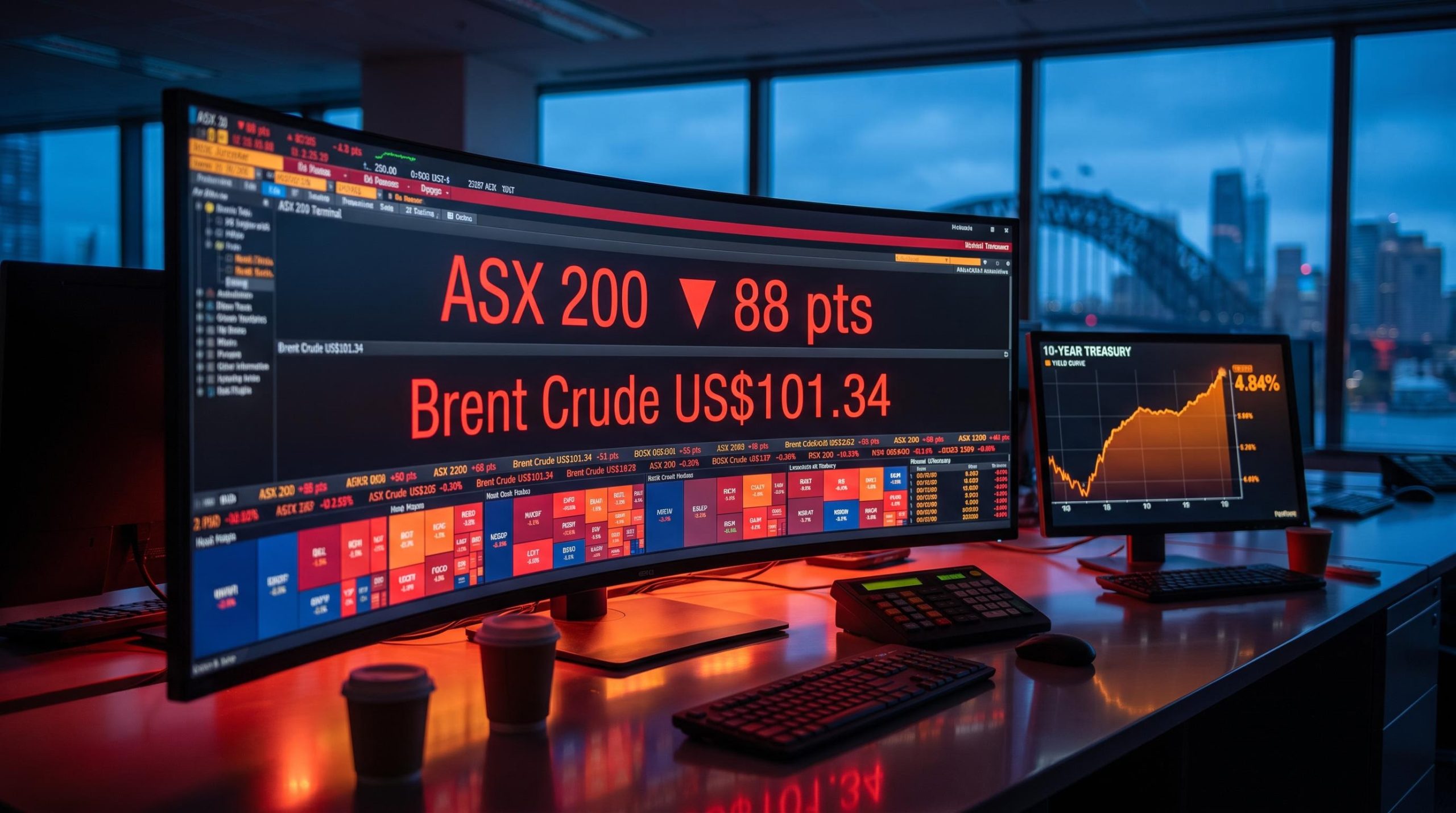
ASX 200 futures have dropped 88 points, roughly 1%, before Thursday’s open, and the forces behind that move are anything but routine.
Oil has pushed above US$100 for the first time in years. US Treasury yields sit at their highest since late 2023. And Washington has just escalated its trade fight with Canada from steep tariffs to outright import bans.
The session ahead for Australian investors sits at the intersection of three separate global shocks arriving at once. Rising energy costs are feeding inflation fears, those fears are pushing bond yields higher, higher yields are compressing equity valuations, and that compression is triggering selling across global indices.
Small-cap stocks are wearing the steepest losses because they carry the most exposure to higher borrowing costs and thinner margins. Australian equities now face the import of that global risk-off mood.
This piece maps where each pressure is coming from, which parts of the ASX are most exposed, and what the combination of high oil and high yields means for the market Australian investors are walking into on Thursday.
Oil above US$100 is the match that lit this sell-off
Brent crude crossed US$100 a barrel ahead of the 10 September 2026 session, and every major data provider confirmed the breach. The number itself is the story’s starting point.
- Bloomberg Markets placed ICE Brent front-month futures at US$101.34
- OilPrice.com quoted US$101.21, up 3.36% on the day
- TradingEconomics reported Brent at US$100.45
All three agree on the same fact: prices had punched clearly through the US$100 line by 9 September 2026.
The primary driver is the Iran conflict. US military strikes on Iran have disrupted supply expectations, and at one point during the escalation, Brent jumped roughly 4.6% in a single session, according to Yahoo Finance’s early September coverage.
The catalyst, in Barron’s words “A fresh flare-up in Middle East tensions” and “renewed US-Iran attacks” have driven another surge in oil and pushed bond yields to multi-decade highs.
Here is why the US$100 threshold matters beyond the digits. It is a level markets treat as a signal, not just a price, and bond markets are now trading in line with oil as it swings above or below that mark. That linkage amplifies the effect on yields and equities at the same time.
For Australian readers, this is where the chain begins. Oil above US$100 is not merely an energy story; it is the upstream cause of the inflation pressure, the yield move, and the valuation compression flowing into the ASX on Thursday morning. It feeds directly into domestic fuel costs, RBA rate expectations, and the global risk-off sentiment dragging futures lower.
Understanding the source helps you tell the difference between a temporary spike and a structural repricing. Right now, the geopolitical driver points toward the latter.
When big ASX news breaks, our subscribers know first
Why the bond market is making equities expensive to hold
The yield move is best understood as a chain, not a scoreboard. Higher oil feeds inflation fears. Inflation fears keep rates elevated. Elevated rates lift the discount rate applied to every future dollar of corporate earnings. And a higher discount rate compresses valuations, which produces the selling now showing up in futures.
The discount-rate channel operates mechanically: each upward move in the 10-year yield reduces the present value of every future dollar of corporate earnings, compressing price-to-earnings multiples even when underlying business performance has not changed, and the IMF has estimated that a 100 basis point rise in global long-term real rates lowers advanced-economy P/E ratios by 10-15%.
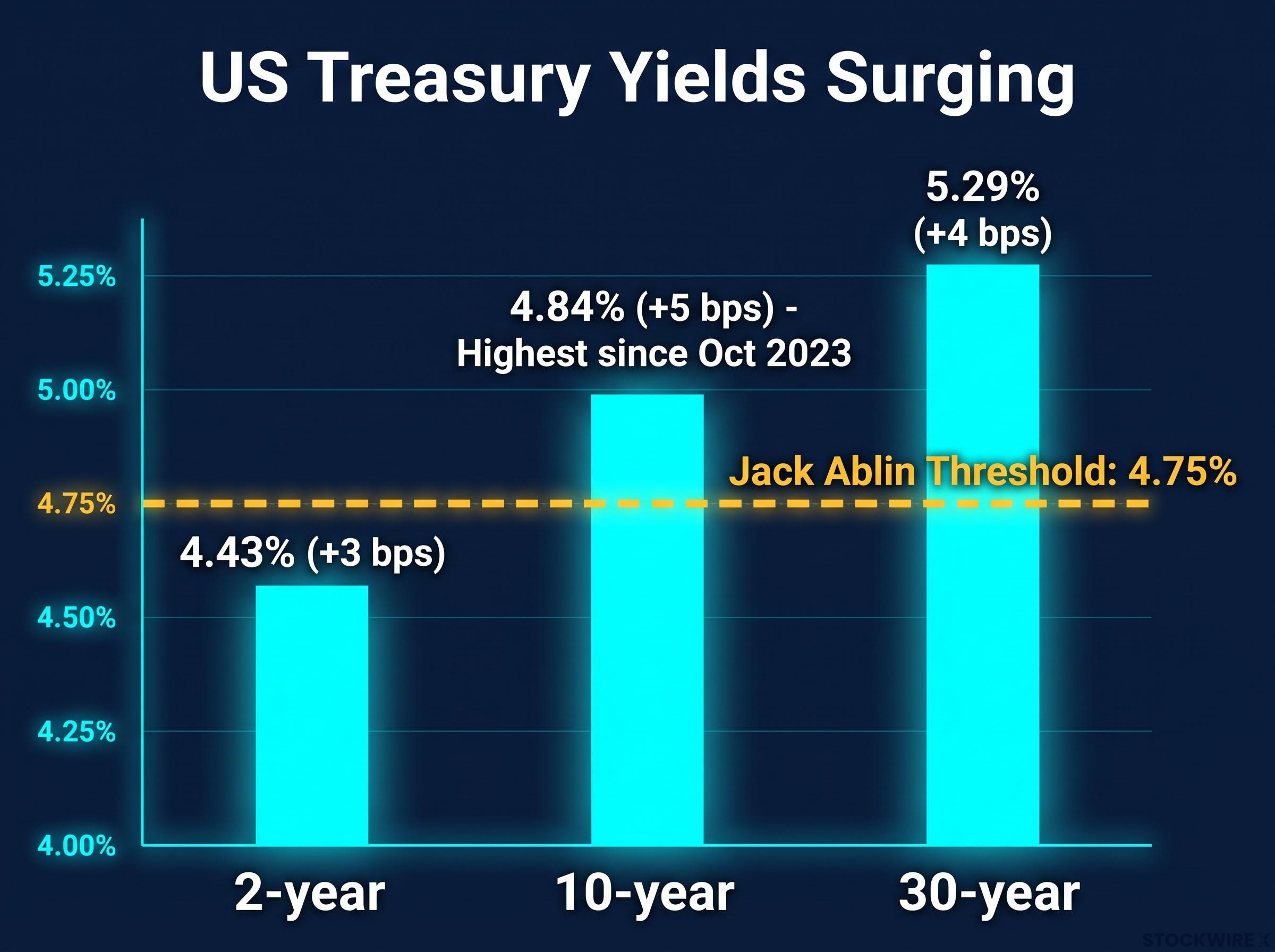
The numbers behind that chain are stark. According to Market Index, US Treasury yields climbed across the curve in the session before Thursday.
| Maturity | Yield Level | Session Change (bps) |
|---|---|---|
| 2-year | 4.43% | +3 |
| 10-year | 4.84% (highest since October 2023) | +5 |
| 30-year | 5.29% | +4 |
The 10-year at 4.84% is the figure to watch. Strategists have identified a specific level where bonds stop being a background asset and start competing with shares for capital.
Reuters strategist Jack Ablin put it plainly, drawing “a line in the sand at four and three quarters” on the 10-year yield, the point above which sustained levels significantly hurt stock valuations. The 10-year is now sitting above that line.
The selling is broad, not concentrated. The equal-weight S&P 500 fell 0.96% against the standard index’s 0.48%, a gap that tells you the pressure is hitting the average stock harder than the mega-cap names propping up the headline number.
The historical severity Sequoia Financial notes that renewed higher oil prices have driven global bond yields to levels “not seen in almost 20 years.”
For Australian investors, yields at these levels mean the global bond market is actively competing with equities for capital, and that competition is the mechanical reason ASX futures are down close to 1% before the market has even opened.
The practical read is this: the selling pressure eases when yields ease. As long as the 10-year holds above Ablin’s 4.75% threshold, valuations across global equities stay under strain, and the ASX imports that strain at the open.
Small-caps are taking the hardest hit, and here is why that matters for the ASX
The single sharpest move in the session belongs to the small-caps. The Russell 2000 fell 1.32%, nearly three times the S&P 500’s 0.48% decline, and well ahead of the Nasdaq’s 0.64% and the Dow’s 0.77%.
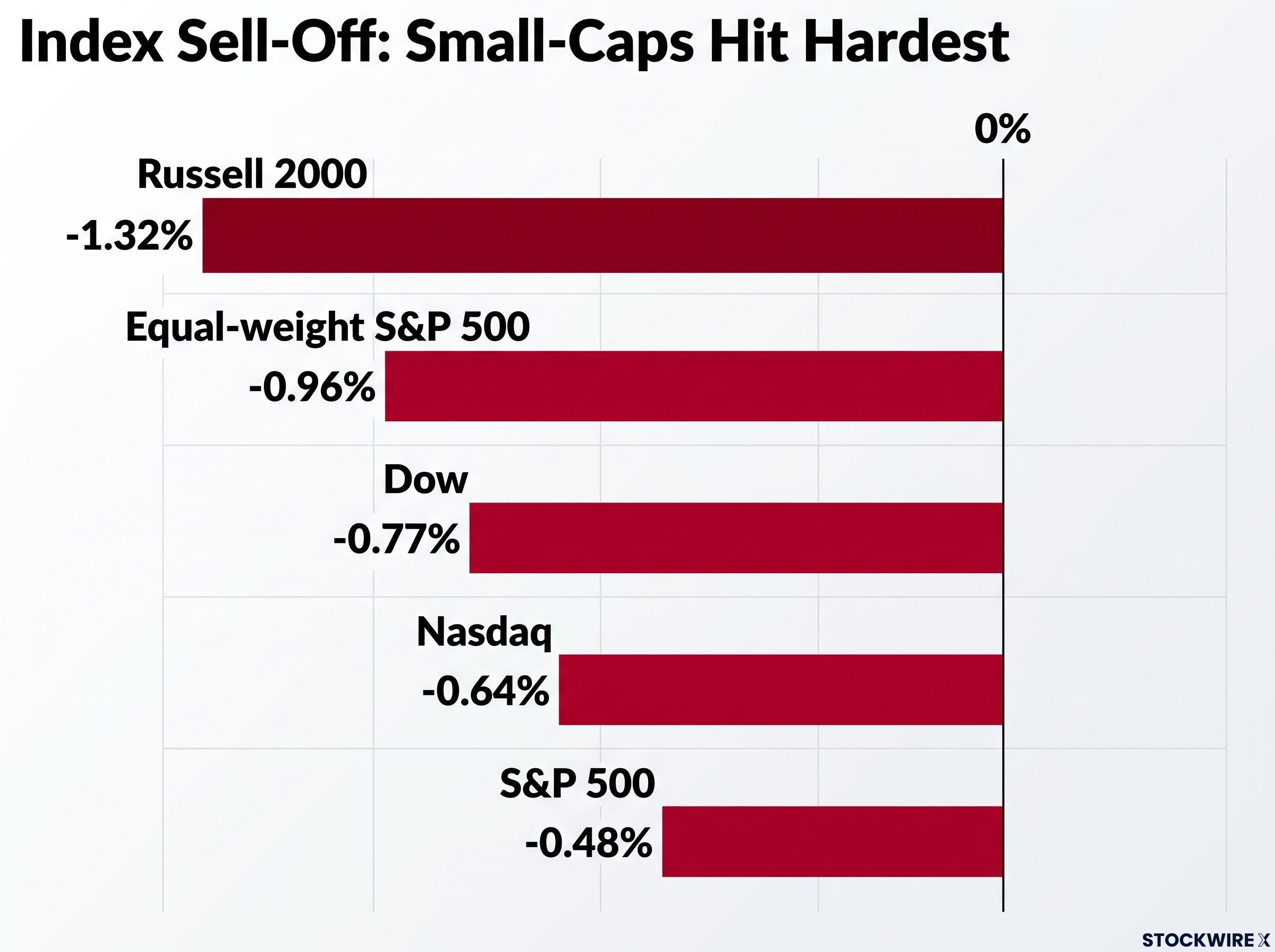
That divergence is not random. Smaller companies are structurally more exposed to exactly this combination of shocks, and three mechanisms explain why.
- Floating-rate debt exposure. Small-caps lean more heavily on bank loans and short-term credit, so their cost of capital rises faster than that of cash-rich large-caps when yields climb.
- Limited pricing power. Smaller firms struggle to pass higher energy and input costs to customers, so an oil spike compresses their margins more severely.
- Reduced risk appetite. High yields and macro uncertainty push investors toward liquid large-caps and bonds, leaving small-caps with thinner liquidity and deeper drawdowns.
This pattern has history behind it. Macquarie Asset Management documents that global small-caps significantly underperformed large-caps through the high-rate stretch from March 2022 to August 2024, driven by greater macroeconomic uncertainty around earnings and higher financing costs.
ASX small-cap drawdowns in risk-off environments are amplified by thin order books and illiquidity rather than fundamental deterioration alone, a distinction that matters for investors trying to separate temporary mark-to-market pressure from genuine business impairment as Thursday’s session opens.
The connection to Australia is direct. Domestically focused, rate-sensitive and smaller-cap ASX names face the same vulnerabilities, and Shane Oliver of AMP has explicitly flagged oil and rising yields as threats to Australian share valuations.
The Australian read Shane Oliver of AMP describes the oil supply shock as “a significant threat to economic growth and shares,” with higher yields reflecting fears that oil-driven inflation will keep the RBA on a higher-for-longer path.
The Russell 2000’s steep underperformance tells you the sell-off is penalising the most rate-sensitive and margin-vulnerable companies most severely. That maps straight onto ASX small-caps and rate-sensitive sectors like property and discretionary retail. If you want to know where Thursday’s session will bite hardest, that is where to look, rather than treating the futures decline as a uniform hit across every stock.
Canada trade ban adds a new fault line as markets absorb existing shocks
On top of an already-stressed market comes a third layer: a qualitative escalation in US trade policy toward Canada. Washington has moved beyond pricing Canadian goods out of the market to prohibiting some of them entirely.
The shift from tariffs to outright bans matters because it changes the nature of the risk, not just its size. A tariff raises the cost of a good; a ban removes it from the market altogether.
| Date | Measure | Goods Affected |
|---|---|---|
| 22 August 2026 | 50% tariffs take effect | Various Canadian goods |
| 15 September 2026 | Additional 50% tariff tranche | Oils, hides and leather, paper, steel and aluminium, furniture |
| 29 September 2026 | Outright import ban | Alcohol, dairy, motorcycles |
The full import ban, effective 29 September 2026, covers three categories, according to Reuters, BBC, CNBC and the Canadian Federation of Independent Business.
- Alcoholic beverages, including beer, wine, spirits and cider
- Dairy products, including whey protein and molasses
- Larger-capacity motorcycles
That 29 September date is the point to note. The ban has not yet landed, which means markets are currently pricing a policy risk that has not fully materialised.
For Australian investors, the Canada escalation matters less as a bilateral trade dispute and more as a signal that US trade policy is entering a more aggressive phase. Trade wars historically add a volatility premium to risk assets, and this one is arriving at a moment when high yields and high oil have already reduced the market’s tolerance for uncertainty.
US trade policy escalation in 2025 and 2026 has consistently imposed costs on allied partners, including Canada and Australia, while falling short of its stated strategic targets, a pattern that frames the Canada import ban as part of a broader shift in Washington’s approach rather than a bilateral exception.
Because the ban is forward-dated rather than fully priced, it also helps explain why markets may stay unsettled beyond Thursday, even if oil and yields steady slightly.
What changes the calculus for Australian equities from here
Thursday’s session is unlikely to mark the bottom of this sell-off unless at least one of the three pressure points shows a genuine reversal. That gives you a concrete set of signposts to watch rather than a static catalogue of bad news.
- Oil price direction. Whether the Iran conflict de-escalates or worsens. President Trump has acknowledged that the conflict and its fuel-price impact are likely to persist beyond the November 2026 midterm elections, so official expectations do not point to near-term relief.
- The 10-year Treasury yield. Specifically whether it holds above or breaks below the 4.75% threshold Reuters strategist Ablin flagged as the level where equity pressure eases.
- US trade policy tone. Any softening or further escalation ahead of the 29 September import ban.
There is a partial offset for Australia worth understanding. Higher oil benefits ASX-listed energy producers and supports some mining names, creating a two-speed dynamic where the broad index falls while the commodity sector diverges upward.
That divergence does not rescue the index, but it does mean resource-heavy portfolios may hold up better than domestically focused ones.
The RBA dimension keeps rate-sensitive stocks under pressure
The oil shock also feeds Australian inflation expectations, and that constrains the RBA’s room to cut. Shane Oliver of AMP argues that as long as oil stays elevated and global yields high, share-market valuations remain under pressure and the RBA faces a tougher policy trade-off.
The RBA rate path was already under pressure before Thursday’s session, with Australia’s July CPI print of 3.5% overshooting consensus and cutting the probability of rate cuts from above 80% to just over 60%, a backdrop that makes the current oil-driven inflation shock land on an already-stressed domestic policy environment.
The configuration is not permanent. Sequoia Financial notes that retreats in long-term yields have historically brought relief to equities, so a reversal in any one variable could shift the picture.
The takeaway for you: Australian investors in rate-sensitive and small-cap stocks carry the most concentrated exposure to the downside here. Watch the three signposts, because they will tell you whether conditions are deteriorating further or beginning to stabilise as the session unfolds.
This article is for informational purposes only and should not be considered financial advice. Investors should conduct their own research and consult with financial professionals before making investment decisions.
These statements are speculative and subject to change based on market developments. Past performance does not guarantee future results.