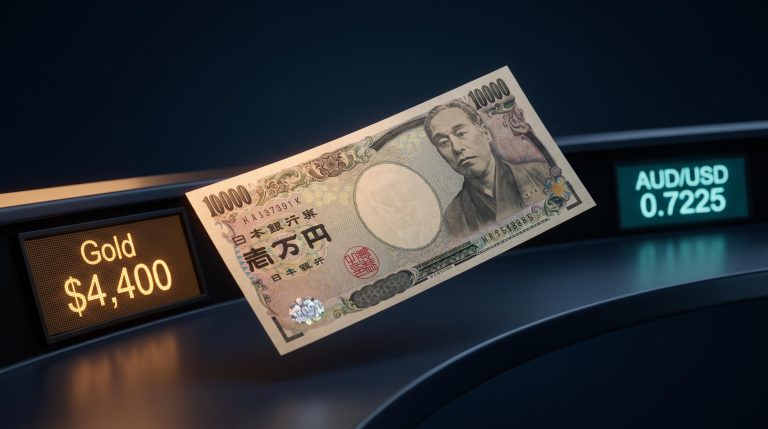
USD/JPY briefly pierced 153.00 this week, its weakest level since February 2026, and it did so without a single yen of official government intervention behind it.
That absence matters. The Yen is climbing on its own, driven by real money moving in real time, and the larger move may not have started yet.
The timing is not coincidental. The Bank of Japan meets on 17-18 September 2026, a 25-basis-point hike is fully priced into rates markets, and roughly $3.2 trillion in global assets funded through the Yen sit exposed to repatriation. These are structural forces, not tactical positioning.
This piece maps the three interlocking drivers behind the move, the technical levels that will decide whether the Yen extends or reverses, and what the history of carry-trade unwinds says about what usually comes next.
A BoJ hike is already priced in, so why does it still matter?
Here is the apparent contradiction. A 25bp hike from the BoJ is fully priced in, confirmed across rates markets and by strategists at Scotiabank, MUFG, and Mitrade, yet the Yen keeps strengthening into the meeting. If the outcome is known, the move should already be over.
It is not, because the hike itself is the least interesting part of 18 September.
The real event is what Governor Ueda says afterward. If the post-decision communication signals a faster future tightening path, the Yen has room to extend. If the language stays deliberately ambiguous, the hike arrives as old news.
The BoJ communication shift predates September’s meeting by weeks: Deputy Governor Himino’s declaration that the central bank does not need complete information before acting structurally lowered the threshold for future moves and changed how carry traders price inaction risk across every scheduled policy date.
The June 2026 precedent is the cautionary tale. The BoJ lifted its policy rate to 1.0% in June, a move markets had fully anticipated, and USD/JPY simply kept trading above 160 afterward. Expected hikes without hawkish framing produce muted reactions.
For anyone positioned short USD/JPY right now, that is the underappreciated risk. A hike without hawkish guidance could erase days of Yen gains in a matter of hours, a “sell the news” reversal that punishes the crowded side of the trade.
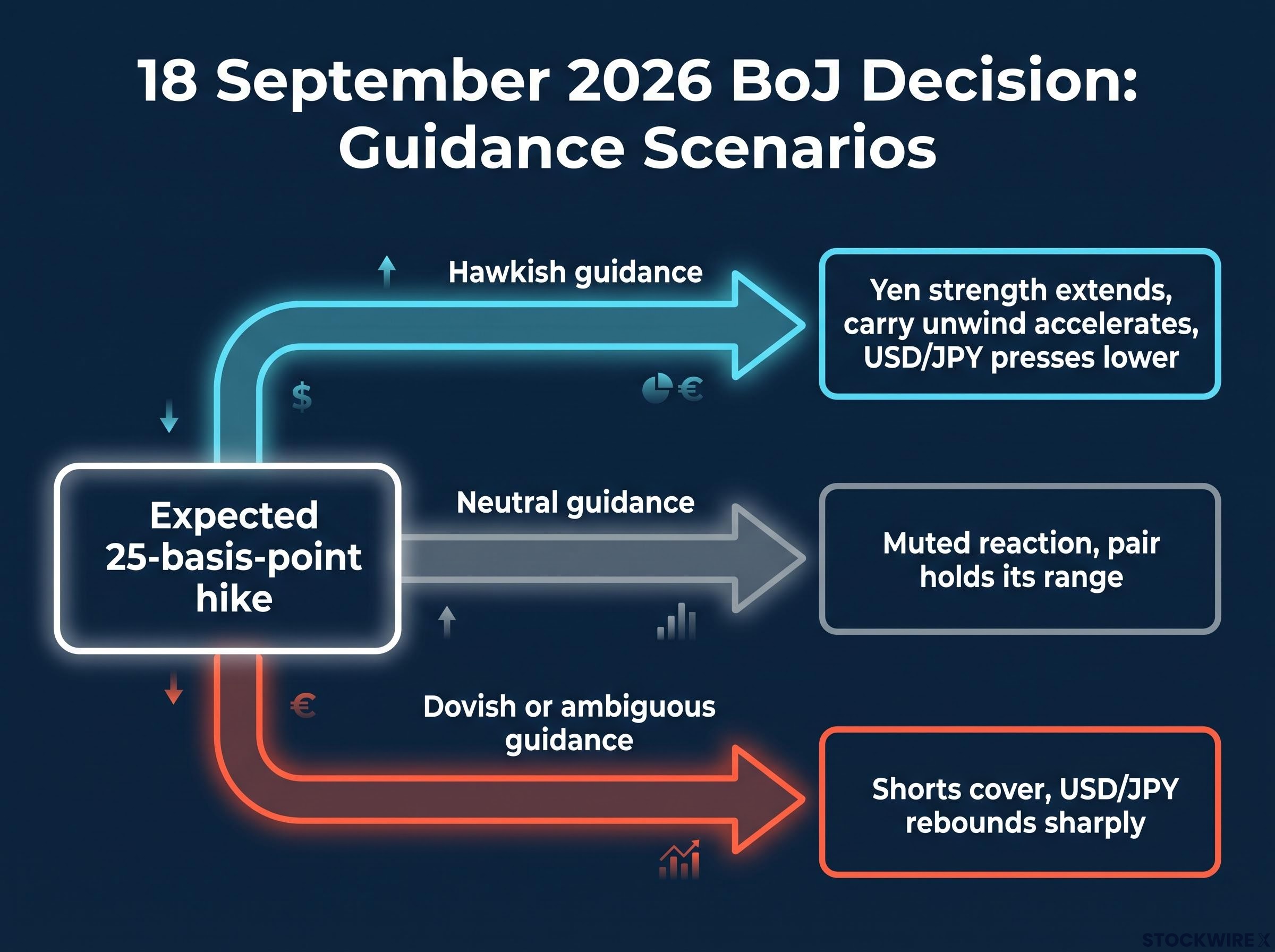
The three communication outcomes break down cleanly:
- Hawkish guidance: Ueda signals more hikes ahead. Yen strength extends, carry unwind accelerates, USD/JPY presses lower.
- Neutral guidance: Language stays balanced. Muted reaction, pair holds its range near current levels.
- Dovish or ambiguous guidance: No forward commitment. Shorts cover, USD/JPY rebounds sharply.
As of 9-10 September 2026, USD/JPY is consolidating near 153.5-153.8, having already tested below 153.00 intraday.
Scotiabank technical call Scotiabank strategists identify 153 as the near-term floor for USD/JPY, with no meaningful support visible before the 2026 low near 152. Resistance sits at 155, a level that previously acted as support.
The distinction between the hike and the guidance is the whole game. Read the communication, not the decision.
When big ASX news breaks, our subscribers know first
What is the carry trade and why does unwinding it push the Yen up?
To understand why the Yen keeps bidding, start with the trade that funded a decade of global risk-taking.
A currency carry trade works in three simple steps:
- Borrow cheaply in a low-rate currency. For years, that meant the Yen.
- Convert the borrowed Yen and invest in higher-yielding foreign assets, such as US Treasuries or equities.
- Pocket the difference between the near-zero borrowing cost and the higher foreign yield.
The trade prints money as long as the Yen stays weak and rate gaps stay wide. The problem is what happens in reverse.
Carry trade spread mechanics explain why the trade survived successive BoJ hikes: at 1.0%, Japanese borrowing costs still sit roughly 2.5-2.75 percentage points below the Fed’s target range, leaving the arbitrage intact even as the structural conditions for an unwind accumulate on either side.
When investors close these positions, they sell the foreign assets and buy back the Yen they borrowed. That buying creates concentrated Yen demand, which pushes the currency higher. A stronger Yen then raises the repayment cost for every remaining carry trader, prompting more of them to close, which drives more Yen buying. The loop feeds itself.
That self-reinforcing quality is what separates a carry unwind from ordinary currency volatility. You are not watching a one-day move; you are watching the early stage of a structural repositioning with a long runway.
What causes the unwind to accelerate?
Three triggers turn a slow drift into a stampede, and they tend to arrive in sequence.
- Rate differential compression. Rising Japanese rates or falling foreign yields shrink the profit gap. The trade becomes less profitable, and momentum in pairs like USD/JPY fades first.
- Appreciation-driven repayment cost. A rising Yen directly raises the cost of paying back the loan, erasing accrued gains. The trade becomes risky.
- Margin calls. High leverage combined with an appreciating funding currency deteriorates the risk-reward ratio non-linearly. Thin liquidity and volatility spikes force closures. The trade becomes forced.
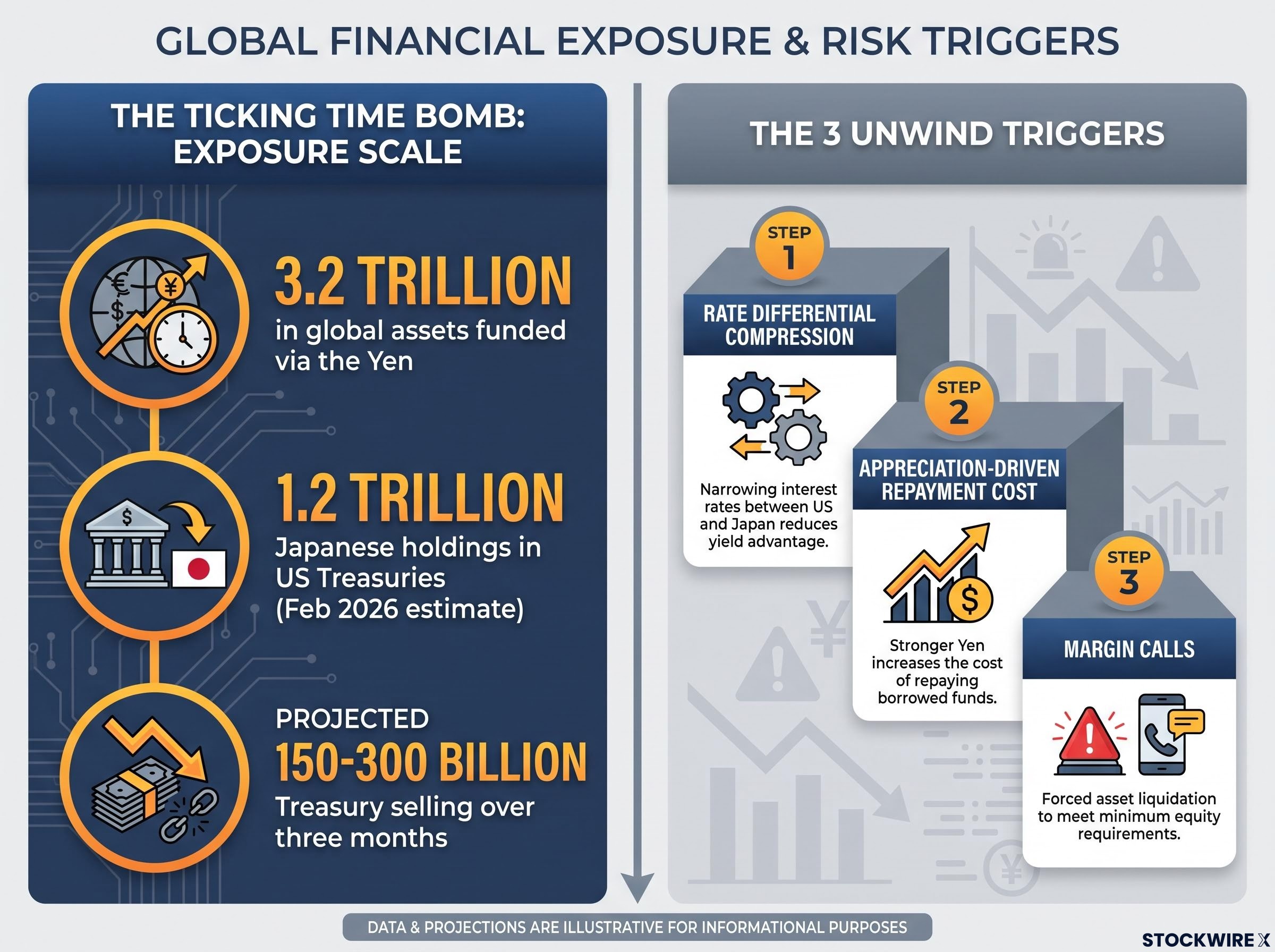
BCA Research has described the setup as a “ticking time bomb,” and the label captures the key point: the unwind does not need a recession to detonate. A liquidity gap and a volatility spike are enough.
The scale explains the stakes. February 2026 analyst estimates put Japanese holdings at roughly $1.2 trillion in US Treasuries and around $3.2 trillion in global assets funded via the Yen. The ongoing unwind is projected to force $150-300 billion of Treasury selling over a three-month window.
Japan’s capital repatriation is the flow beneath the headline
The carry unwind is the mechanism. The repatriation is the money you can actually see moving.
These are related but distinct. Alongside leveraged carry traders closing positions, Japanese institutional investors are deliberately rotating out of overseas bonds and equities as domestic yields climb, bringing capital home. This shows up directly in the Ministry of Finance’s weekly flow data rather than in models or forecasts.
GPIF repatriation flows add an institutional layer to the carry unwind story: Finance Minister Katayama’s July 2026 announcement that the world’s largest pension fund would tilt toward domestic assets triggered a same-session USD/JPY decline, and even a 5-10 percentage-point portfolio reweighting implies tens of billions in FX flows playing out over multiple years.
The July 2025 numbers illustrate the swing. In the week through 19 July 2025, Japanese investors sold a net 331.6 billion yen of foreign bonds, a sharp reversal from net purchases of 1,643.8 billion yen the week before. That is the directional shift, visible in official data.
During the most intense deleveraging episodes, estimates point to $200-300 billion in daily selling pressure across global assets.
| Driver | Direction of flow | Impact on Yen | Estimated scale |
|---|---|---|---|
| Carry-trade unwind | Sell foreign assets, buy back Yen | Appreciation | $3.2T total Yen-funded exposure at risk |
| Overseas bond repatriation | Sell foreign bonds, repatriate capital | Appreciation | $150-300B Treasury selling over three months |
| Overseas equity repatriation | Sell foreign equities, repatriate capital | Appreciation | Part of broader repatriation flows |
Financial media have characterised the broader shift as a “historic repatriation of Japanese capital,” and the framing fits the flow data.
No official intervention The BoJ’s daily account data shows zero evidence of official FX intervention in the current Yen move. The appreciation is entirely flow-driven.
That distinction should shape how you read the trade. When Yen strength comes from intervention, it fades the moment the pressure lifts. When it comes from organic repatriation flows, it tends to persist. The absence of intervention fingerprints suggests this bid can outlast the September meeting, whatever the outcome.
What August 2024 taught markets about Yen unwinds, and what is different now
The market has run this experiment before, and the results are worth remembering rather than fearing.
In August 2024, a BoJ hike collided with a weak US jobs report, and leveraged Yen-funded positions unwound at speed. Analysts estimated $250-500 billion in USD/JPY carry exposure caught in the reversal, and the damage spread fast.
USD/JPY fell roughly 12% over three weeks. The contagion reached far beyond currencies, forcing deleveraging across Nasdaq-heavy US tech, emerging-market bonds, and credit spreads, while the VIX volatility index briefly spiked above 65.
Nikkei 225, 5 August 2024 The Nikkei 225 plunged approximately 12.4% in a single session, its worst day since 1987.
What matters now is how the market behaved after that shock. The December 2025 hike to 0.75% produced controlled deleveraging rather than panic. The June 2026 hike to 1.0% drew a similarly contained reaction, with USD/JPY holding above 160. Markets have partially adapted to the normalisation cycle.
The BoJ’s June 2026 policy decision raised the uncollateralized overnight call rate to around 1.0%, and the accompanying guidance language was deliberately measured, offering no firm commitment to an accelerated tightening path, which is precisely why USD/JPY held above 160 despite the widely anticipated move.
| Factor | August 2024 | September 2026 | Key difference |
|---|---|---|---|
| Trigger type | Surprise hike plus weak US jobs data | Fully priced hike, guidance in focus | Better anticipated, less shock potential |
| USD/JPY starting level | Near 155 before the drop | Consolidating near 153.5 | Already lower, closer to support |
| Carry exposure | $250-500B in USD/JPY carry | Hundreds of billions residual | Most hyper-leveraged positions cleared |
| Global risk environment | Sudden risk-off cascade | Staged, adapted deleveraging | Markets partly conditioned to the cycle |
The residual risk is the caveat. The 2024 shock cleared the most leveraged positions, but hundreds of billions in Yen-funded carry trades remain, which keeps global equities and volatility sensitive to further Yen rallies or a BoJ surprise.
Here is the read the 2024 template gives you. When a Yen unwind interacts with a simultaneous macro catalyst, the speed and contagion turn non-linear. The genuine danger on 18 September is not the hike; it is a concurrent risk-off trigger elsewhere in markets landing at the same time.
What the September 18 decision changes, and what it does not
The structural case for a stronger Yen is real, but it is not a straight line, and the near-term range is defined by two levels.
Per Scotiabank, 153.00 is the floor, with no meaningful support before the 2026 low near 152. On the upside, 155 is the resistance ceiling, a level that previously served as support. Treat that band as a decision zone, not a fixed floor or ceiling.
The scenario split is straightforward. Hawkish BoJ guidance sustains Yen strength and risks further carry unwind. Neutral or dovish guidance, or a concurrent Federal Reserve hike, risks a sharp USD/JPY rebound as rate differentials widen again.
The Fed is the wild card. If it delivers its own 25bp hike at the September meeting, the rate gap between the two currencies widens and USD/JPY likely rebounds regardless of the BoJ’s move. The US Dollar Index (DXY) is consolidating near 98.6 as of 9-10 September 2026, after bouncing from a low that marked its weakest reading since 21 August.
UBS strikes the cautious note. Its strategists argue that sustained Yen strength requires both faster BoJ hikes and a clearer government stance, and that below historically sensitive intervention levels, the pair can recover meaningfully when global risk appetite returns.
Three variables are worth watching from here:
- BoJ guidance language in the post-hike statement and press conference.
- The Fed rate decision and its impact on the US-Japan rate differential.
- USD/JPY behaviour around the 153 and 155 technical levels.
Scotiabank technical call Resistance holds at 155. Below 153, the next meaningful support does not appear until the 2026 low near 152.
Read 18 September not as a verdict on the Yen but as the next data point in a multi-quarter repositioning that began in 2024. Understand the 153-155 band as a decision zone, and you are far less likely to be whipsawed by the first 24-hour move.
For readers wanting a fuller assessment of where USD/JPY heads beyond the September decision, our dedicated guide to the medium-term Yen outlook covers the JGB yield regime change, Japan’s 240% debt-to-GDP ceiling on BoJ hikes, and why institutional forecasts for late 2026 range from 138 to 160 across credible scenarios.
This article is for informational purposes only and should not be considered financial advice. Investors should conduct their own research and consult with financial professionals before making investment decisions. Past performance does not guarantee future results, and financial projections are subject to market conditions and various risk factors. Forward-looking statements are speculative and subject to change based on market developments.