
Ask most investors what moves global bond yields, and they will point straight to the US Federal Reserve. It is the assumption that shapes almost every fixed-income conversation.
That assumption is now being tested from an unexpected direction. Halfway around the world, the Bank of Japan policy reversal is rewriting the rules of global capital flows, and it is doing so at a scale few investors have priced in.
The central bank has lifted its policy rate to 1.0%, a 31-year high, while the yield on 10-year Japanese Government Bonds briefly touched 3.0% in early September for the first time since 1996. After a decade of zero and negative rates, Japan is normalising, and the shockwaves are only beginning to spread.
JGB yield normalisation, as Morningstar DBRS analysts and the IMF have both characterised it, reflects the removal of artificial suppression rather than any deterioration in sovereign creditworthiness, a distinction that matters when assessing whether the current yield level is sustainable or a temporary overshoot.
Here is what this shift actually means for you: how rising Japanese yields are reshaping fixed-income allocations, moving currencies, and pulling structural demand out of markets that have relied on cheap Japanese money for years. Understanding it changes how you read every government bond in your portfolio.
The anatomy of Japan’s decade of ultra-loose monetary policy
To grasp why this matters, you have to understand just how extreme Japan’s policy stance was, because the scale of the easing dictates the scale of the reaction now that it is unwinding.
The Bank of Japan operates with a core mandate: keep prices stable, with an inflation target of roughly 2%. For years, it fell persistently short of that goal, trapped in a low-inflation environment that conventional tools could not fix.
So in 2013, it went further than almost any major central bank in history. It launched Quantitative and Qualitative Easing (QQE), a programme of massive asset purchases including government and corporate bonds, designed to flood the economy with liquidity and force inflation higher.
Then, in 2016, it crossed another line. It introduced negative interest rates, effectively charging banks to park money with the central bank, alongside direct control of long-term government bond yields.
The mechanics of yield curve control
Yield curve control was the piece that reshaped global markets. The central bank committed to capping the yield on 10-year Japanese Government Bonds, buying as many bonds as necessary to hold yields down near zero.
The effect was profound. With domestic bonds offering almost nothing, Japanese banks, insurers, and pension funds were pushed to hunt for returns abroad, pouring capital into US Treasuries, European sovereign debt, and higher-yielding assets across the globe.
This policy also weakened the Yen substantially against major currencies, a trend that accelerated through 2022 and 2023 as other central banks raised rates while Japan held firm.
You should not think of Japan’s zero-rate era as an isolated domestic experiment. It functioned as one of the foundational funding sources for global market liquidity, a river of cheap capital that flowed outward for years. That river is now beginning to run dry, and everything downstream is about to feel it.
When big ASX news breaks, our subscribers know first
Breaking the 3 percent threshold and the new rate reality
The turn came in March 2024, when the Bank of Japan finally began raising rates and exiting its ultra-loose stance. What followed was a steady, deliberate climb out of a decade of stagnation.
The pace picked up sharply. At its meeting on 15-16 June 2026, the Policy Board raised the policy rate from 0.75% to 1.0%, a 25 basis point move that lifted borrowing costs to their highest level in 31 years. From 17 June, the guideline for money-market operations was set to keep the overnight call rate around 1.0%.
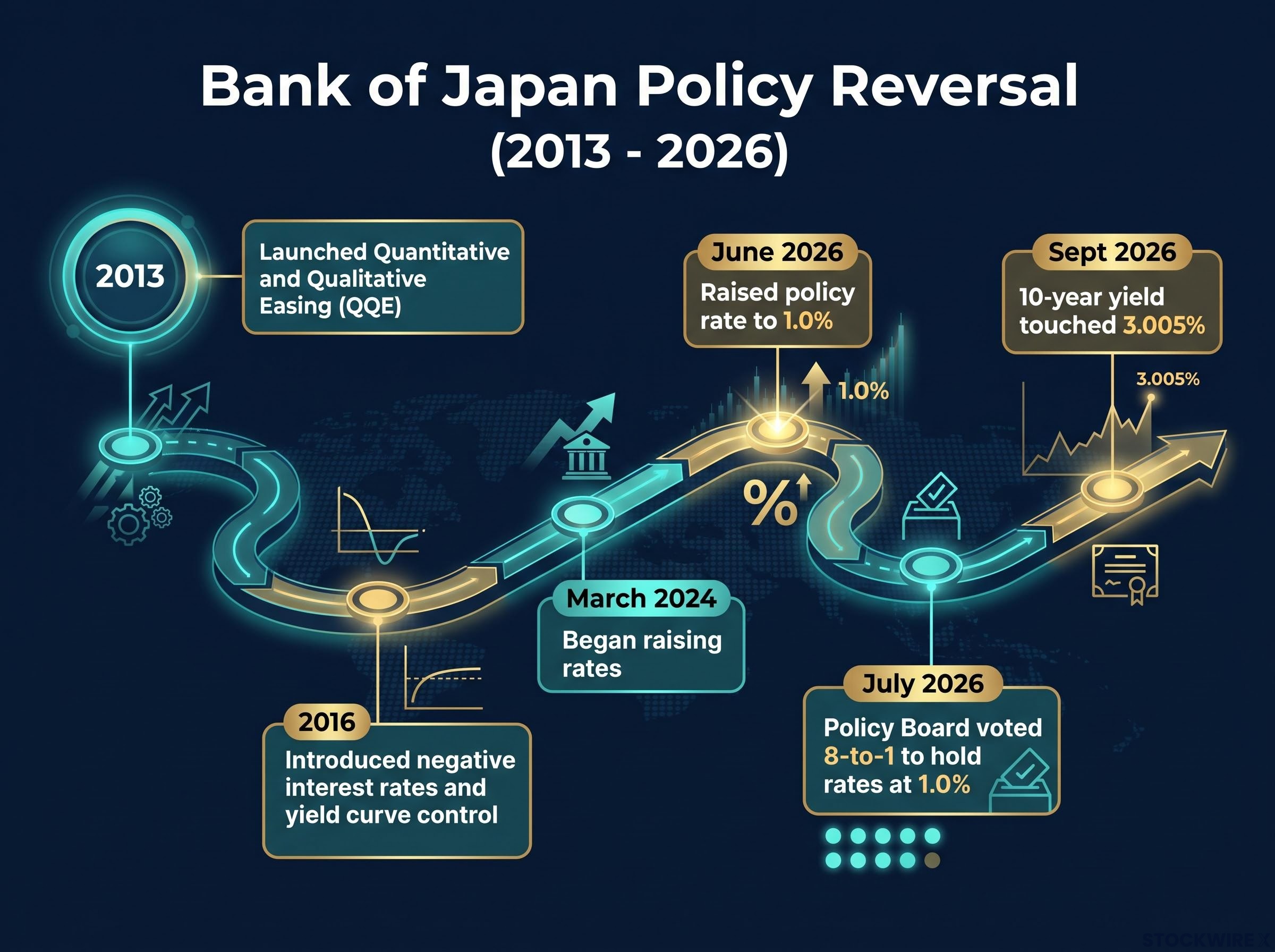
The debate inside the central bank is now about how much further to go. At its most recent meeting on 31 July 2026, the Policy Board voted 8-to-1 to hold rates steady at around 1.0%. The lone dissenter, widely reported as board member Hajime Takata, pushed for an immediate hike to 1.25%, a sign that the hawkish camp wants to move faster.
Then came the symbolic breach. In early September, the 10-year Japanese Government Bond yield touched roughly 3.005% during trading on 1-2 September, the first time it had crossed 3.0% since 1996. It has since settled back, trading at 2.932% on 10 September, but the threshold had been broken.
Japanese benchmark rates are now sitting at their highest level since 1995, marking a definitive end to the era of near-zero policy that defined the country’s markets for a generation.
DBS analysts, cited by Reuters in mid-August, raised their year-end forecast for the 10-year yield to 2.85% and now expect the central bank to hike roughly every three to four months, a faster cadence than markets previously assumed.
Here is what this normalisation path tells you: the era of cheap Yen funding is definitively over. That fundamentally changes the risk-reward calculus of holding Japanese debt, and those specific yield thresholds act as signals for when domestic Japanese bonds become attractive enough to trigger large-scale institutional buying.
Why a 2.2 trillion dollar wealth fund is pivoting to Japanese debt
Nothing illustrates the real-world consequence of this shift better than what is happening at Norway’s sovereign wealth fund, and the numbers are staggering.
Norges Bank Investment Management (NBIM) runs the world’s largest sovereign wealth fund, valued at NOK 22,683 billion, or roughly $2.285 trillion, as of 30 June 2026. When a fund of this size moves, it acts as a leading indicator for how institutional money everywhere is thinking.
And it is moving decisively. NBIM has submitted a proposal to Norway’s Ministry of Finance to reshape its bond portfolio, cutting exposure to US Treasuries while dramatically increasing its holdings of Japanese Government Bonds.
The proposal, reported by CNBC on 4 September and sourced to Jiji Press, would slash the share of US government bonds in its benchmark bond index from 34.1% to 21.9%, a reduction of roughly $80 billion from a Treasury position of around $215 billion. At the same time, it would lift Japanese Government Bond exposure from 4.6% to 7.4%, adding about $17 billion in demand for Japanese debt.
The bigger picture is even more striking. NBIM proposes cutting the overall weight of government bonds in its benchmark from 70% to 50%, freeing up roughly $106 billion to rotate into non-government credit.
| Asset Class | Current Weight | Proposed Weight | Estimated Dollar Impact |
|---|---|---|---|
| US Treasuries | 34.1% | 21.9% | ~$80B reduction |
| Japanese Government Bonds | 4.6% | 7.4% | ~$17B increase |
| Euro-area government bonds | 16.8% | 14.1% | Reduction |
| Total government bonds | 70% | 50% | ~$106B reduction |
Deutsche Bank FX analyst Shreyas Gopal assessed the NBIM reallocation and concluded it would meaningfully reduce US Treasury holdings while boosting Japanese Government Bond allocations, adding that the rotation could lend medium-term support to the Yen, though the flows are too small to shift global benchmarks on their own.
Japanese holdings of US Treasuries fell by roughly $120 billion between February and June 2026 as a direct consequence of this structural rate shift, quietly removing one of the steadiest sources of long-duration demand from US debt markets before the NBIM reallocation proposal even entered the discussion.
Watching the world’s largest sovereign wealth fund rotate $80 billion out of US Treasuries shows you exactly how the smartest institutional money is positioning ahead of this shift. Flows of this magnitude directly affect the liquidity and yield premiums of the government bonds sitting in portfolios worldwide, including yours.
Unwinding the carry trade and the repatriation of global capital
Beyond individual institutions, a broader mechanical shift is under way, and it starts with the collapse of one of the most popular trades in global finance.
The Yen carry trade works on a simple premise: borrow money cheaply in Yen, where rates are near zero, then use it to buy higher-yielding assets abroad, such as US Treasuries. For years, the funding cost was almost nothing, and the profit came from the yield gap.
That gap is now compressing fast. The spread between US Treasuries and Japanese Government Bonds has narrowed by more than 100 basis points over the past two years, eroding the core advantage that made the trade profitable in the first place.
Even at 1.0%, the carry trade spread between Yen funding costs and US yields remains approximately 2.5-2.75 percentage points, which is why the full unwinding of Yen-funded positions has been gradual rather than abrupt, and why the mechanical compression described above plays out over months rather than days.
Here is how the unwind plays out mechanically:
- Rising Japanese rates increase the cost of borrowing in Yen, shrinking the funding advantage.
- Higher volatility in JGBs and the Yen raises the mark-to-market risk on existing positions.
- Investors close their short-Yen, long-foreign-bond trades to lock in gains and cut risk.
- Capital flows back into Japan, boosting demand for the Yen.
- Reduced Japanese demand for foreign bonds removes a structural buyer from those markets.
Reuters’ capital-flows analysis on 2 September captured the dynamic directly, noting that with the 10-year yield crossing 3%, higher domestic returns are starting to tease capital home, reversing what had long been a dependable flow of Japanese money into global bond markets.
The second-order effects reach directly into your holdings. As these cross-border yield gaps compress, you should prepare for higher volatility in global government bonds, because a major structural buyer is packing up and heading home. That creates headwinds for US and European bonds, potential tailwinds for the Yen, and real consequences for currency hedges and international bond valuations.
Navigating fixed income in a normalising yield environment
Japan’s return to conventional monetary policy is not a minor technical adjustment. It is the removal of a structural pillar that supported global bond demand for over a decade, and the repricing is rippling through currencies, sovereign debt, and institutional portfolios alike.
Two views now compete. The structural camp, pointing to NBIM’s multi-year benchmark change and yields more than tripling in two years, sees a lasting regime shift unlikely to reverse quickly. The cautious camp notes the Policy Board’s 8-to-1 preference for gradualism and Japan’s weaker-than-expected Q2 2026 growth, warning that fragile domestic conditions could stall further hikes.
For your fixed-income allocations, the practical takeaway is this: government bond markets that leaned on Japanese demand now face reduced structural support, and that argues for treating US and European sovereign yields as more volatile and less anchored than they have been.
For investors reassessing fixed-income diversification in light of this regime shift, our full explainer on sovereign debt and gold allocation examines how the stock-bond correlation breakdown has led major institutions to increase gold exposure as a replacement for government bonds that no longer provide reliable diversification.
This article is for informational purposes only and should not be considered financial advice. Investors should conduct their own research and consult with financial professionals before making investment decisions. Past performance does not guarantee future results, and financial projections are subject to market conditions and various risk factors.