
When a new virus emerges, the world mobilises within weeks. Funding appears, headlines dominate, and emergency task forces convene. Antimicrobial resistance kills far more people, yet it does its work quietly, one untreatable infection at a time.
The mechanism is slow but relentless. Decades of global antibiotic use have applied constant evolutionary pressure on bacteria, rewarding the strains that survive treatment. Entire classes of medicine that once reliably cured infections now fail more often, and the trend is accelerating.
This piece gives you a framework for evaluating biotech companies attempting to solve systemic, structurally complex health crises. You will understand the scale of the threat, why the traditional drug pipeline has failed to respond, and what a genuinely novel approach looks like in practice.
To ground that framework, this explainer uses Recce Pharmaceuticals (ASX: RCE) as an investigational case study. Every clinical asset discussed here remains subject to standard biotechnology development risks, and nothing below should be read as a claim of approval or proven efficacy.
The mortality math behind a silent global crisis
Antimicrobial resistance is not a problem waiting somewhere in the future. It is already among the deadliest health threats on the planet, and the data makes that impossible to ignore.
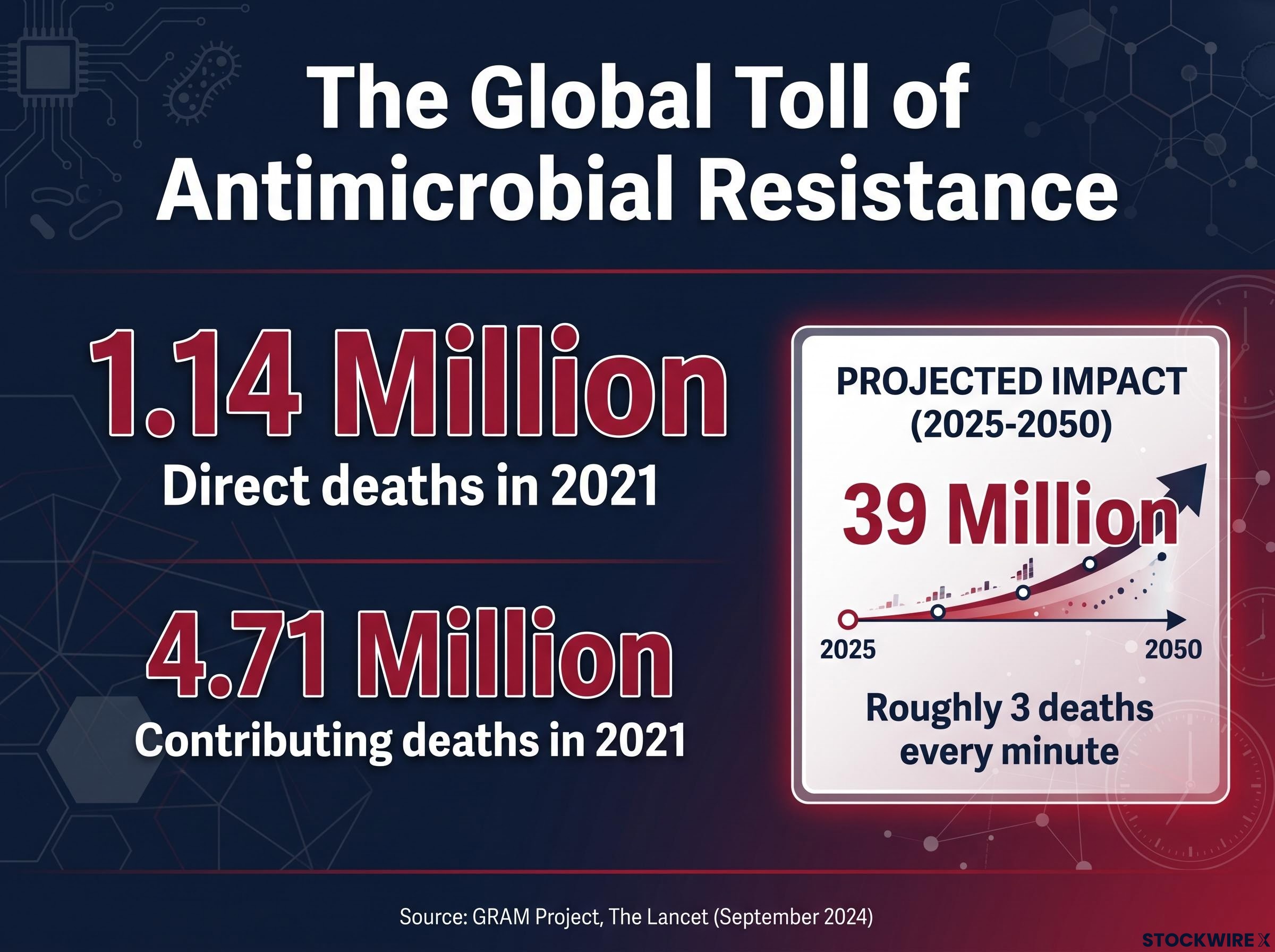
The most authoritative recent estimate comes from the GRAM Project, a research partnership between the Institute for Health Metrics and Evaluation and Oxford University, published in The Lancet in September 2024. According to that analysis, bacterial resistance was directly responsible for 1.14 million deaths in 2021. In a further 4.71 million deaths that year, drug-resistant bacteria played a contributing role.
The GRAM Project’s Lancet analysis, published in September 2024, draws on systematic data from 1990 to 2021 across 204 countries, making it the most comprehensive population-level accounting of bacterial resistance deaths available to researchers and policymakers.
Those are not projections. They are counted outcomes, and they establish the baseline scale you need before evaluating any commercial solution in the sector.
The forward estimates are where the two most-cited numbers get confused, so it is worth separating them clearly. The GRAM Project models a cumulative 39 million lives lost globally between 2025 and 2050 absent stronger policy action.
The GRAM Project projects roughly 39 million cumulative deaths from bacterial resistance between 2025 and 2050, equivalent to around three deaths every minute across a 25-year span.
Separately, and using different methodological assumptions, another widely circulated model projects that resistance could cause as many as 10 million deaths annually by 2050. If that figure were realised, it would surpass current worldwide deaths from cancer. Both numbers are modelled estimates under defined scenarios, not settled facts, and they come from distinct methodologies that should not be merged.
What makes resistance so difficult is that it ignores the boundaries of clinical setting. A diabetic foot wound fails to heal. A burn injury progresses to an untreatable infection. A routine caesarean section becomes a fatal complication. The same failure of standard antibiotics connects them all.
These numbers explain exactly why public health authorities classify resistance as a tier-one global threat. Understanding this baseline is the prerequisite for judging whether any company’s response is meaningful.
When big ASX news breaks, our subscribers know first
Why the traditional antibiotic development pipeline is failing
Here is the uncomfortable part. A crisis of this magnitude has been met with one of the weakest commercial responses in modern medicine, and the reasons are economic rather than scientific.
Antibiotics are widely described as a market failure, and the logic is straightforward once you see it. When a genuinely new antibiotic is approved, doctors are urged to use it as little as possible. This practice is called antibiotic stewardship: restricting a new drug to preserve its effectiveness against resistant bacteria for as long as possible.
That stewardship is medically correct and commercially punishing. A drug that must be held in reserve generates almost no sales, which means the company that spent years developing it struggles to recover its costs.
The reimbursement system compounds the problem. Many hospitals are paid through Diagnosis-Related Group (DRG) models, a volume-based fee-for-service structure that assumes cheap generic antimicrobials are used. When a hospital reaches for a branded, novel agent instead, it can lose thousands of dollars per patient, which quietly discourages uptake of exactly the drugs the world most needs.
Faced with this, most large pharmaceutical companies simply left. The reasons stack up in a clear sequence:
- Stewardship suppresses revenue. New antibiotics are deliberately used sparingly, so even a clinical success rarely becomes a commercial one.
- Reimbursement penalises novelty. Volume-based hospital payment models make branded agents a financial loss at the point of care.
- Returns cannot justify the cost. With low prices and low volumes, the economics do not support the multi-year expense of development.
- The burden shifted downward. Development now rests largely on small, capital-constrained biotechnology companies rather than global drug makers.
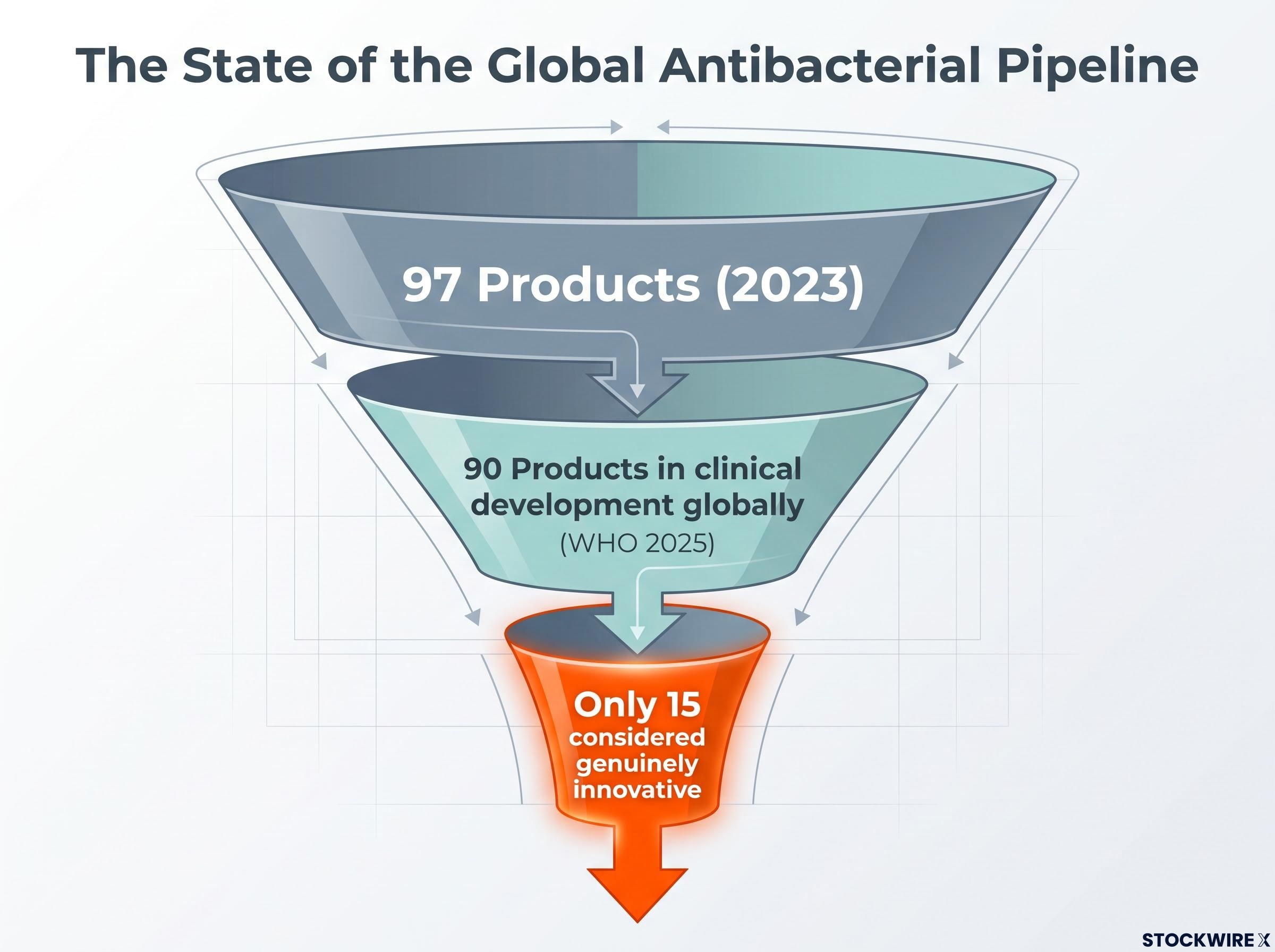
The result is visible in the numbers. According to the World Health Organization’s 2025 antibacterial pipeline analysis, there were just 90 antibacterial products in clinical development globally, down from 97 in 2023. Of those, only 15 were considered genuinely innovative.
The breakdown of antibiotic pipeline economics extends well beyond the stewardship paradox: the WHO’s 2025 analysis identified only 15 genuinely innovative candidates among the 90 products in global clinical development, a figure that reflects decades of large pharma exit from a structurally unrewarding market.
Most of the rest are incremental modifications of existing drug classes that resistant bacteria have already encountered and learned to defeat. That distinction matters to you as an investor: it separates companies chasing short-term reprieves from those attempting something bacteria have not seen before.
When you look at the antibiotic market, you are looking at a broken economic model. Understanding that failure is what explains why the field has been left to smaller, more agile players, and why the ones with truly novel science are worth closer attention.
Engineering a synthetic alternative to traditional anti-infectives
If the core problem is that bacteria eventually defeat every modified version of an existing drug, the logical response is to build something structurally different. That is the premise behind Recce Pharmaceuticals.
Recce is an Australian biotechnology company developing a synthetic, broad-spectrum anti-infective platform. Rather than tweaking established antibiotic classes, it is advancing entirely synthetic polymer compounds designed to attack drug-resistant infections without generating the resistance that has undone conventional medicine.
The distinction between a synthetic polymer and a traditional antibiotic is central to the thesis. Traditional antibiotics are chemical variations that bacteria have adapted to over decades. A synthetic polymer represents a different mode of action that, in principle, sidesteps the evolutionary traps those older classes fell into.
The platform’s core candidates cover both systemic and topical applications, as the table below sets out.
| Candidate | Formulation | Target Application | Current Designations |
|---|---|---|---|
| RECCE 327 (R327) | Intravenous and topical | Serious Gram-positive and Gram-negative infections, including sepsis | FDA QIDP, Fast Track; WHO pipeline list |
| RECCE 327G (R327G) | Topical gel | Diabetic foot infections and burn wounds | In Phase 3 clinical development |
| RECCE 435 (R435) | Oral | Broad-spectrum infection | WHO pipeline list |
| RECCE 529 (R529) | Investigational | Viral infections | WHO pipeline list |
By examining a synthetic approach rather than a modified biological one, you can see how a company is attempting to engineer its way out of the resistance loop entirely. That gives you a sharper lens for judging pipeline potential across the sector: is the science genuinely new, or just a fresh coat of paint on a class bacteria already know?
Independent validation from global health authorities
External recognition is where the platform’s relevance to the crisis gets tested by parties with no commercial stake. The World Health Organization included R327, R435, and R529 on its list of antibacterial products in clinical development for priority pathogens, and its 2025 pipeline report highlighted R327 as the only synthetic polymer antibiotic in clinical development.
The Pew Charitable Trusts, which independently tracks the global antibiotic pipeline, similarly identifies R327 as the sole synthetic polymer and sepsis drug candidate currently in development.
Regulatory designations reinforce that positioning. R327 holds Qualified Infectious Disease Product (QIDP) status under the US Generating Antibiotic Incentives Now (GAIN) Act, a designation that provides Fast Track review and, contingent on eventual FDA approval, 10 years of market exclusivity. That exclusivity window is the mechanism policymakers designed specifically to make novel antibiotics commercially survivable.
Global IP protection across multiple jurisdictions is one of the mechanisms through which a clinical-stage anti-infective developer attempts to convert eventual regulatory approval into durable commercial exclusivity, sitting alongside the GAIN Act exclusivity window as a complementary layer of defensibility.
Advancing clinical trials across civilian wounds and military trauma
Science on paper means little until it meets patients. What makes Recce’s programme worth studying is how the same underlying technology is being tested across two very different worlds at once: civilian chronic wounds and military battlefield trauma.
The strategic logic is deliberate. By running the platform through multiple high-need settings simultaneously, the company spreads clinical risk across indications rather than betting everything on a single trial reading out.
The centrepiece is a pair of concurrent Phase 3 registrational trials for R327G in diabetic foot infections, a devastating diabetes complication that frequently involves multi-drug-resistant bacteria. In Australia, the study advanced to a pivotal Phase 3 trial in June 2026, and on 19 August 2026 a further ethics approval added a randomised active-controlled non-inferiority arm, expanding the cohort to 208 participants. A non-inferiority arm tests whether the new treatment performs at least as well as the current standard of care rather than beating it outright.
Running in parallel is a double-blind, placebo-controlled registrational Phase 3 trial in Indonesia, targeting up to 310 patients across five sites. A regulatory inspection there was completed with no findings in April 2026, and interim data is expected around the third quarter of 2026, following completion by the first 155 patients.
The second front is military trauma. Recce holds two Cooperative Research and Development Agreements (CRADAs), formal research collaborations with US government institutions:
- US Army Medical Research Institute of Infectious Diseases (USAMRIID)
- US Army Institute of Surgical Research (USAISR)
Backed by a US$2 million grant from the Congressionally Directed Medical Research Programs (CDMRP), these agreements are evaluating R327G in burn wound infection models against some of the most problematic resistant organisms in medicine:
- Methicillin-resistant Staphylococcus aureus (MRSA)
- Multi-drug-resistant Pseudomonas aeruginosa
These same pathogens plague both combat casualties and civilian intensive care units, which is why the military and civilian programmes reinforce rather than duplicate each other.
You should read these concurrent trials not simply as a series of clinical hurdles, but as a strategy to address the resistance problem across several distinct high-need settings at once. For an investor, that structure is how a single-platform biotech attempts to diversify its clinical risk without diluting its core science.
Milestone-based analysis, rather than earnings or revenue metrics, is the correct evaluative framework for pre-approval biotechnology companies, and it applies directly to reading concurrent Phase 3 readouts, regulatory designation events, and partnership announcements as the meaningful signals of programme progress.
Tracking the shift in global biodefence and health funding
The final piece of the picture sits above any single company. For decades, resistance suffered from chronic underfunding, with most countries lacking ring-fenced budgets to act. That is now beginning to change, and the direction of travel matters for the entire sector.
Global policy has started to catch up with the scale of the threat. In September 2024, UN Member States adopted a Political Declaration on AMR, setting a target to mobilise at least US$100 million to help ensure at least 60% of countries have funded national action plans by 2030. In May 2026, the World Health Assembly formally adopted an updated Global Action Plan on AMR for 2026-2036, embedding the issue in a long-range, measurable framework.
Decoupling volume from revenue with pull incentives
The most consequential shift is happening in how governments intend to pay for antibiotics. New “pull” incentives aim to reward a drug for its value to the health system rather than the number of prescriptions written, which directly targets the stewardship trap described earlier.
The UK’s “Netflix-style” subscription model pays companies a fixed annual fee, reported at roughly £5-20 million per product per year, in exchange for access rather than volume. In the US, the proposed DISARM concept would reimburse eligible novel antibiotics separately from DRG payments, removing the financial penalty hospitals face when using them. Both approaches try to fix the same broken commercial maths that drove large pharma out of the field.
Biodefence funding is moving in parallel. In July 2026, the US Administration for Strategic Preparedness and Response (ASPR) released a five-year medical countermeasures strategy estimating an overall funding need of US$66.9 billion, with broad-spectrum antimicrobials named as a priority for threat-agnostic technologies.
It is important to frame this correctly. The ASPR strategy is an aligned, sector-level policy tailwind. It is not a confirmed contract, committed funding, or any guarantee of revenue for Recce Pharmaceuticals, and it should not be read that way.
When governments start rewriting how they fund and purchase an entire class of medicine, you are watching structural change that could redefine the commercial viability of the sector over the next decade. That shift is the context every anti-infective company will now be judged against.
Evaluating biotechnology models in a changing policy landscape
Three forces now intersect: a mortality burden already measured in millions of deaths a year, a traditional pipeline that economics has hollowed out, and a small group of companies attempting genuinely synthetic alternatives. Recce sits at that intersection as one investigational example of the new model, not a proven outcome.
The caution is unchanged. Every company in this space, Recce included, faces the standard risks of pre-approval biotechnology: trials can fail, regulators can say no, and clinical data can disappoint. None of the candidates discussed here holds approval or proven efficacy beyond published results.
What has changed is the environment around them. As global policy, new funding models, and novel scientific platforms begin to align, the next decade of anti-infective development will look different from the last. Knowing how to read that alignment is what lets you separate durable opportunities from hopeful ones.
For readers wanting to build a structured framework before evaluating the Phase 3 readouts discussed here, our full explainer on reading clinical milestones covers the taxonomy of regulatory signals, from Fast Track Designation through to registrational pathway confirmation, with worked examples drawn from ASX biotech programmes.
This article is for informational purposes only and should not be considered financial advice. Investors should conduct their own research and consult with financial professionals before making investment decisions. Past performance does not guarantee future results, and forward-looking projections are modelled estimates subject to market conditions, clinical trial outcomes, and regulatory risk.