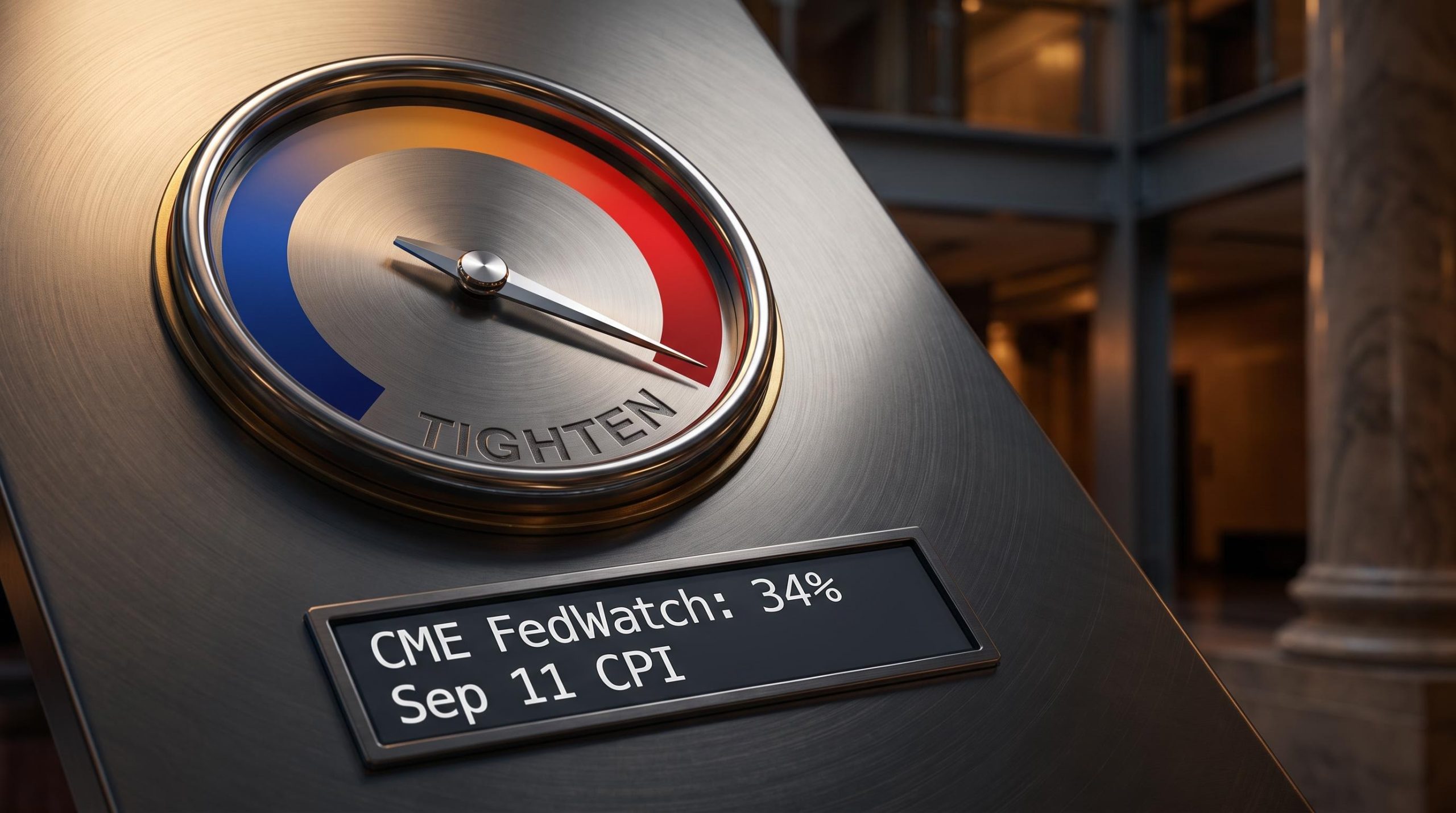
The CME FedWatch tool puts the odds of a September rate hike at roughly 34%, a coin-flip that most investors would round down to “unlikely.” Citi Research has built a composite that tells a different story.
Its new indicator, constructed from the exact variables Fed Chair Kevin Warsh elevated at Jackson Hole, is sitting near levels that have historically preceded Fed tightening cycles. The gap between what the futures market is pricing and what the data Warsh actually watches are signalling is the tension worth sitting with.
This moment is analytically unusual. Warsh has deliberately declined to publish a reaction function, forcing markets to reverse-engineer his decision framework from data rather than statements. The 11 September CPI print and the 15-16 September FOMC meeting compress that ambiguity into a single, high-stakes sequence where one number could resolve it.
This piece gives you a concrete framework for reading the composite’s current signal, understanding precisely which CPI outcome tips the September meeting toward a hike, and knowing which components of Warsh’s framework to watch from here. Treat it as a lens for interpreting an unusually opaque Fed, not a prediction of what it will do.
What Citi’s Warsh shadow rate actually measures
The temptation with any new proprietary indicator is to treat the number as authoritative and move on. The Warsh shadow rate earns its standing differently: it is a deliberate reverse-engineering of one specific person’s stated priorities, not a general gauge of financial conditions.
Citi Research published the composite on 6 September 2026, via Yahoo Finance, building it directly from the economic and financial measures Warsh foregrounded in his Jackson Hole keynote on 28 August. That construction is the whole point. Rather than measuring monetary conditions in the abstract, the indicator estimates how tight policy sits relative to Warsh’s own framework.
The weighting reflects what he emphasised and what he downplayed.
- Greater weight assigned to: underlying inflation, money supply, labour-market claims, financial conditions, and equity-market indicators.
- De-emphasised: inflation expectations, wages, and headline nonfarm payrolls.
That split matters because the variables Warsh elevated are largely sending a hawkish signal right now, while several of the measures he downplayed have softened. A general conditions gauge would blend those and mute the message. This one does not.
How the composite functions mechanically
Shadow-rate composites aggregate a policymaker’s priority variables into a single number summarising the effective stance of policy. Because the inputs are macro and market series aligned with Warsh’s stated focus, the composite moves the moment those series shift, rather than waiting for Fed-funds futures or Treasury yields to reprice.
That gives it early-warning properties. Citi notes the gauge tends to move ahead of two-year Treasury yields, which implies conventional market pricing may still be catching up.
The Warsh shadow rate is currently near historical peaks previously associated with Fed rate-hiking cycles, as of early September 2026.
Here is what that reading means for you. By the logic of Warsh’s own framework, the conditions that have preceded prior hiking decisions are already present. That is a live analytical input, not background colour, and it tells you exactly which data releases to treat as leading signals rather than lagging confirmations.
When big ASX news breaks, our subscribers know first
The Jackson Hole framework behind the signal
To trust the composite, you have to trust the framework underneath it. Warsh laid that framework out on 28 August at the Kansas City Fed’s Jackson Hole symposium, and the address reads as the intellectual architecture of a decision-maker who does not want to be pinned to a schedule.
Warsh’s Jackson Hole address, published in full on the Federal Reserve Board’s official site, is the primary document from which Citi extracted the variable weights underpinning the composite, making it the definitive reference for understanding which data series the indicator treats as leading signals.
Four priorities anchored the remarks.
- Inflation is the dominant concern. Warsh warned that inflation “isn’t meaningfully slowing” and that, absent confidence it is, the Fed has “work to do.”
- The 2% PCE target is firm and fixed. He recommitted to it explicitly, framing price stability as non-negotiable.
- Short-term interest rates are the predominant tool. He prioritised the policy rate over balance-sheet moves or newer themes such as AI.
- Financial conditions are not broadly restrictive. A shift from his July characterisation, implying policy and markets may still be too loose.
Bloomberg and CNBC captured the tone: CNBC noted he delivered “a more hawkish reading of inflation at Jackson Hole than he did after the July Fed meeting,” and the Wall Street Journal titled its piece “Kevin Warsh: the Hawk at Jackson Hole,” calling it his firmest statement to date of determination to tame inflation.
What he pointedly withheld was a reaction function. CNBC reports Warsh “avoided committing either to forward guidance or a reaction function for monetary policy,” declining to spell out rate paths or numerical triggers.
As CNN framed it, investors “are going to have to figure out for themselves when officials will step in.”
This is a deliberate departure from the Powell era, which leaned heavily on explicit projected rate paths and forward guidance. Warsh has removed the verbal map, which is precisely why a data-derived composite carries analytical value his statements do not.
The removal of forward guidance from FOMC statements is the structural reason the Citi composite carries analytical weight it would not have held under Powell; without a dot plot or projected rate paths to anchor expectations, incoming data releases become the primary pricing mechanism.
The read you should take is this. His refusal to narrate a reaction function is not a communication failure, it is a design choice. It rewards investors who build data-driven frameworks and penalises those waiting for guidance that is not coming, which repositions his public remarks as confirming signals rather than your primary input.
The CPI thresholds that determine whether September goes live
If the shadow rate sets the backdrop, the 11 September CPI release is the trigger. Citi has done something unusually specific here: it has drawn three explicit lines in the sand for month-over-month core CPI, each carrying a different implication for the 15-16 September FOMC meeting.
September rate hike odds were already in focus heading into the July CPI print, where a reading at 2.7% or above was identified as sufficient to validate the hawkish faction and revive hike pricing, establishing the analytical template Citi’s composite now applies to the August release.
Read them as a branching decision tree.
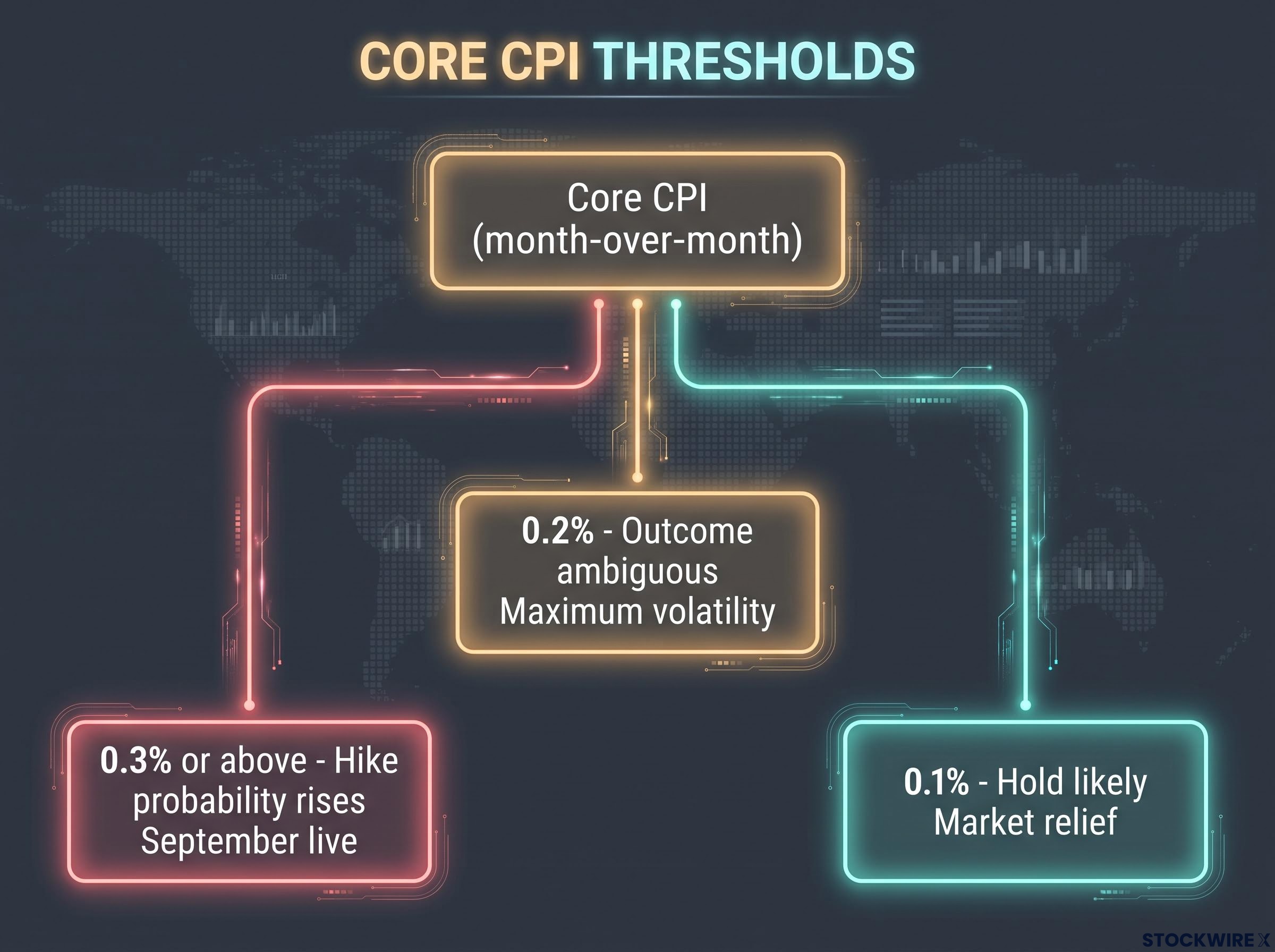
| Core CPI print (month-over-month) | Citi’s implied policy signal | Market implication |
|---|---|---|
| 0.3% or above | Hike probability rises materially | September meeting becomes live |
| 0.2% | Outcome ambiguous | Maximum volatility scenario |
| 0.1% | Hold likely | Hike delayed, market relief |
The 0.2% middle scenario is the one to price into your expectations as the highest-uncertainty outcome. It is the reading where Warsh’s framework and market pricing would be most misaligned, and misalignment is where volatility lives. A 0.3% print hands the hawks their evidence; a 0.1% print lets the doves exhale. A 0.2% print resolves nothing and leaves both camps arguing into the meeting.
For context, Citi’s base case does not anticipate a September hike, with softer inflation figures viewed as sufficient to prevent one. That is your anchor: the thresholds describe risk around a hold, not around a hike.
As of Warsh’s 28 August address, the CME FedWatch tool implied roughly a 34% chance of a September rate rise, per CNN.
The timeline is tight. The August CPI release lands on 11 September, giving policymakers and markets four days to reprice before the meeting opens on 15 September. These thresholds give you a pre-defined framework for reading that print the instant it drops, rather than waiting for consensus commentary to assemble after the fact.
What the indicator’s limitations tell you about how to use it
A tool this specific invites overconfidence, so it is worth being precise about where it can mislead. The point is not to discredit the Citi gauge, it is to sharpen it.
Shadow-rate composites carry three structural limitations.
- Assumed weights may misjudge the trade-offs. The composite guesses how Warsh balances inflation, employment, and financial conditions. If the guess is wrong, the signal is too.
- A stable reaction function is presumed. Historical pivots show that presumption can break fast.
- Qualitative judgment escapes capture. Financial stress or geopolitical risk can dominate a specific meeting in ways no component variable reflects.
What history says about composites like this
Each limitation has a named episode behind it. During the QE era, researchers used the Wu-Xia shadow federal funds rate to summarise policy when the funds rate was pinned at zero, and it tracked reasonably well until regime changes and financial-stability judgments strained it.
Paul Volcker’s shift to targeting monetary aggregates in the early 1980s is the case where a composite would have worked. His framework genuinely prioritised inflation and tight money, and an indicator built around aggregates would have flagged aggressive tightening even as markets hoped for a gentler path.
Fiscal dominance constraints explain why the historical precedents embedded in the Warsh shadow rate, including Volcker’s 1980s tightening campaigns, may not map cleanly onto 2026: federal debt at roughly 122% of GDP means each rate increment carries a fiscal cost four times larger than in Volcker’s era.
Alan Greenspan’s 1994 tightening cycle is the case for markets under-pricing a chair’s inflation intolerance. Bond markets had priced a gradual path, misjudged his willingness to move, and suffered a sharp sell-off when he did.
Jerome Powell’s 2018-2019 shift is the case for reaction-function instability. He described balance-sheet runoff as on “autopilot,” then pivoted to rate cuts in 2019 as growth slowed. Markets that over-weighted his earlier verbal guidance were caught out.
The practical takeaway is a specification, not a warning. The Warsh shadow rate is most useful when his stated priorities are stable and incoming data are moving in a consistent direction, and least useful when a qualitative shock could override the data entirely. Warsh himself declined to specify a reaction function, which is both the reason the indicator exists and the source of its residual uncertainty.
For sizing positions or timing decisions, that means using the composite to shade probabilities up or down, raising or lowering conviction in a directional call. It is not a binary hike-or-hold switch you should trust with high confidence.
Real Treasury yield dynamics compound the shadow rate’s hawkish signal: with the real 10-year at its highest since 2023, the mechanical pressure on equity discount rates is operating in parallel with the Warsh framework’s tightening bias, and the two channels reinforce rather than offset each other.
Reading the September 11 print as an investor
Pull the threads together and you have a decision matrix rather than a summary. The shadow rate is already flagging elevated hike risk. The 11 September print will either confirm that signal, neutralise it, or deepen it, and you can work out which in real time.
Here is the sequence to run when the number crosses the wire.
- Identify the threshold. Sort the print into Citi’s bands: 0.3% or above, 0.2%, or 0.1%.
- Cross-reference the composite’s components. Look beyond headline CPI to the two variables Warsh weights heavily, financial conditions and underlying (not headline) inflation, both embedded in the shadow rate’s construction.
- Assess the signal. Decide whether the print confirms, neutralises, or contradicts the composite’s hawkish reading.
Your practical position is straightforward. If August CPI prints at 0.3% or above, the Warsh shadow rate’s hawkish signal will have proven prescient, and any positioning built on a hold assumption needs re-examining immediately, with only four days between the print and the FOMC opening on 15 September to act.
Whatever September delivers, Warsh’s deliberate opacity on the reaction function means the Citi composite will remain a more reliable interpretive tool than his public statements for as long as he chairs the Fed.
Warsh’s own framework, short-term rates as the predominant tool, financial conditions not broadly restrictive, the 2% PCE target as fixed, tells you the direction of his bias. The composite tells you how close the data have moved toward acting on it.
This article is for informational purposes only and should not be considered financial advice. Investors should conduct their own research and consult with financial professionals before making investment decisions. Past performance does not guarantee future results, and these statements are speculative and subject to change based on market developments.
Five days, one number, and a Fed that will not tell you what it is thinking
The Warsh shadow rate’s value is not that it is clever, it is that it is built from the chair’s own stated priorities rather than from convention. For this specific Fed, that makes it a sharper lens than any generalised conditions gauge.
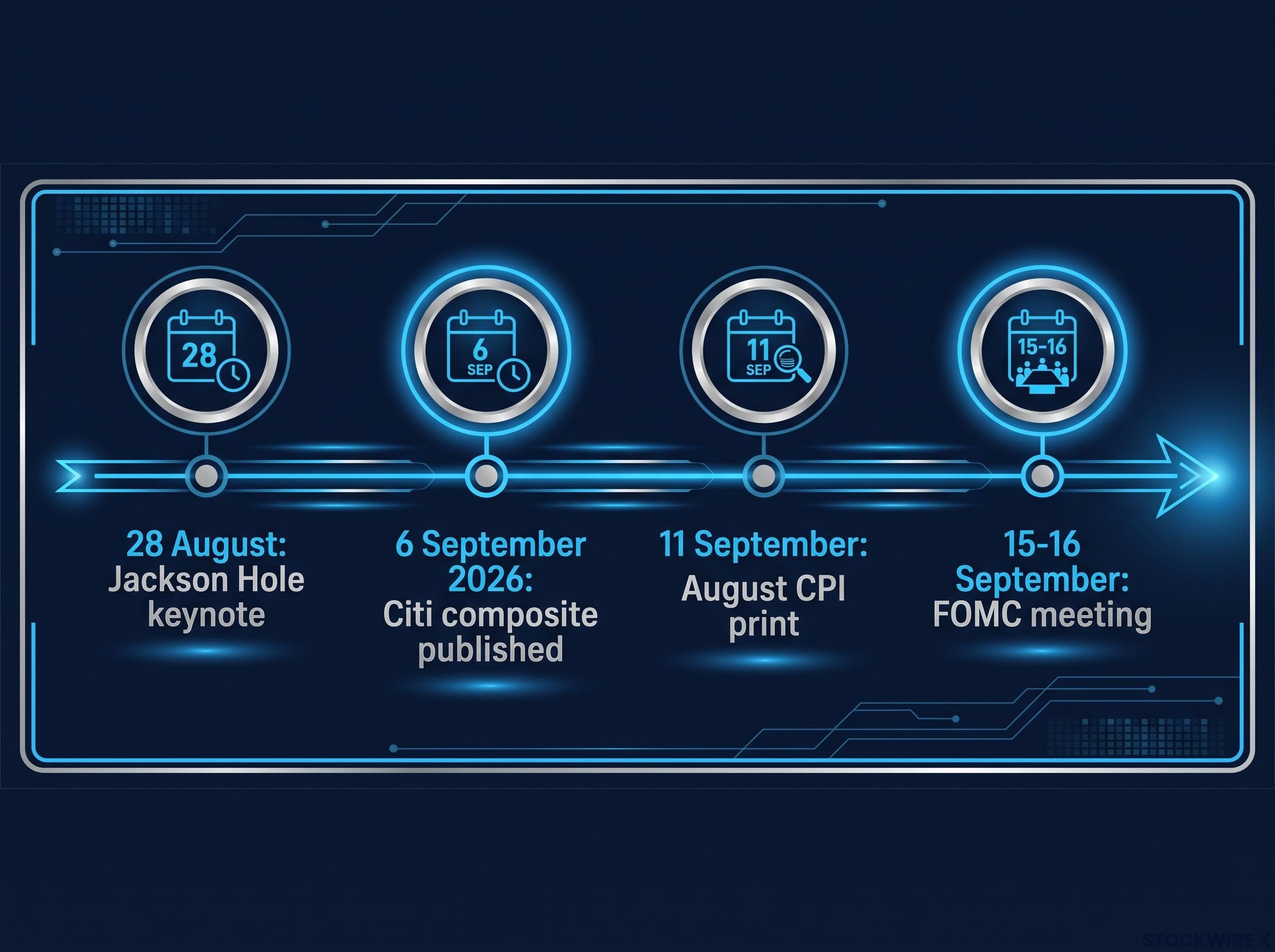
The sequencing is what matters now: the shadow rate signal is already live, the CPI print lands on 11 September, and the FOMC decides on 15-16 September. Warsh has told markets there is “work to do” on inflation and that financial conditions are “not broadly restrictive.” The 34% market-implied hike probability is the gap between consensus pricing and the composite’s more hawkish read.
Remember that Citi’s base case is still no September hike, which is your reminder that the shadow rate is a risk-flagging tool, not a forecast. The deeper point is structural. In a Warsh-chaired Fed that refuses to narrate its own reaction function, building data-derived frameworks is not optional for serious market participants. It is the only way to see the decision coming.