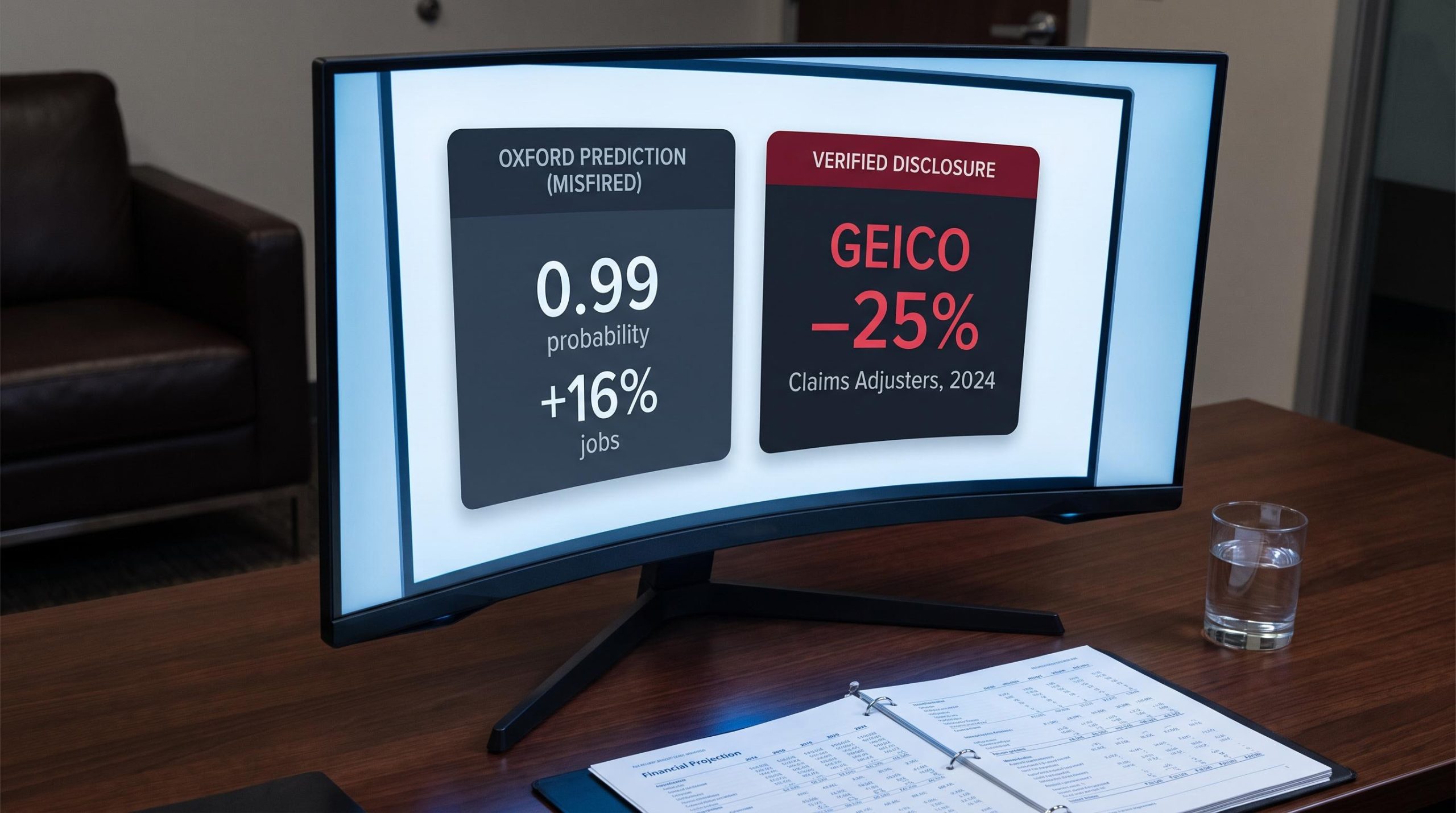
If you chose a broad S&P 500 index fund for your 401(k) because 500 companies sounded like genuine diversification, the arithmetic tells a different story. As of mid-2026, roughly 38 cents of every dollar you contribute lands in a single sector, Information Technology, whose largest constituents are reporting record margins for a specific reason: they are replacing human workers with software and booking the savings as profit.
This is not an abstract labour economics story. It is a portfolio mechanics story. The same AI-driven cost cutting that has eliminated tens of thousands of operational and entry-level roles across banking and technology is the mechanism currently supporting the earnings, and therefore the valuations, that make your retirement fund’s performance line slope upward. The evidence here draws on public earnings disclosures from Q1 2026, a Reuters-obtained internal Goldman Sachs programme memo, Stanford University payroll research, and the World Economic Forum’s 2025 labour projections.
Here is what the numbers in your fund’s fact sheet are not telling you, and how to read them once you understand the structural exposure they represent.
The 500-company illusion: what cap-weighting actually does to your retirement money
Market-cap weighting is the mechanism that determines where your money goes inside an index fund. Rather than splitting each dollar equally across 500 companies, the fund allocates proportionally to each company’s total market value. The bigger the company, the larger the share of your contribution it receives.
Cap-weighted concentration amplifies moves in both directions: technology stocks drove roughly 70% of the market’s Q1 2026 decline despite representing a single sector, then delivered more than half of April’s recovery, a volatility pattern that has no equivalent in the genuinely diversified portfolio most 401(k) holders believe they hold.
The result, as of mid-2026, is a concentration that the word “diversified” does not prepare you for.
Approximately 57% of the S&P 500’s total weighting sits in technology-related sectors (Information Technology, Communication Services, and Consumer Discretionary combined), according to Schwab Center for Financial Research and FactSet data.
That figure shifts over time; earlier estimates placed IT alone closer to 32%, while the most recent mid-2026 data puts it at approximately 38%. The direction, however, has been consistent: upward.
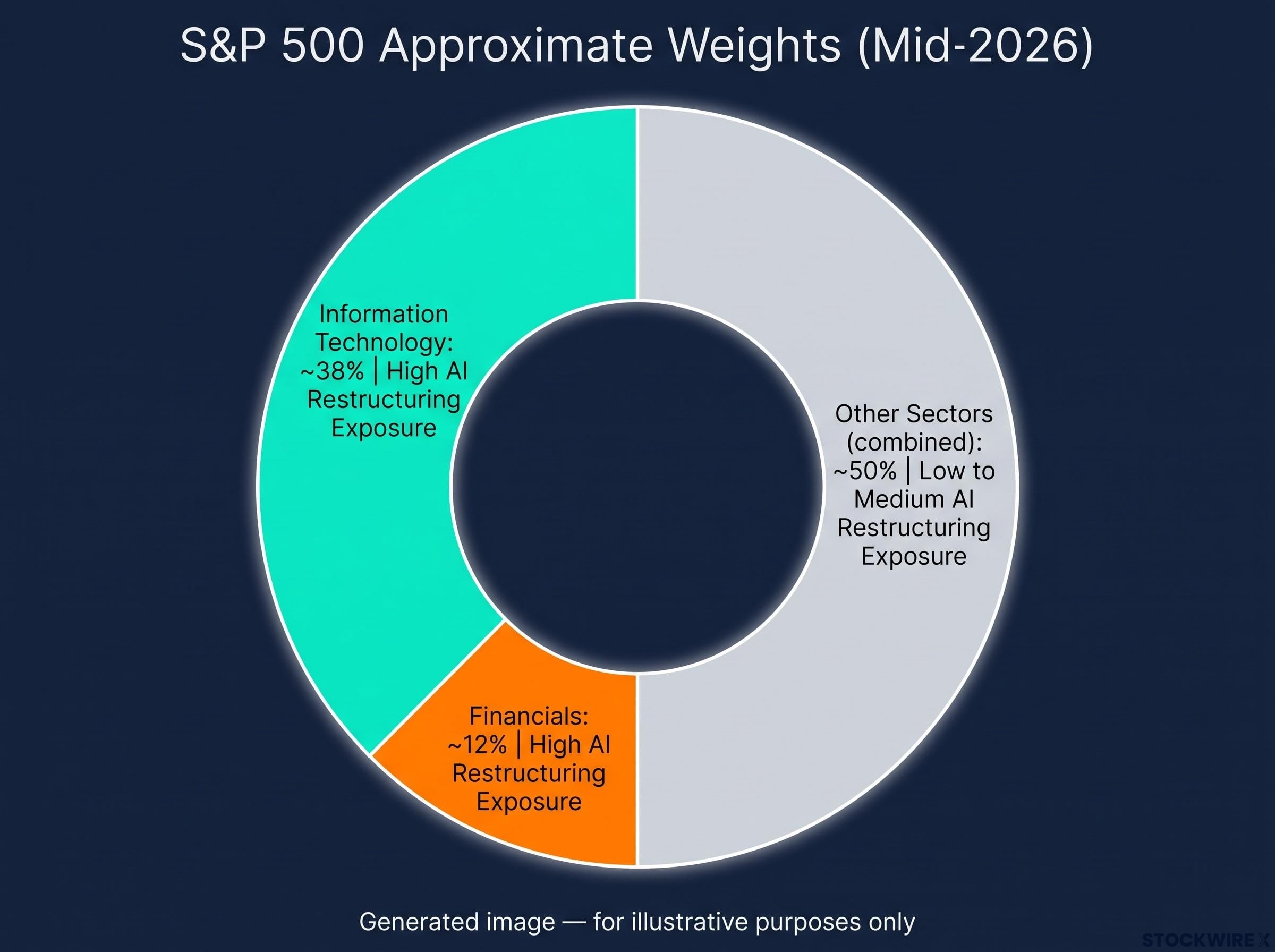
| Sector | Approximate Weight (Mid-2026) | AI Restructuring Exposure |
|---|---|---|
| Information Technology | ~38% | High |
| Financials | ~12% | High |
| Other Sectors (combined) | ~50% | Low to Medium |
The distinction that matters: idiosyncratic risk versus structural risk
Owning 500 companies does reduce idiosyncratic risk, the chance that any single company’s problems damage your portfolio. If one firm’s CEO resigns or a product recall hits, the other 499 absorb the shock. That protection is real.
What it does not reduce is structural trend risk: the exposure that arises when the same force, in this case AI-enabled cost cutting, is simultaneously driving profitability across the dominant sectors. Your fund holds 500 names, but more than half your money is concentrated in businesses whose earnings growth is built, in measurable part, on replacing operational headcount with software. That is what “diversified” actually looks like when you open the label.
When big ASX news breaks, our subscribers know first
How banks turned job cuts into a profit story your fund is already pricing in
During Q1 2026, America’s six biggest banks shed roughly 15,000 positions in aggregate, while simultaneously reporting $47 billion in combined profit, a figure 18% higher than the same quarter the prior year.
15,000 jobs cut. $47 billion in profit. Same quarter, same institutions, same fund holdings.
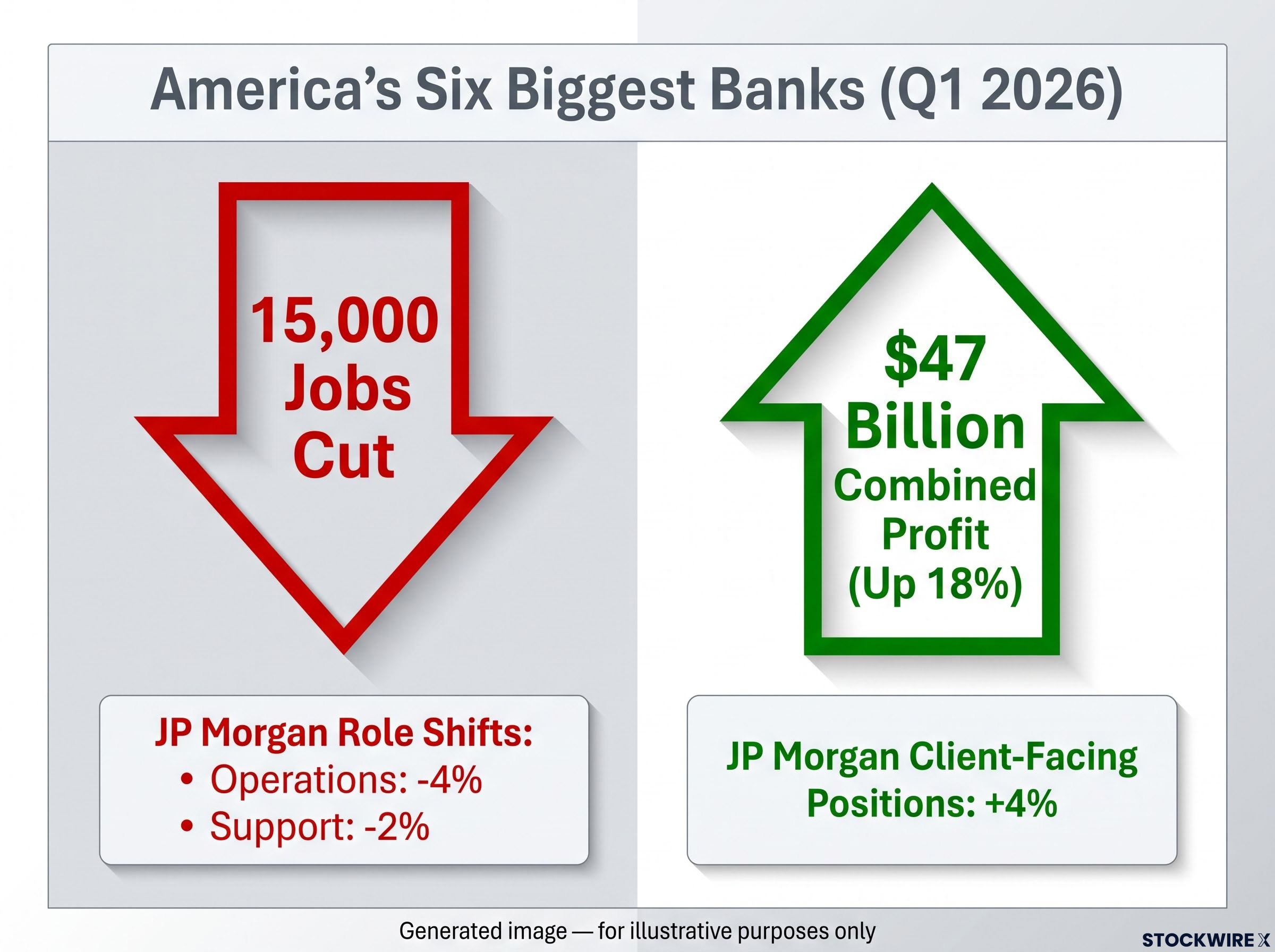
The natural assumption is cost-cycle downsizing: business slows, headcount shrinks, margins hold. But the JP Morgan role-by-role breakdown tells a different story. Within that same period, operations roles contracted by 4% and support functions by 2%, while client-facing and revenue-generating positions actually expanded by 4%. The pattern is not generalised belt-tightening. It is targeted displacement: the work that software can absorb is shrinking, and the work that produces fees is growing.
The pattern is documented and deliberate:
- Goldman Sachs President John Waldron has publicly described the bank as a “human assembly line” that lends itself to automation.
- JP Morgan CEO Jamie Dimon has said outright that AI will cost people their jobs.
- Goldman Sachs’ internal programme 1GS 3.0, obtained by Reuters, sets a target of 3-5% annual workforce reduction tied directly to AI-driven productivity gains.
Bank of America and Wells Fargo, two of the most consistently held names across diversified equity indices, are each in the process of consolidating branch footprints and trimming branch-level headcount. The World Economic Forum’s 2025 Future of Jobs Report ranks bank tellers among the most rapidly disappearing roles of any occupation it surveyed across the entire dataset.
The WEF Future of Jobs Report 2025 ranks bank tellers among the fastest-declining occupations surveyed across any sector, identifying AI-driven automation as the primary displacement mechanism and projecting that financial clerical roles will contract more sharply through 2030 than almost any other category it tracked.
What this tells you is that your index fund is not simply holding banks that are cutting costs. It is holding banks that have found a repeatable formula: replace operational and back-office headcount with software, expand revenue-generating roles, and report the net savings as margin expansion on every quarterly call. Financials represent approximately 12% of the S&P 500. The profit gains flowing into your fund performance right now partially reflect operational roles that no longer exist.
The earnings penalty from displacement compounds beyond the initial job loss: Goldman Sachs research tracking over 20,000 workers found that technology-driven displacement produces a 3% larger real earnings loss at re-employment and a 10-percentage-point earnings growth gap that does not close for a full decade, a consumer spending headwind that sits on the opposite side of the margin gains index funds are currently pricing in.
Analyst-side expectations reinforce the trajectory. Citigroup has projected AI could add roughly $170 billion to global banking profit pools by 2028, and McKinsey has estimated generative AI could cut banks’ operational costs by around 20%, though neither figure has been independently verified and both should be read as directional rather than precise.
Technology’s entry-level disappearing act and what it means for index valuations
Research from Stanford University’s Digital Economy Lab, drawing on actual ADP payroll data rather than survey responses, uncovered a trend buried beneath headline employment figures: workers aged 22-25 in AI-exposed technology occupations saw their employment fall by close to 20% between late 2022 and mid-2025, and that contraction carried forward into 2026.
A roughly 20% decline in early-career tech employment, measured through actual payroll records, not surveys. The entry point to the industry is contracting.
Place that alongside the Bureau of Labor Statistics projection of roughly 15% growth in software developer employment through 2034, a rate nearly five times the average across all occupations it tracks. On the surface, those two figures seem to pull in opposite directions. In fact, both are accurate, and together they map a bifurcation rather than a contradiction.
The sector is simultaneously projecting overall growth and documenting early-career job loss, because the entry-level roles are the ones being automated while senior and specialised positions expand. The pattern was given a concrete illustration when Salesforce’s CEO announced publicly that the company had no plans to bring on new engineers throughout 2025, a deliberate hiring freeze at the bottom of the ladder even as the company’s overall operations continued to scale.
AI job exposure is not evenly distributed across age or income tier: Bank of America’s research found younger workers under 25 and workers in administrative roles face disproportionate near-term risk, a pattern that maps closely onto the entry-level contraction the Stanford payroll data documents within technology specifically.
Which roles are contracting and which are growing
The roles being substituted by AI tools:
- Routine coding and boilerplate development
- Manual testing and QA
- Tier-1 IT support
- Basic data analysis and reporting
The roles expanding in demand:
- AI architecture and model design
- Data engineering
- MLOps (machine learning operations, the work of deploying and maintaining AI systems in production)
The portfolio implication is direct. When companies replace entry-level engineers with AI-assisted tools, output per remaining employee rises, payroll costs fall, and earnings per share improve. Those improved earnings support higher stock prices and larger weights in cap-weighted indexes. The displaced work registers as improved profit margins rather than visible revenue loss.
With IT alone accounting for approximately 38% of the S&P 500, this bifurcation is not a niche labour market story. It is a structural feature of the earnings that support more than a third of your index fund’s weight, and it will not show up as a warning in either employment headlines or stock prices. It shows up as profit.
What the earnings language is hiding and how to read your fund’s fact sheet differently
The quarterly earnings calls of major index constituents contain a vocabulary that, once you recognise it, reveals the substitution pattern in real time. Four phrases in particular signal AI-driven headcount replacement rather than genuine new revenue growth:
- “Efficiency gains”: typically refers to the same output produced by fewer people
- “Disciplined expense management”: often means payroll reduction treated as operational rigour
- “Headcount optimisation”: direct reference to workforce restructuring
- “Productivity improvements”: frequently describes AI tools performing tasks previously done by employees
None of these phrases are inherently misleading. They are accurate descriptions of what is happening. But they frame workforce reduction as operational excellence, and that framing is what allows the cost savings to flow into valuations without triggering the kind of scrutiny a mass layoff announcement would.
Three steps convert this awareness into a practical advantage for anyone holding a 401(k):
- Check your fund’s sector breakdown against the mid-2026 S&P 500 weightings. If Information Technology is near 38% and tech-related sectors combined approach 57%, your “diversified” fund carries the same concentration profile described here.
- Read earnings call summaries for your fund’s largest holdings. Look for the four language signals above. If margin expansion is consistently attributed to efficiency and productivity rather than pricing power or new revenue lines, AI-driven substitution is likely a material component.
- Evaluate concentration alternatives. Equal-weight index funds, which allocate the same dollar amount to every constituent regardless of market cap, structurally reduce mega-cap concentration without requiring active stock selection. Diversified global funds spread exposure across geographies where the AI restructuring timeline differs.
For readers for whom workforce practices matter in portfolio construction, certain ESG and human-capital-focused fund strategies explicitly incorporate automation policies into their investment process. No specific product is the right answer for every reader, but the category exists.
The most important analytical point in this section is what is absent: there is no automatic market mechanism that treats AI-driven job loss as portfolio risk, so long as markets view the resulting cost savings as sustainable. Stock prices will not warn you. The reader must supply that analytical step themselves.
This article is for informational purposes only and should not be considered financial advice. Investors should conduct their own research and consult with financial professionals before making investment decisions.
The point at which “set-it-and-forget-it” becomes a choice you are actively making
The same mechanism, AI turning labour cost reduction into durable margin gains, is operating simultaneously across the two sectors that together represent the majority of a standard S&P 500 index fund’s weight. IT at approximately 38%, tech-related sectors combined at approximately 57%, and Financials at approximately 12%: these are not separate stories. They are the same structural trend observed in different industries.
Broad diversification across 500 companies still genuinely reduces the risk that any single firm’s problems damage your retirement savings. That has not changed. What the evidence above shows is that it does not reduce your exposure to a shared structural force when that force is precisely what is lifting the index.
Correction amplification through concentrated tech exposure is not merely a theoretical concern: BTIG analysis found that five of six instances since 2023 where the SPY RSI exceeded 75 and was followed by a down day resulted in at least 7% peak-to-trough drawdowns, and the same concentration that boosts fund performance in favourable conditions is precisely the mechanism that deepens the decline when conditions reverse.
The forward-looking variable the reader does not need to resolve, but does need to understand: Goldman Sachs’ 1GS 3.0 programme targets 3-5% annual headcount reductions with no stated end date. The Stanford/ADP data shows a 20% decline in early-career tech employment that is continuing, not reversing. These are not one-time restructuring events. They describe an ongoing programme of substitution whose profit benefits are compounding inside the same index funds that most 401(k) holders treat as set-and-forget.
That does not make passive investing wrong. It makes it a decision with specific analytical content. Choosing not to examine that content is itself an active position on AI, labour concentration, and structural risk.
The absence of a market warning signal is the structural feature, not an oversight. AI-driven restructuring registers as profit, and profit is what indexes reward.
Past performance does not guarantee future results. Forward-looking statements about AI adoption and workforce trends are subject to change based on market developments, regulatory action, and corporate strategy shifts.