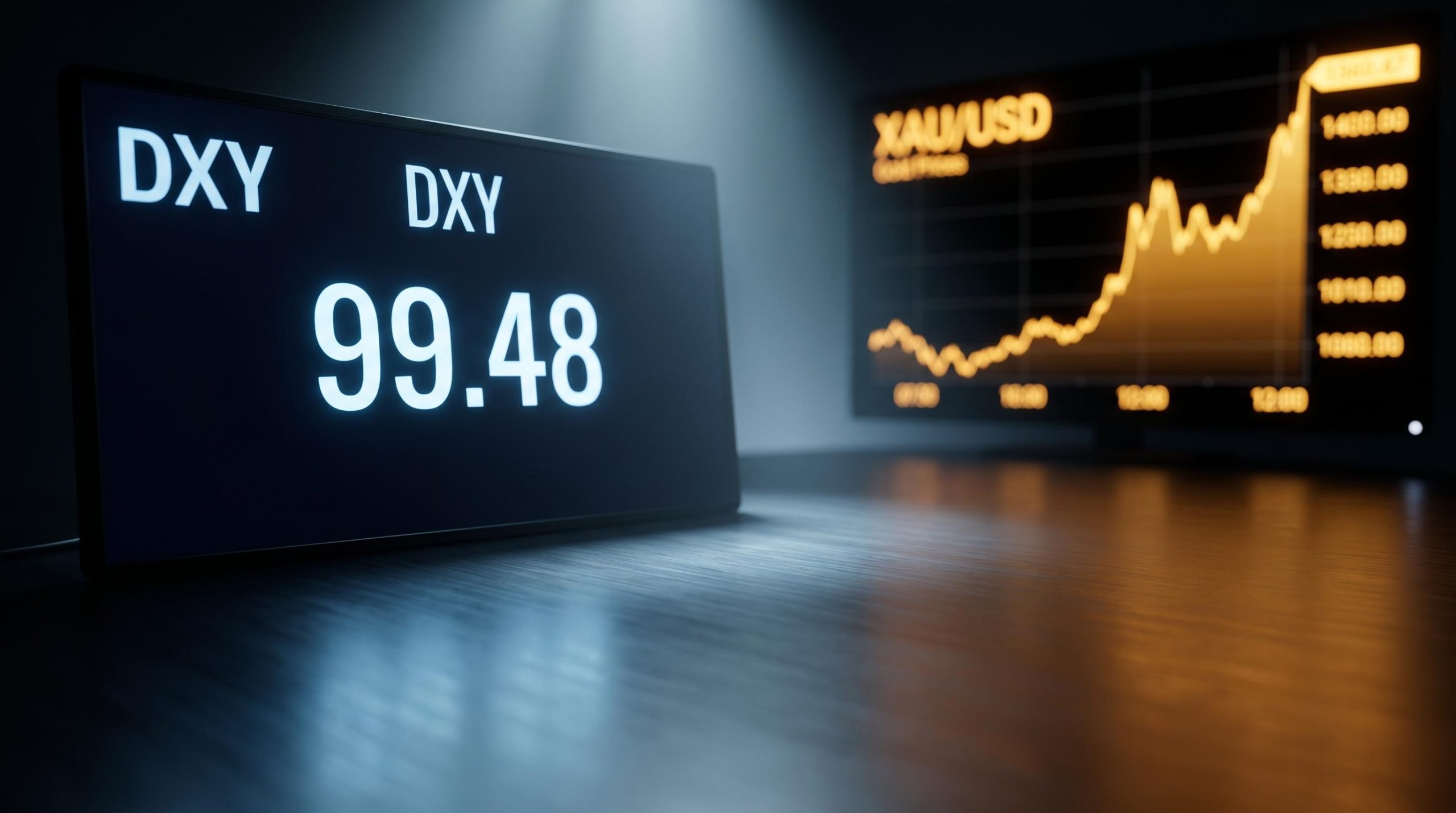
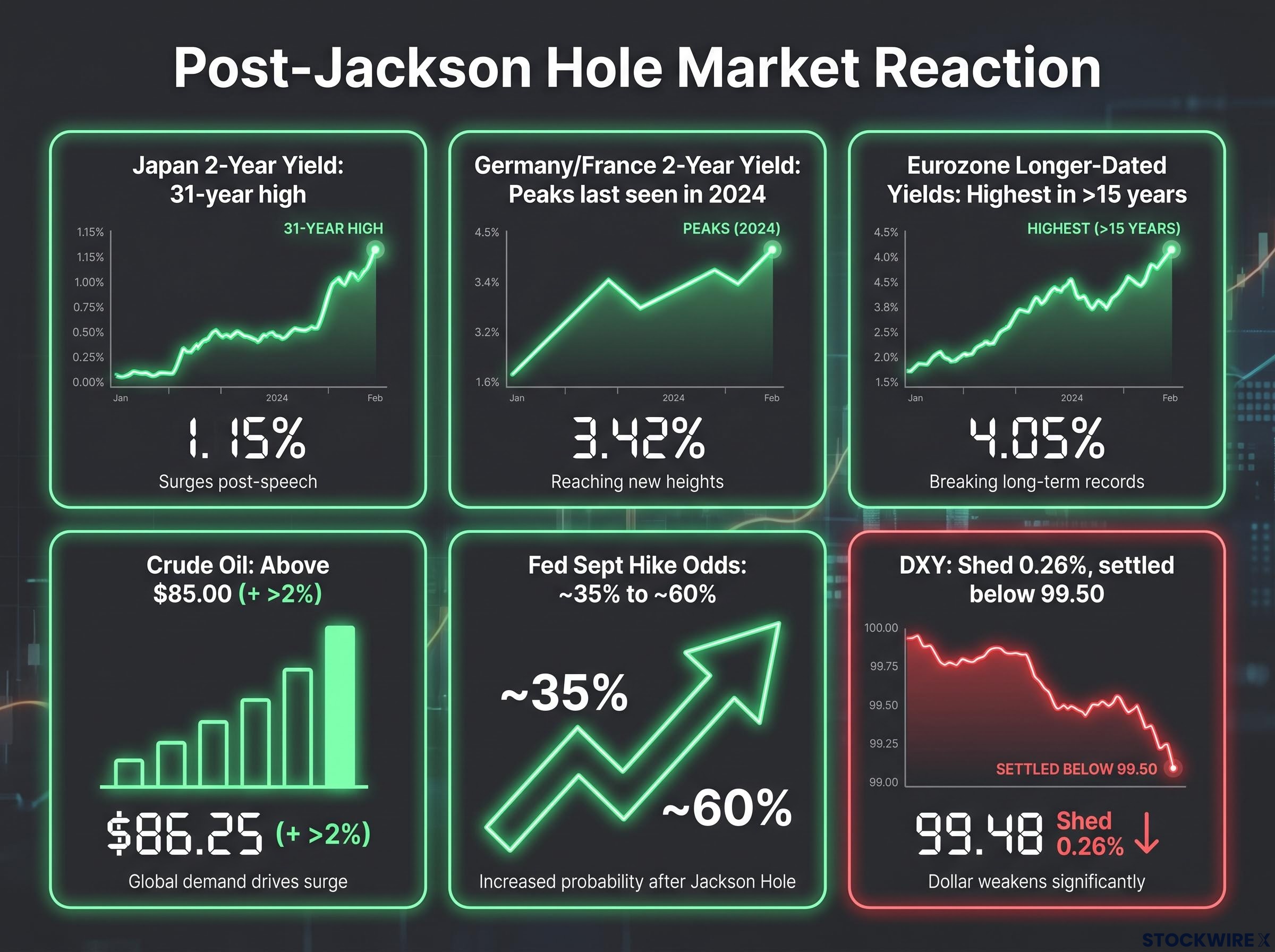
On Monday, the dollar had everything it was supposed to need. Strikes by American forces targeted Iranian positions at Larak Island. Crude oil posted gains exceeding 2%. September Fed tightening odds climbed from around 35% before Friday’s keynote to approximately 60% in the aftermath. The Dollar Index shed 0.26%, settling just below 99.50.
That combination of inputs would have produced a sharp rally in almost any prior geopolitical episode this cycle. The fact that it produced a decline instead is not a curiosity; it is a diagnostic signal. Something structural has changed in how the dollar responds to its traditional catalysts, and anyone holding dollar-denominated assets, managing currency exposure, or interpreting global risk through the DXY needs to understand what broke.
Here is the framework for diagnosing exactly which conditions need to be in place before rate hike expectations or geopolitical risk can be expected to lift the dollar, and which of those conditions are currently absent.
Where the safe-haven flows actually went
Earlier episodes in the Iran conflict, which has been ongoing since February 2026, fit the historical pattern. When oil briefly traded above $100, the dollar firmed. Empirical research from the European Central Bank (ECB) confirms that oil-related geopolitical shocks, particularly disruptions to Middle Eastern supply, tend to push investors into the dollar as a default haven. That relationship was operative for months.
By late August 2026, it had materially weakened. Monday’s strikes on Iranian assets at Larak Island and the accompanying oil surge delivered precisely the type of catalyst that historically drives safe-haven dollar demand. The dollar sold off anyway.
During August, gold was heading towards its best monthly gain in well over a year, a concrete signal that haven capital is being actively redirected away from the dollar and into alternatives.
Three compounding factors explain where those flows are going instead:
- Treasury buyback programme concerns: The US Treasury’s expanded buyback programme, announced in mid-August 2026 with operation sizes doubled to at least $4 billion for longer-dated securities effective September 2026, has raised questions about increasingly interventionist yield management and undermined confidence in the currency’s credibility as a store of value.
- Broader fiscal and political uncertainty: Worries about US fiscal sustainability and political unpredictability mean the dollar is no longer the unambiguous safe harbour it was in earlier cycles.
- Investor diversification into alternatives: Capital is increasingly flowing into gold, other reserve currencies, and high-quality sovereigns rather than concentrating in the dollar alone.
The implication is direct. If you have been assuming that military escalation automatically supports the dollar, that assumption is now a liability rather than a heuristic. Gold and alternative haven assets deserve equal consideration when risk events hit, because haven capital is no longer funnelling into a single destination.
Safe-haven capital rotation away from the dollar and into gold accelerated during the oil supply shock earlier in 2026, establishing the portfolio logic that investors are now applying as the Iran conflict extends: supply shocks that force simultaneous central bank tightening across multiple economies push haven flows into assets that are insulated from that policy response.
When big ASX news breaks, our subscribers know first
Why the dollar index is structurally weighted against the dollar
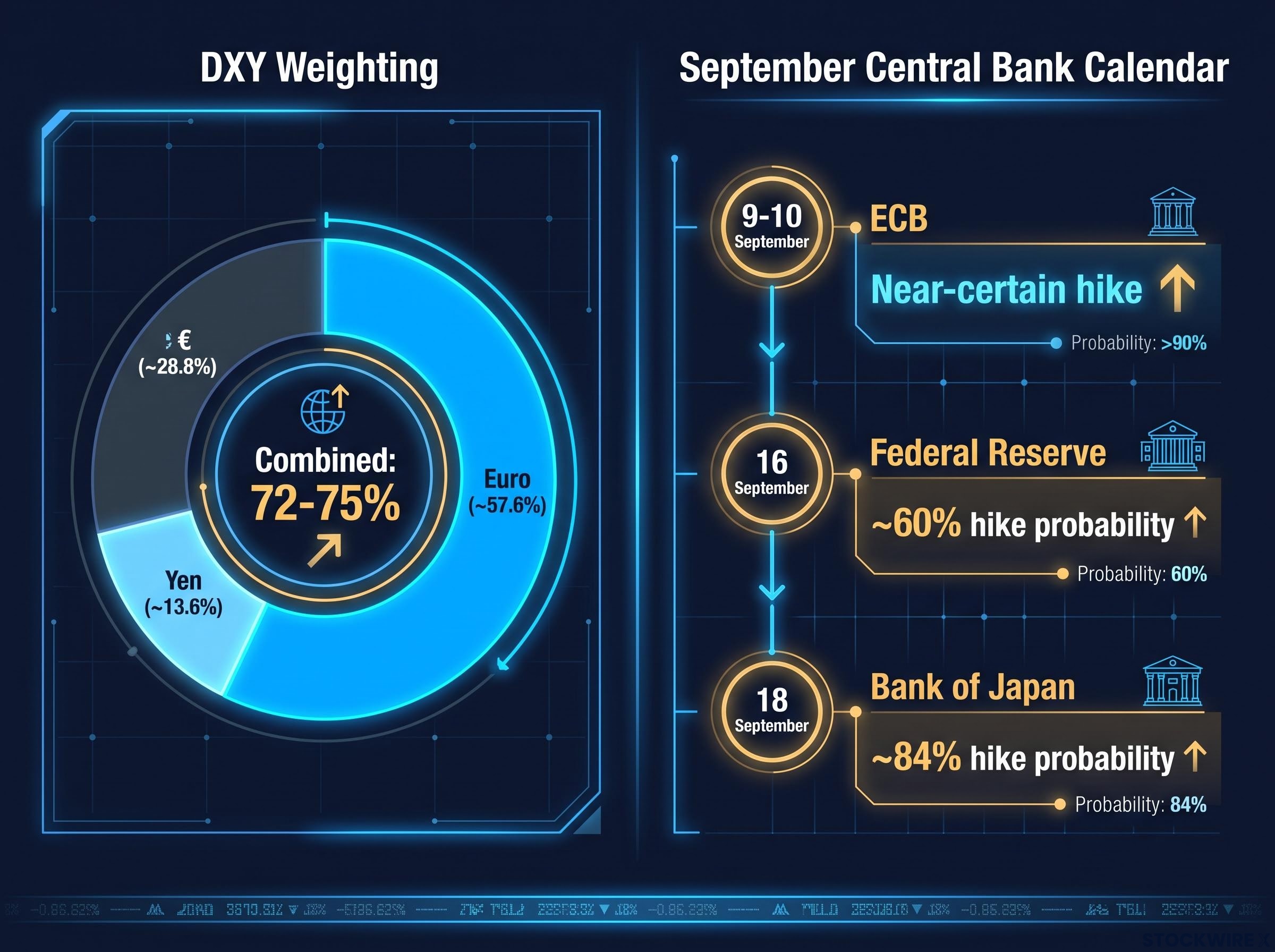
The DXY, the headline number most investors watch when they check “dollar strength”, is not a neutral measure. The euro carries an index weighting of approximately 57.6%. The Japanese yen sits at roughly 13.6%. Combined, those two currencies represent somewhere in the region of 72-75% of the entire index.
That means the DXY is overwhelmingly a measure of how the dollar trades against two specific currencies, not a broad gauge of dollar health. A dollar that is strengthening against commodity currencies and emerging markets can still produce a falling DXY if the euro and yen are moving the other direction. Knowing this composition changes how you should interpret every DXY headline.
The problem deepens when you look at who is hiking and when.
| Currency | DXY Weight | Central Bank | Next Decision Date | Hike Probability |
|---|---|---|---|---|
| Euro | ~57.6% | ECB | 9-10 September | Near-certain |
| Yen | ~13.6% | Bank of Japan | 18 September | ~84% |
| US Dollar | Base currency | Federal Reserve | 16 September | ~60% |
The central bank calendar as a structural headwind
The sequencing matters as much as the probabilities. The ECB’s meeting falls on 9-10 September, putting its decision seven days ahead of the Fed’s on September 16. The Bank of Japan follows two days after the Fed, on 18 September. Incoming eurozone inflation figures due this week are widely anticipated to strengthen rather than undercut the argument for an ECB hike, adding further upward pressure on the euro before the Fed even walks into the room.
When markets assign a higher or earlier probability of hikes to the ECB and BoJ than to the Fed, the euro and yen hold firm or strengthen mechanically. The DXY falls even if the dollar is performing adequately against smaller-weight currencies. That is not a signal of dollar collapse; it is a reflection of the dollar losing a specific competition against the two currencies that dominate its benchmark. Through August 2026, the DXY has been stuck in the 99-100 range near multi-month lows, even as global risks remained elevated. The composition tells you why.
The DXY’s position near the mechanically loaded 100 level concentrates option strikes, stop-loss clusters, and algorithmic triggers in a way that amplifies the impact of every macro catalyst that arrives while price sits there, making the structural floor more significant than a round-number coincidence.
The rate shock that moved every market except the dollar
Dollar strength from Fed tightening is always a relative phenomenon. The dollar benefits when the Fed tightens more than its peers, not merely when it tightens. Monday’s session demonstrated what happens when that distinction disappears.
Dollar strength from Fed tightening has always been a relative phenomenon, and relative rate differentials between the Fed and peer central banks are the actual variable driving currency direction, not the US rate level in isolation; futures-implied probabilities on ECB and BoJ decisions carry as much signal as the CME FedWatch read on any given day.
Following the Jackson Hole keynote on Friday, borrowing cost expectations were revised upward simultaneously across the entire developed-market rate complex. Markets moved through the adjustment in a span of roughly six hours across a single trading session:
- Japan’s two-year government bond yield surged to a 31-year high
- Two-year sovereign borrowing costs in Germany and France rose to peaks last seen in 2024
- Longer-dated eurozone yields advanced to their highest readings in over fifteen years
Oil breaking above $85.00 pushed the inflation challenge onto every major economy simultaneously, prompting parallel tightening expectations rather than a repricing confined to the United States. Every major bond market moved in the same direction, by a comparable magnitude, within the same session.
The “reluctant hiker” constraint: Softer US data earlier in August had already capped how far US rate expectations could run relative to peers. The Fed entered Monday’s session on a reluctant footing, meaning the post-Jackson Hole shift landed in a market already sceptical about sustained US tightening.
The result: Fed September hike probability jumped to roughly 60%, a meaningful move in isolation. But it is irrelevant to dollar direction if the ECB and BoJ are repricing by a comparable magnitude at the same time. What matters for the currency is the gap between US and peer expectations, not the US number alone. On Monday, that gap did not widen. The dollar had no edge to trade on.
This dismantles a persistent misreading of how rate expectations drive currencies. If you act on “the Fed is hiking, therefore buy dollars” without checking what peer central banks are pricing, you will repeatedly find yourself on the wrong side of the trade in a synchronised tightening environment.
When rate hikes do and do not produce dollar strength: a practical diagnostic
The three sections above describe separate mechanisms. Together, they form a diagnostic checklist you can apply the next time you see a Fed hike headline and wonder whether it is actually good for the dollar.
The dollar benefits from rate hike expectations when all three conditions are met:
- The Fed is repricing more aggressively than the ECB and BoJ. If all three central banks are tightening in lockstep, higher US yields do not create a relative premium. The rate gap has to widen in the dollar’s favour, not just move higher.
- DXY basket dynamics are not working against the dollar. Because the euro and yen make up roughly 72-75% of the index, the dollar needs those two currencies to soften, not just smaller-weight peers. If the ECB and BoJ are matching or exceeding Fed hawkishness, the index mechanically suppresses any dollar gains.
- Safe-haven flows are not being diverted by US-specific concerns. When fiscal doubts, Treasury buyback programme questions, or political uncertainty send haven capital into gold and alternative sovereigns instead of the dollar, geopolitical risk stops being a dollar tailwind.
As of late August 2026, none of the three conditions are fully met. Fed hike probability sits at approximately 60%, but the ECB is near-certain for 9-10 September and the BoJ is priced at roughly 84% for 18 September. The DXY is trading at 99-100, near multi-month lows. Gold is posting its strongest month since January.
That is why multiple tailwinds, war, oil, and higher rate expectations, produced limited altitude.
The variables most likely to shift the dollar’s trajectory before year-end
The framework is not a permanent verdict. Conditions can shift, and monitoring them is the point.
The ECB decision on 9-10 September and this week’s eurozone inflation data are the first test. If ECB hike expectations recede, the rate gap condition could shift in the dollar’s favour. The BoJ decision on 18 September is the second variable; with hike probability at roughly 84%, yen strength pressure on the DXY will persist unless that probability falls. A resolution or de-escalation of the Iran conflict could reduce the oil-driven uniform inflation repricing dynamic, potentially narrowing the synchronised tightening problem that eliminated the dollar’s rate premium on Monday.
What the dollar’s failure to rally reveals about the new rate environment
The dollar is not broken. The framework investors used to trade it is.
Monday’s traditional catalysts, geopolitical risk, oil, and Fed hawkishness, retain their logic individually. But they only produce currency gains when the dollar holds a relative advantage over peer currencies in its own benchmark basket. On current pricing, it does not.
This is a structural transition period, not a permanent reversal. The conditions for a dollar rally exist, but they require peer central bank expectations to diverge downward from US expectations rather than move in lockstep.
DXY overvaluation signals from institutional research, including Morningstar’s mid-2026 estimate that the index is approximately 15% overvalued, add a valuation layer to the structural argument: the dollar’s current 99-100 range already reflects a cyclical premium that requires the rate and growth narrative to hold indefinitely to justify itself.
The September central bank calendar is the first real test of whether that divergence materialises:
- ECB: 9-10 September (a hike is widely anticipated as near-certain; a downside surprise would narrow the rate gap in the dollar’s favour)
- Fed: 16 September (markets are currently pricing around 60% odds of a hike; the dollar needs this to hold or rise while peers soften)
- BoJ: 18 September (markets are assigning approximately 84% odds to a hike; a repricing lower would ease yen-driven DXY pressure)
The DXY at 99-100 marks the structural floor to watch. The Iran conflict and oil pricing remain ongoing variables that will continue triggering uniform inflation repricing unless resolved.
September’s central bank sequence is not routine calendar risk. It is the specific mechanism by which the dollar’s current structural disadvantage either resolves or entrenches. Watching it with that lens changes how you should interpret every outcome.
This article is for informational purposes only and should not be considered financial advice. Investors should conduct their own research and consult with financial professionals before making investment decisions. Past performance does not guarantee future results. Financial projections are subject to market conditions and various risk factors.
—