
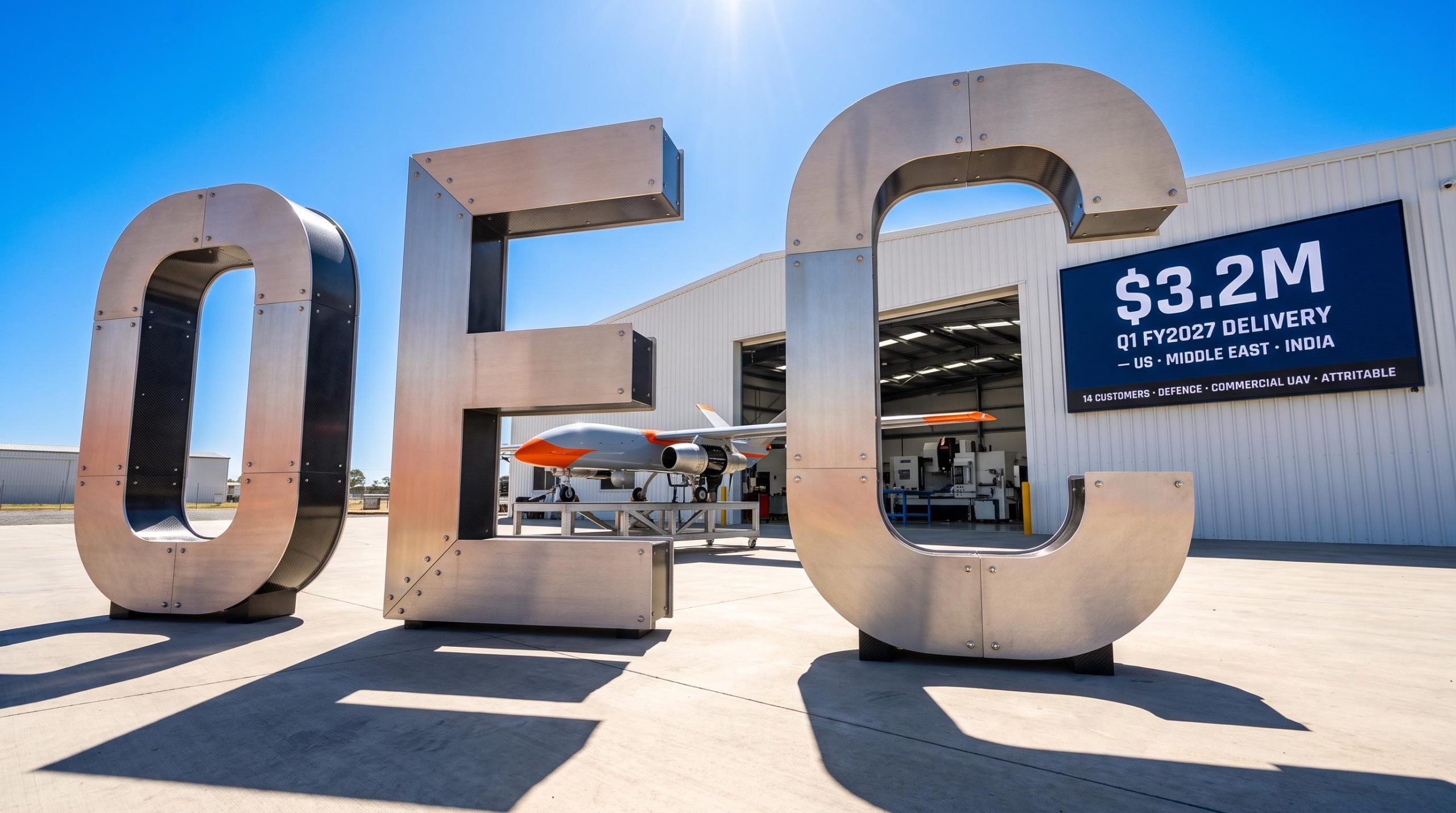
Orbital lifts customer base to 14 and targets $3.2 million Q1 revenue as UAV market accelerates
Orbital Corporation Limited (ASX: OEC) has released its FY2026 Annual Report for the year ended 30 June 2026, highlighting a broadened customer and product base heading into FY2027.
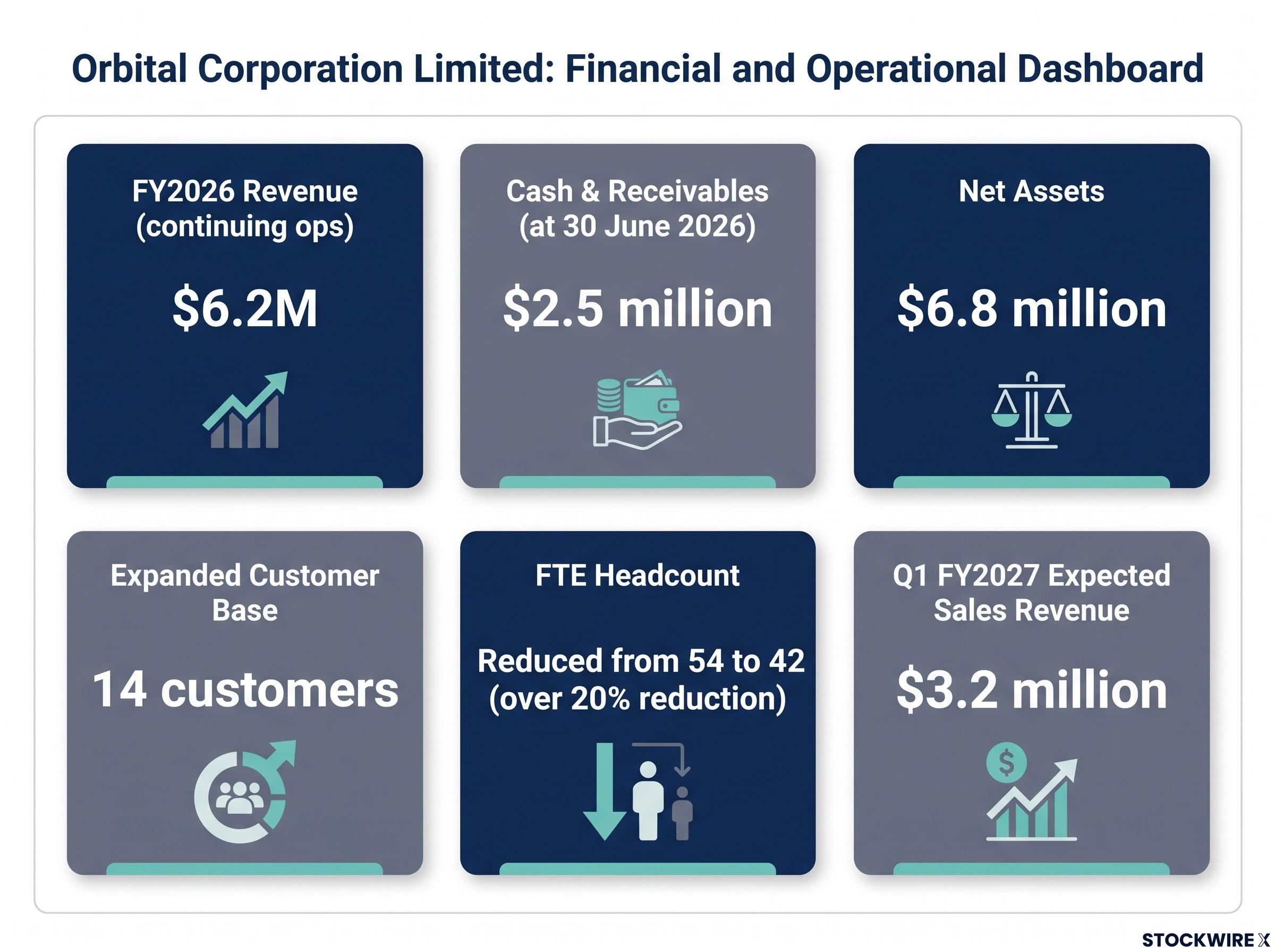
The Company expanded its customer base to 14 across key international markets and entered the commercial unmanned aerial vehicle (UAV) sector during the year. It also reduced its full-time equivalent (FTE) headcount from 54 to 42, a reduction of over 20%.
Looking ahead, Orbital expects $3.2 million of sales revenue to be delivered to customers in the US, Middle East and India during Q1 FY2027.
When big ASX news breaks, our subscribers know first
FY2026 highlights at a glance
-
Customer base expanded to 14, including entry into the commercial UAV sector, putting the Company on track to deliver $3.2 million of Q1 FY2027 revenue
-
Product portfolio broadened with the 350HFE and Generation 2 Power Management System, alongside development of an ICE-Electric hybrid propulsion solution
-
Business efficiency program reduced FTE headcount by over 20%, alongside engineering and supply chain initiatives targeting lower product costs
-
Enters FY2027 with exposure to growing opportunities across defence, commercial BVLOS and emerging Attritable UAV markets
CEO Commentary
“Orbital enters FY2027 with a much broader customer base, an expanded product portfolio and growing exposure to some of the fastest-evolving areas of the UAV market.
“Our focus now is on converting these customer relationships and development programs into production orders. The initial orders received from new customers during the year reflect the integration of our propulsion systems into customer UAV platforms, and the conversion to production volumes has a lead time of six to eighteen months,” said Stephen Pearce, CEO, Orbital Corporation Limited.
A transitional year in the numbers
FY2026 represented a transitional year for Orbital, with revenue adversely impacted by the cancellation of the FTUAS program by the US Government, while the Company simultaneously completed its business efficiency program and continued to invest in an expanded product portfolio, positioning it to deliver against its current pipeline of global opportunities.
| Metric | FY2026 | FY2025 | Context |
|---|---|---|---|
| Revenue (continuing ops) | $6.2M | $8.2M | Impacted by FTUAS program cancellation |
| Other income | $3.3M | $4.5M | — |
| Net loss after tax | $4.8M | $4.3M loss | Reflects reinvestment and efficiency program |
Key balance sheet and funding items for the period included:
-
Cash and receivables of $2.5 million at 30 June 2026
-
Net assets of $6.8 million
-
$4.1 million received under the Australian Research and Development Tax Incentive program
-
Completion of a $3.0 million equity placement
Understanding the UAV propulsion opportunity
Orbital is a Perth, Western Australia-based designer and manufacturer of integrated heavy fuel propulsion systems for Group 2 and Group 3 UAVs, serving both defence and commercial applications. The Company holds over 40 years of engineering heritage and more than 1.2 million proven in-field service hours across multiple Tier 1 defence customers, including Boeing Insitu and Textron Systems.
During FY2026, Orbital entered the commercial UAV sector through its range of Commercial Off-The-Shelf (COTS) propulsion systems, while continuing to progress customer programs across the United States, South-East Asia, India and the Middle East. It also established a dedicated Business Development function covering the United States and Europe.
Two new growth segments
The Company has identified substantial opportunities within two emerging market segments:
-
Commercial UAV segment — the key driver being regulatory changes in the US to allow unmanned flights in commercial airspace
-
Attritable segment (US defence) — characterised by lower unit costs, shorter development cycles and substantially higher potential production volumes than traditional defence aviation programs
Increased payload requirements are driving demand for higher-capacity engines capable of supporting larger aircraft and more complex mission profiles, a trend that supported development of the 350HFE. The growing adoption of Vertical Take-Off and Landing (VTOL) configurations is also increasing demand for onboard electrical power generation and high-voltage battery charging, which Orbital is addressing through its Generation 2 Power Management System and ICE-Electric hybrid propulsion technology.
From evaluation to production — building recurring revenue
Orbital’s strategy is to establish long-term customer relationships that progress from engineering evaluation through integration, ground testing, flight testing and qualification before advancing to potential large-scale production programs. For defence programs, this commercialisation pathway typically spans six to eighteen months, reflecting the rigorous qualification requirements of military customers, while commercial UAV programs generally progress more rapidly, offering the potential for shorter sales cycles.
A first customer deployment of the Gen 2 PMS marked a notable step during the year. Orbital received an initial order from a new Indian engineering, defence and aerospace customer comprising the new 350HFE propulsion system along with the Gen 2 PMS, earmarked for integration into a new high-altitude tactical UAS for military applications in India. A further order for two additional 350HFE units and PMS units is expected to support integration and flight testing.
The Indian customer relationship referenced in the annual report has since deepened further, with Orbital securing an additional 350HFE engine order for the Super Cheel military drone programme, extending its supply position across both the Indian Army and Indian Navy platforms.
The Company’s growing portfolio of customer programs spans North America, Europe, the Middle East, India, Singapore and Australia, and includes new customers:
- ST Engineering
- AATI
- MightyFly
- Sky Front
- Freespace Operations
- IGG
- Callen-Lenz (BAE Systems)
As these programs mature, Orbital expects to generate propulsion system production and spare parts orders, enter into in-service support agreements and implement the “Power by the Hour” model, in line with its strategy to develop multiple and recurring revenue streams.
The financial logic behind Orbital’s commercialisation pathway is illustrated by a May 2026 US engine order, where a A$600,000 initial hardware sale for five 150HFE engines was structured explicitly as a precursor to a Power by the Hour recurring revenue model that Orbital estimates could generate approximately three times the hardware value per engine in aftermarket income.
What FY2027 holds for Orbital investors
Orbital enters FY2027 with a broader, more diversified customer base and product portfolio, focused on converting its expanded international customer base and business development pipeline into production contracts and longer-term revenue opportunities.
Management outlined the following priorities for the year ahead:
-
Convert the international customer base and business development pipeline into production contracts
-
Grow presence across established defence markets while further penetrating the commercial UAV sector
-
Pursue new opportunities emerging from changing defence procurement requirements, including the Attritable UAV segment
-
Continue expanding its propulsion technology portfolio to build a broader and more diversified revenue base
The expected delivery of $3.2 million in revenue during Q1 FY2027 represents an early near-term proof point of pipeline conversion, with the six-to-eighteen-month lead time for defence programs framing the broader timeline for converting relationships into recurring production volumes.
Don’t Miss the Next UAV & Defence Breakout
Big News Blast delivers FREE breaking ASX news straight to your inbox within minutes of release, complete with in-depth analysis already done for you. Join 20,000+ investors who never miss a market-moving announcement. Click the “Free Alerts” button at Big News Blast to get the next UAV and defence update the moment it hits the ASX.