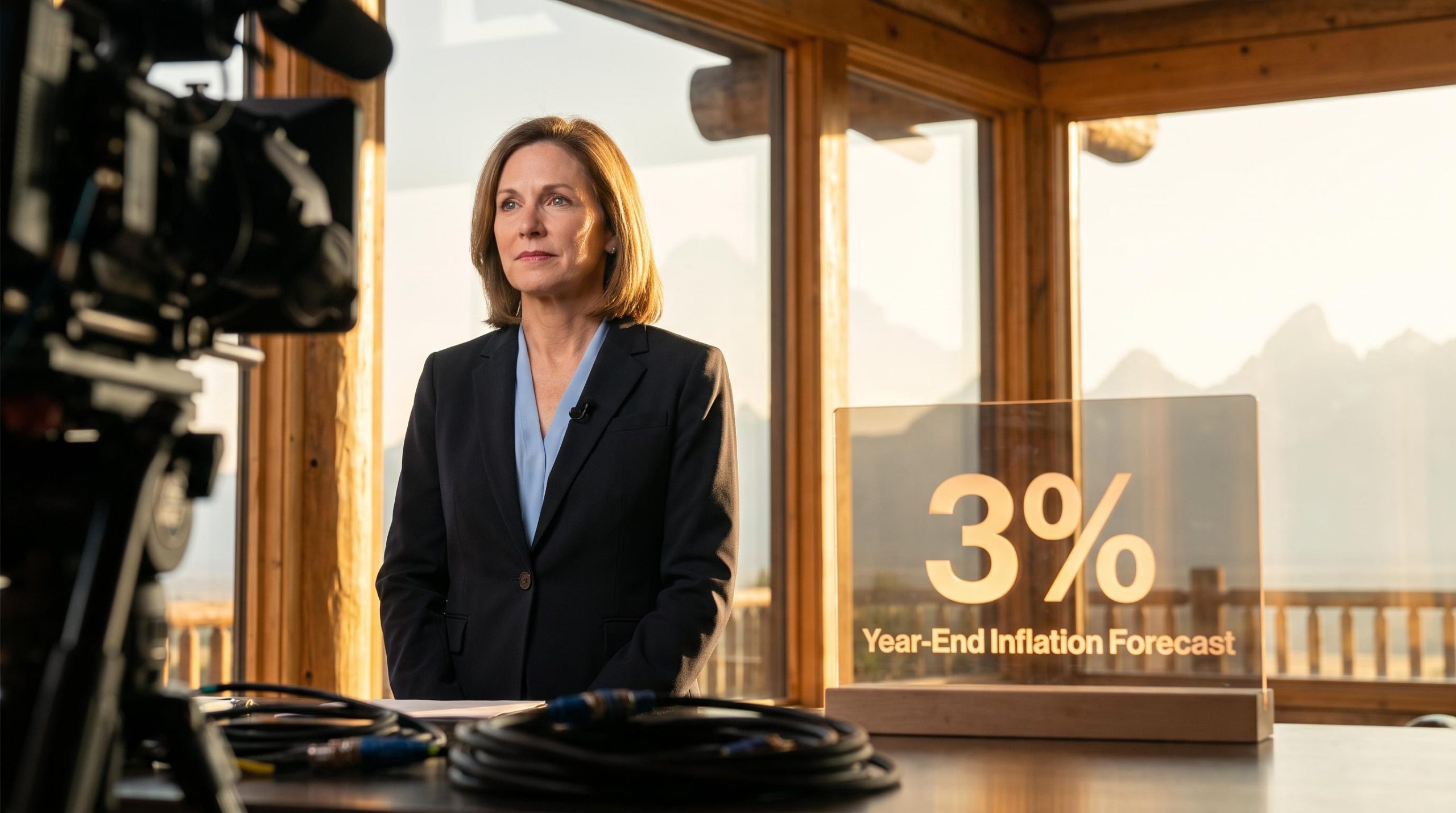
Cleveland Fed President Beth Hammack stepped in front of Bloomberg cameras at Jackson Hole on Friday and said the quiet part out loud. Inflation is heading toward 3% by year-end, financial conditions are not tight enough to fix that on their own, and the Fed needs to raise rates.
Hammack is a voting FOMC member who already backed her words with a formal dissent in favour of a rate hike at the July 2026 meeting. Her Jackson Hole remarks are not speculative commentary from a non-voter. They are a public preview of where she intends to push policy at the next meeting cycle, delivered from the Fed’s most-watched annual gathering.
Here is what Hammack said, what her record says about how seriously to take it, and what it means for the Fed’s interest rate trajectory in the months ahead.
Hammack says rates need to rise as inflation tracks toward 3%
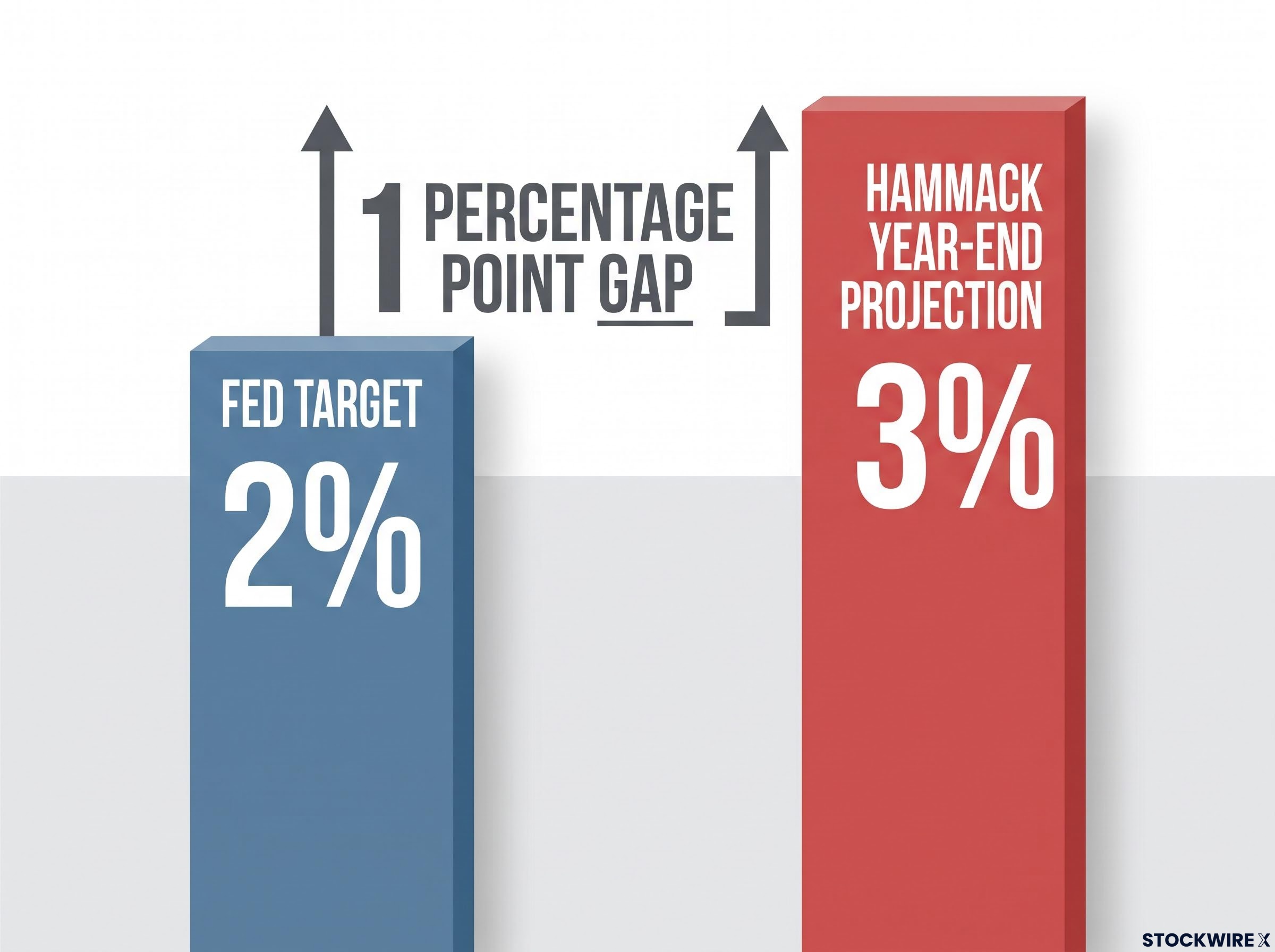
Hammack’s message on Friday was direct. In a Bloomberg interview from Jackson Hole on 28 August 2026, she projected year-end inflation at approximately 3%, a full percentage point above the Fed’s 2% target, and argued that current financial conditions are not restrictive enough to close that gap without further action from the central bank.
She framed rate hikes as the Fed’s most transparent and comprehensible tool, one whose effects on the economy are well documented and whose use signals institutional seriousness to households and markets alike.
Hammack positioned interest rates as the Fed’s most direct and legible instrument for action, stressing that market forces can play a supporting role but are no replacement for the central bank’s own policy decisions.
Her warning carried a cost dimension too: delayed action, she said, will increase the eventual pain for households. That framing moves the argument beyond abstract inflation metrics and into a direct case for urgency.
When a voting Fed official publicly projects a 1 percentage point miss on the inflation target and calls conditions insufficiently tight, this is not routine caution. It is the opening argument for a policy move. In Hammack’s view, the institution’s standing rests on its willingness to deploy its own tools to fulfil the dual mandate, rather than leaving that work to market dynamics.
When big ASX news breaks, our subscribers know first
A voting member with a dissent on record, not just hawkish rhetoric
Hawkish commentary from Fed officials is common. What separates Hammack from routine caution is institutional weight: she is a voting member of the 2026 FOMC, and she has already demonstrated she is willing to break with the committee on record.
At the July 2026 meeting, Hammack dissented in favour of a rate hike. That dissent was not a marginal call on language or a procedural objection. It was a formal vote that existing policy was too loose, placed on the record when the rest of the committee chose to hold.
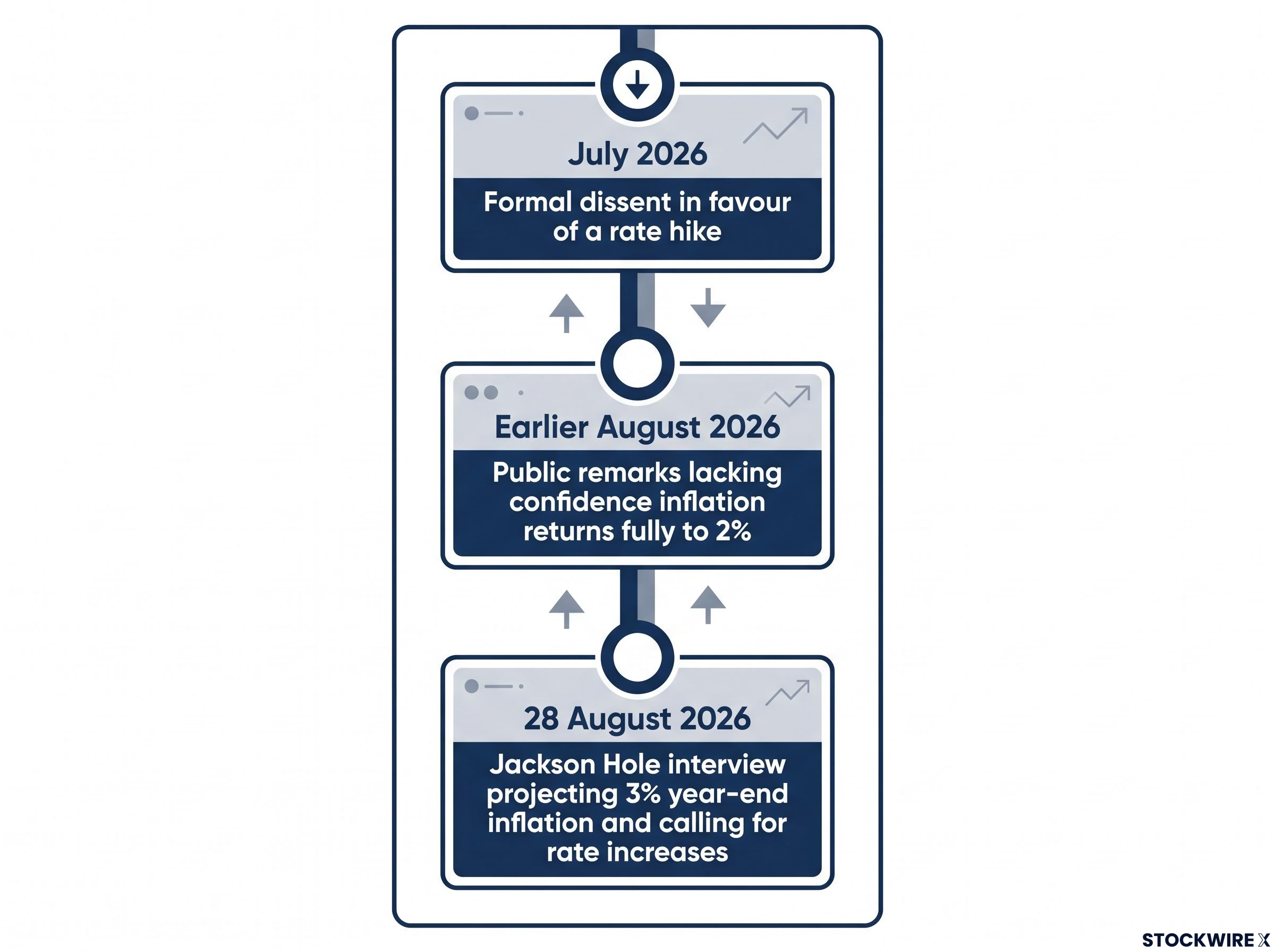
Her pattern across recent months has been consistent and directional:
- July 2026: Formal dissent in favour of a rate hike at the FOMC meeting
- Earlier August 2026: Public remarks questioning whether recent disinflation would continue, stating she lacked confidence inflation would return fully to 2%
- 28 August 2026: Jackson Hole interview projecting 3% year-end inflation and calling for rate increases
She has also characterised current rates as only “barely” or “in the vicinity of” neutral, a signal that she views existing policy as still somewhat stimulative rather than genuinely restrictive.
The July dissent is the detail that matters most. It tells you Hammack has already been willing to vote against the committee in favour of tightening. Her Jackson Hole remarks are not a negotiating position. They are a credible signal of future action, backed by a record that proves she will follow through.
What the sentiment data says about the broader Fed shift
Hammack’s hawkishness is measurable, and the numbers confirm she is not an outlier. She is at the leading edge of a directional shift visible across aggregated Fed communications.
The FXS Speechtracker, a tool that scores the hawkish or dovish tenor of individual Fed speeches on a scale from 0 to 10, rated Hammack’s Jackson Hole remarks at 8.2 out of 10. The historical baseline for Fed communications sits at 7.5 out of 10, meaning her language was materially more hawkish than the typical Fed speech.
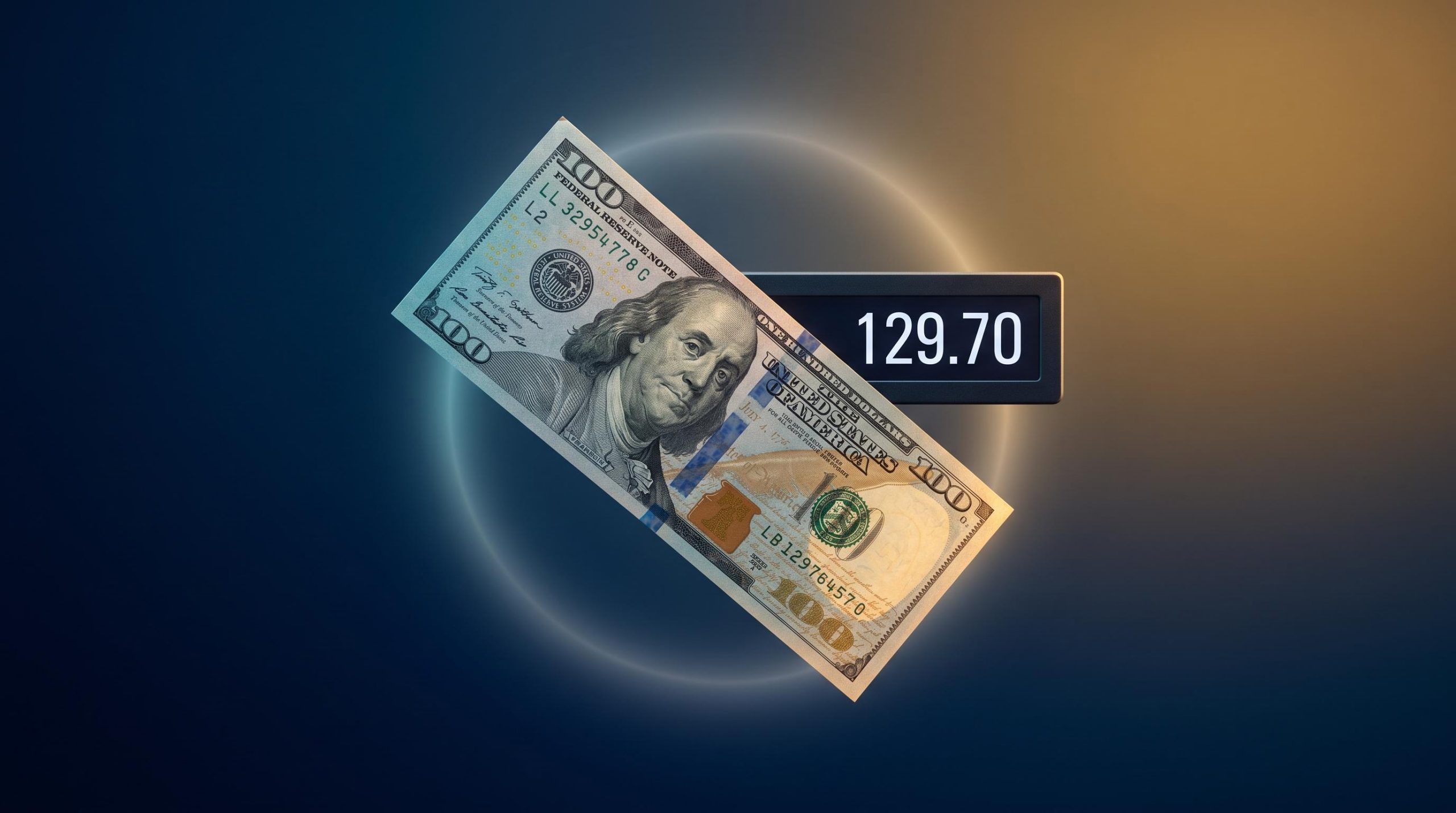
The broader FXS Fed Sentiment Index, which aggregates the tone of all recent Fed communications into a single reading, climbed 0.59 points following her remarks to reach 129.70. The neutral threshold for this index is 100.
| Metric | Reading | Baseline / Neutral | Interpretation |
|---|---|---|---|
| FXS Speechtracker Score | 8.2 / 10 | 7.5 / 10 | Materially above historical average; confirms hawkish language |
| FXS Fed Sentiment Index | 129.70 | 100 (neutral) | Well into restrictive territory; pushed higher by Hammack’s remarks |
A Sentiment Index reading of 129.70 against a neutral threshold of 100 tells you the aggregated signal from Fed communications is not marginally hawkish. It is running well into restrictive territory, and Hammack’s remarks pushed it further in that direction. These quantified readings are consistent with a broader market repricing toward a higher-for-longer or further-tightening scenario.
What Hammack’s Jackson Hole remarks mean for markets and the next FOMC cycle
The policy pressure from Friday’s interview is immediate and specific. Other FOMC officials now face a public challenge: clarify whether they share Hammack’s view that conditions are too loose, or explain why they believe disinflation can proceed without additional hikes.
The market mechanics follow a familiar pattern. Hawkish Fed rhetoric of this kind typically supports higher yields and a firmer dollar, and rate-sensitive assets face headwinds if other officials echo her message in the coming days.
Hammack suggested the prolonged low interest rate environment of recent decades may have been an anomaly rather than a norm, implying a higher-rate environment could be closer to the new normal than markets have priced.
That comment carries structural weight beyond the immediate news cycle. If the pre-pandemic rate environment was the exception rather than the rule, the entire framework for valuing duration-sensitive assets shifts.
The key variables to watch in the days ahead:
- Whether other FOMC officials respond to or echo Hammack’s framing in their own public remarks
- Incoming inflation data relative to her 3% year-end projection
- Yield and dollar movement in the trading sessions following the interview
- Positioning shifts in rate futures ahead of the next FOMC meeting
If other officials move in Hammack’s direction, the probability distribution for the next FOMC outcome shifts materially toward a hike or a prolonged hold at higher levels. The next meeting is not a routine hold-or-cut decision any more. It is the first test of whether Hammack’s dissent gains company.
How seriously to take one hawk’s call for higher rates
Hammack has built a coherent case across her recent public appearances. Conditions are not tight enough. Inflation will miss the 2% target by a full percentage point. The Fed’s credibility depends on acting rather than waiting. Her argument is internally consistent and backed by a willingness to dissent on record.
That said, she represents one end of the FOMC spectrum. A single hawkish dissenter does not determine the majority. The question is whether her framing gains traction with other members or remains a minority view.
The answer is conditional. If incoming data through September confirm inflation is holding near 3%, the case for a hike at the next meeting becomes harder for the broader committee to dismiss. If disinflation resumes convincingly, Hammack’s position may stay isolated.
What clears the threshold here is the combination of signals: voting status, a confirmed dissent, a quantified sentiment score above baseline, a named inflation forecast, and a public case delivered from Jackson Hole. That puts Hammack in a different category from routine commentary. The rate hike debate has returned to the table in a way it had not been for several months, and the next round of inflation data will determine whether it stays there.
This article is for informational purposes only and should not be considered financial advice. Investors should conduct their own research and consult with financial professionals before making investment decisions. These forward-looking statements regarding inflation projections and rate expectations are subject to change based on incoming economic data and FOMC deliberations.