
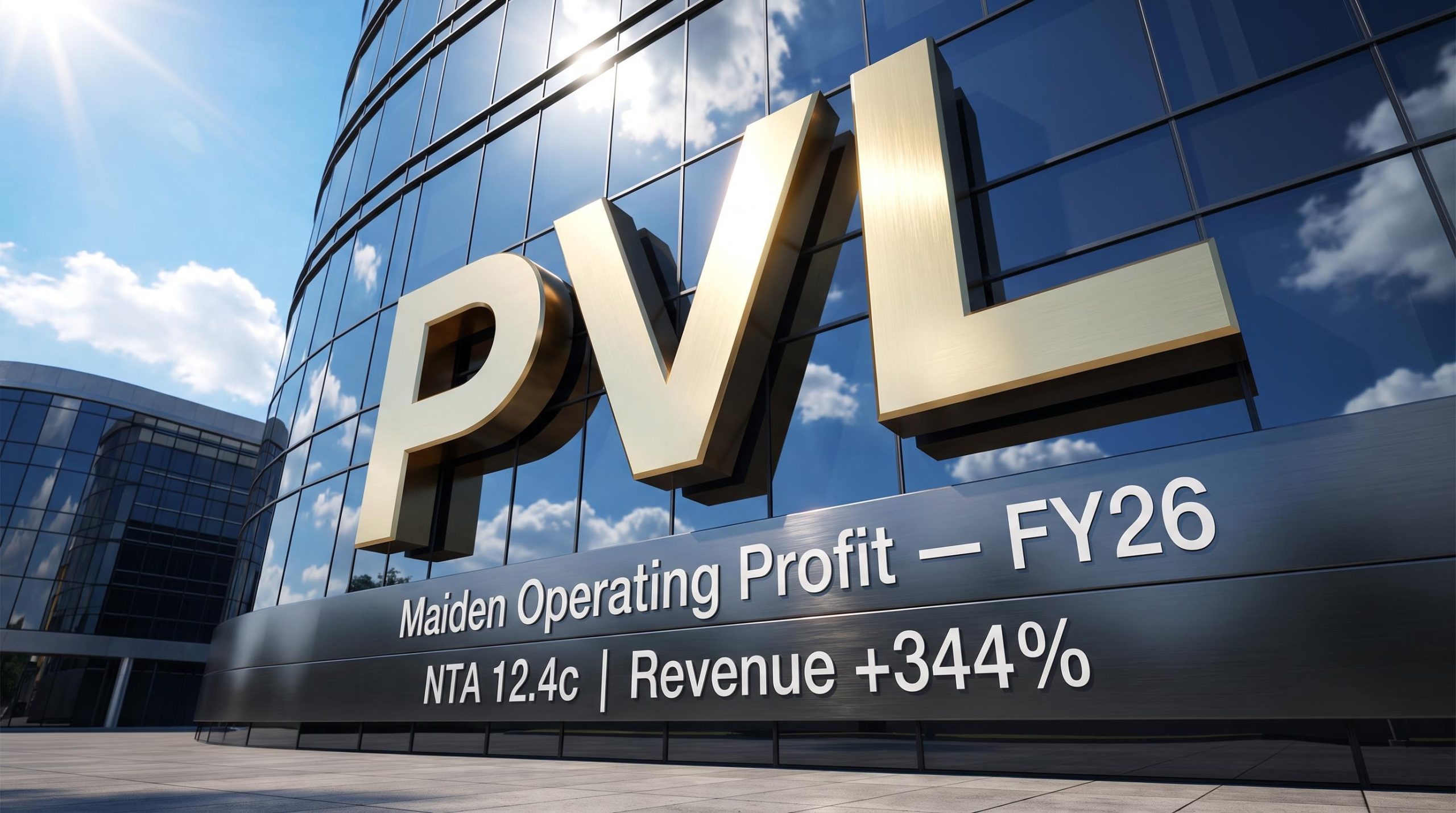
Powerhouse delivers maiden operating profit in first full year as a merchant capital business
In its FY26 results presentation dated 28 August 2026, Powerhouse (PVL) detailed its first full year operating as a merchant capital business, reporting a maiden operating profit delivered with no equity raised across the period.
The company reported operating revenue of $3.89m, up 344% on FY25, and an operating profit before tax of $0.82m, a 226% improvement. Net tangible assets (NTA) per share rose 21% to 12.4c.
Management emphasised that FY26 growth was self-funded from the balance sheet, with no equity issued during the year. The figures presented position the merchant capital model as cash profitable and self-sustaining in its first full year of operation.
When big ASX news breaks, our subscribers know first
FY26 results at a glance
The presentation set out the group’s headline financial scorecard, comparing the FY26 result against the prior corresponding period.
| Metric | FY26 | FY25 | Change |
|---|---|---|---|
| Operating Revenue | $3.89m | $0.88m | +344% |
| Operating Profit (pre-tax) | $0.82m | ($0.65m) | Returned to profit |
| Total Revenue | $6.69m | $5.32m | +26% |
| Adjusted EBITDA | $3.62m | $3.80m | -5% |
| NTA per share | 12.4c | 10.2c | +21% |
Adjusted EBITDA declined 5% across the period. The presentation attributed this to $1.50m fewer investment gains, offset by $3.01m more fee revenue. In effect, the earnings mix shifted toward recurring fee income, which management framed as an improvement in earnings quality.
What a merchant capital model actually means
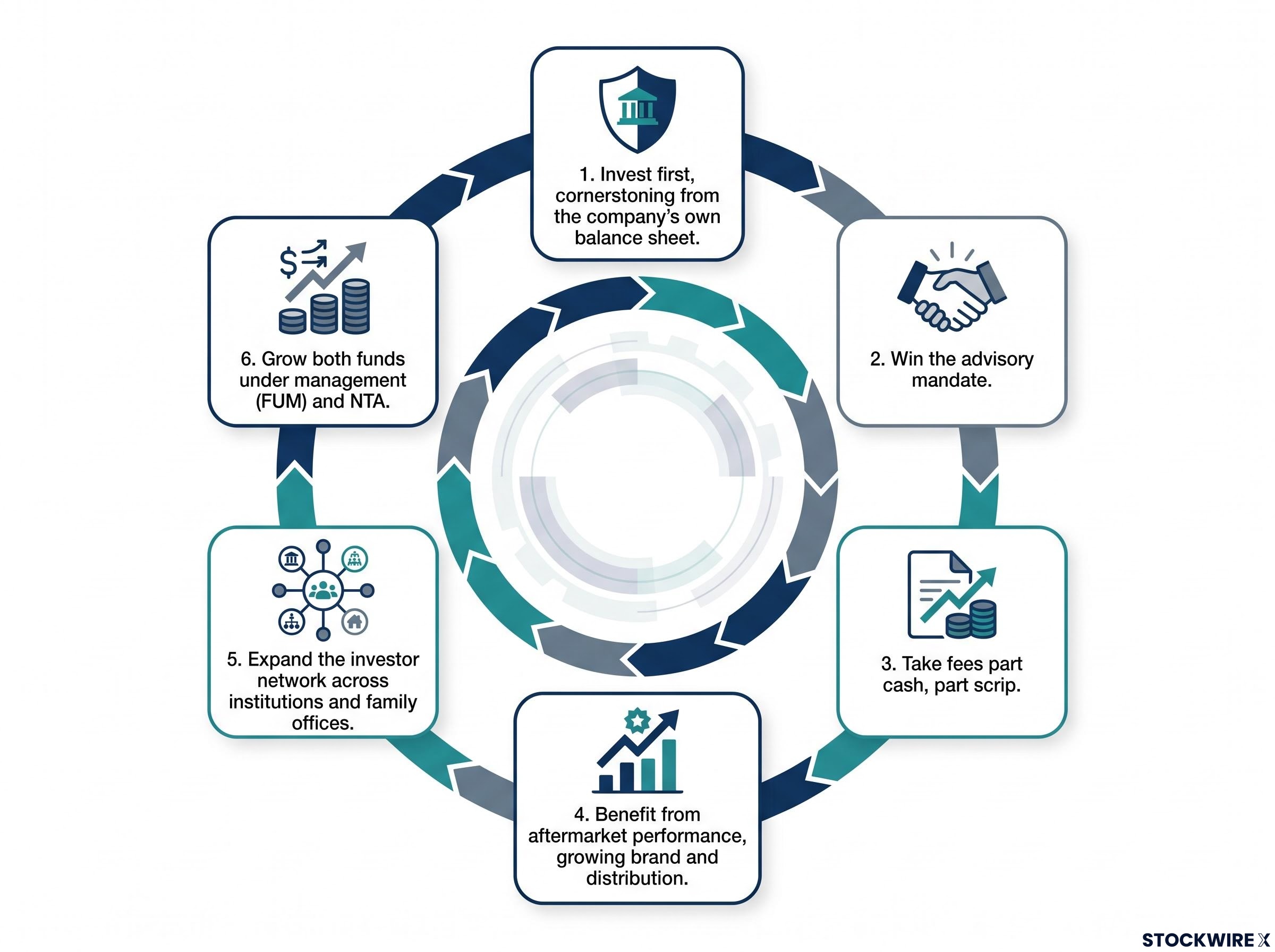
Powerhouse operates what it describes as a merchant capital model, or “Value Flywheel”. Rather than acting purely as an adviser, the company cornerstones every mandate from its own balance sheet, investing first before taking advisory fees part in cash and part in scrip (shares).
Those scrip positions accumulate on the balance sheet. As holdings appreciate, they compound NTA. Balance sheet positions can then seed fund products, converting one-off holdings into recurring management fees.
The presentation outlined the flywheel in sequential steps:
- Invest first, cornerstoning from the company’s own balance sheet.
- Win the advisory mandate.
- Take fees part cash, part scrip.
- Benefit from aftermarket performance, growing brand and distribution.
- Expand the investor network across institutions and family offices.
- Grow both funds under management (FUM) and NTA.
The mechanism produces operating leverage. Management noted operating revenue grew 344% in FY26 while the cost base, excluding share-based payments, grew 135%. NTA per share has progressed from 9.2c at FY24 to 10.2c at FY25, and to 12.4c in FY26.
Corporate Advisory drives the group’s earnings
The presentation positioned Corporate Advisory as the group’s engine room, contributing 92% of Group adjusted EBITDA.
The Advisory segment generated adjusted EBITDA of $3.34m on segment revenue of $4.69m, representing a 71% adjusted EBITDA margin. The unit completed 10 mandates with more than $40m in transaction value.
On execution quality, 7 of 8 equity capital markets (ECM) deals traded at or above their issue price, with an equal-weighted annualised ECM return of 62.7%. Notably, 53% of Advisory revenue was taken in scrip or earned on scrip held.
The revenue mix showed broad-based growth across fee lines:
- Success fees of $2.47m, up 515%
- Mandate fees (retainers) of $444,776, up 189%
- Corporate brokerage of $304,983, up 160%
The presentation illustrated the model in practice with two transactions. On Nordic Resources (ASX: NNL), Powerhouse acted as Lead Manager & Cornerstone across $14m institutional placements, taking fees in scrip at the original issue price of $0.06. On Pivotal Metals (ASX: PVT), it acted as Lead Manager & Cornerstone on a $4.25m placement at $0.011.
Management noted that strong aftermarket performance builds brand recognition and is translating into proprietary, inbound deal flow.
Funds platform reset and a top-ranked listed product
The presentation covered the reset of the Funds Management unit and the performance of its listed product. The Aliwa Alpha Fund ranked 2nd of 100 in the Equity Long Small/Mid Cap Australia peer group, per the FundMonitors.com FY26 Annual Fund Manager Performance Review.
The fund reported a 1-year net return of 34.73% against a benchmark of 7.53%, with a since-inception return of 20.88% p.a. PVL acquired Aliwa Funds Management on 19 December 2024, and returns for periods before that date were generated under prior ownership. Past performance is not a reliable indicator of future performance.
FUM stood at circa $31.5m at 30 June 2026, with a capital raising underway targeting a soft-close during FY27.
On the venture side, Powerhouse Venture Partners is developing a Technology Fund targeted to launch in FY27. Management announced an MOU to JV with a European Venture Firm, seeking to establish a global fund with a target size of circa AUD100m+. The strategy focuses on companies at higher technology readiness (TRL 7–9), described as the “Goldilocks zone” where technology is proven but capital markets have not yet priced in the full opportunity.
The MOU underpinning this ambition involves co-managing a USD100 million global fund alongside the European partner, with USD50 million in limited partner contributions already earmarked and a Q3 2026 target launch date set at the time of signing.
A stronger, more liquid balance sheet
The presentation highlighted balance sheet strength and improving asset quality. Net assets grew $3.25m to $19.86m, with no debt across the year.
Cash, treasury and ASX listed assets totalled $6.27m at 30 June 2026, comprising cash of $1.09m, treasury investments of $0.49m and ASX listed securities of $4.69m. Level 1 assets, which include listed and cash-like holdings, represented 20% of the base, up 6%, with management targeting above 25% in FY27.
Operating cash flow was negative $0.85m, which the presentation attributed to the timing of Q4 Advisory success fees, with $0.95m of receipts falling in Q1 FY27.
Key message from the presentation
FY26 was the first full year operating as a merchant capital business, with a maiden operating profit delivered with no equity raised in FY26.
FY27 priorities and capital management
Management outlined a set of forward priorities for FY27, framed as strategic focus areas rather than commitments.
- Technology Fund launch (CY2026), targeting a joint venture strategy with total commitments of US$100m.
- Aliwa Alpha Fund capital raising, underway from July 2026.
- Advisory execution, with momentum expected to continue.
- Strategic inorganic growth opportunities to augment the platform.
On capital management, the presentation noted franking capacity of circa 1.0 cent per share, derived from the FY26 tax charge of $349,809 which becomes available as franking credits when paid. No equity was raised during the year, with the only cash issue being $200,000 on the exercise of options.
The Board indicated it will consider the most appropriate and tax-effective means of returning capital to shareholders over the medium term. The presentation stated explicitly that nothing on this point constitutes dividend guidance, and no dividend has been declared or recommended.
Stay Ahead on ASX Finance and Fintech News
Big News Blast delivers FREE breaking ASX announcements straight to your inbox within minutes of release, complete with in-depth analysis already done. Join 20,000+ investors who never miss a market-moving moment. Click the “Free Alerts” button at Big News Blast to get ahead of the market before the rest catch up.