

Harvey Norman posts $9.64bn system sales as international earnings surge 25%
In its FY26 full-year results presentation for the year ended 30 June 2026, Harvey Norman Holdings Limited reported total system sales of $9.64bn, up 3.1%, alongside profit before tax of $654.69m (excluding AASB 16 net impact, net property revaluations and the pecuniary penalty recognised in FY26), an increase of 10.9%.
Management characterised the year as one of resilience, with a strong first half mitigating softer second-half trading amid rising global uncertainty. The company lifted its fully-franked dividend to 27.5c and reported statutory PBT of $790.29m, up 4.9%.
When big ASX news breaks, our subscribers know first
FY26 results at a glance
The headline scorecard presented by management is summarised below. The underlying profit figures exclude the AASB 16 net impact, net property revaluations and the pecuniary penalty recognised in FY26.
| Metric | FY26 | FY25 | Change |
|---|---|---|---|
| Total system sales | $9.64bn | — | +3.1% |
| Reported PBT | $790.29m | $753.10m | +4.9% |
| Underlying PBT (excl. AASB 16, revaluations & penalty) | $654.69m | $590.36m | +10.9% |
| Reported NPAT | $528.46m | $518.02m | +2.0% |
| Basic EPS | 42.41c | 41.57c | +0.84c |
| Dividend (fully-franked) | 27.5c | 26.5c | +1.0c |
| Net assets | $4.94bn | $4.84bn | +2.0% |
| Total assets | $8.85bn | $8.37bn | +5.7% |
A year of two halves
Management highlighted a clear divergence between the two reporting halves. First-half trading was supported by improved consumer confidence, a more stable inflation outlook and solid Christmas trading across the Home, Lifestyle and Technology categories.
Harvey Norman’s 1H26 results recorded franchising margins expanding 49 basis points to 5.89%, reflecting the cost discipline that helped the first half carry the full-year performance through a more challenging second half.
Conditions became more challenging in the second half. The presentation cited inflationary pressures across fuel, energy and freight costs, alongside cost-of-living pressures following three consecutive interest rate increases and softer consumer confidence after the May 2026 Federal Budget.
Key drivers by half:
- 1H26 tailwinds: improved consumer confidence, stable inflation outlook, solid Christmas trading across Home, Lifestyle and Technology.
- 2H26 headwinds: higher fuel, energy and freight costs, cost-of-living pressures after three consecutive rate rises, softer confidence post-Budget.
Despite the softer second half, Australian franchisee aggregated sales rose 2.4% to $6.584bn, with the 2H26 figure declining only 0.2% against a strong comparative. Technology categories remained an important contributor, supported by growing adoption of AI-enabled devices.
International expansion drives earnings momentum
Overseas company-operated PBT rose 23.4% to $135.72m, a key earnings driver in FY26. Excluding UK establishment losses, established international retail PBT reached $166.93m, up 25.2%, while company-operated retail sales increased 4.5% to $3.052bn.
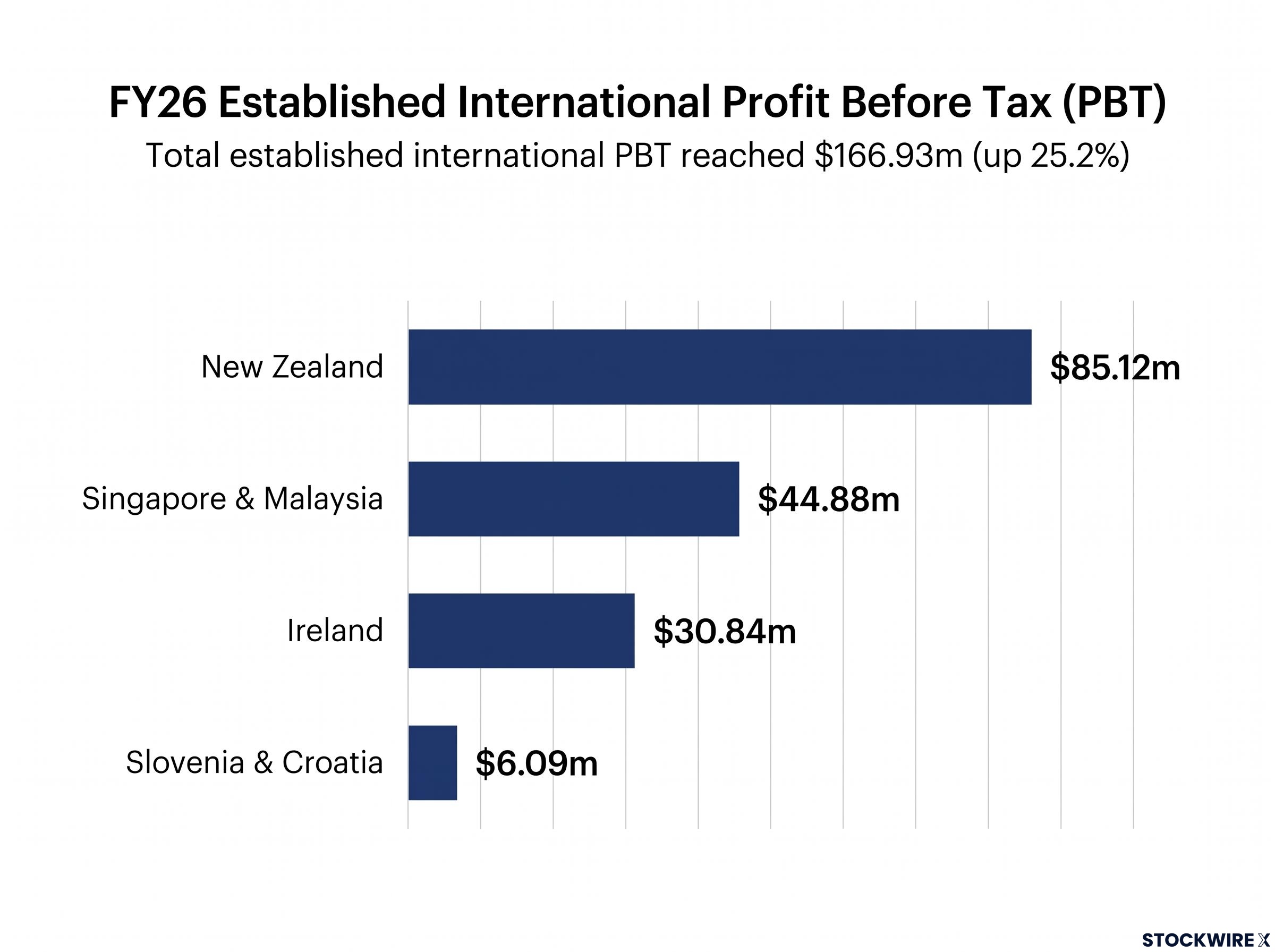
| Region | FY26 PBT | FY25 PBT | Change |
|---|---|---|---|
| New Zealand | $85.12m | $64.89m | +31.2% |
| Singapore & Malaysia | $44.88m | $41.43m | +8.3% |
| Ireland | $30.84m | $22.65m | +36.2% |
| Slovenia & Croatia | $6.09m | $4.39m | +38.8% |
| Total established international | $166.93m | $133.36m | +25.2% |
| United Kingdom | ($31.21m) | ($23.37m) | (33.5%) |
The UK investment story
Management framed the UK losses as deliberate long-term investment rather than underperformance. The presentation stated the UK strategy is about building a sustainable business for the long term, requiring investment ahead of the growth the company expects to achieve.
The year saw the second English company-operated store open at Gracechurch Shopping Centre, Sutton Coldfield, in April 2026. The network also evolved through the reintroduction of the Computers and Electrical categories at the Boucher Road store in November 2025. Across Asia and the UK, five new company-operated stores were opened during FY26.
Understanding Harvey Norman’s integrated model
Harvey Norman operates an integrated retail, franchise, property and digital system across 8 countries. Management emphasised that multiple earnings streams reduce reliance on any single market, geography or category, a diversification that matters to investors assessing earnings resilience.
The three strategic pillars are:
-
Franchising: 195 franchised complexes and 549 independent franchisees in Australia, delivering PBT of $345.18m at a margin of 5.24%. Notably, sales made by Australian franchisees do not form part of the consolidated entity’s financial results.
-
Overseas company-operated retail: 123 stores across 7 countries, contributing PBT of $135.72m.
-
Property: a $5bn global portfolio generating PBT of $333.49m.
This structure allows earnings to be drawn from franchising fees, international retail and property income simultaneously, cushioning the group against weakness in any individual segment.
Property portfolio underpins balance sheet strength
The $4.80bn freehold property portfolio represents 54.3% of the group’s $8.85bn total assets, providing core asset backing. Property segment PBT rose 3.7% to $333.49m, supported by a net revaluation increment of $156.75m, rental growth and low vacancy.
The company remains the largest single owner of Large-Format Retail (LFR) real estate in Australia, owning 99 franchised complexes (50.8% of 195) with more than 480 third-party tenants.
Key balance sheet and property figures:
- Net assets approaching $5bn at $4.94bn.
- Net debt-to-equity ratio of 18.81%, up from 13.43%, reflecting the funding of strategic property acquisitions while remaining conservatively geared.
- Total assets of $8.85bn, up 5.7%.
Operating cash flows declined 22.6% to $537.22m, which management attributed to the timing of working capital funding ahead of collections, including increased financial accommodation extended to franchisees.
What’s ahead for FY27
The July 2026 trading update showed softer early figures, with Australian franchisees down 3.4% and New Zealand total sales down 4.4% in local currency. Management attributed this to timing, noting the Samsung Galaxy Fold launch shifted from July to August this year, and the period cycled strong prior comparable growth of 6.4% in Australia and 7.2% in New Zealand.
A more positive signal followed, with Australian franchisee comparable written sales up 3.8% for the period 1 to 24 August 2026. Momentum in Europe remained positive, with Ireland up 2.4% and Slovenia and Croatia up 4.1% on a comparable, local-currency basis.
The FY27 expansion pipeline outlined by management includes:
- Australia: 1 new franchised complex, 4 relocations (3 to newly constructed freehold sites) and further refits.
- United Kingdom: a third West Midlands site in final lease negotiations, anticipated to open in 2027, with a further site under negotiation.
- Croatia: land acquired in East Zagreb for a flagship store expected to open in 2028.
- Malaysia: 3 new store leases signed for FY27.
- Singapore: 1 new store lease signed for FY27.
- Ireland: a new clearance centre lease signed for FY27.
Don’t Miss the Next Consumer Discretionary Earnings Mover
Big News Blast delivers FREE breaking ASX news straight to your inbox within minutes of release, complete with in-depth analysis so the work is already done. Join 20,000+ investors who stay ahead of the market on consumer sector stocks. Click the “Free Alerts” button at Big News Blast to start receiving alerts the moment news breaks.