
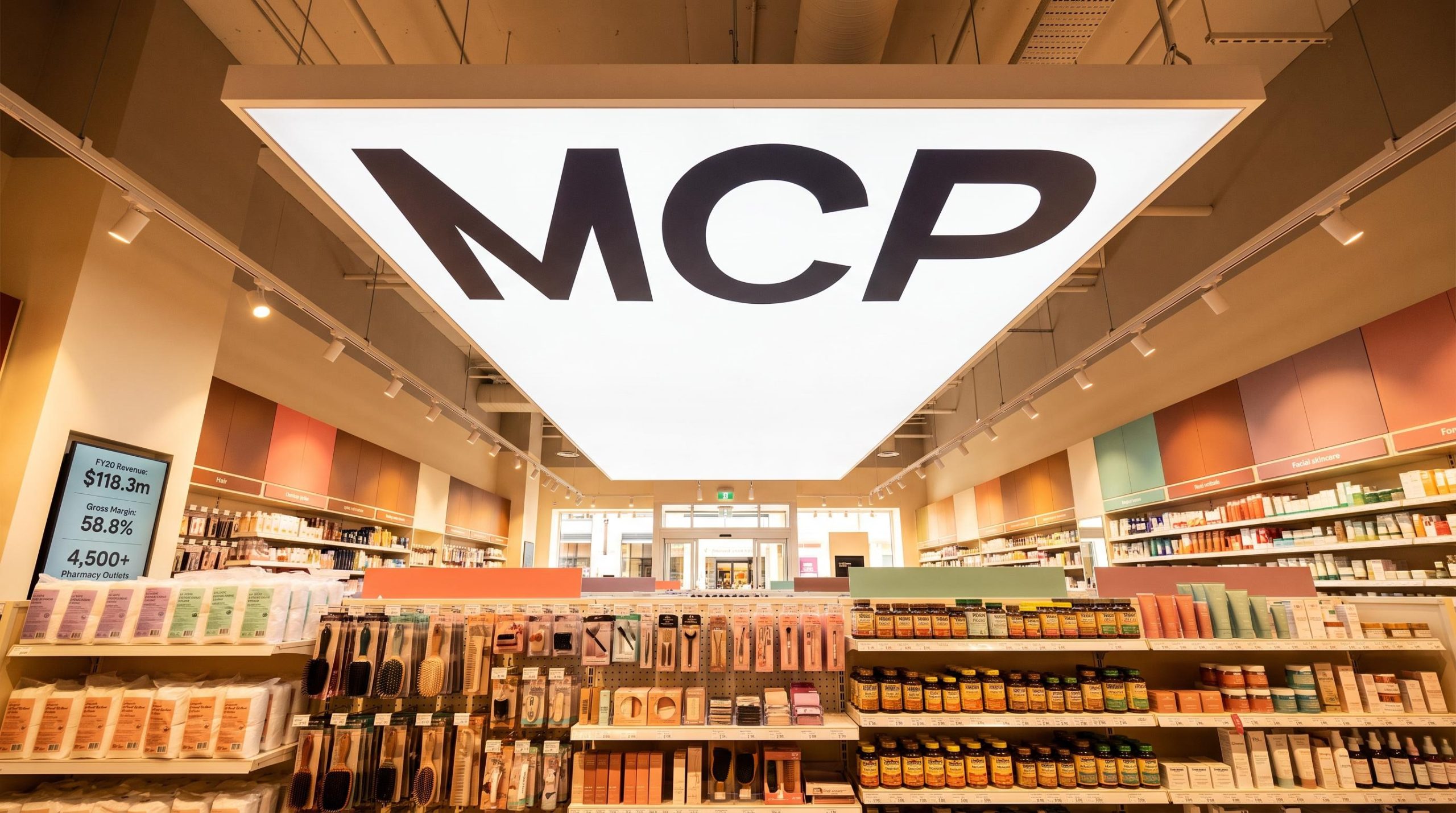
McPherson’s outlines FY26 transition year as revenue falls to $118.3m
In its FY26 results presentation delivered on 27 August 2026, McPherson’s Limited detailed a below-expectation full-year result, marking its first complete year operating under a new operating model. Revenue for the year ended 30 June 2026 declined 14.9% to $118.3m, with underlying EBITDA down 41.4% to $4.3m and a statutory net loss after tax of ($20.3m).
Management was candid that route-to-market transition and execution challenges weighed on the period. The company ended the year with net cash of $4.5m and pointed to structural savings unlocked, a completed debt refinance, and a defined FY27 recovery plan.
When big ASX news breaks, our subscribers know first
FY26 results at a glance
The headline metrics reflected a year shaped by transition disruption and softer trading, partially cushioned by a lower-cost operating base and improved gross margin.
The FY26 revenue downgrade had been flagged in July 2026, when McPherson’s guided to a $115m-$120m revenue range and confirmed that non-cash intangible impairments of $15m-$20m would be recorded as material items, with out-of-stock issues described as largely resolved by that point.
| Metric | FY26 | FY25 | Change |
|---|---|---|---|
| Revenue | $118.3m | $139.0m | (14.9%) |
| Core Brand Revenue | $110.5m | $124.6m | (11.3%) |
| Underlying EBITDA | $4.3m | $7.3m | (41.4%) |
| Underlying NPAT | ($0.5m) | ($0.1m) | ($0.4m) |
| Statutory NPAT | ($20.3m) | ($15.0m) | ($5.2m) |
| Net Cash | $4.5m | $8.8m | ($4.3m) |
What drove the FY26 result
The challenges
Management outlined four principal headwinds that impacted FY26 sales:
-
The route-to-market transition created greater disruption than anticipated, particularly in independent pharmacy.
-
Out-of-stock issues in Dr. LeWinn’s reduced product availability and promotional participation.
-
Promotional activity did not generate the level of demand targeted.
-
Performance in Fusion Health came in weaker than expected.
The structural progress
Set against these challenges, the presentation detailed tangible benefits delivered by the transition, forming the foundation of the recovery case:
-
The pharmacy wholesale model transition is now complete, with products available in 4,500+ pharmacy outlets, up approximately 950 outlets on FY25.
-
Structural benefits from the new operating model were unlocked, contributing approximately $2.8m EBITDA and approximately $5.6m EBIT.
-
New e-commerce sites were launched for Dr. LeWinn’s and Fusion Health.
-
Debt facilities were refinanced and right-sized to the new operating model.
Understanding McPherson’s route-to-market transition
For investors weighing the result, understanding the operating model shift is central to interpreting the revenue decline. A route-to-market transition refers to how a company moves products from its warehouses to retailers and consumers.
McPherson’s shifted from in-house distribution toward a wholesaler and third-party logistics (3PL) model, outsourcing warehousing and delivery. This lowers the fixed-cost base by making the business more asset-light, though it introduces new wholesaler rebates that are now accounted for as an offset to revenue.
The practical effect is that reported revenue can optically fall even where underlying volumes hold, because those rebates reduce the recorded sales figure. A related factor is net transitional pipe-fill, one-off stocking revenue weighted to FY25 (approximately $4m) as pharmacy wholesalers were onboarded, which flattered the prior-year comparison.
In effect, the company accepted short-term revenue disruption in exchange for a structurally lower-cost platform.
Brand performance across the portfolio
The presentation emphasised that McPherson’s three largest brands retained category leadership even as MCP brand execution lagged. Australian scan data pointed to growing categories, with headroom in facial skincare (a $814m category) and vitamins, minerals and supplements (a $2.0b category).
| Brand | FY26 Revenue | Sales Performance | Like-for-like (ex pipe-fill/rebates) | Category Trend |
|---|---|---|---|---|
| manicare | $45.1m | (5.7%) | (0.1%) | +1.0% |
| swisspers | $21.8m | +1.0% | +4.1% | +5.4% |
| LADY Jayne | $15.8m | (18.7%) | (14.4%) | +3.6% |
| Dr.LeWinn’s | $15.7m | (22.3%) | (15.5%) | +7.8% |
| FUSION health | $12.1m | (22.1%) | (16.9%) | +5.3% |
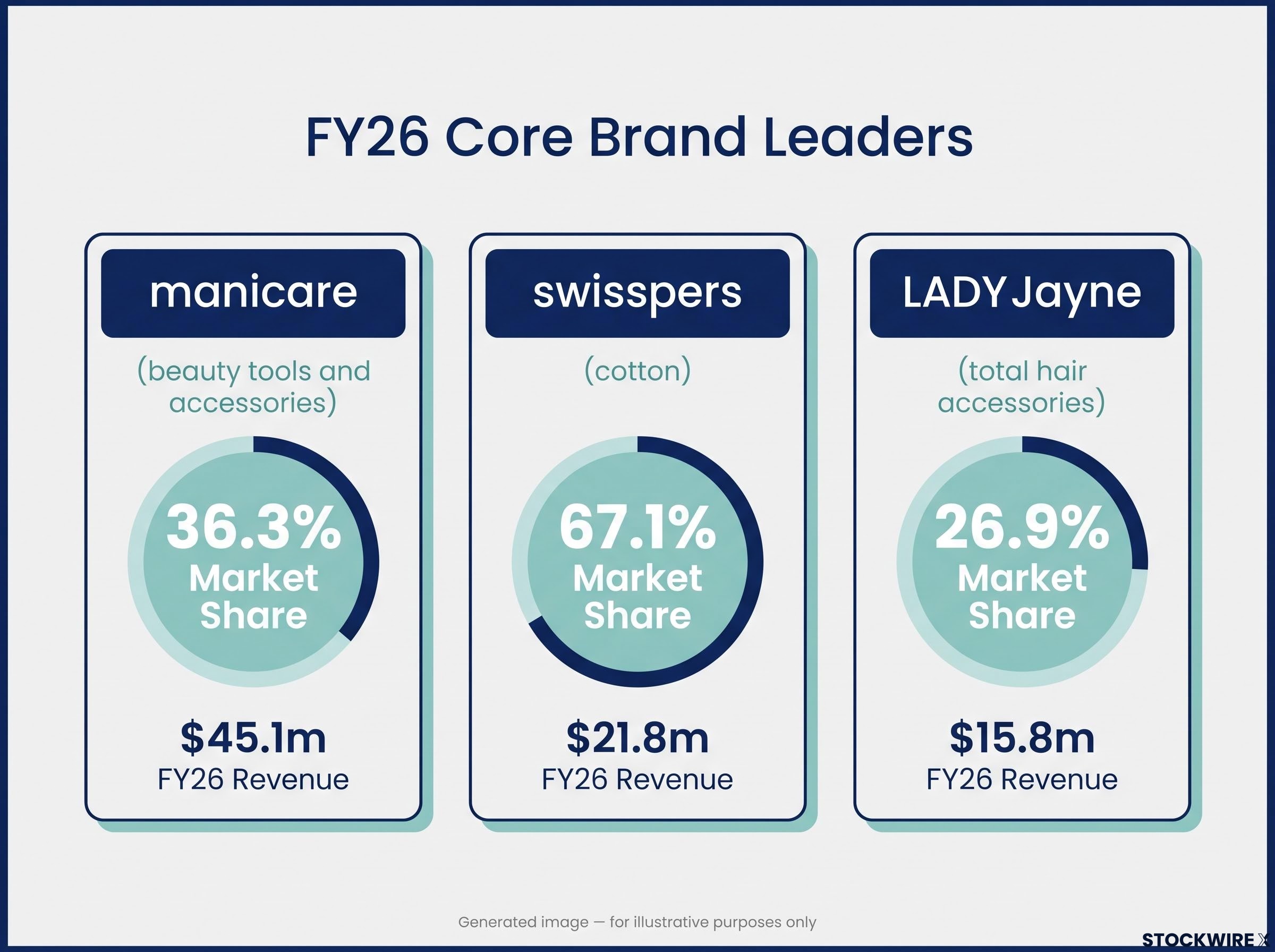
The three category leaders held share at manicare 36.3% (beauty tools and accessories), swisspers 67.1% (cotton) and LADY Jayne 26.9% (total hair accessories). Management noted that Dr. LeWinn’s out-of-stocks have now been resolved following targeted inventory investment.
Financial position and cash
New operating model benefits
Savings from the new model were achieved consistent with expectation, though they were more than offset by trading performance. Employee and other cost savings of approximately $7.7m were driven largely by the exit of the Kingsgrove warehouse. Gross margin percentage improved to 58.8%, up from 57.9% in FY25.
Material items and impairments
The result included $23.5m in non-cash material items and $2.1m in cash items, largely non-cash in nature:
-
$20.7m impairment of intangible assets, comprising $15.0m of goodwill impairment and $5.7m of brand impairments.
-
$1.5m in restructuring and transformation costs associated with the new operating model.
-
$3.3m in other items, including $2.3m in costs related to the company’s ASIC proceedings.
Cash and capital management
Net cash moved from $8.8m to $4.5m, driven mainly by a deliberate $6.4m inventory upweight to restore product availability, framed as investment rather than distress. The balance sheet remained sound, with the company undrawn on facilities offering $15m capacity.
An ATO tax benefit of $3.3m was secured earlier in FY26 following a review of strategic alliance costs, providing a cash contribution to the balance sheet at a point when the company was navigating operating model costs and a declining net cash position.
No final dividend was declared, reflecting the retained losses balance at 30 June 2026 and the FY26 loss after tax. An on-market buyback was initiated, which the company described as reflecting continued confidence in its long-term strategy.
FY27 priorities and outlook
Management framed FY27 around building brand momentum and driving revenue growth, setting out five priorities:
-
Strengthen customer engagement through joint business development planning.
-
Optimise wholesaler ranging by increasing SKU availability of bestsellers.
-
Accelerate growth through new social and creator-led marketing.
-
Increase the launch frequency of the innovation pipeline, supported by sustained A&P investment.
-
Upweight investment in e-commerce capabilities across owned and marketplace channels.
The company was candid that subdued sales in 4Q26 continued into July. With the benefit of the new operating model, its FY27 priorities and a disciplined approach to cost management, McPherson’s stated it is focused on delivering underlying EBITDA growth for the full year.
Management commentary from Brett Charlton indicated the company enters FY27 with a clear imperative to build brand momentum and drive revenue growth, converting a stronger platform into improved financial performance.
Don’t Miss the Next Consumer Sector Turnaround
Get breaking ASX consumer sector news delivered to your inbox within minutes of release, complete with in-depth analysis already done for you. Join 20,000+ subscribers staying ahead of the market with FREE real-time alerts. Click the “Free Alerts” button at Big News Blast to make sure the next move reaches you before the market reacts.