
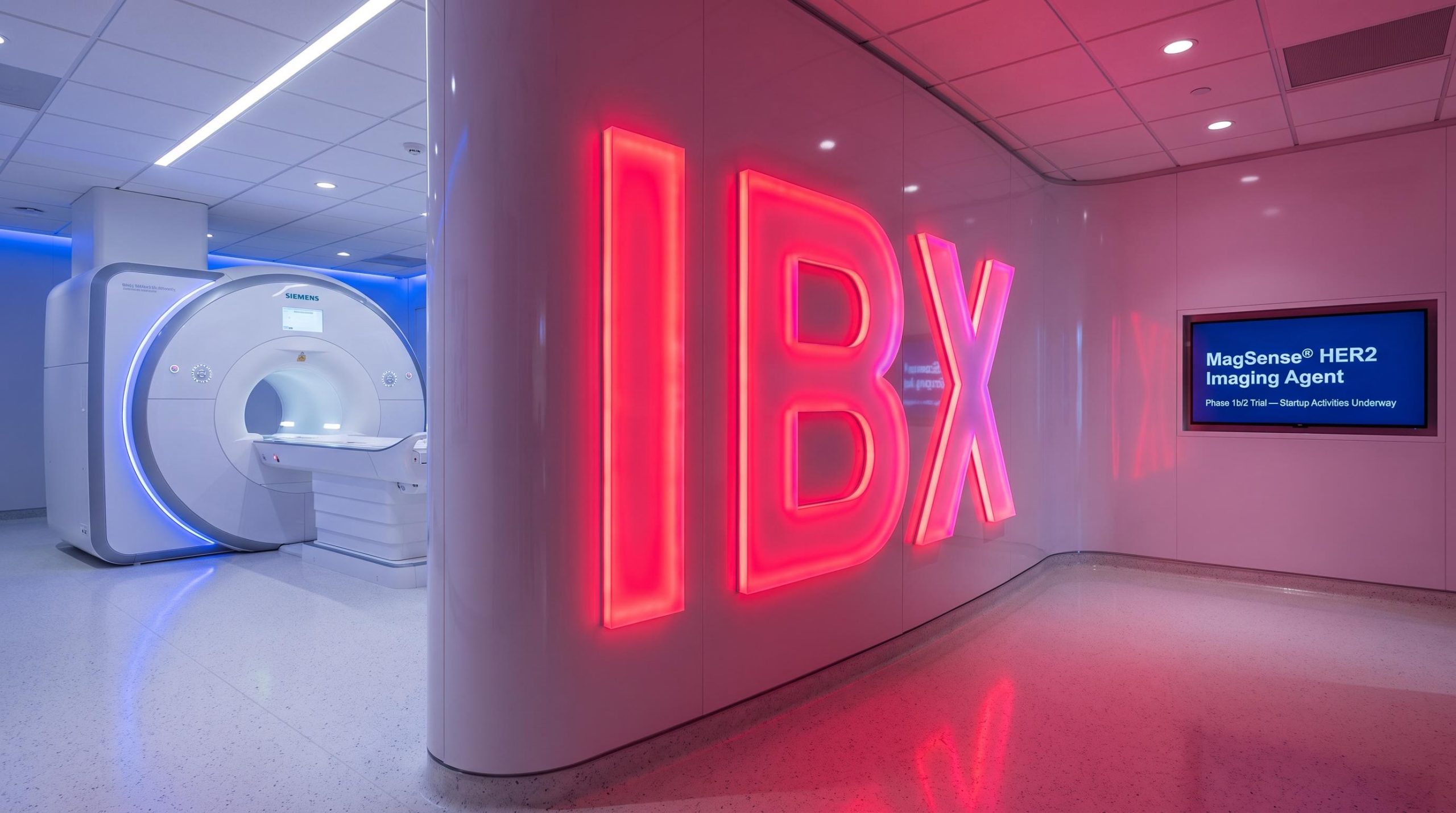
Imagion locks in CRO partners as MagSense® agent readied for Phase 1b/2 breast cancer trial
Imagion Biosystems (ASX: IBX) has executed Work Orders with its primary contract research organisation (CRO), plus separate CROs managing imaging and pathology responsibilities, for the MagSense® HER2 Imaging Agent Phase 1b/2 Clinical Trial. Manufacturing of the MagSense® HER2 investigational product (IP) is complete and ready for distribution to trial sites.
Imagion is an ASX-listed clinical-stage medical imaging company advancing non-invasive, non-radioactive cancer detection. Study initiation activities are now underway across seven prospective trial sites, with contract negotiation initiated with the first site after receiving confirmed intent to participate.
These are the concrete steps that move the Trial from FDA clearance in June toward eventual enrolment. Importantly, the study has not yet opened for enrolment, with several startup activities still to be completed.
The FDA clearance milestone in June assigned IND number 165081 via a Study May Proceed Notice, converting years of preclinical and Phase 1 work into a cleared regulatory pathway for the Phase 1b/2 programme now moving through site startup.
When big ASX news breaks, our subscribers know first
Key steps completed toward study startup
The announcement outlined five key highlights of progress made since the June IND clearance:
-
Phase 1b/2 Trial Work Orders signed with the primary CRO plus imaging and pathology CROs, with startup activities now underway.
-
MagSense® HER2 investigational product (IP) manufacturing complete, having passed requisite stability testing, with distribution logistics in place.
-
Contract negotiation initiated with the first USA clinical trial site after confirmed intent to participate was received.
-
Study initiation activities underway with seven prospective trial sites.
-
Imaging protocol finalised, incorporating advanced quantitative MRI techniques developed through the previous research engagement with Wayne State University and validated for clinical adoption via the company’s collaboration with Siemens Healthineers.
These CRO relationships support the integrity and clinical compliance of the study, advancing site selection and onboarding, data management, investigator training, and participant recruitment strategies.
Before the study can formally open for enrolment, the company and its partners must still complete several remaining startup activities. These include relevant Institutional Review Board (IRB) approval(s), registration with ClinicalTrials.gov, investigator training, and IP shipment to engaged sites. This sequential approach signals disciplined, methodical de-risking rather than a completed launch.
Why the MagSense® HER2 imaging trial matters
Each year, approximately 450,000 women receive a HER2-positive (HER2+) breast cancer diagnosis globally. The HER2+ subtype is considered an aggressive phenotype, associated with a high rate of recurrence and metastasis, which carries significant prognostic and predictive implications for patients.
After a new diagnosis, clinicians perform nodal staging, a process that evaluates whether cancer has spread to nearby regional lymph nodes. Precise nodal staging is essential to breast cancer management, as treatment decisions depend on the primary tumour characteristics, nodal status, and evaluation for distant metastatic disease.
The most commonly employed imaging method is ultrasound. While convenient and potentially lower cost compared to MRI, ultrasound faces diagnostic challenges, resulting in wide variability in both sensitivity and specificity, as well as limited ability to assess the extent of disease spread. Accurate nodal assessment to support early cancer diagnosis therefore represents a critical unmet need.
MagSense® technology is a new class of MRI imaging agent that adds molecular specificity without using radioactivity or ionizing radiation. According to the company, MagSense® agents will be the first imaging technology to use targeted magnetic nanoparticles to tag and detect cancers for MRI visualisation.
In the successfully completed Phase 1 study, independent radiologists found that the MagSense® HER2 Imaging Agent produced a readily identifiable change in MRI images, differentiating between tumour-involved and non-involved nodes. The combination of a large addressable patient population and a clear diagnostic gap underpins the commercial rationale for the programme.
Inside the Phase 1b/2 trial design
The Trial is designed in three parts, beginning with an initial cohort to collect additional safety data (Part A), as agreed with the FDA. A reduced dosing regimen and optimised imaging protocol are then evaluated in a second group (Part B), before proceeding to a larger cohort to establish diagnostic performance (Part C).
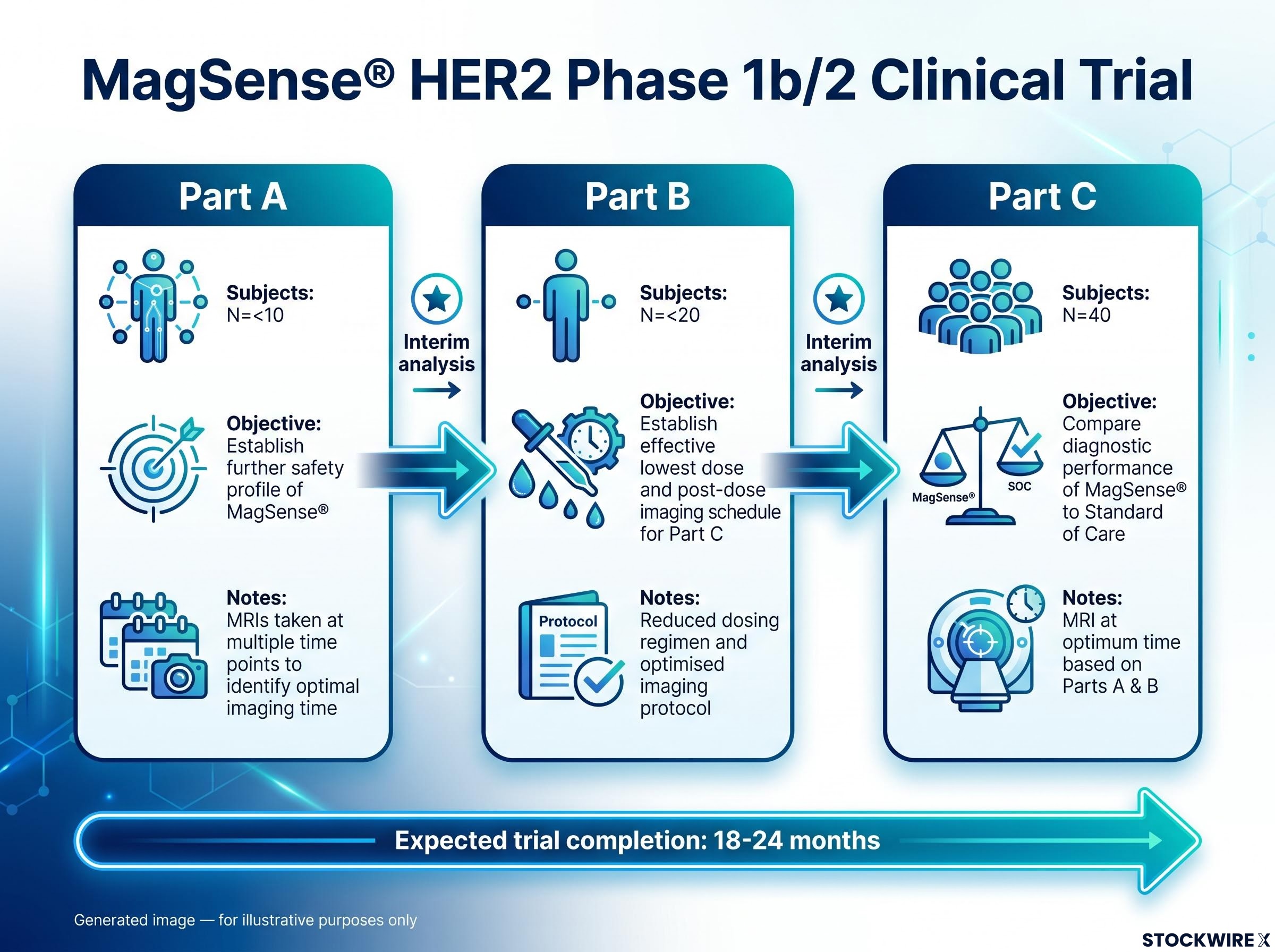
| Trial Part | Subjects | Objective | Notes |
|---|---|---|---|
| Part A | N=<10 | Establish further safety profile of MagSense® | MRIs taken at multiple time points to identify optimal imaging time |
| Part B | N=<20 | Establish effective lowest dose and post-dose imaging schedule for Part C | Reduced dosing regimen and optimised imaging protocol |
| Part C | N=40 | Compare diagnostic performance of MagSense® to Standard of Care | MRI at optimum time based on Parts A & B |
The Trial is expected to be completed in 18-24 months, with interim analyses anticipated after Part A and after Part B. Beyond diagnostic performance, the results are expected to provide insight into the potential impact on cost of care, patient outcomes, and overall clinical value. By integrating quantitative imaging techniques, the Trial will also yield data useful for the development and training of AI diagnostic tools.
Dr. Eghtedari, Section Chief, Women’s Imaging in the Department of Diagnostic Radiology at City of Hope hospital in Los Angeles, California, will serve as principal investigator. Dr. Eghtedari also participated as an independent reviewer of the MagSense® HER2 Phase 1 study.
Management commentary
Ward Detwiler, President, Imagion Biosystems, Inc.
“Since receiving our IND clearance and Study May Proceed notice from the U.S. FDA in June, the Imagion team and its key Trial partners have been laser focused on Trial initiation activities. We have been making tremendous progress towards study start-up and look forward to opening the Clinical Trial for enrolment as quickly as possible.”
What’s next for Imagion investors
The near-term roadmap centres on completing the remaining startup activities required before the study can formally open for enrolment:
-
Finalise the first site contract and progress additional site contracting.
-
Secure relevant IRB approval(s).
-
Register the study on ClinicalTrials.gov.
-
Complete investigator training.
-
Ship the IP to engaged sites, then formally open the study for enrolment.
Beyond the lead programme, the MagSense® technology is extendable. Imagion has identified two additional agents targeting prostate cancer and ovarian cancer, which could progress into IND-enabling studies as resources become available.
For investors, the interim analyses anticipated after Parts A and B offer potential data catalysts as the lead programme advances toward commercialisation, with the broader platform providing additional pipeline optionality.
For investors exploring the funding structure behind the trial’s execution, our full explainer on the $3.75 million placement covers the two-tranche structure, shareholder approval mechanics, and the option terms attached to new shares issued to participating investors.
Don’t Miss the Next ASX Healthcare Breakthrough
Big News Blast delivers FREE breaking ASX healthcare news straight to your inbox within minutes of release, complete with in-depth analysis. Join 20,000+ subscribers already staying ahead of the market. Click the “Free Alerts” button at StockWire X to get the next market-moving announcement the moment it drops.