The US dollar is sitting at one of the most analytically interesting points in recent memory, and the reason is not drama but the absence of it. Real yields on long-dated Treasuries are near 3% in inflation-adjusted terms, a level that should, by most historical standards, be pulling capital into dollar assets with force. Yet the dollar is range-bound, refusing to break meaningfully higher or lower.
Today’s Jackson Hole symposium (25 August 2026) has sharpened the debate. OCBC analysts Sim Moh Siong and Christopher Wong have published a framework explaining their neutral USD positioning over the next one to two quarters, concluding that dollar-supportive and dollar-capping forces are currently in rough equilibrium, with Fed credibility on inflation representing the key variable that could ultimately break the stalemate. Their framework is the anchor for this analysis.
Here is the evidence-based framework for reading dollar signals over the coming quarters, including the specific indicators that would signal a range break and the three forces holding the currency in place.
Why the dollar has a floor: real yields and the AI investment effect
Start with the number.
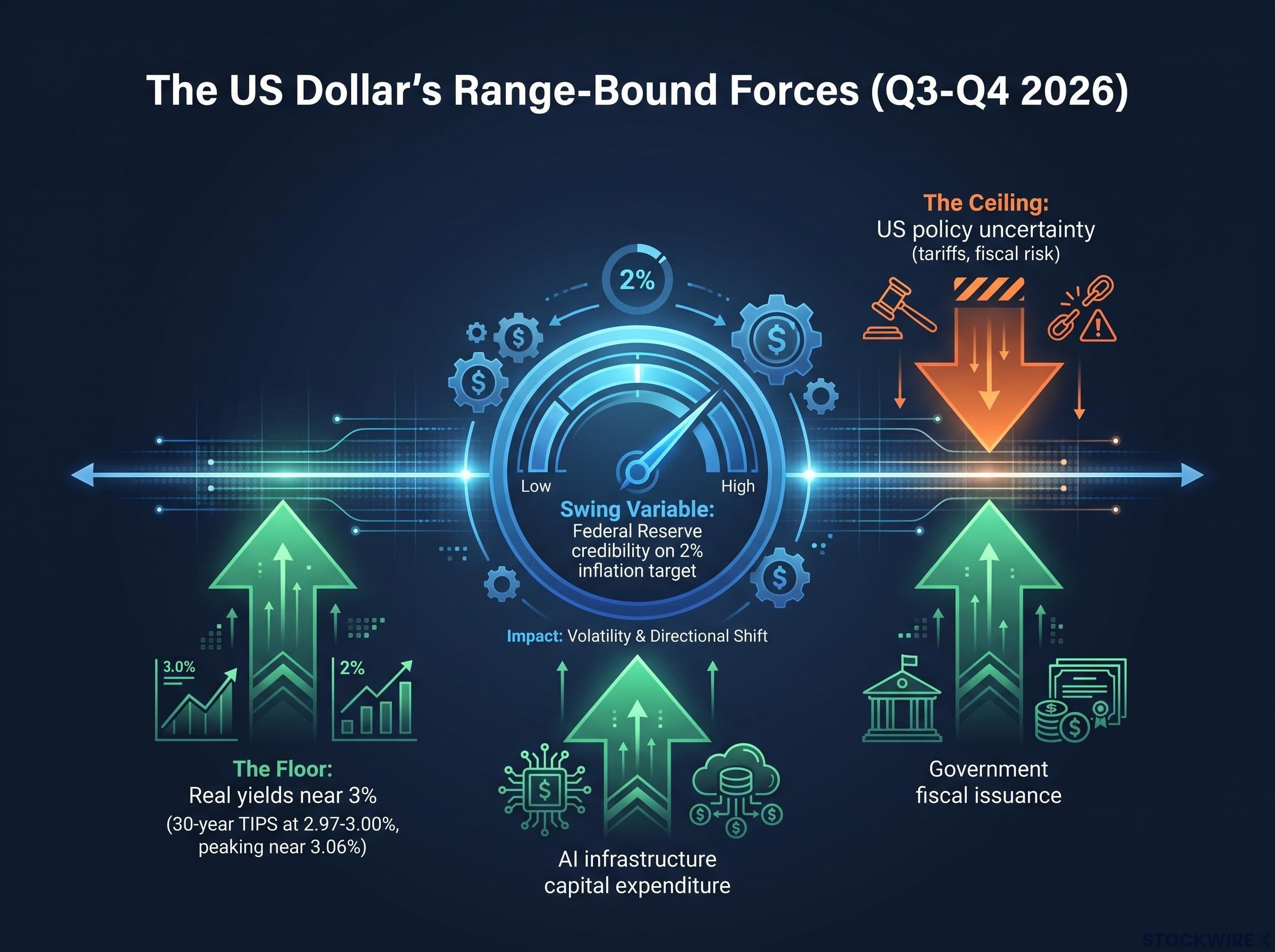
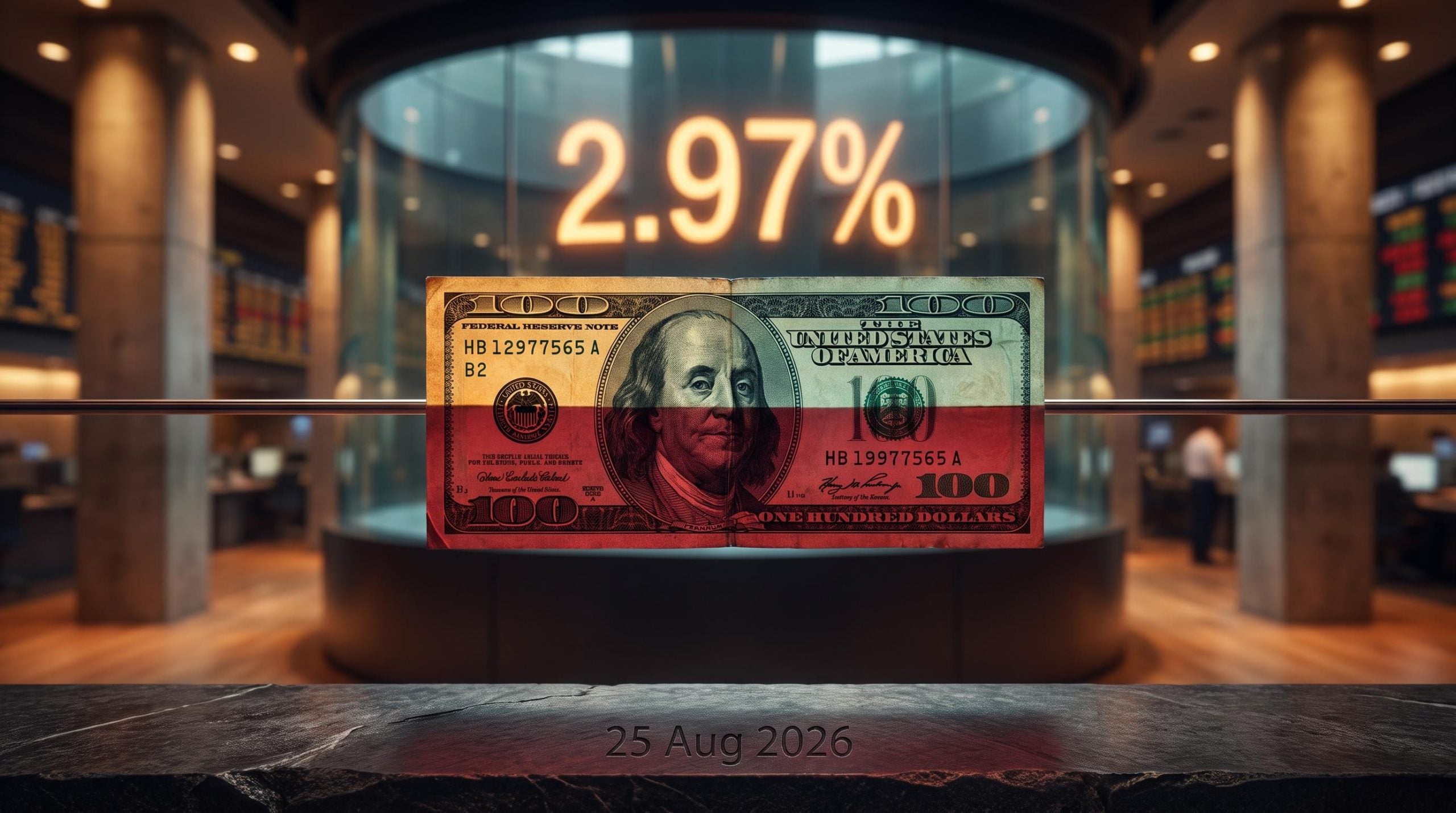
30-year TIPS real yields sat at approximately 2.97-3.00% in late August 2026, with intraday session peaks reaching near 3.06%.
That figure carries weight. A 3% inflation-adjusted yield on long-dated US government debt means investors are being paid a meaningful, real premium simply for holding dollar assets. That premium is the most concrete reason the dollar has not broken lower despite months of political noise and policy uncertainty.
The mechanism is direct. Elevated real yields raise the relative appeal of dollar-denominated bonds and other assets compared with alternatives denominated in euros, yen, or sterling. Capital flows toward the higher real return, and those inflows support the currency. Market strategists have noted that higher US bond yields and still-decent growth prospects attracted capital into dollar assets through 2026, even as sentiment wavered on other fronts.
The question is what has pushed real yields to these levels, and whether that pressure is durable.
How AI investment and government borrowing are keeping real rates elevated
Three structural forces are driving the elevated real yield environment:
- AI infrastructure capital expenditure: Hyperscale technology companies are funding enormous buildouts, competing for long-term capital and increasing the supply of debt instruments
- Government fiscal issuance: Heavy sovereign bond issuance to fund deficits has added to the supply of long-duration paper, forcing up yields as compensation to attract buyers
- Investor demand for inflation-adjusted returns: After years of negative or near-zero real yields, allocators now require meaningful real compensation before committing to long-duration positions
The supply-demand dynamic is straightforward. More long-term paper hitting the market means issuers must offer higher real yields to clear the supply. AI capex and fiscal borrowing are both contributing to that supply pressure from different directions.
AI capital expenditure among hyperscalers is projected to reach $755-$800 billion in 2026 and absorb close to 94% of operating cash flow, a scale of long-term paper issuance that feeds directly into the supply-side pressure keeping real yields elevated and creating the dollar’s current yield floor.
Academic and central bank analysis cautions that AI investment may not yet dominate macro outcomes at the whole-economy level. But the narrative is clearly influencing how investors price dollar assets right now. Whether the effect is permanent or not, it is priced in, and that pricing is what gives the dollar its floor. Before asking whether the dollar will weaken, you need to understand the premium you are betting against. At nearly 3% real, that is a substantial hurdle.
The supply-demand dynamic across long-duration paper does not stop at currencies; real yield pressure on equities operates through a parallel channel, compressing equity risk premiums and raising discount rates simultaneously, a transmission mechanism that has historically produced equity drawdowns before any deterioration in underlying earnings.
When big ASX news breaks, our subscribers know first
What is capping the dollar’s upside: the anatomy of policy uncertainty
If real yields explain why the dollar has not collapsed, they do not explain why it has not surged. That requires a different lens.
Not all uncertainty works the same way for the dollar. Global uncertainty shocks, a pandemic, a war in a region far from the US, tend to push the dollar higher as investors seek safety in the world’s reserve currency. But when the source of uncertainty is US policy itself, the safe-haven dynamic inverts. Investors diversify away from dollar assets rather than toward them.
| Uncertainty type | Dollar effect |
|---|---|
| Global uncertainty (geopolitical, pandemic) | Safe-haven inflows support the dollar |
| US-sourced policy uncertainty (tariffs, fiscal risk) | Diversification outflows cap or weaken the dollar |
This distinction is what makes the current cycle different from prior episodes. The uncertainty weighing on the dollar is not coming from abroad. It is originating in Washington.
NBER research finds that heightened tariff uncertainty can weaken the currency of the tariff-imposing country by reducing goods demand and introducing a risk premium that weighs on the exchange rate.
Tariff policy is the clearest channel. Market strategists argue that recent and prospective US tariffs are likely to slow growth and weaken the dollar over a 12-month horizon. But tariffs are not the only source. Fiscal sustainability questions and budget resolution uncertainty have added to the discount that investors apply to long-term dollar positioning.
Fiscal credibility and the dollar have become linked through a channel the current cycle has made newly visible: the US Treasury’s scaled-up buyback operations for longer-dated bonds were read by markets as quasi-monetisation, introducing a debasement narrative that sits alongside tariff uncertainty as a second source of the policy-risk discount capping dollar upside.
Studies using Economic Policy Uncertainty (EPU) indices, a measure of policy unpredictability derived from news coverage, legislative activity, and forecaster disagreement, confirm the link. Higher US policy uncertainty is associated with greater volatility in the dollar’s effective exchange rate and can alter its correlation with macroeconomic variables. When future policy is hard to read, investors hedge and diversify rather than building concentrated dollar-long positions.
This reframes the bull case. Pointing to real yields alone as a reason to be long the dollar is insufficient if policy uncertainty is simultaneously imposing a discount that offsets the yield advantage. The OCBC analysis shows that elevated policy uncertainty acts as a binding constraint on how far the dollar can advance, regardless of whether the underlying rate environment is broadly favourable. The range is not just a rate-differential story; it reflects a structural risk premium that will not disappear until the policy environment becomes more legible.
Fed credibility as the swing variable: what Jackson Hole reveals
Real yields provide the floor. Policy uncertainty provides the ceiling. The variable that determines which force eventually dominates is Federal Reserve credibility on inflation.
The mechanism is direct. If investors trust that the Fed will defend its 2% inflation target, the real yield embedded in dollar assets is credible. That trust reduces the risk premium attached to holding dollars, because investors believe their inflation-adjusted returns will be protected. If that trust erodes, the yield figure stops meaning what it appears to mean. A 3% real yield is only as good as the inflation framework underpinning it.
The Fed credibility gap is already visible in the yield curve’s structure: long-term Treasury yields rose after the July FOMC meeting while short-term yields fell, a steepening that signals investors are pricing an ongoing inflation-resolve discount into long-end rates rather than treating the 2% target as fully defended.
Time-series evidence from the recent global tightening cycle confirms that changes in monetary policy expectations have economically meaningful effects on advanced-economy currencies over time, even though short-term correlations between policy shifts and exchange rate moves have been weaker than in past episodes. That weakened short-term relationship suggests the market is already discounting some credibility risk, which makes Fed communication more consequential, not less.
This is why Jackson Hole matters today, and not because a single speech will move the dollar by two handles. It matters because the symposium reveals whether the credibility premium embedded in dollar real yields is justified or vulnerable. That determination shapes which direction the range breaks over the next one to two quarters.
The two scenarios analysts are watching from Jackson Hole
OCBC’s framework identifies two signal paths:
- Credibility reaffirmed: Fed officials push back firmly against any notion of inflation tolerance, reinforcing their commitment to the 2% target and rejecting narratives that the institution might accept currency debasement as a policy outcome. This would reduce the policy-uncertainty discount on the dollar and modestly reinforce the yield floor.
- Credibility eroded: Signals of tolerance for higher inflation, or hints of political deference in the policy path, emerge from the symposium. This would undercut the real-yield support by making the inflation-adjusted return less trustworthy, raising the probability of a range break lower.
The read you should take from this is practical: Fed communication is not background noise. It is a live pricing input for every dollar-denominated position. Understanding why credibility is a priced variable positions you to interpret central bank signals as directional information, not theatre.
Breaking the range: the bull case, the bear case, and what to watch
The OCBC neutral stance over one to two quarters is not fence-sitting. It is the evidence-consistent position given the current balance of forces. Understanding what would change that balance is where the practical value lies.
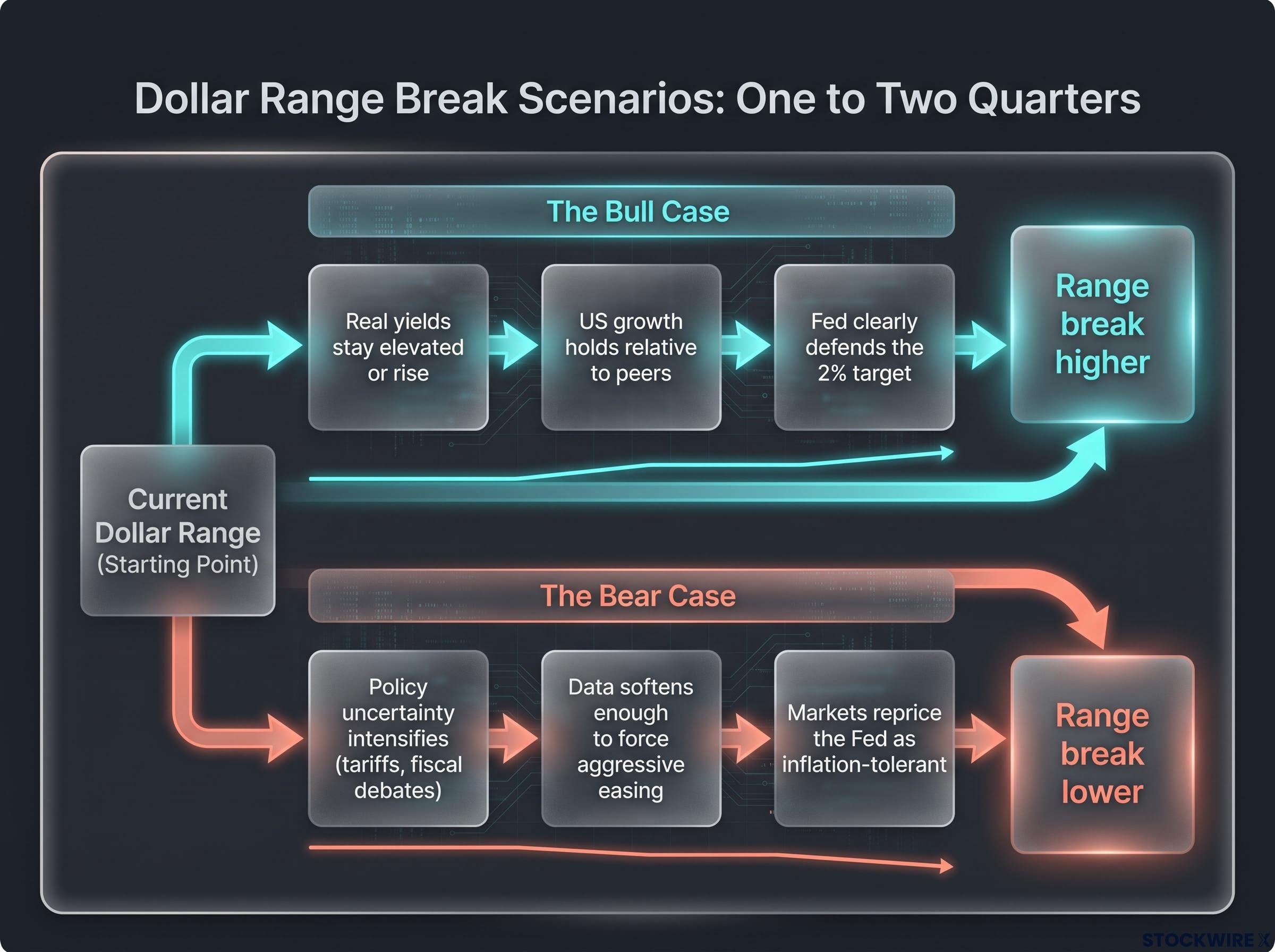
| Scenario | Conditions required | Dollar direction |
|---|---|---|
| Bull case | Real yields stay elevated or rise; US growth holds relative to peers; Fed clearly defends the 2% target | Range break higher |
| Bear case | Policy uncertainty intensifies (tariffs, fiscal debates); data softens enough to force aggressive easing; markets reprice the Fed as inflation-tolerant | Range break lower |
Neither scenario requires all three conditions simultaneously, but a credible range break likely needs at least two of the three forces to shift in the same direction. A single data point, one soft jobs report or one hawkish speech, is unlikely to be sufficient when two countervailing forces remain intact.
The OCBC framework translates into four variables worth tracking:
- TIPS and long-end real rates: Any sustained move away from the 2.97-3.00% range signals the structural floor is shifting
- AI-related investment and fiscal headlines: Watch for changes in the market’s conviction that capital demand will keep real rates elevated
- Policy and political developments: Tariff escalation, fiscal debates, or institutional developments that alter the policy-uncertainty discount
- Fed communication on the 2% target: Any softening in how strongly officials defend the inflation anchor
The asymmetry is currently limited in both directions. Conviction trades on the dollar require a clear signal from at least two of the three forces before a range break becomes credible. Tracking these four variables positions you to detect a shift before it is widely acknowledged, rather than reacting after the dollar has already moved.
What the dollar’s range actually tells you about the current macro regime
The dollar’s refusal to trend in either direction is not market indecision. It is a precise reflection of balanced forces: a real yield floor near multi-decade highs, a policy-uncertainty ceiling that prevents those yields from translating into sustained currency strength, and a Fed credibility variable that has not yet resolved in either direction.
The dollar occupies an “uncomfortable middle ground”: not weak enough to collapse, not trusted enough to surge.
Recognising that balance for what it is gives you an advantage over analysis that treats range-bound conditions as a prelude to an imminent breakout. The range may persist through Q3-Q4 2026 precisely because the forces producing it are structural rather than temporary. Jackson Hole is the most proximate catalyst for recalibration, but even there, the signal needs to be decisive enough to shift at least two of the three forces.
The OCBC one-to-two quarter neutral stance is the appropriate working timeframe for reassessment. Until real yields crack, policy uncertainty resolves, or Fed credibility tips decisively in one direction, the range is the message. Reading it clearly is the edge.
This article is for informational purposes only and should not be considered financial advice. Investors should conduct their own research and consult with financial professionals before making investment decisions. These statements are speculative and subject to change based on market developments and Federal Reserve policy decisions.