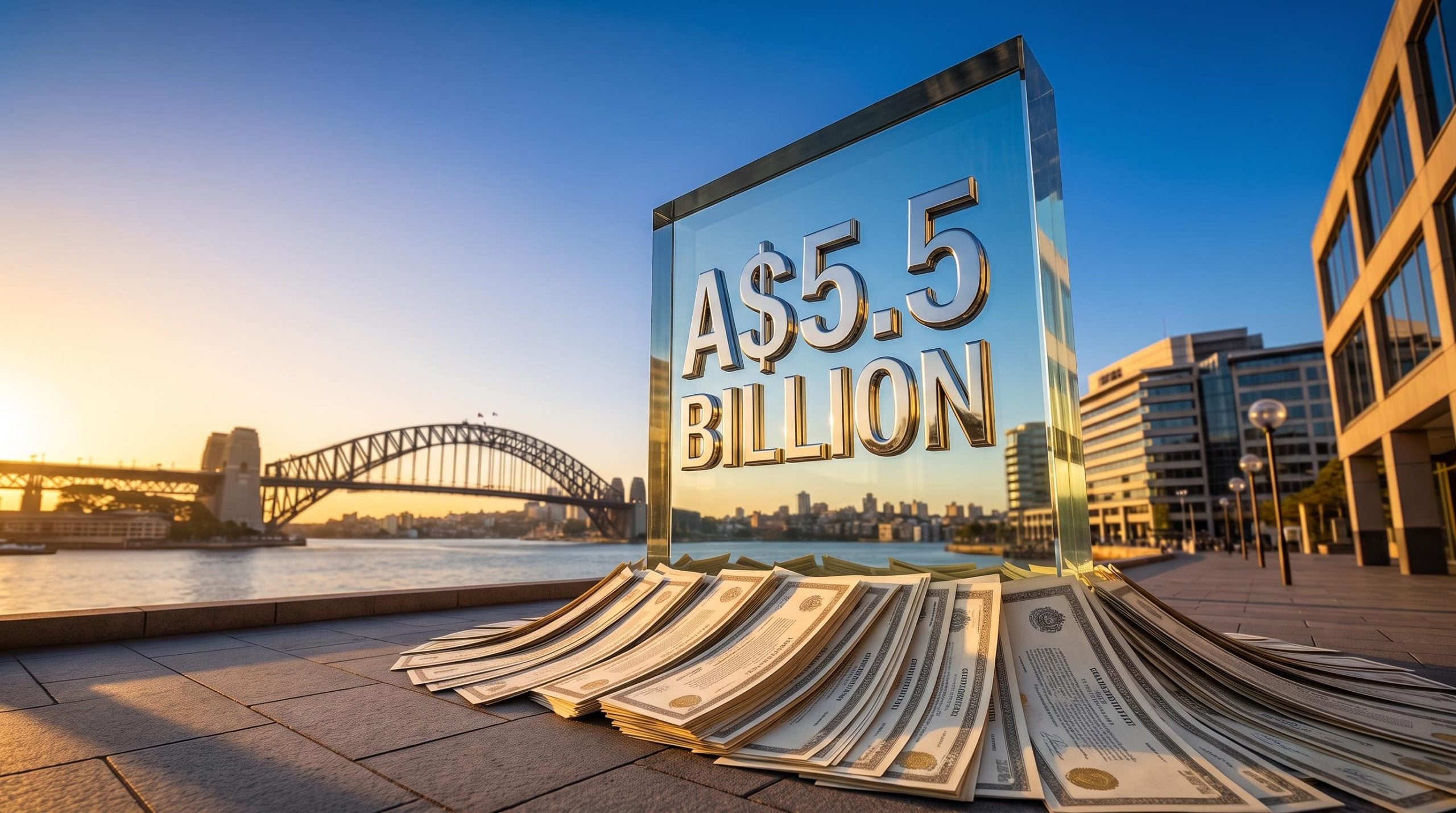
Alphabet has just completed the largest corporate bond sale in Australian market history, raising A$5.5 billion in a single week despite holding more than US$100 billion in cash. The question the deal immediately raises is not whether Google’s parent can afford its AI buildout. It is why a company that flush is borrowing at all, and what the answer reveals about the scale of the infrastructure race underway.
The transaction, priced in the week ending 25 August 2026, attracted more than 200 investors and generated orders of approximately A$18-20 billion against A$5.5 billion of bonds available. That demand-to-supply ratio of roughly three to four times tells a secondary story: Australian institutional investors, dominated by superannuation funds and asset managers, are hungry for investment-grade non-financial corporate paper that the domestic market has historically not supplied. Alphabet walked into a structural gap and filled it.
Here is what this Alphabet Australian bond deal means for the local fixed-income market’s development, what it signals about the company’s AI capital plans, and what Australian fixed-income and equity investors should take from the terms and the oversubscription figures.
The deal in detail: record size, record yield, four maturities
Alphabet structured the offering across four tranches covering roughly 3, 5, 10, and 20-year maturities. Shorter tenors were available in both fixed and floating rate formats, giving investors flexibility across duration and rate exposure. The bulk of the deal by volume sits in five-years-and-under at fixed rates in the mid-5% range, reflecting strong institutional demand for shorter-dated, high-grade paper.
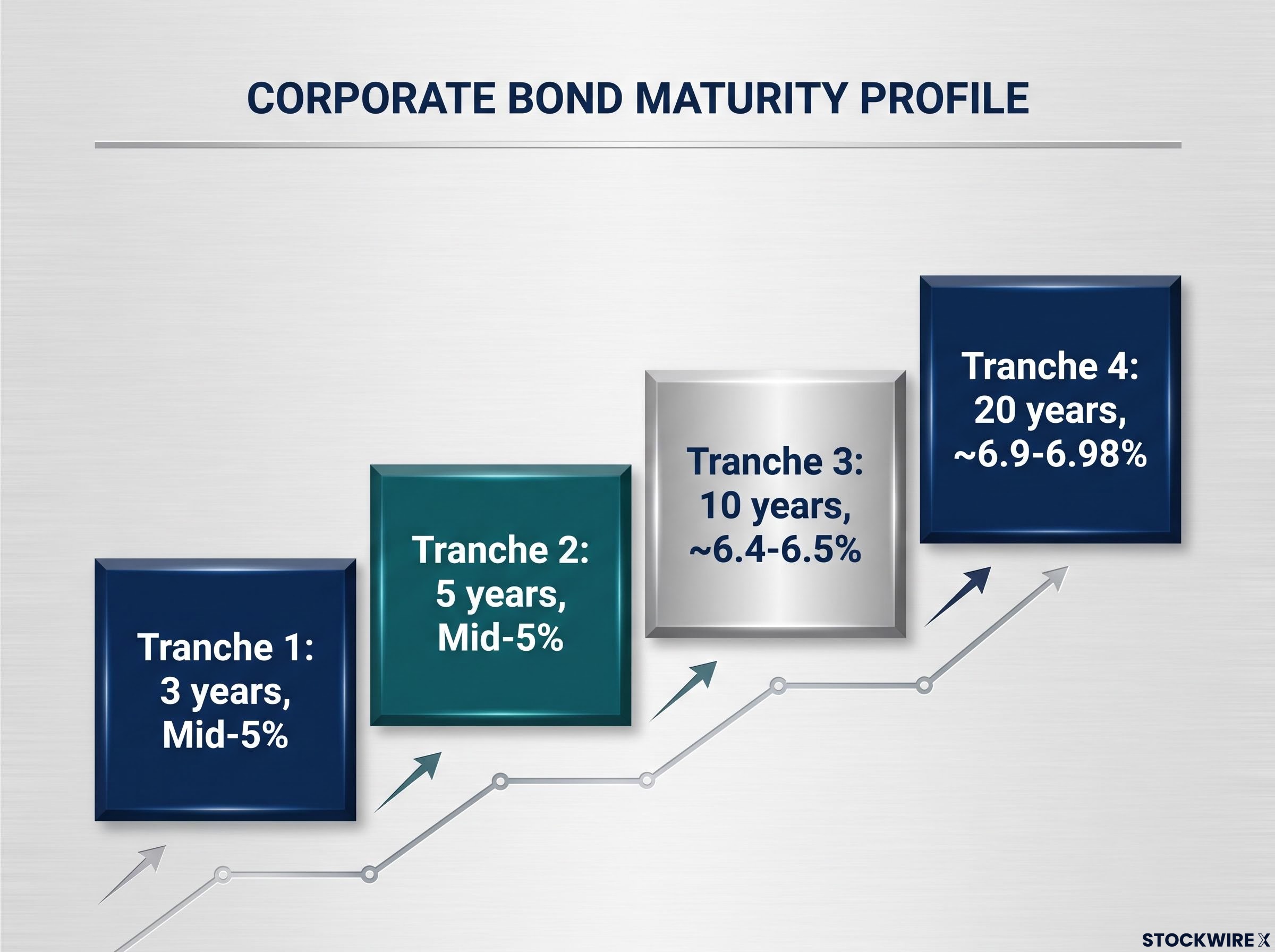
| Tranche | Approximate Maturity | Rate Type | Indicative Coupon Range |
|---|---|---|---|
| 1 | 3 years | Fixed and floating | Mid-5% |
| 2 | 5 years | Fixed and floating | Mid-5% |
| 3 | 10 years | Fixed | ~6.4-6.5% |
| 4 | 20 years | Fixed | ~6.9-6.98% |
The 20-year tranche is the headline. At a coupon of approximately 6.9-6.98%, it represents the highest borrowing cost Alphabet has paid on record for a bond. That is a company with one of the strongest balance sheets in global corporate history choosing to lock in its most expensive debt ever, and to do so for two decades.
Oversubscription: Approximately A$18-20 billion in orders against A$5.5 billion of bonds available, a demand-to-supply ratio of roughly three to four times.
The willingness to pay near-record yields for 20-year paper tells you something specific about Alphabet’s management: they have assigned a long time horizon to AI infrastructure returns, and they are matching it with the longest and most expensive debt they have ever issued. That is not a company hedging its bets. That is a company pricing in conviction.
When big ASX news breaks, our subscribers know first
Why Australia, why now, and what makes this a market first
Australia’s corporate bond market has long been dominated by domestic banks and government borrowers. Non-financial corporate issuers have been a rare presence, and those that have appeared have typically stuck to shorter maturities and smaller deal sizes. The investor base, heavily weighted toward superannuation funds managing trillions of dollars in retirement savings, has been structurally undersupplied with the kind of investment-grade non-financial corporate paper that is routine in the US market.
Alphabet’s multi-maturity offering is a departure from those norms. The deal carries several firsts:
- First AI hyperscaler to issue Australian-dollar Kangaroo bonds (bonds issued in Australia by a foreign borrower, denominated in Australian dollars)
- First US large-cap technology issuer to tap the AUD market since Apple’s deal in 2016, approximately ten years prior
- Largest corporate bond sale ever completed in Australia
- Largest local non-financial corporate issuance on record
Joel Grosvenor, portfolio manager at Morningstar Investment Management, and Mark LaMonica, CFA, Director of Personal Finance at Morningstar Australia, described the transaction as among the largest deals within Australia’s corporate bond segment.
The structural gap Alphabet stepped into
The chronic undersupply of investment-grade non-financial corporate paper in Australia relative to superannuation fund demand created the opening. Australian financial sector issuers have historically favoured shorter-dated debt, leaving duration-hungry institutions with limited domestic options. Alphabet stepped into that gap with a four-tranche structure stretching out to 20 years.
For Australian fixed-income investors, the arrival of the world’s largest technology company as a local-currency borrower signals that the Australian market has crossed a credibility threshold. If Alphabet treats Australia as a viable large-scale debt market, peer hyperscalers now have a tested template to follow.
The cash paradox: why Alphabet is borrowing despite sitting on more than US$100 billion
The headline contradiction is straightforward. Alphabet holds well over US$100 billion in cash and liquid investments, yet chose to borrow at the highest yield in its bond-issuance history.
Alphabet holds well over US$100 billion in cash and liquid investments, yet chose to borrow at near-record yields.
The resolution sits in how large-scale infrastructure financing actually works. AI infrastructure assets, including data centres, custom chips, power and cooling systems, land, and fibre, are long-lived assets. They generate returns over decades, not quarters. Matching them with long-dated liabilities is standard asset-liability management, and doing so at investment-grade spreads while preserving cash for buybacks, acquisitions, and unexpected shocks is a strategic choice, not a sign of strain.
The stated uses of proceeds map directly to the AI buildout:
- Data centres
- Custom chips
- Power and cooling infrastructure
- Land
- Fibre
This also sits within a broader sector-wide shift. The AI capital expenditure that hyperscalers once covered entirely through robust operating cash flows has grown to a point where debt markets are now being tapped to carry a meaningful share of the load. At the spending volumes required for large-scale AI infrastructure build-out as of August 2026, relying solely on internal generation is no longer sufficient. Alphabet’s broader funding programme includes multi-part US dollar offerings and other currency deals explicitly linked to AI and cloud infrastructure expansion.
For equity investors in Alphabet, the distinction matters. The debt issuance does not signal financial stress. It signals management’s conviction that AI infrastructure returns justify locking in long-dated funding now, even at the highest borrowing cost in the company’s history. That is the difference between “borrowing because you need to” and “borrowing because the strategic calculus favours it.” The former compresses multiples. The latter supports them.
What the investor demand figures reveal about Australian fixed income
The A$18-20 billion in orders against A$5.5 billion of bonds available is not just a measure of Alphabet’s credit quality. It is a measurement of unmet demand.
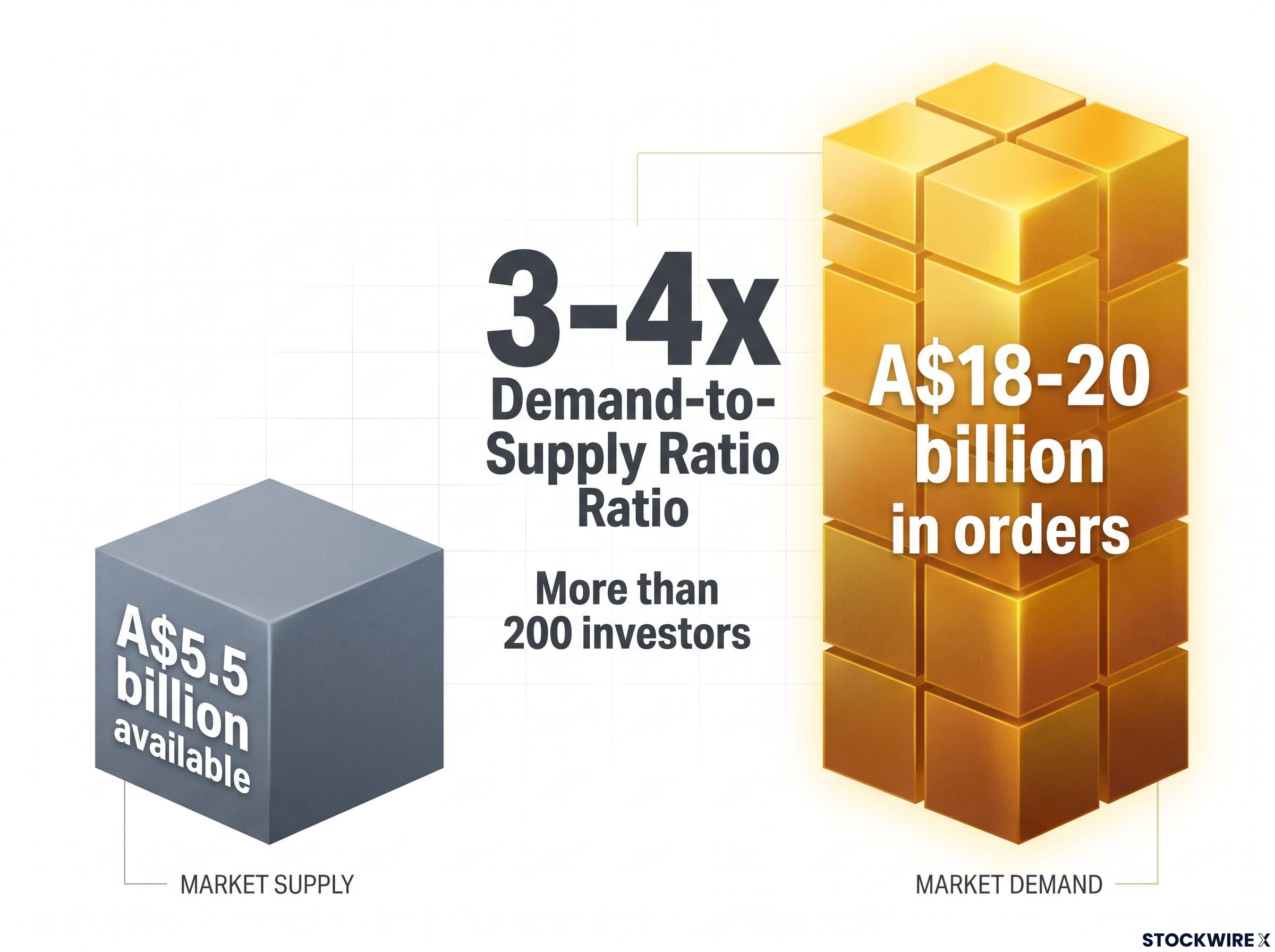
The three-to-four times oversubscription, drawn from more than 200 participating investors, reveals three things about the structural condition of the Australian bond market:
- Chronic shortage of non-financial corporate paper. The Australian corporate bond market has historically been shaped by financial-sector issuers concentrated in shorter maturities, leaving institutions seeking sector diversification and duration with few domestic avenues to pursue them. The scale of oversubscription reflects that accumulated unmet demand, rather than Alphabet’s credit quality alone.
- Institutional breadth of demand. The participation of more than 200 investors, encompassing global asset managers and superannuation funds, confirms the demand is diversified. This is not a concentrated bet by a handful of large accounts.
- A template created for peer hyperscalers. The deal provides a tested pricing benchmark and investor-base map that removes the primary uncertainty preceding a debut issuance.
Which hyperscalers could follow Alphabet into the AUD market
Microsoft, Amazon, and Meta are the peer hyperscalers most likely to consider AUD issuance given their comparable credit quality and AI infrastructure spending programmes. Alphabet’s deal now provides a pricing reference and an investor-base map that removes the guesswork that would have preceded any of those companies attempting a debut offering.
For Australian fixed-income investors, the demand figures are a signal that similar high-grade non-financial corporate deals may follow, potentially expanding the investable universe and providing more alternatives to bank paper and government bonds.
What this deal changes for Australian investors, and what to watch next
The implications split cleanly along asset-class lines.
For fixed-income investors:
- The deal expands the investable universe with local-currency exposure to one of the world’s strongest investment-grade technology credits, removing FX risk and offshore custody complications
- The four-tranche structure offers duration flexibility from short-dated floating rate paper to 20-year fixed, a breadth not previously available in Australian non-financial corporate issuance
- Any repeat or peer deal would further shift the composition of the local corporate bond market away from its historical financial-sector dominance
For equity investors:
- The debt issuance confirms the priority and scale of Alphabet’s AI infrastructure commitment across multiple currencies and geographies
- Near-term free cash flow pressure from the AI buildout is offset by management’s strategic conviction about long-term returns, evidenced by their willingness to issue at the highest borrowing cost in the company’s history
- The AUD deal is part of a broader multi-currency funding programme explicitly linked to AI and cloud infrastructure expansion
Three indicators to watch: Whether Alphabet returns to the AUD market for repeat issuance; whether a peer hyperscaler announces an AUD deal in the coming months; and how Alphabet’s 20-year paper trades in secondary markets relative to its issue spread.
Whether you are approaching this as a fixed-income or equity investor, the deal’s structure and scale confirm that AI infrastructure spending by hyperscalers has crossed from a capex cycle into a multi-decade financing commitment. Australia now has a seat at that table.
This article is for informational purposes only and should not be considered financial advice. Investors should conduct their own research and consult with financial professionals before making investment decisions.