
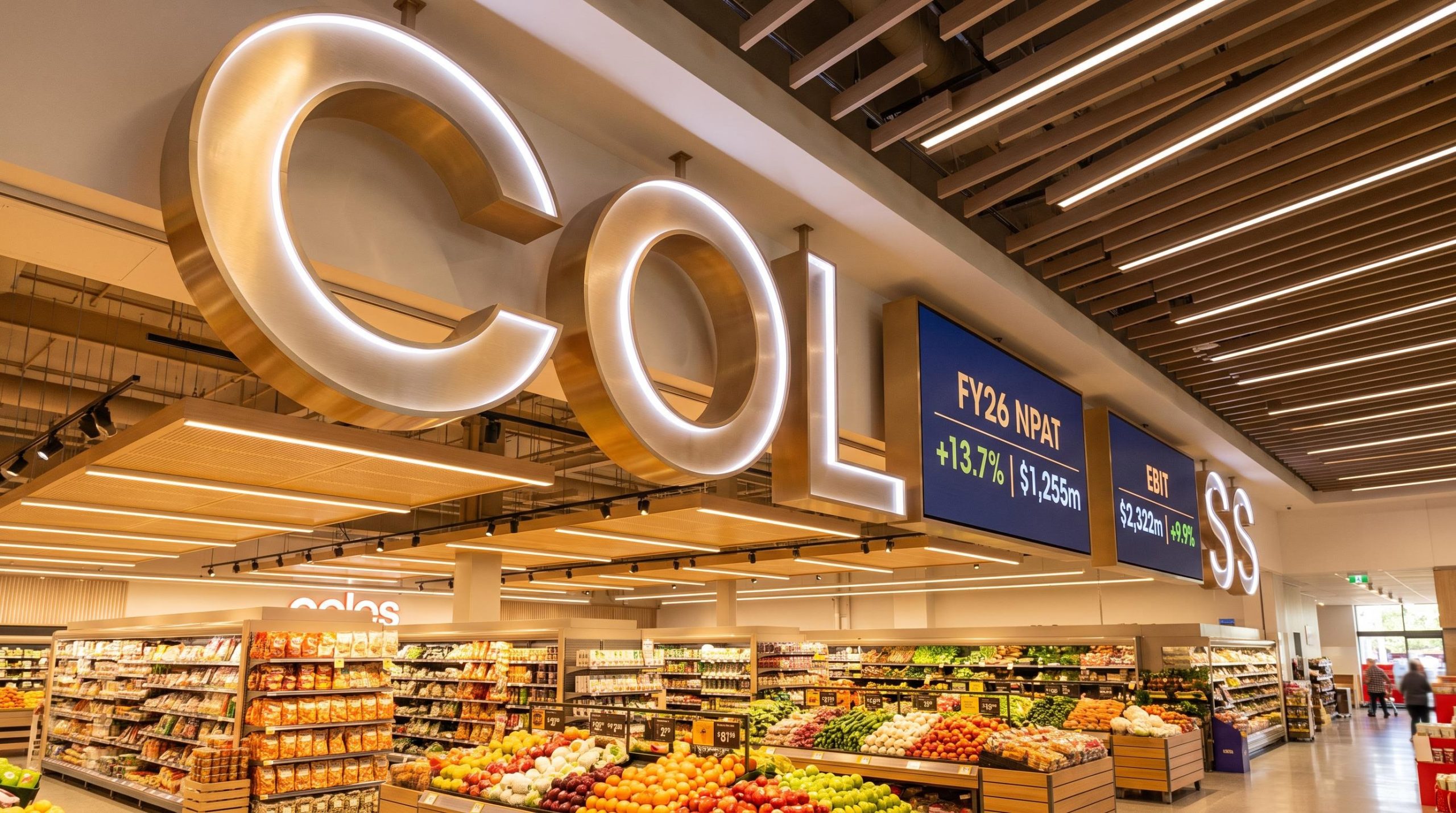
In its FY26 full year results presentation, delivered on 25 August 2026 by Managing Director and Chief Executive Officer Leah Weckert and Chief Financial Officer Charlie Elias, Coles Group (ASX: COL) detailed a 13.7% lift in net profit after tax (excluding significant items) to $1,255m, with Group EBIT up 9.9% to $2,322m.
Management outlined market share gains across Supermarkets and lifted total fully franked dividends by 13.0% to 78 cents per share (cps), on Group sales revenue of $45.6 billion, up 2.8%.
FY26 results at a glance
The FY26 result showed earnings growth running well ahead of sales, a pattern management attributed to sustained productivity gains and margin expansion in the core Supermarkets business.
The FY26 full year result extends the earnings trajectory established in the 1H FY26 results, where Coles posted 14.6% supermarkets EBIT growth and a 12.5% NPAT increase driven by the same automation and sourcing benefits that continued to compound through the second half.
| Metric | FY26 | FY25 | Change |
|---|---|---|---|
| Sales revenue | $45,580m | $44,352m | +2.8% |
| EBIT excl. SI | $2,322m | $2,112m | +9.9% |
| NPAT excl. SI | $1,255m | $1,104m | +13.7% |
| Supermarkets EBIT margin | 5.7% | 5.3% | +43bps |
| Total dividends | 78cps | — | +13.0% |
Operational highlights disclosed in the presentation included:
- Supermarkets sales ex-tobacco +5.1%
- Supermarkets eCommerce sales +26.4%, with Customer Fulfilment Centres (CFCs) EBITDA positive in their second year
- $311m in Simplify and Save to Invest (SSI) benefits delivered
- 101% cash realisation, with leverage reduced to 2.3x
Investors should note the distinction between the two profit figures. A significant item charge of $235m ($165m after tax) was recorded following the Federal Court judgment received in September 2025 relating to the Fair Work Ombudsman’s (FWO) proceedings. On a reported basis (including significant items), NPAT was $1,090m, up just 1.0%.
When big ASX news breaks, our subscribers know first
Supermarkets power ahead while Liquor lags
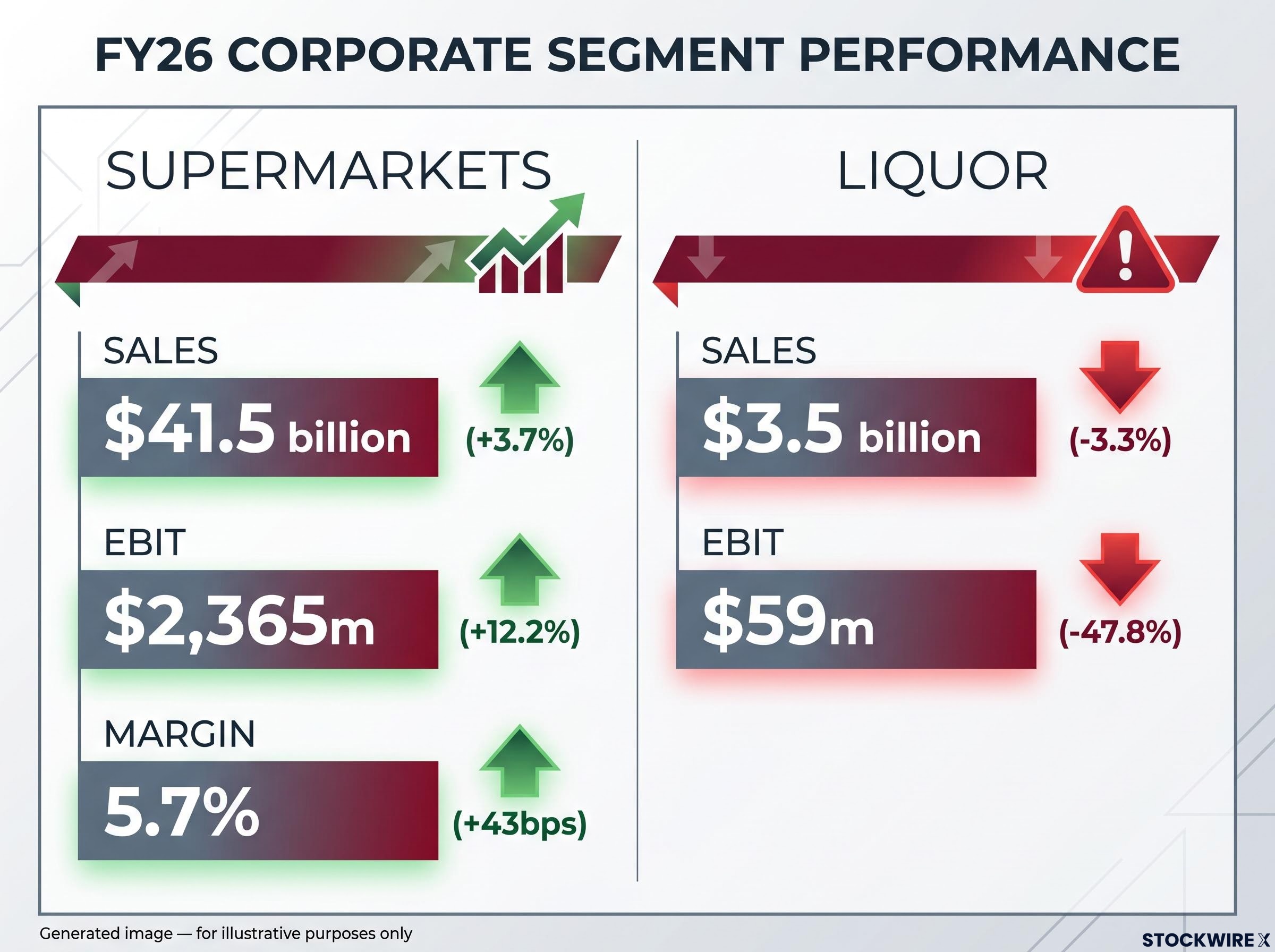
The segment story showed a clear divergence. Supermarkets sales rose to $41.5 billion, up 3.7% (+5.1% ex-tobacco), with EBIT climbing 12.2% to $2,365m and margin expanding 43bps to 5.7%.
Management attributed the margin gains to automated distribution centre (ADC) benefits, strategic sourcing, the SSI programme, Coles 360 retail media income, and the absence of major project implementation and dual-running costs that had weighed on prior periods.
Liquor told a softer story. Sales declined 3.3% to $3.5 billion, with EBIT falling 47.8% to $59m. The presentation attributed this to the cycling of prior-year benefits from a competitor’s supply chain disruption, ongoing cost-of-living pressures, elevated sector promotional activity, and $20m in Simply Liquorland one-off costs.
Despite the earnings pressure, Liquor gross margin still improved 40bps, and the Q4 sales decline moderated to 2.5%.
eCommerce and CFCs scaling profitably
Digital emerged as a profit driver rather than simply a growth channel. Supermarkets eCommerce sales rose 26.4% to $5.6 billion, more than double the FY23 figure, with penetration climbing to 13.6%, up 245bps.
The company’s CFCs turned EBITDA positive in their second year of operation, recording sales growth above 30% and a Net Promoter Score 710bps ahead of total Online. Coles also detailed an expanded Uber Eats partnership giving customers access to around 17,000 products, alongside a 72% increase in Coles Plus and Coles Plus Saver subscribers.
What the SSI programme means for investors
The Simplify and Save to Invest (SSI) programme is a structured productivity and cost-savings initiative. It converts efficiency gains across the business into savings that can be reinvested or dropped through to earnings.
This is why EBIT growth of 9.9% ran so far ahead of sales growth of 2.8%. The savings create a flywheel, where productivity funds reinvestment in value and capability, which in turn supports further growth.
The programme delivered $311m in FY26, taking cumulative benefits to $876m since FY24. Management indicated the programme remains on track to exceed $1 billion by FY27, with $1.9 billion delivered since FY20 under the SSI and Smarter Selling programmes.
Leah Weckert, MD & CEO
“We know what matters most to our customers – delivering great value, quality and convenience every time they shop with us. We have made significant progress over the last three years, and have a strong plan for the year ahead to keep improving the customer offer, strengthen the business and support sustainable long term growth.”
Targeted investment to drive the next leg of growth
Management outlined a disciplined, returns-focused reinvestment programme funded by balance sheet strength. Four key initiatives were detailed for FY27 and beyond:
-
Victorian ADC — an $880m investment in a third automated distribution centre, with capacity of 4.6m cartons per week (around 15% above the NSW and QLD ADCs). Commissioning is targeted by FY30, completing eastern seaboard ambient automation.
-
Stores, renewals, data and technology — a $300m incremental investment by end-FY28, covering approximately 45 new supermarkets, around 150 renewals, and priority technology and AI investment.
-
Repositioning Liquor — a multi-year programme aimed at creating a more focused and efficient business, with greater supermarket co-locations.
-
Coles Capability Centre — a strategic partnership with Accenture, targeting >$100m per annum run-rate benefits by end-FY29, funded by an approximately $190m one-off FY27 investment covering the change programme, dual running and redundancy costs.
FY27 forecast capital expenditure was disclosed at approximately $1.55 billion, which excludes the Coles Capability Centre one-off costs.
The presentation also framed a structural AI advantage narrative. With around 18m transactions per week, 10.3m active Flybuys members and more than 8,000 suppliers, management positioned the business to move from discrete AI use cases toward connected systems of work spanning customers, operations and team productivity.
Balance sheet strength underpins returns
Coles reinforced a capital position that supports both reinvestment and shareholder returns. Key metrics disclosed in the presentation included:
- 101% cash realisation for the year
- Leverage of 2.3x, down from 2.6x in FY23
- Investment grade credit ratings (S&P BBB+ / Moody’s Baa1)
- Undrawn facilities of $2.5 billion
- A franking credit balance of approximately $550m after payment of the final dividend
The Board declared a fully franked final dividend of 37cps, with a record date of 4 September 2026 and a payment date of 22 September 2026.
Outlook: entering FY27 with momentum
Forward guidance disclosed in the presentation pointed to continued momentum. In Supermarkets, sales for the first eight weeks of FY27 were consistent with Q4 FY26, following a temporary moderation during a competitor’s collectibles campaign in late July and early August, after which sales recovered quickly. eCommerce penetration increased to 15.7% over the period.
In Liquor, the sales trajectory strengthened across the first eight weeks relative to Q4 FY26, with the convenience portfolio continuing to deliver positive growth.
Management framed the investment thesis around strong earnings growth, disciplined capital allocation, market share gains and targeted reinvestment, positioning Coles for what it described as sustainable long-term growth.
That disciplined capital allocation philosophy was visible earlier in FY27, when Coles walked away from acquisition talks with TPG Capital over Greencross Pet Wellness Company just 16 days after disclosing them, reaffirming that deals must clear a strict internal strategic and financial bar before proceeding.
Don’t Miss the Next Consumer Sector Winner
Big News Blast delivers FREE breaking ASX news straight to your inbox within minutes of release, complete with in-depth analysis already done for you. Join 20,000+ investors who stay ahead of the market across Consumer, Tech, Healthcare and more. Click the “Free Alerts” button at Big News Blast to start receiving alerts the moment news breaks.