Most investors watching the Bank of Japan’s September 17-18 meeting are focused on whether a rate hike arrives. That focus is misplaced. The hike is already priced in. The real catalyst sits in the press conference that follows.
A 25 basis point increase is the consensus baseline among institutional investors and economist surveys. Markets have absorbed it. What they have not absorbed is the range of possible signals Governor Kazuo Ueda could deliver about the pace and ceiling of further tightening through 2027. That communication layer, not the rate decision itself, will determine how the Yen reprices across major pairs into year-end and beyond.
Here is a framework for reading the September meeting as a communication event rather than a policy event, covering what is already embedded in currency markets, how forward guidance actually moves exchange rates, why the inflation backdrop has shifted the analytical game, and three specific scenarios that map the range of outcomes for your Yen exposure.
The September tightening that markets have already digested
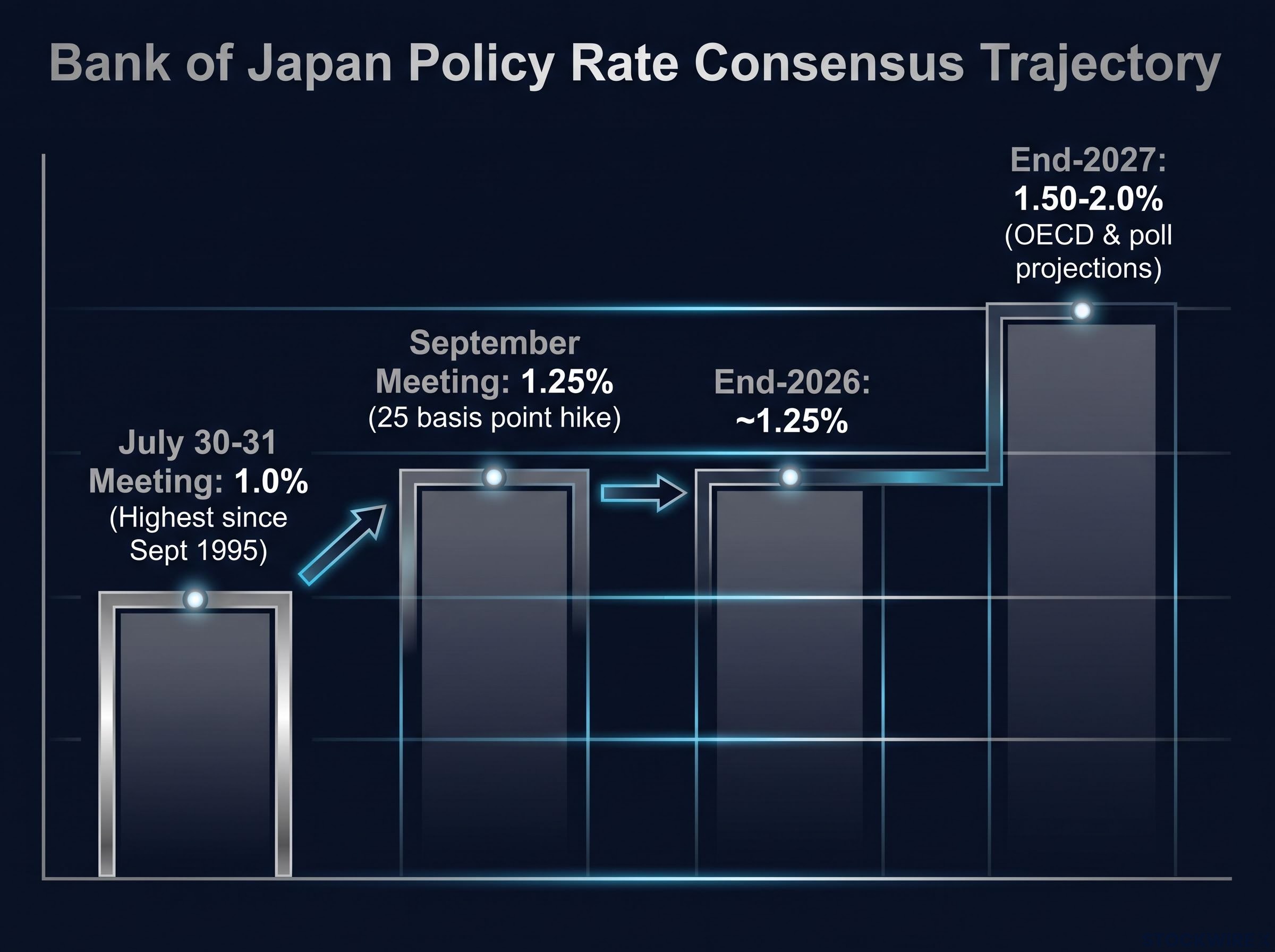
The Bank of Japan held its policy rate at 1.0% at the July 30-31 meeting, the highest level since September 1995. That hold came with a clear signal: the summary of opinions flagged upside inflation risks and left the door open for a September move. Markets took the hint.
A 25 basis point hike to 1.25% at the September meeting is now the consensus expectation across Reuters economist surveys and institutional forecasts. Market pricing already embeds nearly one additional hike by December 2026 beyond the September move. The broader trajectory points toward a policy rate of approximately 1.25% by late 2026, with polls and OECD projections mapping a path toward 1.50-2.0% by the end of 2027.
The shift in BoJ hike probability from roughly 23% before the July hold to 78-85% by late August reflects two consecutive months of above-forecast core CPI, providing the sustained inflation trend the central bank cited as the explicit condition for continued normalisation.
| Timeframe | Consensus Policy Rate | Implied Action |
|---|---|---|
| Current (August 2026) | 1.0% | Holding at 30-year high |
| End-2026 | ~1.25% | One additional hike beyond September |
| End-2027 | 1.50-2.0% | Continued gradual normalisation |
When an outcome is this widely anticipated, the headline decision delivers only modest currency support. Trading the rate hike itself is a positioning trap because institutional money has already absorbed it. What moves the Yen from here is whether the rhetoric around the decision confirms, softens, or accelerates the expected path. Your portfolio strategy needs to look past the immediate decision and into the communication that frames it.
When big ASX news breaks, our subscribers know first
Why forward guidance dictates currency values
Forward guidance is a central bank’s public communication about where interest rates are heading. It is not a promise. It is a signal, and currency markets treat it as the single most important input for pricing exchange rates over the next 12-24 months.
Central bank forward guidance operates differently from explicit rate commitments: two decades of Fed experience show that credibility risk rises sharply when prior guidance is later reversed, which is why markets treat the BoJ’s September tone as a quasi-commitment to the rate path rather than a casual signal.
The mechanics are straightforward. Currency pairs are priced partly on interest rate differentials, the gap between what you earn holding one currency versus another. A single 25 basis point move barely shifts that gap. But a credible signal about where rates will be in 2027 reprices the entire expected path, and that repricing moves exchange rates immediately.
Scotiabank strategists have pointed to this distinction as the defining risk around the September meeting. In their assessment, the central bank’s tone as it shapes expectations for the rate path into year-end and early 2027 carries more market significance than any individual policy decision. It is the quality and direction of that communication, rather than the simple hike-or-hold outcome, that will determine whether the current consensus trajectory holds or begins to drift.
The Yen’s value right now is anchored to where Japanese interest rates will be in 2027. That makes Governor Ueda’s tone the ultimate pricing mechanism for your currency exposure, not the rate number itself.
Decoding the asymmetric risk for the Yen
The communication risk is asymmetric, meaning the potential market reactions are not equal in both directions.
A more hawkish tone, one emphasising persistent inflation, strong wages, and normalisation as an ongoing process, would narrow interest rate differentials against the US Dollar and Euro. That typically supports Yen appreciation. If the BoJ signals a faster or higher rate path than currently expected, short-Yen positions get squeezed and the currency gains broadly.
A cautious, heavily data-dependent tone creates the opposite effect. Language stressing downside risks, global uncertainty, or a high bar for further moves would signal a slower, lower ceiling for Japanese rates. Even if a hike is delivered on the day, that kind of guidance undermines Yen support because it tells carry traders, investors who borrow in low-rate currencies to invest in higher-yielding ones, that the interest rate gap will persist longer than expected. The result could be a “sell-the-news” event where the Yen weakens despite receiving a rate increase.
Inflation credibility replaces intervention fears
Through most of the past decade, the currency’s direction was heavily bound up with whether Tokyo would step in to defend it. Japanese authorities did re-enter the market in 2026, and intervention language continues to surface in analyst commentary. Yet the focus among market participants has gradually moved elsewhere, with underlying fundamentals now attracting far more attention than the prospect of official action.
The repeated failure of yen intervention to produce durable currency strength, even after $215 billion in operations since 2022, is the empirical foundation for why the analytical weight has shifted from watching for official action to monitoring BoJ communication about the domestic rate trajectory.
At the July 2026 meeting, Bank of Japan officials noted that underlying inflation could exceed the 2% target and framed future policy discussions around upside price risks. That language marked a departure from a decade of chronic inflation shortfalls where the BoJ struggled to generate any meaningful price growth at all.
OECD projections support the shift, showing an inflation and wage backdrop that sustains gradual normalisation through 2027. When those fundamentals are credible, the BoJ’s forward guidance carries more weight. Markets treat it as binding rather than aspirational, which means the words in the September statement have more pricing power than they would have had even two years ago.
The implication for your Yen strategy is direct: stop watching for government intervention lines in the sand and start monitoring domestic wage growth as the primary driver. Four specific elements of messaging will be worth scanning in the official statement:
- Statement tone and ordering: Whether the BoJ leads with inflation progress and wage momentum (hawkish) or with uncertainty and downside risks (cautious)
- Language around future meetings: Whether continued normalisation is framed as the baseline scenario or as a fresh, high-bar decision each time
- Implicit rate path references: Phrases like “further adjustment” or “additional increases as appropriate” will be mapped against the 1.25% and 1.50-2.0% consensus benchmarks
- Treatment of external risks: Whether global concerns are front-loaded (cautious) or treated as secondary to domestic fundamentals (hawkish)
This framework gives you a more stable analytical foundation for medium-term positioning than reacting to daily intervention rumours.
Three communication scenarios for medium-term pricing
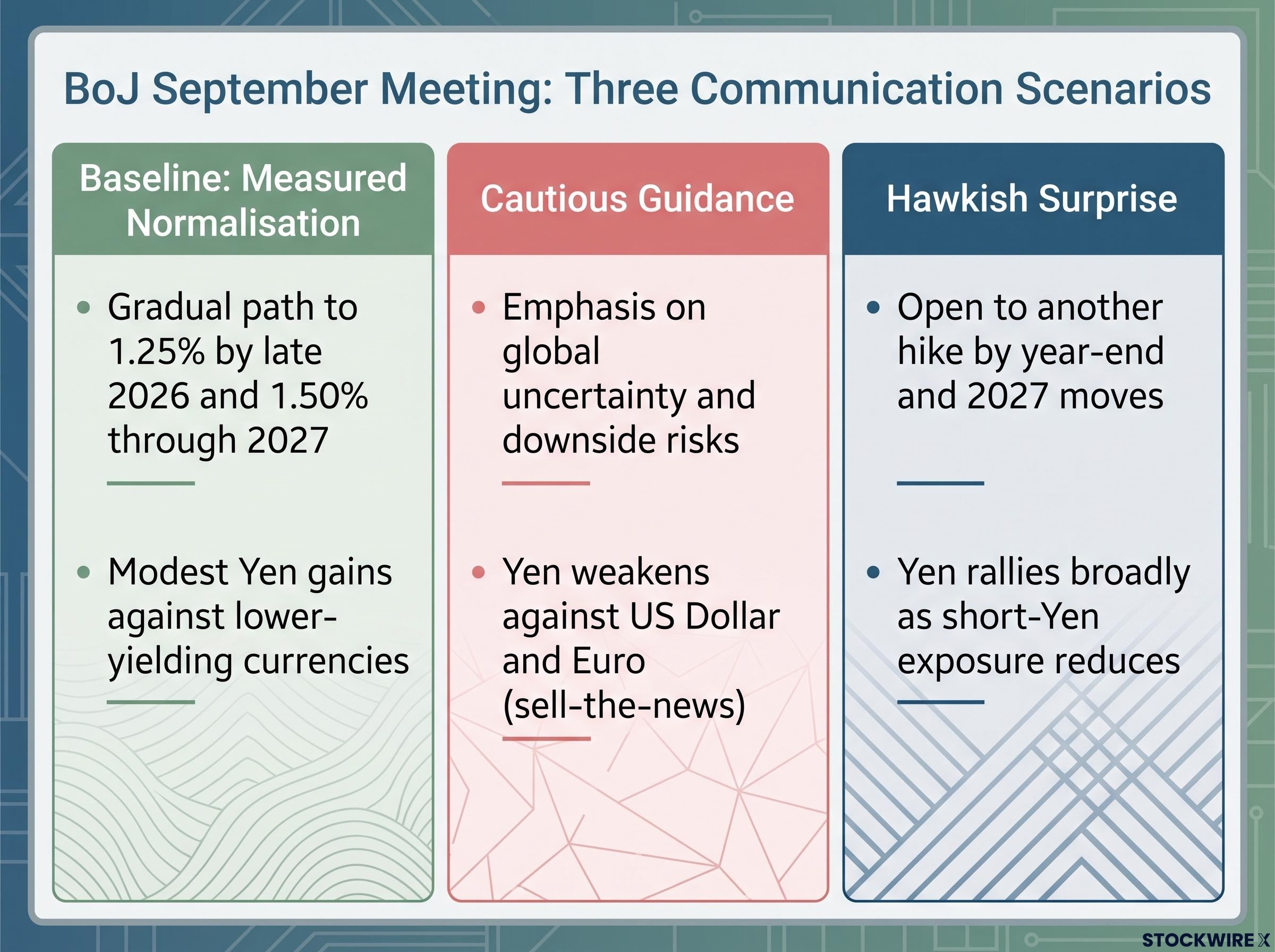
Scotiabank and other institutional strategists identify the deviations from a standard hike as the true communication risks. Three scenarios frame the range of outcomes.
- Baseline: hike with measured, confident normalisation. The BoJ raises rates as expected and reiterates that, provided inflation and wages evolve as projected, rates will continue to rise gradually. This aligns with the consensus path toward 1.25% by late 2026 and 1.50% through 2027. The Yen gains modestly, mainly against lower-yielding currencies, but moves are constrained because much of this path is already priced in.
- Communication disappointment: cautious guidance. The BoJ hikes but emphasises downside risks, global uncertainty, and a high bar for further moves. Markets infer that September may function as a pause point, pushing out or flattening the expected rate path. The Yen weakens despite the rate increase, particularly against the US Dollar and Euro, as carry trades remain attractive and short-Yen positions are rebuilt. This is the “sell-the-news” scenario strategists have warned about.
- Hawkish surprise: accelerated path. The BoJ signals a faster or higher trajectory than consensus, showing clear openness to another hike by year-end and one or more moves in 2027, in line with the more aggressive tails of OECD projections. The Yen rallies broadly as markets compress rate differentials and reduce short-Yen exposure.
Day-of-reporting cross-rate data illustrates the current state of play. On the day of the source reporting, the Yen declined approximately 0.10% against the US Dollar and 0.06% against the Euro while gaining 0.43% against the Canadian Dollar and 0.11% against the New Zealand Dollar. That mixed performance, modest weakness against major reserve currencies alongside strength against commodity-linked pairs, reflects the uneven nature of BoJ-driven Yen support in an environment where fiscal concerns run alongside the monetary policy tailwind.
Map your specific currency exposure against these three outcomes. If you hold Yen-denominated assets or have unhedged exposure to JPY pairs, stress-testing your positions against both the cautious guidance scenario and the hawkish surprise before the press conference begins is more useful than waiting to react after the fact.
This article is for informational purposes only and should not be considered financial advice. Investors should conduct their own research and consult with financial professionals before making investment decisions. Forward-looking statements regarding the Bank of Japan’s policy path are speculative and subject to change based on economic developments and central bank decisions.
Positioning for the 2027 rate trajectory
The September meeting is a communication inflection point, not just a policy adjustment. The hike itself is absorbed. The words framing it will determine how yield curves and rate differentials reprice into early 2027.
For anyone evaluating Yen exposure heading into the fourth quarter, the weight of your analysis should sit on how the BoJ articulates its trajectory, not on the headline rate number. Governor Ueda’s press conference language will either confirm the gradual normalisation path markets expect, disappoint with caution, or surprise with aggression. Each outcome reprices your position differently. Evaluate your Yen holdings against the long-term trajectory rather than the short-term headline, and factor in the broader global economic crosscurrents, including fiscal concerns and rate paths from the Federal Reserve and European Central Bank (ECB), that will interact with Japanese policy signals through the rest of 2026.
Global central bank divergence is the broader context within which the BoJ’s September communication will land: with the Fed frozen at 3.50-3.75% and the ECB navigating its own tightening path, even a modest shift in Ueda’s tone ripples across USD/JPY and EUR/JPY simultaneously rather than affecting a single currency pair in isolation.