
Canada’s biggest trade risk in a generation is fading, and the central bank responsible for responding to it has not moved. The Bank of Canada held its policy rate at 2.25% for the fifth consecutive time on 15 July 2026, and nothing in its communication suggests a sixth hold on 3 September will be any different.
That should surprise you. The conventional logic runs like this: remove a major downside risk, and the central bank gains room to act. But the Bank of Canada’s posture tells a different story. The constraint is not political uncertainty; it is structural. The data the Bank needs to justify a move does not exist yet, and the economic conditions it can already measure do not call for one.
Here is exactly why the BoC is likely to stay at 2.25% through all of 2026, and what that means if you are tracking Canadian rates, fixed income, or CAD positioning against global peers.
The Bank of Canada’s holding pattern in 2026
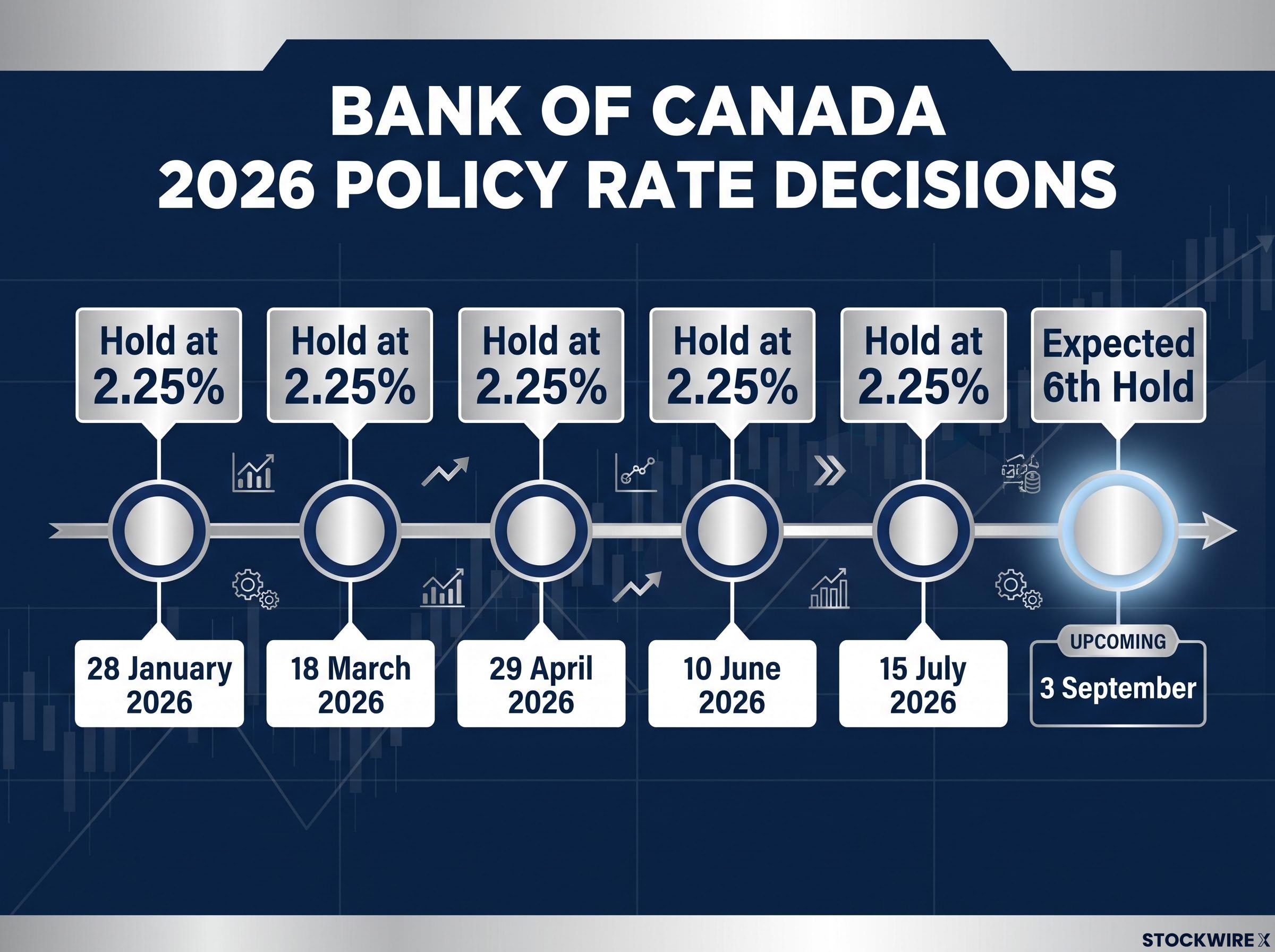
Every scheduled decision this year has produced the same result: no change. The BoC has held at 2.25% five times running, and each hold has been an active policy stance, not a default.
- 28 January 2026: Hold at 2.25%
- 18 March 2026: Hold at 2.25%
- 29 April 2026: Hold at 2.25%
- 10 June 2026: Hold at 2.25%
- 15 July 2026: Hold at 2.25%
The Bank’s own language has reinforced this pattern. Communications across all five decisions have emphasised balanced risks and data dependency, framing the current rate as appropriate given the range of plausible outcomes.
Private-sector economists have converged on the same view. A Reuters poll in early 2026 found a strong majority expecting no change throughout the year, with trade developments flagged as the primary risk. That consensus has only hardened since.
A July 2026 survey found all 36 economists polled expected a hold at 2.25%, with most seeing no change until at least mid-2027.
TD Economics’ overnight rate forecast reinforces the point, projecting 2.25% through every quarter of 2026 and 2027. Five consecutive holds is not indecision. It signals that the Bank has consciously concluded the current rate is appropriate across a range of plausible scenarios, and you should read that consistency as forward guidance in itself. The question is not “when will they act?” It is “what would it take to make them act?”
Central bank week outcomes in June 2026 illustrated how compressed macro calendars amplify rate repricing risk, with the BoC holding at 2.25% alongside a neutral-to-hawkish bias while the ECB and Fed delivered independent signals that shifted EUR/USD and Treasury markets simultaneously.
When big ASX news breaks, our subscribers know first
Why a tariff deal alone is not enough to move rates
A tariff agreement changes the forward outlook the moment it is signed. It does not change measured economic conditions the moment it is signed. That gap between political resolution and economic confirmation is where the BoC’s caution sits, and it is measured in months, not days.
The data lag that locks the Bank in place
TD Securities analyst Robert Both projects the BoC will hold throughout 2026 regardless of whether a tariff deal is finalised, with the first rate move projected to be a hike in January 2027, not a cut.
TD Securities projects a hold at 2.25% through all of 2026, with the first rate increase in January 2027.
The reason is specific. TD Securities identifies November as the earliest point at which trade-related data, covering export volumes, business investment, and GDP effects, would be available for the Bank to assess. Until those figures are published and analysed, the BoC cannot know whether a deal is actually boosting activity enough to warrant a policy shift.
What this tells you is straightforward: even a tariff deal signed today would not produce the evidence base the Bank needs to adjust policy before the end of the year. That rules out any 2026 cut driven by trade resolution. The BoC has repeatedly emphasised that its decisions are grounded in realised data and forecast models, not in single political announcements. If you are positioning around Canadian rates, the calendar to watch is the data release schedule, not the negotiating table.
How the BoC weighs growth, inflation, and the output gap
Three variables explain why the Bank has run out of urgent reasons to cut but has not yet found a compelling reason to hike. Understanding how they interact is what separates a reactive headline read from a durable view on the rate cycle.
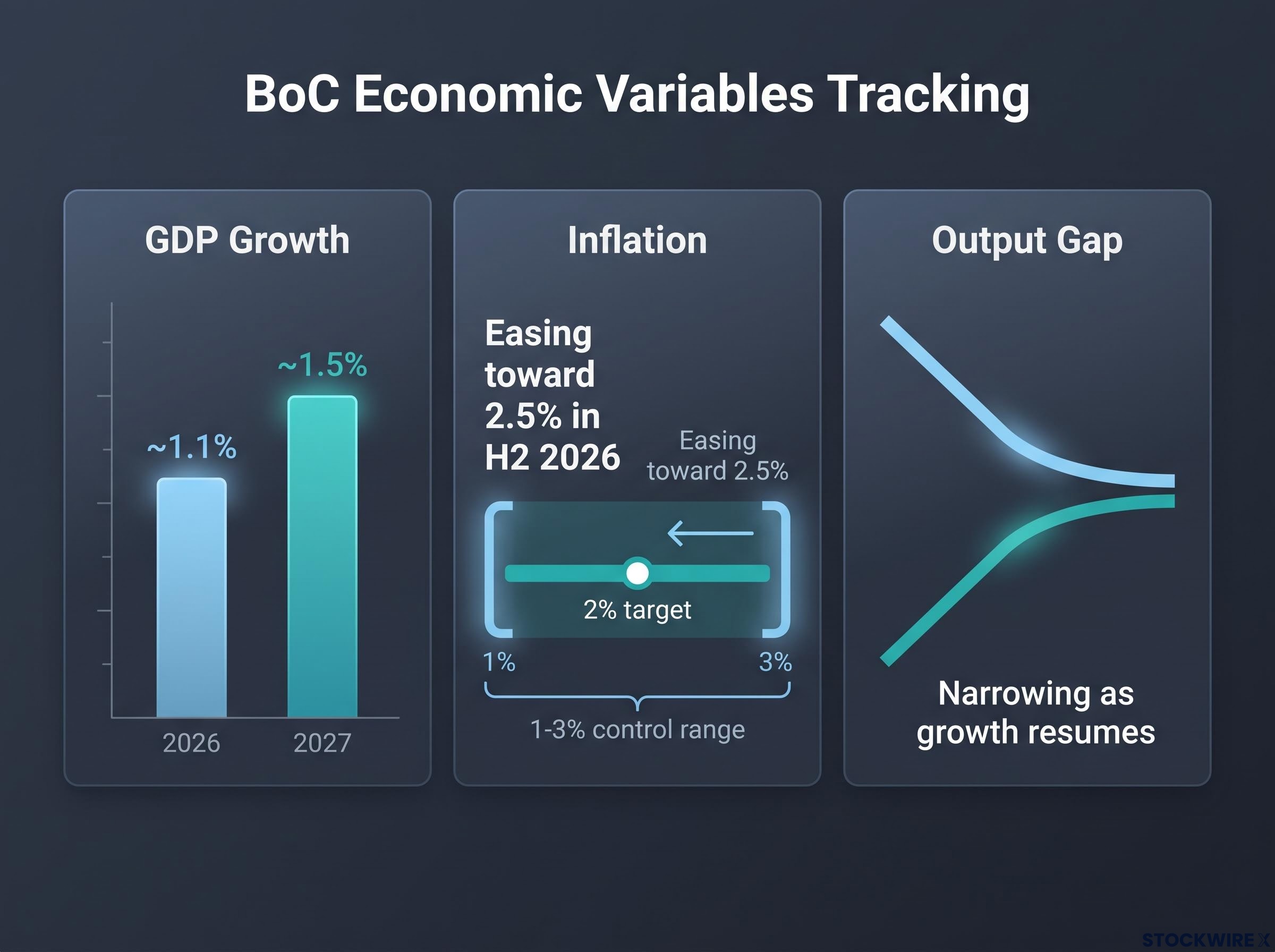
GDP growth is the starting point. The Bank’s projections put growth at approximately 1.1% in 2026 and 1.5% in 2027. That is modest but positive, enough to keep the economy expanding without generating the kind of overheating that demands tighter policy.
The C.D. Howe Institute analysis of rate sensitivity across Canadian industries shows that business investment responds unevenly to rate changes, which helps explain why the BoC must weigh sectoral transmission effects rather than assuming a uniform economic response to any policy adjustment.
Inflation is the second variable. The BoC targets 2% inflation within a 1-3% control range. Current projections show inflation easing toward 2.5% in the second half of 2026 and moving closer to the 2% midpoint thereafter. That places the Bank squarely in neutral territory: inflation is not low enough to justify further stimulus, and not high enough to trigger tightening.
Canada’s core inflation measures, specifically CPI-trim at approximately 1.8% and CPI-median at approximately 1.9%, are both running below the Bank’s own quarterly forecasts, a divergence that complicates any straightforward read of the headline 2.9% CPI figure and shapes how the BoC interprets its current policy stance.
The output gap, which measures the difference between what the economy is producing and what it could produce at full capacity, is the third piece. Growth resumed after earlier weakness, and stronger activity is expected in the second half of 2026. A narrowing output gap means the original case for easing, built on the risk of a trade-driven slump, has weakened. When output is near potential, the stimulus rationale fades.
| Variable | Current condition | BoC forward projection |
|---|---|---|
| GDP growth | Modest, resuming after weakness | ~1.1% (2026), ~1.5% (2027) |
| Inflation | Easing toward 2.5% in H2 2026 | Toward 2% target over forecast horizon |
| Output gap | Narrowing as growth resumes | Approaching potential output |
For anyone holding rate-sensitive positions, this combination means the BoC’s next move could plausibly be a hike rather than a cut, depending on how second-half 2026 data lands. That is a materially different risk profile from what many investors assumed at the start of the year.
From downside risk to balanced risk: the shifting trade calculus
The Bank of Canada’s risk framing has not stayed static in 2026. It has moved through distinct phases, and tracing that progression reveals why trade resolution no longer functions as an automatic easing trigger.
- Early 2026: Trade tensions dominated the risk assessment. The BoC flagged tariff escalation as the primary downside risk, and markets priced in the possibility of further cuts if restrictions worsened.
- Mid-2026 (June): The BoC signalled that a material expansion of trade barriers directed at Canada remained a potential trigger for additional rate reductions. Trade risk remained a live easing trigger at this stage.
- Late Q2 into Q3 2026: Growth resumed, inflation settled, and commodity dynamics shifted. The risk profile moved from downside-skewed to balanced.
- Current posture (August 2026): The Bank treats trade as one variable among several, not the dominant force shaping policy direction.
As recently as June 2026, the BoC communicated that a meaningful broadening of trade restrictions against Canada could push it toward cutting interest rates once more.
That guidance from just two months ago now looks like a different era. As growth returned and inflation eased toward target, the Bank’s risk calculus recalibrated. An oversupplied oil market and the resulting softness in energy prices have reduced inflationary pressures, allowing the Bank to maintain a patient stance even as trade headwinds subside.
The distinction matters. Removing a downside risk is not the same as creating a case for stimulus. The BoC needs evidence of a positive impulse, not just the absence of a negative one. If you priced in BoC cuts on the back of trade-tension relief, you are working from an outdated risk map. The easing trigger has moved from trade headlines to concrete growth underperformance, and that shift is the single most important change in the Bank’s posture this year.
What a prolonged rate plateau means for Canadian markets
The policy analysis above translates into three specific market implications. Each follows directly from a BoC that is not the source of rate volatility in the months ahead.
- Fixed income: A 2.25% rate held through 2026 and into 2027 means yield curves will price a longer-than-usual plateau. Duration strategy shifts toward global moves, particularly US Federal Reserve and European Central Bank (ECB) policy, rather than near-term BoC surprises. TD Economics’ quarterly forecast shows 2.25% across every quarter of both years, leaving little room for domestic rate repricing.
- Canadian dollar: If peer central banks begin adjusting policy while the BoC stays flat, relative rate differentials become the dominant driver of CAD performance. Forward pricing already reflects a “steady BoC, gradual global normalisation” narrative. The risk is asymmetric: a surprise BoC hike (ahead of the January 2027 base case) would move CAD more than another hold.
CAD performance drivers in the current environment are unusually decoupled from commodity prices, with Scotiabank research confirming that the oil-to-CAD beta has weakened materially over the past decade even as Brent crude has surged on Hormuz supply disruptions.
- Data-tracking framework: Across all asset classes, the actionable shift is from watching political announcements to watching the BoC’s Monetary Policy Report (MPR) cycle. The MPR, which is the Bank’s quarterly economic outlook released alongside select rate decisions, is published four times annually. Those releases, combined with GDP, trade statistics, and investment data, are where any policy shift will be telegraphed first.
The practical implication: for CAD and fixed income positioning in 2026, the BoC itself is not the source of volatility. Global rate divergence and Canadian data releases are, and strategy should be calibrated accordingly.
What would actually change the BoC’s calculus before 2027
The hold is the base case. But base cases break, and knowing the specific conditions that would force a move gives you a forward-looking filter to apply to incoming data.
A rate cut before 2027 would require clear deterioration in growth and inflation data pointing to renewed downside risk, the kind of trade-driven slump that the Bank feared earlier this year but that has not materialised. A rate hike before January 2027, TD Securities’ projected timing, would require evidence of an overheating economy beyond current projections, stronger-than-expected GDP prints, persistent above-target inflation, or a demand surge the Bank did not forecast.
Central banks react to measured conditions, not forecasted ones. Investors who track the right data calendar will be better positioned than those following political news flow.
Central bank independence has become a live market variable in 2026, with the Warsh confirmation illustrating how documented political pressure on a reserve bank is repriced through bond yields, the dollar, and equity valuations in ways that create spillover effects for peer central banks including the BoC.
Here is the checklist that matters through the rest of 2026 and into early 2027:
- November 2026 trade data: The earliest window, per TD Securities, in which trade-related figures reflecting any deal’s impact become available for BoC assessment.
- Q3 2026 GDP release: The first comprehensive growth reading that captures the second-half recovery the Bank is projecting.
- H2 2026 inflation prints: Whether inflation continues easing toward the 2% target or stalls above 2.5% will shape the direction of the Bank’s next move.
- BoC MPR cycle and eight fixed decision dates: Any policy shift will be communicated through these institutional channels. The next MPR accompanies the 22 October decision.
This article is for informational purposes only and should not be considered financial advice. Investors should conduct their own research and consult with financial professionals before making investment decisions. Forward-looking rate projections, including TD Securities’ January 2027 hike timeline, are subject to change based on economic data and market conditions.